



Modernizing Enterprise Risk Management
Strengthen your risk program with a unified platform that connects risk identification, assessment, mitigation, monitoring, and reporting. SmartSuite centralizes your entire risk lifecycle — helping teams reduce complexity, eliminate silos, and make confident, data-driven decisions.

One Platform for Connected Risk Management
SmartSuite modernizes ERM by centralizing risk registers, assessments, KRIs, mitigation plans, and reporting within a single unified platform. Improve visibility, reduce manual work, and empower teams to identify, assess, and mitigate risk with confidence.
Risk Registers
Maintain a centralized library of enterprise, operational, IT, strategic, and compliance risks.
Assessments
Standardize scoring, likelihood, impact, and effectiveness evaluations.
Mitigation Tracking
Assign owners, monitor progress, and automate follow-up.
Dashboards
Visualize exposures, trends, KRIs, and heat maps in real time.
Enterprise Risk Management Suite Products
Core Capabilities of the Risk Management Suite
SmartSuite delivers a complete set of linked solutions to help organizations implement, scale, and govern enterprise risk programs.
Identify, assess, and manage enterprise risk with clarity and control.
Centralize risk registers, assessments, controls, KRIs, and mitigation plans in one workspace. SmartSuite links risks to controls, issues, and remediation actions—providing visibility, consistent risk evaluation, and confidence in decision-making across the organization.
Maintain a living risk register with ownership, scoring, controls, treatment plans, and reporting across the organization.
Run repeatable risk assessments with scoring models, questionnaires, evidence, and rollups by process, vendor, or system.
Define KRIs, set thresholds, ingest metrics, trigger alerts, and trend indicators to detect rising risk early.
Track policy or control exceptions, risk acceptances, and issues—approvals, expirations, mitigations, and renewals.
Map controls to risks, requirements, processes, and systems to show coverage, ownership, and evidence reuse.
Define appetite and tolerance limits and monitor risks against thresholds, triggering alerts when limits are exceeded.
Create mitigation plans with tasks, milestones, due dates, and accountability to ensure follow-through and effectiveness.
Provide real-time dashboards, heat maps, and board-ready reporting on exposure, trends, and mitigation progress.
Identify and Categorize Risks Consistently
Build a complete picture of enterprise exposure with standardized risk types and categories.
Highlights:
- Risk scoring templates
- Linked records for processes, systems, and vendors
- Customizable taxonomies


Conduct Structured Assessments at Scale
Replace inconsistent scoring models with workflows and clear evaluation criteria.
Highlights:
- Likelihood/impact scoring
- Control effectiveness evaluation
- Automated assessment reminders
Rate, Score and Weight Risk with Methods You Can Read
SmartSuite GRC Products rate risk on ordinal scales and turn those ratings into scores with formulas your team can open and change. Every scale, weight and band is a field on the record, so an assessor, a reviewer and an auditor see the same arithmetic.
Rate likelihood and impact on five labeled levels, from Remote to Almost Certain and from Insignificant to Critical. A rationale field sits beside each rating, inherent and residual.
Each level carries a value from 1 to 5. Enterprise Risk Management multiplies them into inherent and residual scores from 1 to 25, bands each from 1-Low to 5-Critical and plots both on heat maps.
Third-Party Risk scores 14 engagement questions across five weighted domains: data exposure 30, operational 25, technology 20, regulatory 15 and reputational 10. The result sets the inherent rating, the due diligence tier and the reassessment cycle.
Record an Annual Loss Expectancy for each enterprise risk, and store an external provider’s breach likelihood and annual financial impact for each vendor. Chart them by category beside the rated risks.
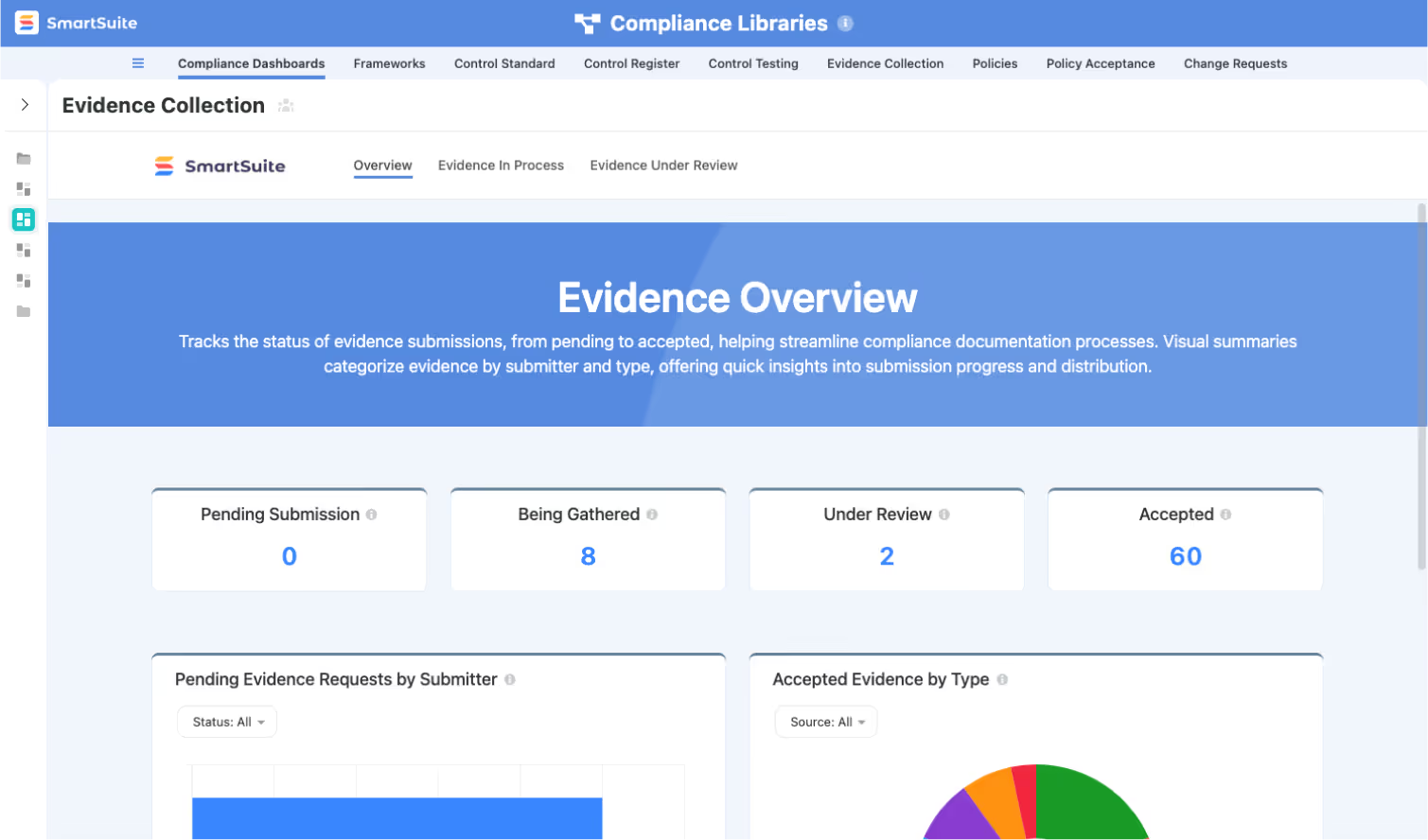
See Risk Management in Action
Watch how SmartSuite helps organizations identify risks, conduct assessments, track mitigation plans, and monitor trends through linked dashboards and automated workflows.

Drive Accountability With Mitigation Tracking
Assign owners, set deadlines, and monitor follow-through.
Highlights:
- Mitigation plans & tasks
- Escalation workflows
- KRI-based alerts


Monitor KRIs and Trends Proactively
Track lagging and leading indicators across business units through live dashboards.
Highlights:
- KPI/KRI tracking
- Heat maps & trend analysis
- Risk appetite thresholds
Integrate Risks With Audit, Compliance & Controls
Break down silos by connecting risks to controls, findings, evidence, and remediation.
Highlights:
- Linked risk–control–issue relationships
- Shared dashboards
- Cross-functional visibility

Built For Modern Enterprise Risk Teams
SmartSuite brings enterprise-grade risk management with consumer-grade usability. Choose the rollout path that fits your ERM program today—and expand as your risk landscape, governance needs, and organizational maturity evolve.
Adopt a Single Capability
Begin with a Risk Register, Risk Assessments, or KRI Tracking—prove value quickly and expand as your enterprise risk program grows.
Roll Out a Full Category
Enable Enterprise Risk Management end-to-end—connecting risk identification, assessment, mitigation, and monitoring across business units and risk domains.
Deploy the Entire ERM Suite
Standardize risk oversight with shared risk taxonomy, linked controls, and live dashboards—delivering consistent, enterprise-wide risk visibility and decision support.
Explore Further
Learn how SmartSuite helps risk teams centralize risk identification, automate assessments, improve mitigation follow-through, and strengthen enterprise-wide visibility.
Frequently Asked Questions
Answers to common questions about how SmartSuite improves risk visibility, collaboration, and operational efficiency across the enterprise.
Risk data is often fragmented across spreadsheets, email threads, and disconnected systems.
SmartSuite unifies the full risk ecosystem — risks, controls, KRIs, assessments, issues, and mitigations — in one connected platform.
This shared visibility eliminates duplication, ensures alignment, and enables teams to work from the same real-time information.
SmartSuite connects risk owners, analysts, control teams, and leadership with shared workspaces and real-time communication.
Assessments, mitigation tasks, escalations, and evidence collection are automated and transparent, accelerating decision-making and reducing manual coordination.
SmartSuite’s consistent, intuitive design helps new risk team members quickly understand scoring models, record structures, and workflows.
Guided forms, standardized templates, and role-based dashboards simplify onboarding and enforce methodological consistency.
Traditional ERM programs rely on a mix of spreadsheets, shared drives, email, and standalone tools.
SmartSuite consolidates everything — risk registers, KRIs, assessments, controls, issues, mitigations, and reporting — into one unified platform, reducing complexity and improving accuracy.
Real-time dashboards show risk scores, trending exposures, overdue mitigations, KRI shifts, and changes in risk posture.
CROs and leaders gain instant insight into organizational exposure, enabling timely decisions and proactive governance.
See How SmartSuite Transforms Risk Management
Experience an ERM platform for centralizing risks, KRIs, assessments, and mitigation.
What the research shows
Independent research on what fragmented risk management costs teams today, and what changes when the work lives in one system.
Source: The IIA Internal Audit Foundation and Baker Tilly, Enhanced Enterprise Risk Management and Strategic Decision-Making press release, 2025: nearly a quarter of 567 surveyed professionals had not conducted a risk assessment in the past three years (https://www.theiia.org/en/content/communications/press-releases/2025/june/new-report-from-baker-tilly-and-internal-audit-foundation-reveals-gaps-in-enterprise-risk-management-maturity-calls-for-closer-internal-audit-collaboration/).
of ERM survey respondents ran no risk assessment in three years
Centralized risk registers, scoring workflows and standardized methods help teams keep risk assessments on a regular cycle.
Source: The IIA Internal Audit Foundation and Baker Tilly, Enhanced Enterprise Risk Management and Strategic Decision-Making press release, 2025: nearly 60% of 567 surveyed professionals said their organizations still rely on word processing and spreadsheets for ERM, versus 21% using GRC platforms (https://www.theiia.org/en/content/communications/press-releases/2025/june/new-report-from-baker-tilly-and-internal-audit-foundation-reveals-gaps-in-enterprise-risk-management-maturity-calls-for-closer-internal-audit-collaboration/).
of organizations still rely on word processing and spreadsheets for ERM
SmartSuite replaces spreadsheet-driven tracking with linked controls, automated updates and real-time risk dashboards.
Source: The IIA Internal Audit Foundation and Baker Tilly, Enhanced Enterprise Risk Management and Strategic Decision-Making press release, 2025: fewer than half of 567 surveyed professionals (49%) said risk awareness resonates within their organization (https://www.theiia.org/en/content/communications/press-releases/2025/june/new-report-from-baker-tilly-and-internal-audit-foundation-reveals-gaps-in-enterprise-risk-management-maturity-calls-for-closer-internal-audit-collaboration/).
of respondents say risk awareness resonates across their organization
Unified dashboards show risk ownership, trends, KRIs, mitigation plans and business unit exposure in one place.
Source: KPMG, Risk & Resilience Survey press release, 2025: 52% of U.S. organizations surveyed have not integrated risk and resilience capabilities, accountabilities, or organizational structure (https://kpmg.com/us/en/media/news/kpmg-risk-resilience-survey-2025.html).
of U.S. organizations have not integrated risk and resilience accountabilities
Automated remediation workflows, owner assignments and alerts keep mitigation actions assigned and visible.
Key Benefits of the Risk Management Solution Suite
Organizations face increasing complexity across operational, strategic, financial, and technology risks. SmartSuite connects data, teams, and processes to help risk leaders proactively identify threats, drive accountability, and build a resilient, risk-aware culture.
Risk Visibility, Analysis & Insight
Capture, categorize, and evaluate all risks — operational, strategic, financial, IT, or compliance — in one unified system.
Monitor KRIs, heat maps, scoring distributions, mitigation progress, trends, and emerging issues.
Give Risk, Compliance, IT, Operations, and Leadership a shared view of exposures, ownership, and business impact.
Connect risks to their underlying controls, incidents, findings, and related data for full contextual clarity.
Track risks against predefined tolerance thresholds with automated alerts for deviations.
Evaluate the impact of each risk with scoring models and links to the business processes, controls, and objectives it affects.
Workflow Efficiency, Operational Execution & Risk Reduction
Use consistent scoring models, likelihood/impact methodologies, and assessment processes across the enterprise.
Assign owners, set deadlines, and automate reminders to ensure timely mitigation and accountability.
Route new risk submissions through standardized triage, scoring, and approval workflows.
Track exceptions, findings, and corrective actions linked to the risk they impact.
Provide auditors and compliance teams with clear, linked evidence and documentation.
Use the AI Assistant to summarize assessments and draft board-level updates for review.
Governance, Control & Organizational Confidence
Ensure risk policies, methodologies, and assessment standards are applied consistently across all teams.
Protect sensitive risk data with granular permissions, role-based access, encryption, and audit logs.
Generate live dashboards and summary views suitable for board committees, regulators, or executive reviews.
Link risks to controls and frameworks to ensure mitigation strategies align with organizational and regulatory expectations.
Support ERM, Operational Risk, IT & Cyber Risk, Strategic Risk, and emerging risk domains in a single platform.
Modify risk scoring models, dashboards, forms, and workflows without relying on developers or IT backlog.
Strengthen Your Risk Program with Connected Data
Automate assessments, visualize exposure, and improve collaboration between risk, audit, and operations.
How the SmartSuite Platform Powers Risk Management
SmartSuite connects risk data, workflows, controls, and mitigation activities in one integrated platform — ensuring complete traceability and continuous visibility.
Customize risk categories, scoring models, registers, and workflows without technical resources.
Automate reminders, escalations, and risk review cycles.
Generate risk narratives, trend analyses, and board-ready summaries.
Connect risks to controls, KRIs, findings, incidents, and mitigation plans.
Monitor scores, exposure, overdue mitigations, and trends through dynamic dashboards.
Control access and track every update with full traceability.
Unify Risk, Control & Mitigation Data for Complete Traceability
SmartSuite links risks to controls, assessments, KRIs, and remediation activities — ensuring full context and visibility at every step of the risk lifecycle.

Streamline Risk Assessments & Mitigation Plans
Automate scoring workflows, collect evidence, assign mitigation tasks, and monitor progress — reducing manual effort and increasing accountability.

Gain Continuous Insight Into Risk Exposure
Live dashboards surface emerging issues, high-risk areas, overdue actions, and trend shifts — enabling proactive, data-driven decision-making.

AI Assistant & Governance Strengthen Risk Oversight
The AI Assistant speeds up reporting and risk narratives.

The SmartSuite Platform:
Powered by Eight Interconnected Frameworks
The SmartSuite Platform consists of eight interconnected frameworks that provide a foundation for designing, automating, analyzing, and governing connected workflows.
Platform

Security and Governance, Built for Enterprise Scale
SmartSuite provides fine-grained, role-based permissions that protect data without slowing innovation. Define access down to the record, field, or workflow level, enforce compliance with SSO, 2FA, and IP restrictions, and maintain a complete audit trail of every action. With SmartSuite, governance and agility work together — innovation moves fast, and your security moves with it.
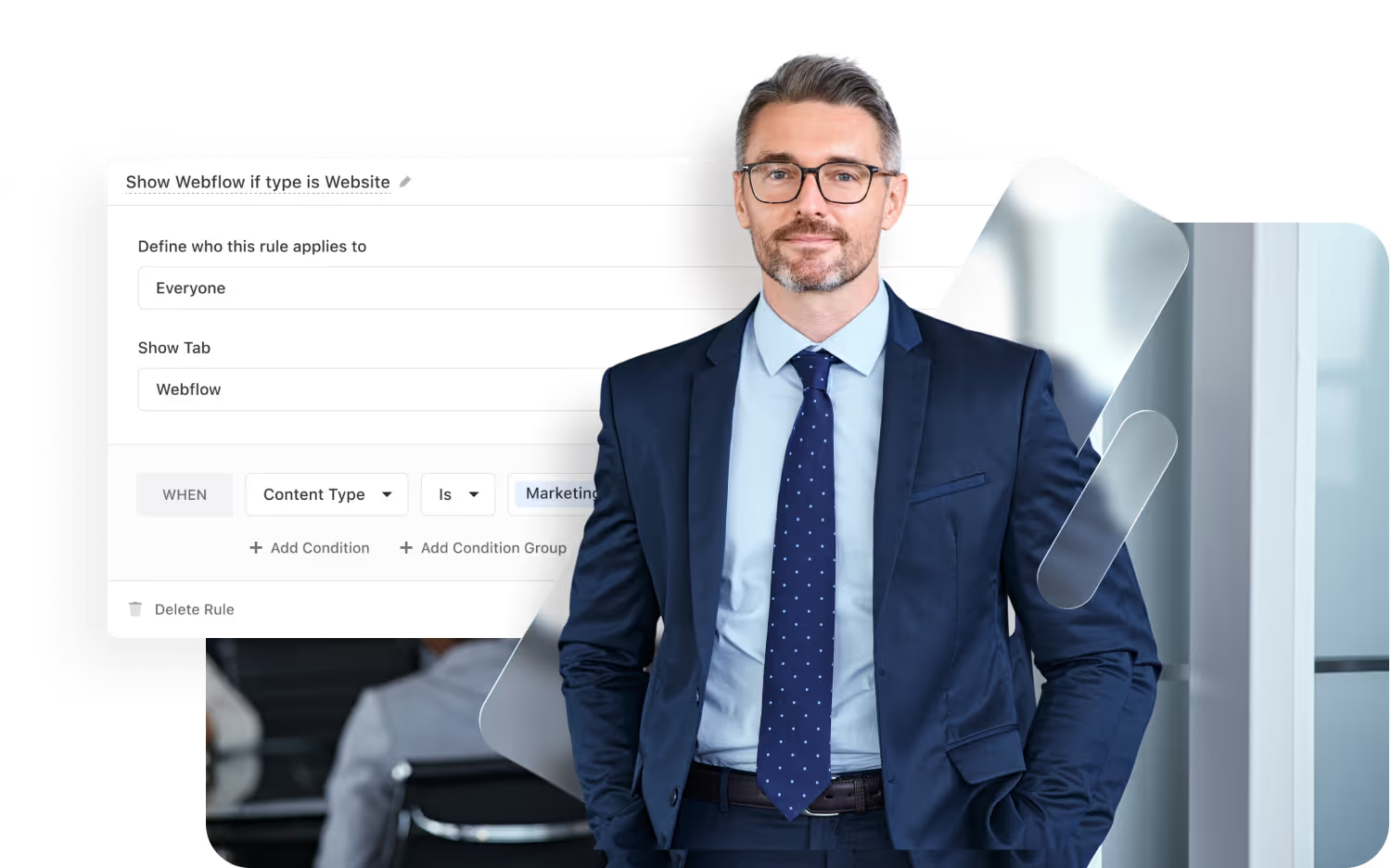
Work Anytime, Anywhere, on Any Device
Stay connected and productive wherever you are. SmartSuite works across web, tablet, and mobile, so your team can manage projects, collaborate, and automate workflows in real time — whether in the office, remote, or on the go.


The Platform That Connects Your Entire Risk Ecosystem
SmartSuite links risks, controls, issues, KRIs, and mitigation plans to provide full traceability.
Role-Based Capabilities for Enterprise Risk Management
SmartSuite empowers every role involved in risk — from the CRO to individual risk owners — with insights, automated workflows, and linked data that strengthen organizational resilience.

Audit Manager / Internal Auditor
Evaluates risk controls and tests effectiveness as part of assurance activities.
- Benefit Statement:
SmartSuite links audit, risk, and controls into one system for unified assurance.
- Benefit Source:
Linked records, dashboards, assessment workflows, and audit trails.
How they use the Enterprise Risk Management suite
Control testing
Reviews and tests controls linked to enterprise risks.
Findings documentation
Records audit observations tied to specific risks.
Assurance coordination
Aligns audit results with ERM reporting and remediation efforts.

Chief Operating Officer
Ensures operational activities align with organizational risk tolerances and resilience goals.
- Benefit Statement:
SmartSuite enables COOs to monitor operational risks and verify that remediation actions are effective.
- Benefit Source:
Real-time dashboards, KRIs, linked issues, and operational risk views.
How they use the Enterprise Risk Management suite
Operational risk monitoring
Tracks risks affecting business operations, services, and processes.
Trend analysis
Reviews risk patterns and emerging operational exposures over time.
Issue oversight
Monitors remediation progress for risks impacting delivery and performance.

Chief Risk Officer
Oversees enterprise-wide risk management, ensuring risks are identified, assessed, and managed in alignment with strategic goals.
- Benefit Statement:
SmartSuite gives CROs unified visibility into risks, KRIs, trends, and mitigation progress.
- Benefit Source:
Heat maps, dashboards, linked records, automated scoring, and risk rollups.
How they use the Enterprise Risk Management suite
Enterprise risk oversight
Reviews enterprise-wide risk exposure, top risks, and mitigation status in real time.
Strategic exposure reports
Delivers executive and board reporting on risk posture and trends.
Mitigation governance
Ensures mitigation plans are owned, tracked, and executed on schedule.

Control Owner
Implements and maintains controls tied to risk mitigation and compliance requirements.
- Benefit Statement:
SmartSuite gives control owners clarity on expectations, deadlines, and evidence requirements.
- Benefit Source:
Automated reminders, dashboards, linked evidence.
How they use the Compliance Management suite
Control execution
Performs assigned control activities on schedule.
Evidence submission
Uploads documentation supporting control effectiveness.
Review coordination
Responds to testing and validation requests.

Director / Head of Enterprise Risk
Leads ERM processes, methodologies, reporting, and governance across the organization.
- Benefit Statement:
SmartSuite streamlines risk assessments, consolidates data, and accelerates enterprise risk reporting.
- Benefit Source:
Assessment workflows, standardized templates, dashboards, and automated reporting.
How they use the Enterprise Risk Management suite
Assessment coordination
Manages enterprise-wide risk assessment cycles and scoring consistency.
Reporting & analytics
Produces risk summaries, heat maps, and executive dashboards.
Program governance
Enforces ERM standards, review cadences, and documentation requirements.

Operational Risk Manager
Manages risks for specific departments, functions, or business units.
- Benefit Statement:
SmartSuite provides clear visibility and structured processes for ongoing operational risk monitoring.
- Benefit Source:
Department-level dashboards, automated reviews, and linked risk records.
How they use the Enterprise Risk Management suite
Localized risk review
Reviews risks impacting their department or business unit.
Control evaluation
Assesses effectiveness of controls supporting risk mitigation.
Business unit coordination
Collaborates with teams to address and remediate risks.

Risk Manager / Risk Analyst
Conducts assessments, monitors KRIs, documents risks, and manages mitigation.
- Benefit Statement:
SmartSuite simplifies assessments and centralizes mitigation tracking for ongoing risk management.
- Benefit Source:
Scoring workflows, linked records, automated tasks, and dashboards.
How they use the Enterprise Risk Management suite
Risk scoring
Evaluates likelihood and impact, inherent and residual, using standardized methodologies.
Findings & issues
Documents identified risks, gaps, and related issues.
Mitigation tracking
Assigns owners, sets deadlines, and tracks mitigation progress.
Built for Every Role in Risk Management
SmartSuite empowers CROs, risk managers, analysts, control owners, and executives with insights.
Flexible Pricing Designed for Every Organization
GRC and IT Service Delivery products are licensed on the Signature plan (per-solution pricing) only.
Signature Plan: Per-Solution Pricing for Enterprise Scale
For global organizations and regulated industries requiring complex governance or large-scale rollouts, SmartSuite offers the Signature plan (per-solution pricing). This plan allows enterprises to license specific SmartSuite Solutions — such as GRC, ITSM, or Procurement — for tens of thousands of users, tailored to their exact needs.
- Tailored Licensing — Structure licenses by department, region, or regulatory requirement.
- Purpose-Built for Scale — Designed for enterprises managing thousands of users.
- Customizable Agreements — Includes the ability to tailor terms and access levels to meet unique business needs.
- Enterprise Confidence — Built for large financial institutions, insurers, and global enterprises who require high-performance
and governance.
- Audit Management
- Issues Management
- Operational Resilience
- Business Impact Analysis (BIA)
- Incident Management
- Crisis Management
- Enterprise Risk Management
- Third-Party Risk
- Vendor Portal
- Cyber Threat Management
- RCSA (Risk & Control Self-Assessment)
- Issues Management
- Business Structure
- Contract Management
- Policy Management
- Regulatory Change Management
- SOC 2 Compliance
- CRI Profile Compliance
- Control Framework & Regulatory Libraries
- Compliance Assessments & Testing
- ESG & Sustainability Management
Frequently Asked Questions
Answers to common questions about SmartSuite’s pricing models, plan options, and onboarding programs.
SmartSuite has three per-seat plans and one per-solution plan. Team ($15 per seat per month billed annually, minimum 3 users) and Professional ($32 per seat per month billed annually, minimum 5) are self-serve. Enterprise is custom priced and adds SSO, SCIM, audit logs, data residency and a Customer Success Manager. Signature licenses specific solutions, such as GRC or ITSM, for large user populations and is priced per solution.
Signature is priced per solution rather than per user, so an organization can roll a solution out to hundreds or thousands of people without per-seat cost. It pairs the Enterprise platform with governance and support arrangements agreed for your deployment. Terms, minimums and support levels are set in your contract.
Yes, by plan. Team includes 5,000 records per Solution, 50 GB of attachment storage per Solution and 25,000 automation runs and API calls per month. Professional includes 100,000 records, 100 GB and 100,000 runs and calls. Enterprise includes 400,000 records, 500 GB and 500,000 runs and calls. Solutions are unlimited on every plan, and reaching a limit never stops your Solutions from working.
Every plan includes the Help Center, real-time chat, onboarding guides, daily office hours, live monthly training and certifications, bi-weekly getting-started workshops, SmartSuite Academy and the user community. Enterprise adds a named Customer Success Manager and Professional Services, and Premium Support is available as an Enterprise add-on.
Yes. Enterprise is custom priced, with payment by invoice available for plans that meet a minimum fee, and Signature prices a whole solution rather than each user. Both are shaped around your user population, security review and support requirements.
Contact sales or schedule a demo. A member of the team will walk through your requirements and put together an Enterprise or Signature proposal.
Flexible Pricing for Enterprise Risk Programs
Choose per-user or per-solution pricing that aligns with risk program maturity and organizational size.
Featured Resources
Videos and a customer story on enterprise risk management, RCSA, and issues management.
See Risk Management in Action
Watch how SmartSuite helps organizations identify risks, conduct assessments, track mitigation plans, and monitor trends through connected dashboards and automated workflows.









SmartSuite Resources
Everything you need to learn, build, connect, and grow with SmartSuite — from expert guidance and self-paced learning to community collaboration and continuous innovation.
Getting Started with SmartSuite




Resources to Strengthen Your Risk Program
Explore whitepapers, customer stories, and webinars on modern ERM practices.