

Over the last decade, the financial services technology landscape has exploded.
Cloud providers. Continuous control monitoring tools. Threat intelligence platforms. Identity systems. Vulnerability management tools. Vendor-risk systems. Audit platforms. Resilience suites. SOC automation tools. Data-loss prevention engines. Fintech infrastructure.
Every one of these tools is valuable. Every one plays a part in strengthening cyber and operational resilience. But together, they have created a new kind of complexity, an ecosystem where nothing speaks the same language.
Across global banks, mid-tier institutions, credit unions, and fintech platforms, the story is the same:
- Vendors describe risk using incompatible definitions.
- Vendors measure maturity differently.
- Vendors define evidence differently.
- Vendors score risk differently.
- Vendors map controls to different frameworks.
- Vendors integrate with enterprise systems using different data models.
Institutions don’t suffer from a lack of vendor capability. They suffer from a lack of vendor alignment.
And this is where the Cyber Risk Institute’s CRI Profile is becoming transformational, not just for banks, but for the entire vendor ecosystem supporting them.
CRI is the first framework to give vendors a stable, consistent, unified diagnostic structure that maps directly into how financial institutions evaluate cyber, risk, and resilience maturity.
For vendors, SIEMs, cloud posture tools, TPRM platforms, resilience suites, and continuous monitoring products, this changes everything.
Why Vendors Have Struggled to Align With FS Needs
For more than 20 years, vendors have struggled to deliver integrated value to financial institutions because of four structural barriers:
1. Every financial institution uses a different maturity model.
This means vendors must explain their value differently to every customer.
2. Every institution maintains a different control taxonomy.
This forces vendors to create endless mapping layers just to fit into customer systems.
3. Every regulatory regime defines expectations differently.
Vendors must translate NIST → FFIEC → ISO → OCC → DORA → internal frameworks. This translation work is costly and fragile.
4. Every vendor defines outcomes differently.
A “critical” alert from one vendor has no relationship to a “critical” risk in internal frameworks.
Because there was no industry standard, vendors built their own models, creating a fragmented ecosystem where integrations were shallow, dashboards were inconsistent, and boards could not compare or interpret outputs.
Institutions have been stitching together vendor outputs manually for years. It hasn’t worked. And it won’t scale.
CRI solves this systemically.
CRI Provides the Common Language the Industry Was Missing
CRI’s diagnostic statements give vendors something they’ve never had before:
A single target.
Instead of aligning to dozens of frameworks, vendors can align to one diagnostic model.
A shared meaning.
Maturity can be expressed in the same language banks use internally.
A consistent structure for integrations.
Vendor outputs can map to CRI diagnostics directly.
A framework for comparability.
A finding from Vendor A becomes comparable to a finding from Vendor B.
A way to plug into financial institution workflows.
Because CRI diagnostics sit behind operational workflows, vendor tools can finally integrate in a way that reflects real-world processes.
This is a once-in-a-generation opportunity for vendors.
For the first time, they can align their platforms to an industry-defined structure, instead of building custom interpretations for every customer.
Why CRI Is So Important for the Vendor Ecosystem
Across vendor categories, cloud security, identity, monitoring, vulnerability management, threat intelligence, third-party risk, resilience, audit, CRI matters for five powerful reasons.
1. CRI becomes the “interpretation engine.”
Vendor outputs (alerts, indicators, failures, gaps) can be mapped directly into CRI diagnostic statements.
That means:
- No custom translation per customer
- No re-scoring to match bank frameworks
- No guesswork around what “maturity” means
2. CRI aligns vendor insight with internal processes.
Instead of sending alerts into a black hole, vendors can place insight exactly where it belongs in the institution’s CRI-structured workflows.
A cloud misconfiguration → CRI diagnostic → issue workflow → evidence → remediation → updated maturity.
3. CRI enables comparable outputs across vendors.
Boards and regulators can compare maturity across tools, rather than comparing apples and oranges.
Vendor alignment → institutional coherence.
4. CRI accelerates vendor onboarding.
Banks can rapidly integrate vendors who already map their intelligence to CRI diagnostics.
This becomes a competitive advantage for vendors.
5. CRI enables continuous assurance.
Vendor signals tied to CRI diagnostics feed directly into dynamic maturity scoring, real-time controls monitoring, and continuous risk visibility.
This is the future of cyber governance, and vendors who align early will shape it.
Vendors Are Already Moving Toward CRI
While names will remain confidential until partnerships are public, the trend is unmistakable:
- Continuous monitoring platforms are mapping signals into CRI diagnostic statements.
- Identity governance tools are aligning privilege models to CRI controls.
- Cloud posture vendors are aligning drift detection to CRI’s governance and resilience diagnostics.
- Resilience platforms are mapping continuity indicators into CRI outcomes.
- Audit tools are aligning test plans to CRI expectations.
- TPRM platforms are mapping vendor-control evidence to CRI third-party diagnostics.
These are conversations I’m having weekly with vendors globally. The appetite for alignment is massive, because the cost of misalignment has become unsustainable.
Why SmartSuite Is Central to This Vendor Alignment Story
CRI provides the diagnostic backbone. Vendors provide the signals. SmartSuite provides the operational layer.
Because SmartSuite is workflow-native, CRI-aligned vendor outputs can flow:
- Into issues.
- Into remediation.
- Into evidence repositories.
- Into controls.
- Into automated workflows.
- Into dashboards.
- Into continuous assurance.
- Into board narratives.
CRI gives the vendor ecosystem meaning. SmartSuite turns meaning into motion.
This makes SmartSuite the natural hub for CRI-aligned integrations, the workflow engine that turns diagnostics into action across cyber, risk, compliance, audit, and resilience.
The Strategic Opportunity for Vendors
Vendors aligning to CRI gain three long-term advantages:
1. Reduced integration friction
Customers will choose the vendors they can plug into CRI faster.
2. Increased institutional trust
Banks trust outputs that map to recognized diagnostics.
3. Greater differentiation
The earliest vendors to align to CRI will stand out as industry leaders.
This is the next evolution of "FS-ready."
Not just compliant. Not just secure. CRI-aligned.
Conclusion: CRI Is Becoming the OS of FS Vendor Ecosystems
In a world where institutions may use 50+ cyber, risk, and resilience platforms, the ecosystem cannot function without a shared structure.
CRI provides that structure. Vendors who embrace it will become essential partners. Vendors who ignore it will fall behind.
The future of financial services governance will not be shaped by the tools with the most features, but by the tools that align with the frameworks that define the industry.
CRI is becoming that framework. And the vendors who align now will define the next decade of cyber-risk collaboration.
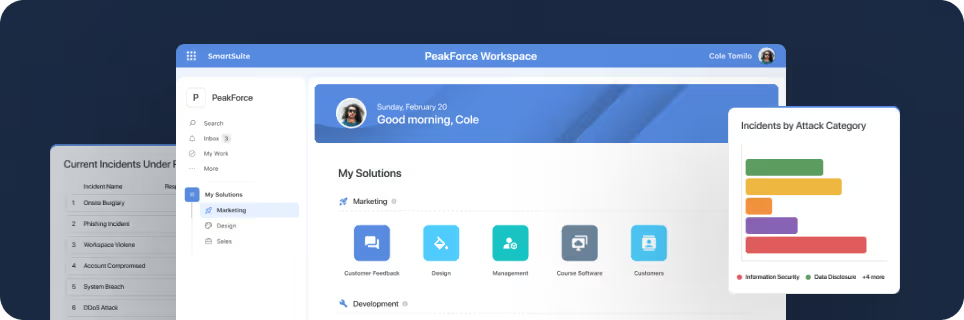
SmartSuite provides work platform for standardizing workflows in the following areas:
- Governance, Risk & Compliance
- IT & Service Ops
- Project / Portfolio Management
- Business Operations