For decades, resilience has been treated as a cost center: an insurance policy to minimize downtime, avoid fines, and keep regulators satisfied.
But that view is changing.
Today’s leading institutions are proving that resilience isn’t just defensive, it’s strategic.
And when it’s measured, managed, and connected through modern frameworks and workflows, it becomes one of the smartest investments a business can make.
Welcome to the new economics of resilience.
The Old Model: Compliance Over Capability
Historically, resilience spending was reactive. Organizations invested after an outage, breach, or regulatory mandate, often with little ability to demonstrate return.
The focus was on compliance, not capability.
- A plan documented? ✅
- A backup system in place? ✅
- An annual test performed? ✅
These checkboxes satisfied auditors, but rarely improved agility, efficiency, or confidence.
Resilience was something companies had to do, not something they wanted to do.
The Shift: Resilience as a Value Multiplier
In the digital economy, resilience has become an enabler of growth.
Customers, investors, and regulators now expect organizations to operate reliably, no matter what.
That expectation has real economic implications:
- Downtime impacts revenue.
- Data breaches erode trust.
- Supply chain disruptions inflate costs.
- Regulatory failures damage reputation.
Conversely, resilient organizations outperform peers because they:
- Respond faster to disruptions.
- Retain customer confidence during crises.
- Reduce operational risk premiums.
- Attract partnerships and investors seeking stability.
Resilience has evolved from a cost of doing business into a competitive advantage.
The CRI Profile and the Economics of Clarity
One reason resilience was undervalued is because it was difficult to measure.
The Cyber Risk Institute’s CRI Profile is changing that.
By harmonizing frameworks and providing diagnostic statements, it gives organizations a consistent way to quantify maturity across cybersecurity, risk, and operational resilience.
When you can measure resilience, you can manage it.
When you can manage it, you can monetize it: through efficiency, trust, and performance. That’s the foundation of the new economics of resilience.
SmartSuite’s Role: Making Resilience Measurable
At SmartSuite, we help organizations turn resilience from aspiration into action, and action into insight.
Through our GRC Solution Suite, institutions can:
- Align resilience activities to CRI Profile diagnostic statements.
- Quantify control performance and readiness across programs.
- Automate evidence collection and reporting for audits and regulators.
- Translate operational performance into measurable KPIs and ROI.
The result? A real-time, data-driven view of how resilience contributes to the business. Resilience stops being a line item, it becomes an asset.
How Connected Workflows Create Economic Value
Resilience delivers the highest return when it’s integrated across the enterprise.
SmartSuite’s connected-workflow architecture enables that integration by linking:
- Cyber Resilience: Detect and recover from incidents faster.
- Operational Resilience: Maintain continuity through disruptions.
- Third-Party Resilience: Identify and mitigate supplier risks proactively.
- Regulatory Resilience: Map evolving requirements to active controls.
This holistic model lowers operational friction, reduces redundancy, and surfaces risk insights that drive smarter investments.
Each efficiency compounds, creating tangible, measurable ROI.
The Metrics That Matter
Modern resilience metrics extend beyond uptime and incident counts.
The organizations that lead are tracking:
- Mean Time to Detect (MTTD) and Mean Time to Recover (MTTR).
- Regulatory Audit Cycle Time.
- Control Automation Rate.
- Framework Coverage (CRI, DORA, ISO, etc.).
- Operational Downtime Cost Avoidance.
With SmartSuite, these metrics become part of the same connected ecosystem, visible to executives and boards, continuously updated, and grounded in real evidence.
When resilience metrics live alongside financial metrics, they drive better decisions at every level.
Building the Business Case for Resilience
The economics of resilience come down to one truth:
Preparedness is cheaper, and far more valuable, than recovery.
Industry data consistently shows that proactive risk and resilience investment pays for itself many times over:
- The average cost of downtime per hour exceeds $300,000.
- Organizations with integrated risk programs experience 40% fewer incidents.
- Regulatory non-compliance costs companies 2.7x more than compliance.
Resilience investment isn’t just risk reduction, it’s performance protection.
The Future: From Cost Center to Growth Strategy
The institutions leading the next decade of resilience will treat it not as overhead, but as strategy.
They’ll embed resilience metrics in business planning, investment models, and customer reporting.
Frameworks like CRI make it possible. Platforms like SmartSuite make it real.
💡 See how SmartSuite is transforming the way financial institutions approach CRI Profile implementation to replace the FFIEC CAT and modernize a broader GRC integration:
Because resilience is no longer just about bouncing back, it’s about moving forward faster.
That’s the new economics of resilience.
Jon Darbyshire is CEO and Founder of SmartSuite and previously founded Archer IRM, one of the first enterprise GRC platforms. He continues to work closely with financial institutions, regulators, and technology partners to advance the future of integrated risk management.
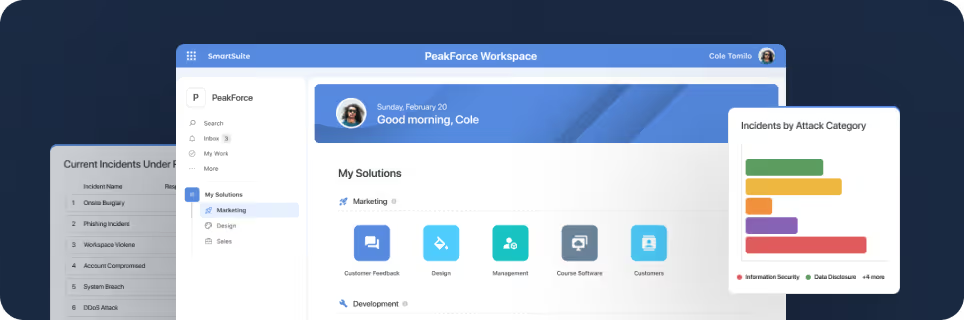
SmartSuite provides work platform for standardizing workflows in the following areas:
- Governance, Risk & Compliance
- IT & Service Ops
- Project / Portfolio Management
- Business Operations