Across the financial-services sector, AI has become the shorthand for innovation.
Executives are asking what use cases are feasible. Vendors are racing to embed copilots into their platforms. Regulators are exploring governance expectations.
Boards are asking how AI will reshape risk management itself.
Yet in hundreds of conversations I’ve had across global banks, mid-sized institutions, credit unions, fintech organizations, and technology partners, the same realization keeps surfacing:
AI is not limited by its intelligence, it is limited by the structure of the information it’s given.
AI doesn’t magically “reason” about misaligned frameworks, siloed controls, fragmented vendor outputs, unstructured evidence, conflicting taxonomies, or inconsistent maturity models. It can’t harmonize what institutions have not harmonized themselves.
If an organization doesn't share a common language for risk, AI has nothing to interpret. If controls don’t map to standard diagnostics, AI has nothing to correlate. If evidence lives in disconnected systems, AI has nothing to evaluate. If maturity is defined differently across teams, AI has no truth to anchor to.
This is where the Cyber Risk Institute’s CRI Profile becomes one of the most important enablers of AI-driven governance, not because it is technical, but because it is structured.
AI needs structure. AI needs patterns. AI needs meaning. AI needs consistency. AI needs a diagnostic model with unified expectations across teams.
CRI provides exactly that.
Why AI Fails in Fragmented Environments
In many institutions, AI experiments break down because:
1. Risk data does not share a common schema
AI cannot draw connections across cyber, audit, vendor risk, continuity, and compliance when each uses a different data model.
2. Evidence is stored in inconsistent formats
AI cannot assess evidence when artifacts lack uniform taxonomy or diagnostic anchors.
3. Controls are mapped differently across systems
AI cannot reason over dependencies or maturity when the definitions vary.
4. Maturity models contradict each other
AI cannot interpret “readiness” when every function defines it differently.
5. Vendor outputs are inconsistent
AI cannot evaluate third-party signals without a common alignment layer.
These are not AI problems. These are standardization problems.
The brilliance of CRI is not that it simplifies risk, it standardizes the language of risk, giving AI something concrete to map to, reason over, and predict against.
CRI Creates the Semantic Layer AI Has Been Missing
To understand why CRI is so important for AI, think of CRI as the semantic foundation of modern risk governance.
CRI provides structure
300+ diagnostic statements aligned to regulators.
CRI provides consistency
Uniform expectations for cyber, resilience, and governance.
CRI provides meaning
Each diagnostic describes an outcome AI can interpret.
CRI provides relationships
Diagnostics map naturally to controls, issues, evidence, and risk statements.
CRI provides context
Maturity reflects posture, not activity.
AI needs structure, consistency, meaning, relationships, and context. CRI is the first FS framework to deliver all five. This is why CRI is increasingly being used as the foundation for AI-enabled GRC, cyber, risk, and resilience platforms.
Why CRI Is the Ideal Model for AI Reasoning
AI models excel when the domain has:
- A harmonized taxonomy.
- Clear maturity expectations.
- Consistent evaluation logic.
- Measurable evidence.
- Definable gaps.
- Observable data patterns.
CRI was built with these properties from the start.
AI can:
- Map vendor signals into diagnostics.
- Interpret configuration drift against maturity expectations.
- Assess evidence completeness.
- Recommend remediation paths.
- Summarize resilience readiness.
- Identify diagnostic weak signals.
- Correlate cyber findings with continuity risk.
- Explain posture in business terms.
- Produce consistent board narratives.
AI isn’t guessing, it’s reasoning over a shared structure.
Examples of What AI Can Reason Over When CRI Is the Backbone
1. AI can analyze vendor data and map it directly to CRI diagnostics
Vendor gap → CRI diagnostic → remediation → maturity update → reporting.
2. AI can interpret cloud signals through CRI’s governance diagnostics
Configuration drift → diagnostic mismatch → evidence update → risk scoring.
3. AI can recommend remediation based on diagnostic deficiencies
AI can propose the next most impactful action tied to a weak diagnostic.
4. AI can summarize board reporting
“Here are the diagnostic areas with the greatest movement this quarter.”
5. AI can identify cross-domain dependencies
“This cyber gap influences three continuity diagnostics and one governance diagnostic.”
6. AI can enhance continuous assurance
“When this evidence changes, this diagnostic should be updated.”
7. AI can benchmark maturity
“Your institution’s diagnostic maturity is trending above the FS median.”
8. AI can predict operational impacts
“This diagnostic weakness increases risk to two critical business services.”
Without CRI, these use cases collapse into noise. With CRI, they become coherent and impactful.
Why SmartSuite Is the Ideal Operational Layer for CRI + AI
CRI provides the semantic layer. AI provides the intelligence layer. SmartSuite provides the workflow layer. SmartSuite is uniquely suited for CRI + AI because:
1. It is workflow-native
AI recommendations flow directly into automated workflows.
2. It centralizes evidence
AI can evaluate artifacts from a single source of truth.
3. It unifies remediation
AI can trigger, suggest, and sequence actions across the enterprise.
4. It supports continuous maturity
AI can update diagnostic scoring in real time as evidence and signals evolve.
5. It models CRI diagnostics natively
Diagnostic structures map directly to fields, workflows, and dashboards.
6. It integrates ecosystem signals
AI can reason across vendor, cyber, audit, continuity, and compliance systems.
In SmartSuite, CRI provides the meaning and boundaries, AI provides the intelligence and acceleration, and workflows provide the motion and execution.
This is the governance architecture of the future.
What Happens When Institutions Adopt CRI + AI Together
Across institutions exploring CRI-anchored AI, I’ve observed several breakthroughs:
1. Maturity stops being a subjective debate
AI evaluates maturity against diagnostic logic.
2. Evidence stops being a static library
AI treats evidence as living data.
3. Remediation becomes proactive instead of reactive
AI identifies weak signals long before auditors or regulators do.
4. Assurance becomes continuous
AI updates posture continuously, not annually.
5. Reporting becomes coherent
AI writes the report based on consistent diagnostic structures.
6. Collaboration becomes natural
Teams speak the same diagnostic language, AI amplifies their alignment.
7. The board gains clarity
AI explains posture in business terms anchored to the CRI model.
This is real AI governance, not hype, not features, not copilots bolted onto legacy modules.
The Future: CRI Will Become the Domain Model AI Relies On
If current trends continue, CRI will become:
- The diagnostic schema AI models train on.
- The structure behind vendor integrations.
- The maturity model boards rely on.
- The evaluative model regulators prefer.
- The ontology used for continuous assurance.
- The governance backbone for real-time insight.
- The reasoning layer for AI governance copilots.
AI needs order. AI needs structure. AI needs patterns. AI needs common definitions. AI needs CRI.
Conclusion: Standardization Is What Makes AI Powerful, Not the Other Way Around
The industry’s next transformation won’t come from AI alone. It will come from pairing AI with a unified diagnostic model that gives it something to reason over.
CRI provides that model. SmartSuite provides the workflows. AI provides the intelligence.
Together, they unlock a new era of GRC: real-time, connected, diagnostic, intelligent, and continuously improving.
This is the future of governance, and it starts with standardization.
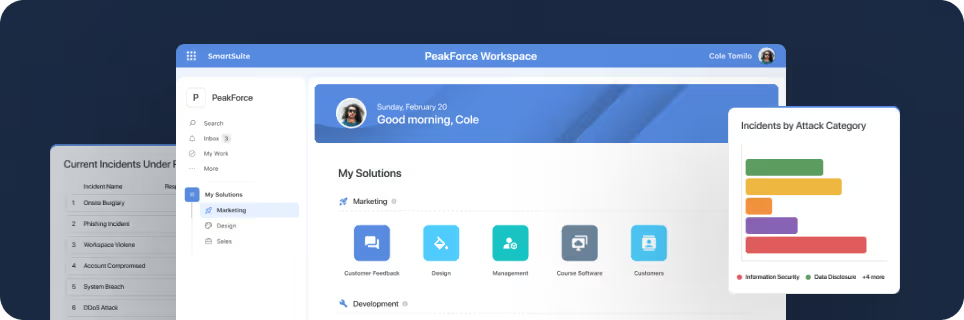
SmartSuite provides work platform for standardizing workflows in the following areas:
- Governance, Risk & Compliance
- IT & Service Ops
- Project / Portfolio Management
- Business Operations