



CRI + SmartSuite: Turning Diagnostic Statements into Actionable Workflows

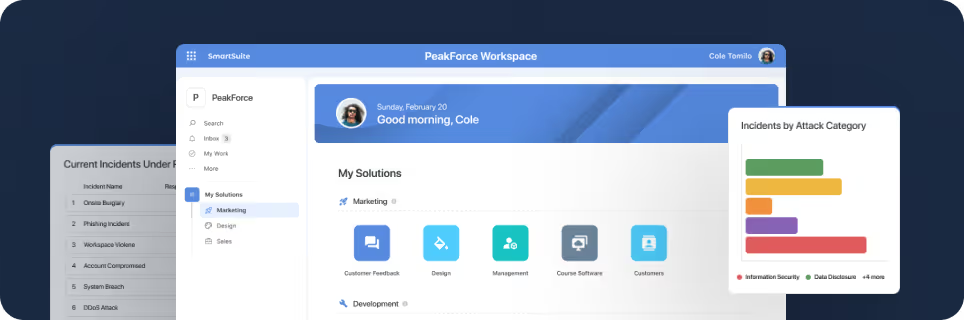
SmartSuite provides work platform for standardizing workflows in the following areas:
-
Governance, Risk & Compliance
-
IT & Service Ops
-
Project / Portfolio Management
-
Business Operations

For years, financial institutions have struggled with translating regulatory frameworks into something usable, something operational, measurable, and connected to daily work.
Frameworks explained what mattered, but not how to execute. Diagnostic statements described what needed to be assessed, but not how evidence should flow.
Teams interpreted requirements in different ways, often reinventing the same process across cyber, risk, compliance, audit, and resilience programs.
The Cyber Risk Institute (CRI) Profile changed that.
It created a single, coherent set of diagnostic statements that brings clarity, consistency, and comparability to the assessment of cyber and operational resilience.
But even with this breakthrough, institutions still face a larger challenge, one I’ve seen repeatedly across global banks, regional institutions, credit unions, and fintech companies:
- How do we turn these diagnostic statements into real workflows?
- How do we operationalize them?
- How do we make them actionable?
This is where technology, and specifically, workflow-native architecture, becomes essential.
Diagnostic Statements Are the “What”; Workflows Are the “How.”
CRI diagnostic statements are exceptionally well structured. They clearly articulate what must be evaluated across governance, cyber, third-party oversight, resilience, and technology.
But diagnostic statements alone cannot close a gap, validate a control, or prepare a board for emerging risks.
Without operationalization, diagnostic statements remain:
- Well-written.
- Well-structured.
- Well-intentioned.
…but incomplete.
To realize their full value, they must be linked to:
- People.
- Processes.
- Evidence.
- Automation.
- Remediation.
- Continuous monitoring.
- Reporting.
Diagnostic statements must become workflow triggers, not static descriptions.
This is the bridge most institutions struggle to build, and it is the exact bridge SmartSuite was designed to support.
Where do institutions struggle?
Across my experience supporting major financial institutions, the pain points around operationalizing frameworks like CRI tend to fall into a few predictable categories:
1. Interpretation varies across teams
Different groups translate diagnostic statements differently, resulting in inconsistent maturity scoring, evidence expectations, and remediation plans.
2. Evidence is scattered across systems
Audit has one repository. Cyber has another. Vendor risk has a third. Resilience lives somewhere else entirely.
3. Remediation happens in silos
Teams fix issues independently, without shared prioritization or unified accountability.
4. Reporting is manual
Institutions build maturity summaries and executive reporting through spreadsheets, slide decks, and reconciliation meetings.
5. Controls drift over time
Without workflows, diagnostic expectations don’t stay tied to real-world operational behaviors.
These challenges are not failures of capability. They are failures of architecture, failures of systems that were built around modules, not workflows.
How does SmartSuite make diagnostic statements operational?
SmartSuite was intentionally architected to solve this very problem.
Because it is a workflow-native platform, CRI diagnostic statements do not sit above the work. They sit inside it.
Here is what that means in practice:
1. CRI Becomes the Structure Behind Every Workflow
Each diagnostic statement can be mapped to:
- Controls.
- Evidence requirements.
- Risk assessments.
- Issue categories.
- Remediation processes.
- Automated tasks.
- Metrics and dashboards.
This creates a consistent backbone across teams: one source, one structure, one interpretation.
2. Evidence Follows the Work
Instead of storing evidence in folders or static libraries, SmartSuite ties evidence directly to:
- The diagnostic.
- The workflow.
- The process owner.
- The audit trail.
- The reporting outcome.
Evidence becomes living, connected, and reusable, not isolated or fleeting.
3. Remediation Becomes Unified
A CRI-relevant issue triggers a connected remediation lifecycle:
- Assignment.
- Escalation.
- Evidence collection.
- Validation.
- Closure.
- Continuous monitoring.
The entire institution sees the same issue, the same workflow, and the same outcome.
4. Maturity Scoring Becomes Real-Time
Diagnostic scores are no longer annual artifacts:
- They update automatically.
- They reflect control performance.
- They reflect evidence status.
- They adjust with remediation.
- They feed directly into dashboards and board reporting.
Boards finally see progress, not just posture.
5. Assurance Becomes Continuous
By embedding diagnostic statements inside workflows, SmartSuite supports:
- Continuous control monitoring.
- Automated alerts.
- Anomaly identification.
- Cross-domain notifications.
- Resilience linkage.
- Cyber-event downstream impact.
This is the real promise of CRI: dynamic, connected, consistent governance.
Why does this matter for CISOs, risk leaders, audit, and boards?
Shared frameworks reduce language barriers.
Shared workflows reduce operational barriers.
Together, they create:
- Consistent maturity evaluations.
- Transparent control performance.
- Connected remediation.
- Unified reporting.
- Faster decision cycles.
- Increased confidence at the leadership level.
Boards finally see a coherent story, one that connects cyber events, resilience posture, third-party dependencies, and control effectiveness through the same underlying diagnostic structure.
Institutions stop arguing about interpretations and start aligning on outcomes.
This is the difference between a framework on paper and a framework in practice.
A Workflow-Based Future
CRI’s diagnostic statements represent one of the strongest foundations our industry has ever had.
SmartSuite provides the operational layer that brings those statements to life.
Together, they enable financial institutions to move from:
- Static assessments → dynamic readiness.
- Siloed teams → connected functions.
- Manual reporting → continuous insight.
- Fragmented tools → unified workflows.
- Translation → clarity.
In a world moving faster every quarter, this combination is not simply helpful; it is essential.






Put these ideas to work
Start a free trial, or book a demo and see how it runs in SmartSuite.

