
For more than 20 years, the Governance, Risk, and Compliance (GRC) market has been shaped by a simple assumption: that risk can be managed through modules.
Entire platforms were built around this one idea.
- You had a cyber module.
- A compliance module.
- A resilience module.
- A third-party risk module.
- An audit module.
Each was designed to capture data, store evidence, document controls, or manage remediation, usually in its own contained space, with its own terminology, workflows, and structure.
For a while, that model made sense. The problems were smaller, the connections between functions were fewer, and organizations were willing to force their processes into the shapes their systems demanded.
But over the last decade, and especially in the last five years, the entire environment changed.
Digital transformation erased boundaries.
Cloud adoption accelerated interdependence.
Cyber incidents triggered governance events.
Continuity failures revealed technology risk.
Third-party issues became resilience issues.
Regulatory expectations converged.
Risk outgrew the module. But the systems powering GRC did not.
Workflow, Not Modules, Is the True Architecture of Modern Risk
One of the most surprising realizations I’ve had, after working with nearly all of the top 30 global banks, dozens of mid-sized institutions, credit unions, and fintechs, is that risk teams aren’t struggling with their domains.
They’re struggling with their processes. More specifically, they’re struggling with the paths risk takes across teams, tools, and decisions.
Risk is not a category. Risk is a workflow.
And that workflow never fits neatly inside a module.
A vulnerability doesn’t stop at the cyber module. An issue doesn’t stay inside the audit module. A vendor problem doesn’t live solely inside the third-party module. A continuity event doesn’t remain in resilience.
Every one of these events touches multiple functions, multiple teams, and multiple frameworks. Yet the systems designed to support this work still split everything into rigid compartments, forcing institutions to stitch together the big picture manually.
This is the structural flaw at the center of legacy GRC: It organizes risk by label, not by flow.
Modern GRC requires the opposite.
Why Modules Fail: Lessons From Real-World Institutions
Across every institution I’ve worked with, from global FS giants to fintech startups, the same patterns appear:
Modules create informational dead zones.
Critical details live in one function’s system and never reach the teams who need them most.
Cross-functional work gets bottlenecked.
A cyber issue touches compliance, audit, resilience, and third-party risk, but the tools don’t.
Teams end up shadow-mapping everything.
Excel becomes the universal translator because systems cannot interpret each other.
Board reporting becomes an interpretation exercise.
Executives spend more time reconciling storylines than understanding risk.
Remediation becomes fragmented.
Every module runs its own version of “fixing the issue,” with no unified lifecycle.
These problems have nothing to do with the professionals doing the work, and everything to do with tools that organize risk by hierarchy instead of by behavior.
Risk is dynamic. Modules are static.
That mismatch grows more painful every year.
A Product Person’s View: Why Processes Matter More Than Categories
I’ve never approached GRC as a former auditor or CISO. My perspective has always been shaped by building products, and by studying how work actually happens.
Across thousands of workflows, a single truth emerges:
Teams succeed when the process is connected, visible, intuitive, and shared. They struggle when the process is fragmented, hidden, rigid, or isolated.
Risk is fundamentally a process discipline. It lives in workflows, not in modules.
And the institutions that recognize this are already outperforming those that don’t.
The Process Layer: The Missing Foundation of Modern GRC
Every modern risk program rests on five universal processes:
- Identify.
- Assess.
- Control.
- Monitor.
- Respond.
These processes don’t belong to departments. They don’t belong to categories. They don’t belong to modules. They belong to the organization as a whole.
The “GRC Process Layer” is the connective tissue that brings these behaviors together, not by replacing frameworks or merging teams, but by aligning them inside a shared, continuous workflow.
This process layer does three critical things:
1. It unifies work across functions.
A cyber alert → risk evaluation → control mapping → issue remediation → evidence collection → executive reporting all flow through one operational fabric.
2. It gives teams a shared language.
Diagnostic statements, maturity models, control logic, and resilience indicators all map into the same workflow backbone.
3. It grounds decisions in real-time context.
Instead of five dashboards and three meetings, teams get one story of what’s happening, why, and what requires attention.
This is the architecture legacy GRC tools never supported, because they never recognized process as the organizing principle.
Why SmartSuite Was Built Workflow-Native
When we built SmartSuite, we didn’t set out to rebuild the GRC products of the 2000s. We set out to build the platform those teams should have had all along.
A platform where:
- Workflows define structure.
- Processes define visibility.
- Context defines connections.
- Frameworks map into work (not the other way around).
- Controls live inside processes.
- Evidence follows the flow of remediation.
- Issues move across domains seamlessly.
- Risk decisions reflect reality, not module boundaries.
This is why SmartSuite integrates so naturally with the CRI Profile, DORA, NIST CSF, and internal frameworks: these standards describe behavior and relationships, not modules.
A workflow-native architecture mirrors how risk actually behaves.
How Workflow-Centered GRC Changes Outcomes
When institutions shift from module-based governance to workflow-based governance, three major improvements occur immediately:
1. Clarity increases
Teams finally see how their work fits into the larger operational picture.
2. Efficiency improves
Risk, cyber, resilience, and audit teams stop doing parallel versions of the same work.
3. Resilience strengthens
Issues, evidence, and remediation flow through one lifecycle, not several.
This is the true promise of next-generation GRC: not more features, but better connection.
Why This Matters for the Future
Risk is accelerating.
Regulatory expectations are converging.
Technology dependencies are deepening.Board expectations are rising.
Resilience needs are becoming existential.
Institutions cannot keep layering new modules onto old structures. They need a new foundation: one that reflects the continuous, interconnected nature of risk.
Workflow is that foundation. The process layer is the architecture. Connected GRC is the future.
And because the future belongs to institutions that move faster and see clearer, the process layer isn’t just a technology advantage, it’s a strategic one.
Conclusion
After decades spent observing, building, and improving how risk is managed, I’ve come to believe that the biggest shift ahead for GRC is not more automation, more dashboards, more integrations, or more frameworks.
It is the recognition that workflow is the true operating system of modern risk.
Modules divide. Workflow unites.
And as risk becomes more interconnected every year, the process layer will define which institutions stay ahead, and which ones fall behind.
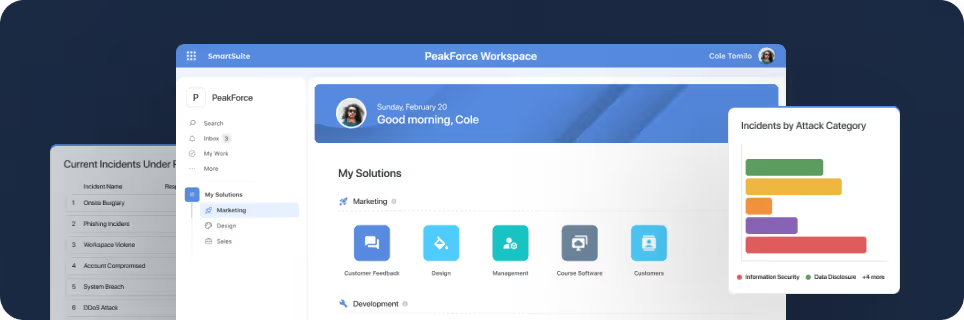
SmartSuite provides work platform for standardizing workflows in the following areas:
- Governance, Risk & Compliance
- IT & Service Ops
- Project / Portfolio Management
- Business Operations