



Smartsheet vs. Workfront vs. SmartSuite: Which Tool to Pick? [2026]
![Smartsheet vs. Workfront vs. SmartSuite: Which Tool to Pick? [2026]](https://cdn.prod.website-files.com/60db0944651d4b59a704ef93/6acacd55d63d2caea65a2929_6acacd5181d0b61fedf43836_smartsheet-vs-workfront-thumbnail-image.webp)
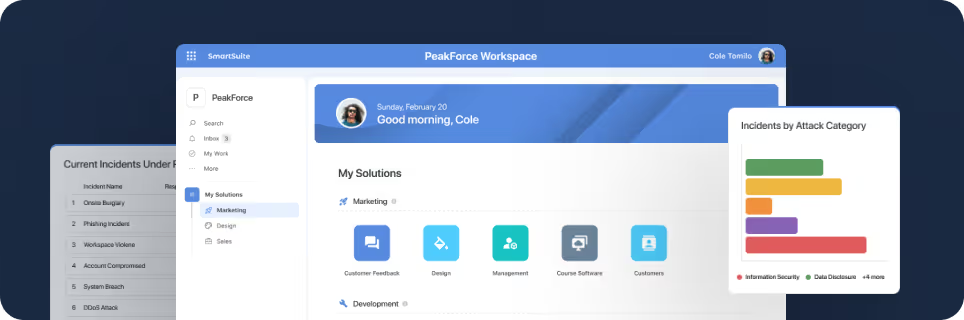
SmartSuite provides work platform for standardizing workflows in the following areas:
-
Governance, Risk & Compliance
-
IT & Service Ops
-
Project / Portfolio Management
-
Business Operations

Smartsheet vs Workfront seems like a clear choice, spreadsheets versus enterprise control, until real work starts to scale.
- Smartsheet is strongest when work revolves around structured tables, formulas, and reporting. It gives teams spreadsheet-level control with added automation, dashboards, and broad native integrations, but can become rigid, costly, and harder to manage as workflows move beyond rows, columns, and formulas. Pick Smartsheet if spreadsheets are already how your team thinks, plans, and executes work.
- Adobe Workfront excels at enterprise-scale planning, governance, and cross-functional execution, especially for marketing and creative organizations embedded in the Adobe ecosystem. It delivers deep visibility, approvals, and automation, but comes with a steep learning curve, heavier setup, and higher total cost. Pick Workfront if you need strict control, structured planning, and enterprise governance across large teams.
- SmartSuite offers a more balanced path. It combines record-based project execution, automation, collaboration, and AI in one flexible workspace without forcing spreadsheet logic or heavy enterprise overhead. It adapts as work evolves and stays approachable as teams scale. Pick SmartSuite if you want flexibility, visibility, and real execution in a single platform that’s easy to adopt and grow with.
This comparison cuts through the labels to show where each tool breaks down in practice and why SmartSuite often fits teams that need structure, speed, and flexibility at the same time.
Let’s dive in!
How do Smartsheet, Workfront and SmartSuite compare on features?
I’ll begin by breaking down key features each of these tools has to offer, starting with Smartsheet.
Smartsheet’s features
1. Formulas
Formulas are the backbone of how Smartsheet works, allowing teams to calculate values, apply logic, and automate fields directly inside sheets.
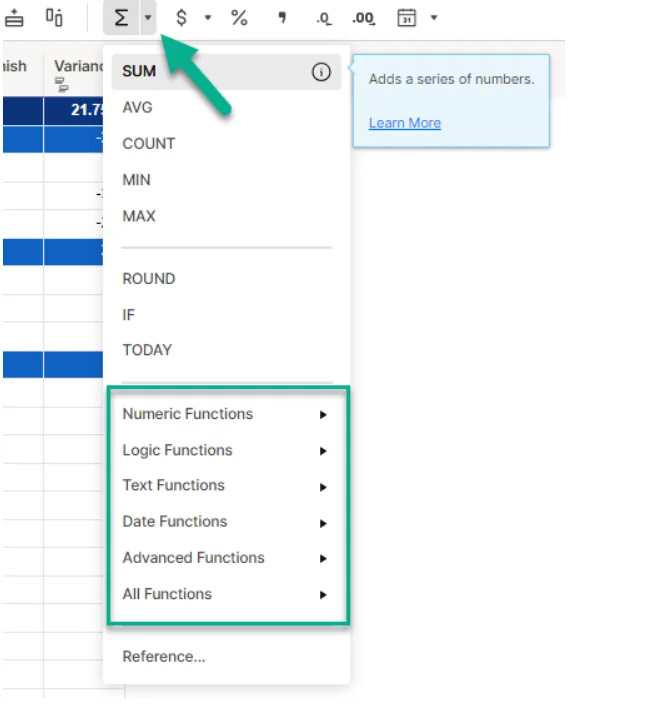
In addition to standard functions like SUM, AVG, and IF, Smartsheet includes spreadsheet-style hierarchy functions (such as CHILDREN()) and supports cross-sheet formulas for rolling up data across projects.
Column formulas make it easy to enforce consistent logic across entire sheets as new rows are added, which is especially useful for reporting and dashboards.
The tradeoff is that much of Smartsheet’s power depends on spreadsheet logic, which can become restrictive as workflows grow more complex or less table-driven.
2. Built-in AI for analysis, setup, and summaries
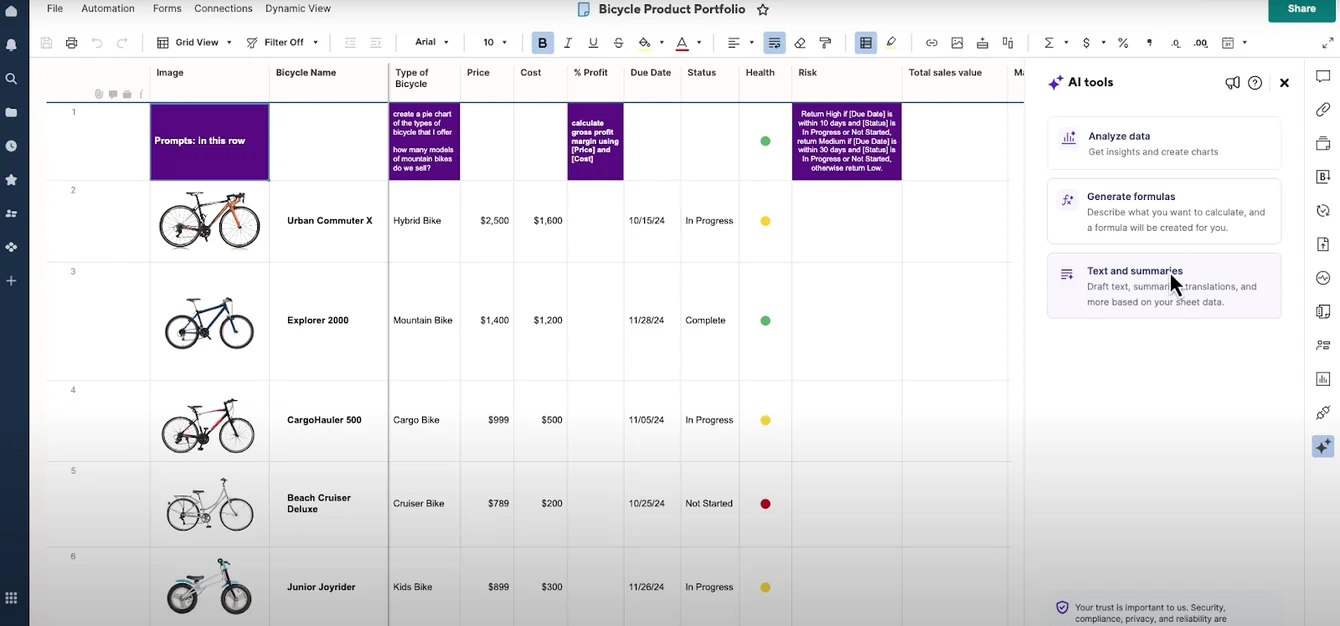
Smartsheet AI is built to help teams work faster inside spreadsheets by reducing setup friction and manual effort.
It can generate formulas from plain-language prompts, analyze sheet data, and instantly create charts and metrics for dashboards without manual configuration.
AI also supports content tasks like summarizing work, generating text, refining messaging, and identifying sentiment using existing project data.
3. Collaboration designed around sheets
Smartsheet supports team collaboration by keeping files, feedback, and conversations directly tied to work items.
Teams can attach files to rows or entire sheets, manage shared content through a central file library, and collaborate asynchronously without switching tools.
Built-in proofing allows reviewers to pin comments directly on documents or images, track versions, and maintain a clear feedback history.

4. Data management in Smartsheet
Smartsheet offers several tools to help teams manage and work with data at scale without relying entirely on manual updates.
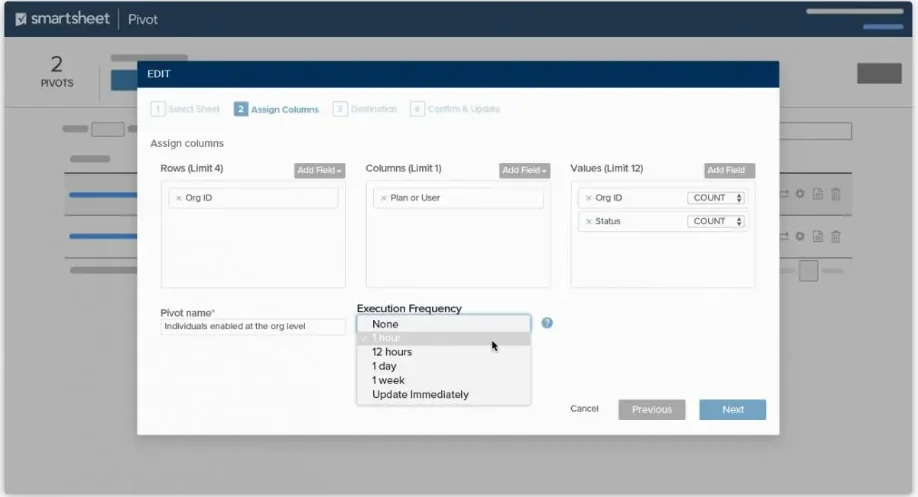
Features like Data Shuttle and DataMesh automate data imports, exports, and syncing between sheets, reports, and external systems, reducing copy-paste work and complex formulas.
DataTable and the Pivot App allow teams to visualize, summarize, and analyze large datasets pulled from ERPs, CRMs, and databases directly inside Smartsheet.
Smartsheet is ideal if you:
✅ Rely heavily on spreadsheets, formulas, and structured tables to plan, track, and report on work.
✅ Manage data-heavy projects that require roll-ups, cross-sheet reporting, dashboards, and consistent calculations.
✅ Work in a mid-sized to large organization that values standardization, reporting, and strong integrations with enterprise tools.
Smartsheet isn’t the best choice if you:
❌ Need highly flexible workflows that don’t fit neatly into rows, columns, and formula-driven logic.
❌ Expect non-technical teams to own complex automations and data models with minimal setup or ongoing maintenance.
❌ Prefer workflow-first execution over spreadsheet-based planning and reporting.
Workfront’s features
1. Planning in Adobe Workfront
Adobe Workfront’s planning features are built for organizations that need to connect strategy directly to execution at scale.
The Planning module lets teams model their marketing lifecycle using custom records, workspaces, and linked data that tie campaigns, activities, and projects back to strategic priorities.
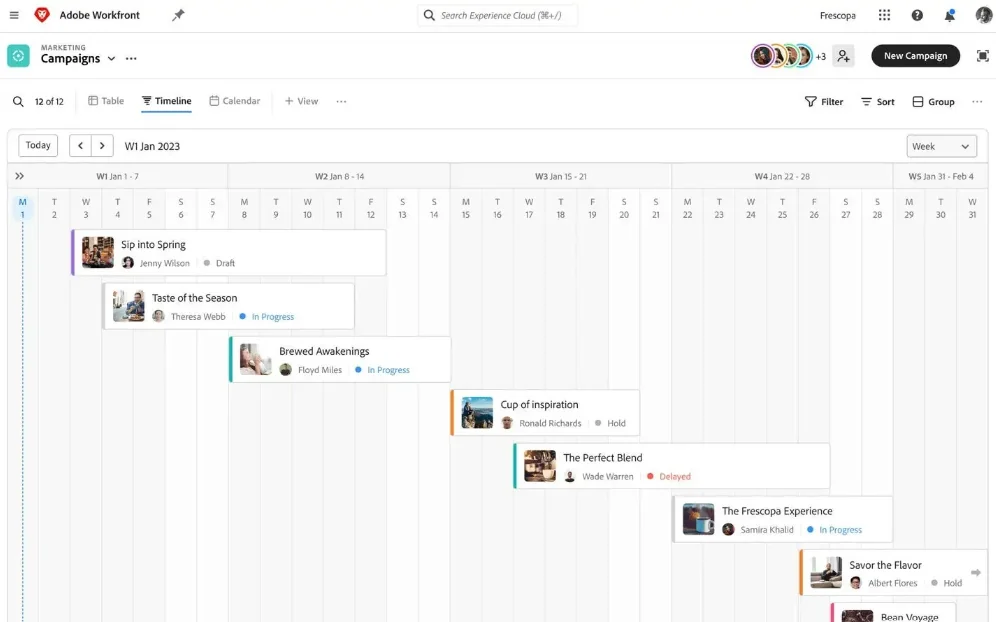
With shared campaign calendars, custom views, and connected records, stakeholders get end-to-end visibility into how plans translate into active work.
This makes Workfront especially strong as a marketing system of record, but also means that it might not be as good in different industries and business environments.
2. Centralized work management at enterprise scale
Adobe Workfront is designed to centralize work across large, distributed teams by acting as a single system of record for requests, projects, tasks, and resources.
Centralized request queues, custom forms, and automated routing ensure all incoming work is captured, vetted, and assigned through consistent processes.
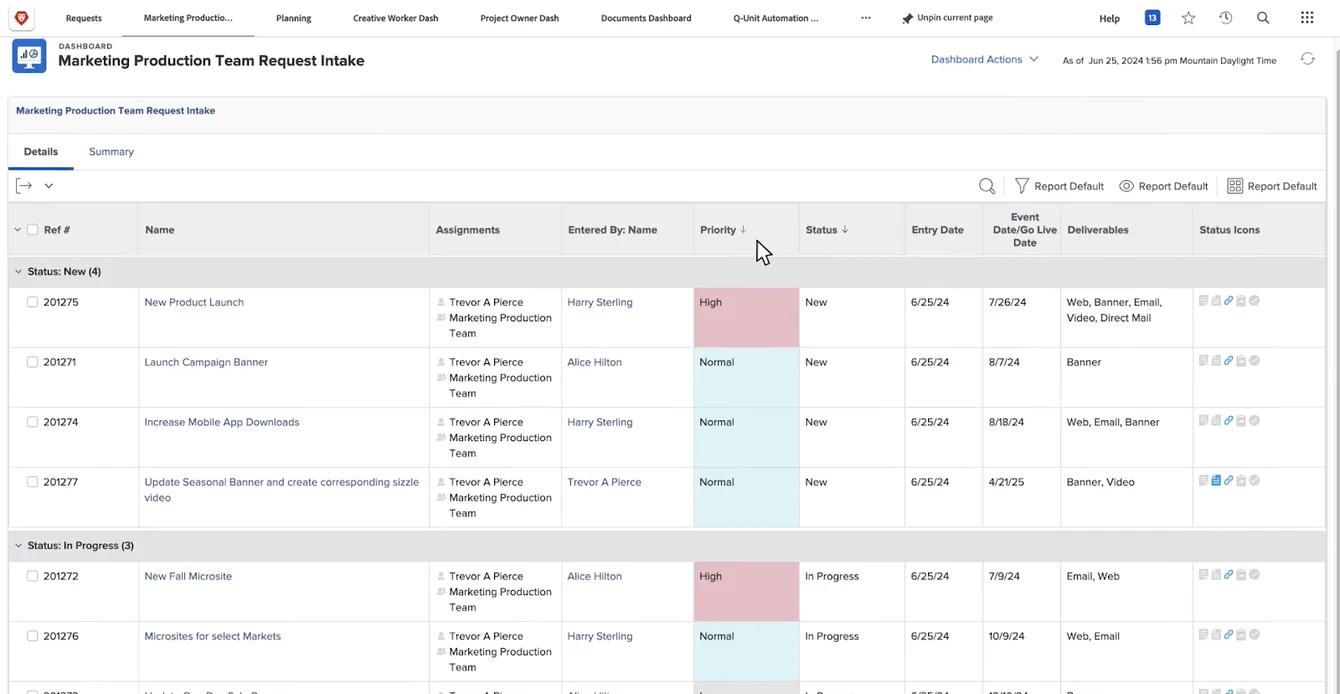
Workfront also layers in AI-driven assistance for prioritization, summaries, and task management, helping users stay focused through unified views like Priorities and customizable home dashboards.
This level of centralization is valuable for enterprise-scale operations, but it comes with a heavier structure compared to lighter work management tools.
3. Reviews and approvals
Adobe Workfront is built to handle high-volume, high-stakes reviews and approvals where quality, brand consistency, and auditability matter.
Its digital proofing tools centralize feedback with in-file annotations, version tracking, and support for many asset types, while automated single- and multi-stage approval workflows keep decisions moving without manual follow-ups.
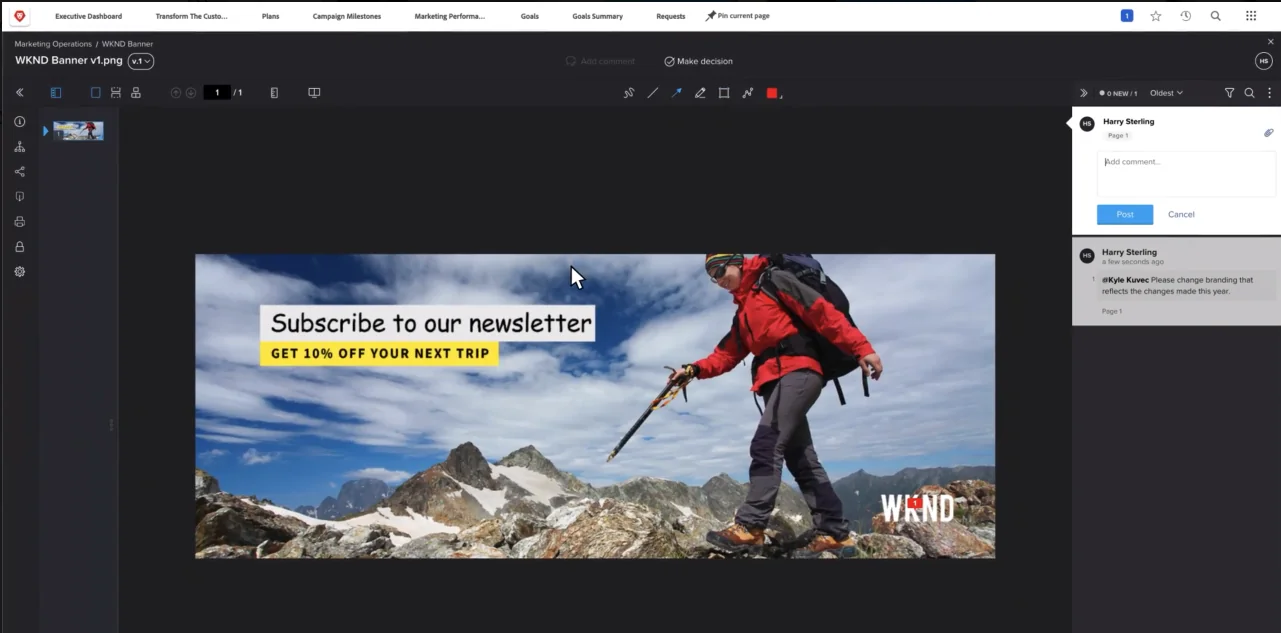
AI-powered asset review adds an extra layer of brand compliance by flagging issues early in the review cycle.
Combined with deep integrations across Adobe tools like Frame.io, GenStudio, and Adobe Express, Workfront excels in structured, enterprise-grade content approval workflows, especially for creative and marketing teams operating at scale.
4. Automation designed for consistency at scale
Adobe Workfront’s automation focuses on standardizing and accelerating repeatable work across large organizations.
Teams can use project templates and blueprints to quickly spin up consistent projects, workflows, and permissions for common use cases like campaign launches, creative production, or service delivery.
Automated workflows handle reviews, approvals, dependencies, and visibility rules, helping enforce brand and process compliance at scale.
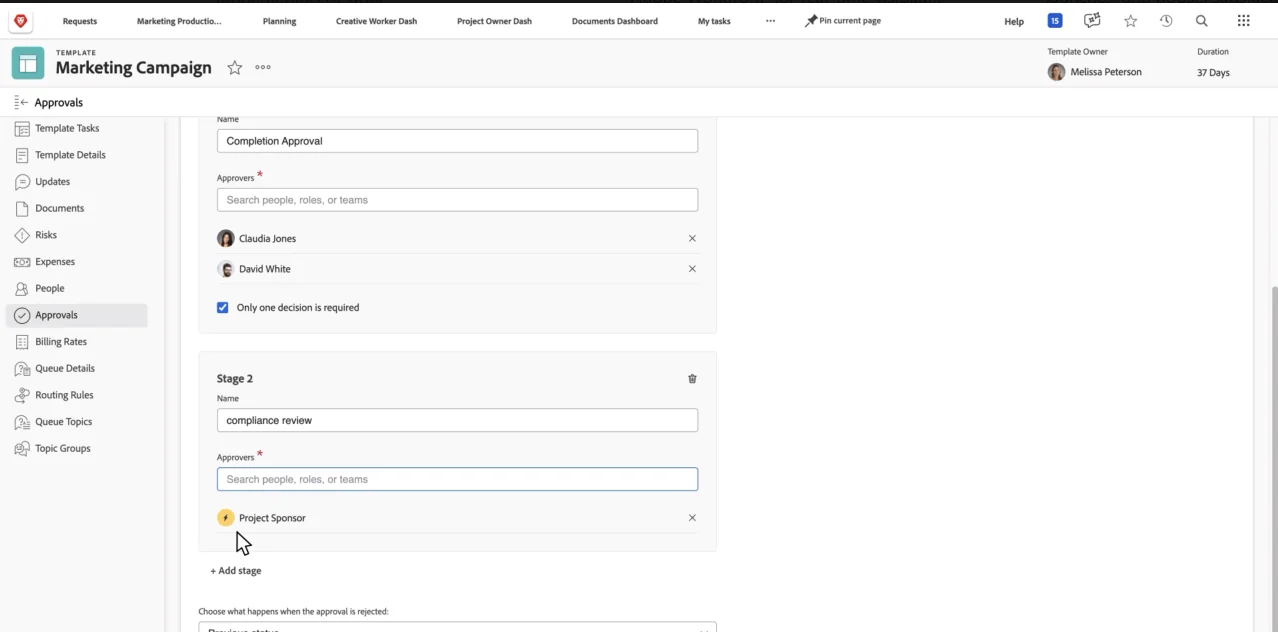
AI-powered briefs further reduce manual setup by turning unstructured documents into structured projects, making Workfront automation capable, but best suited for teams that value control and consistency over lightweight, ad-hoc automation.
Workfront is ideal if you:
✅ Operate in a large or enterprise organization that needs strict process control, governance, and a centralized marketing system of record.
✅ Manage high volumes of creative or marketing work that require structured planning, formal reviews, approvals, and brand compliance.
✅ Are already invested in the Adobe ecosystem and want deep integrations with Creative Cloud, Frame.io, Experience Manager, or GenStudio.
Workfront isn’t the best option if you:
❌ Need a lightweight, fast-to-adopt tool for everyday project or task management.
❌ Want teams to customize workflows freely without heavy structure, planning, or admin oversight.
❌ Don’t have the time, budget, or internal ownership required to implement and maintain an enterprise-grade platform.
SmartSuite’s features
Smartsheet and Workfront approach work management from very different ends of the spectrum. One is rooted in spreadsheets and formulas, the other in enterprise planning, governance, and control.
But not every team fits cleanly into either model.
SmartSuite is built for teams that need to manage real work across projects, processes, and data without turning every change into a rebuild or implementation effort.
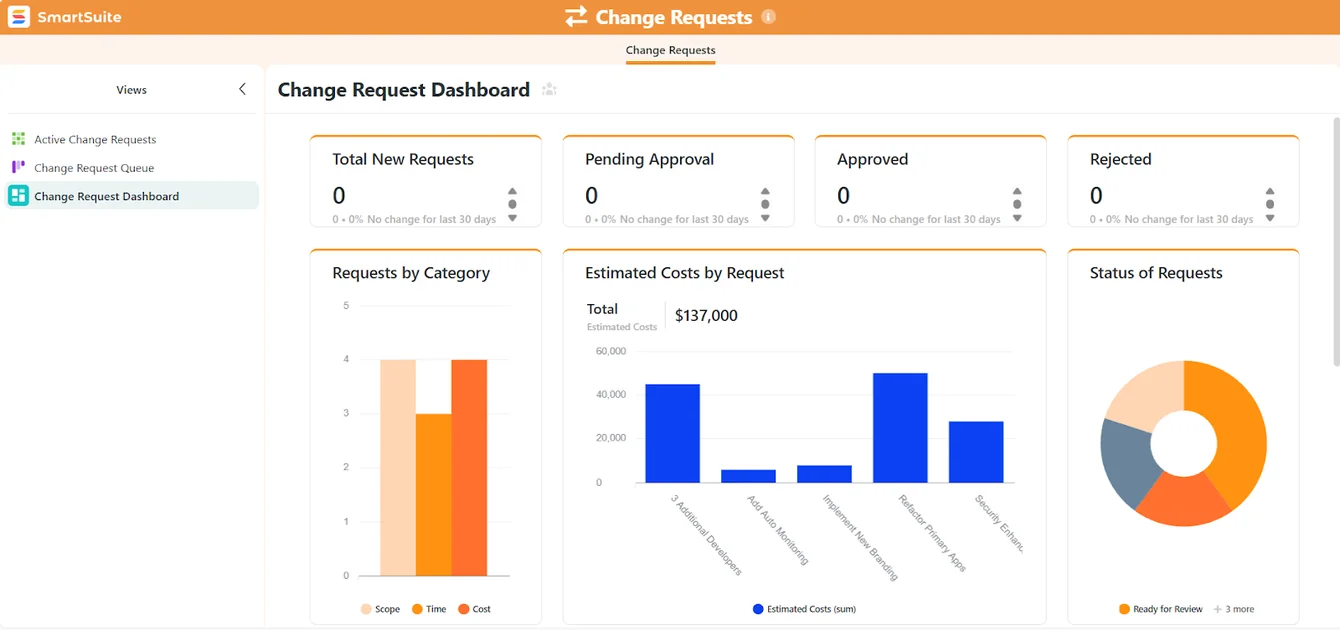
It brings task execution, structured records, automation, collaboration, and AI into one flexible workspace that adapts as work evolves.
And this is exactly why I’ve included SmartSuite here, as it fills the practical middle ground: it’s capable enough for complex workflows, yet approachable enough for teams that want to move fast without enterprise overhead.
Next, we’ll get a closer look at some of its key features.
1. All-in-one work management (records, not spreadsheets)
SmartSuite brings project execution, portfolio oversight, and day-to-day work into a single, unified system built around flexible records rather than spreadsheets or rigid enterprise workflows.
On one platform, you can:
- Plan and manage projects of any size: Run everything from simple task lists to complex, multi-workstream programs with tasks, subtasks, phases, milestones, owners, and dependencies.
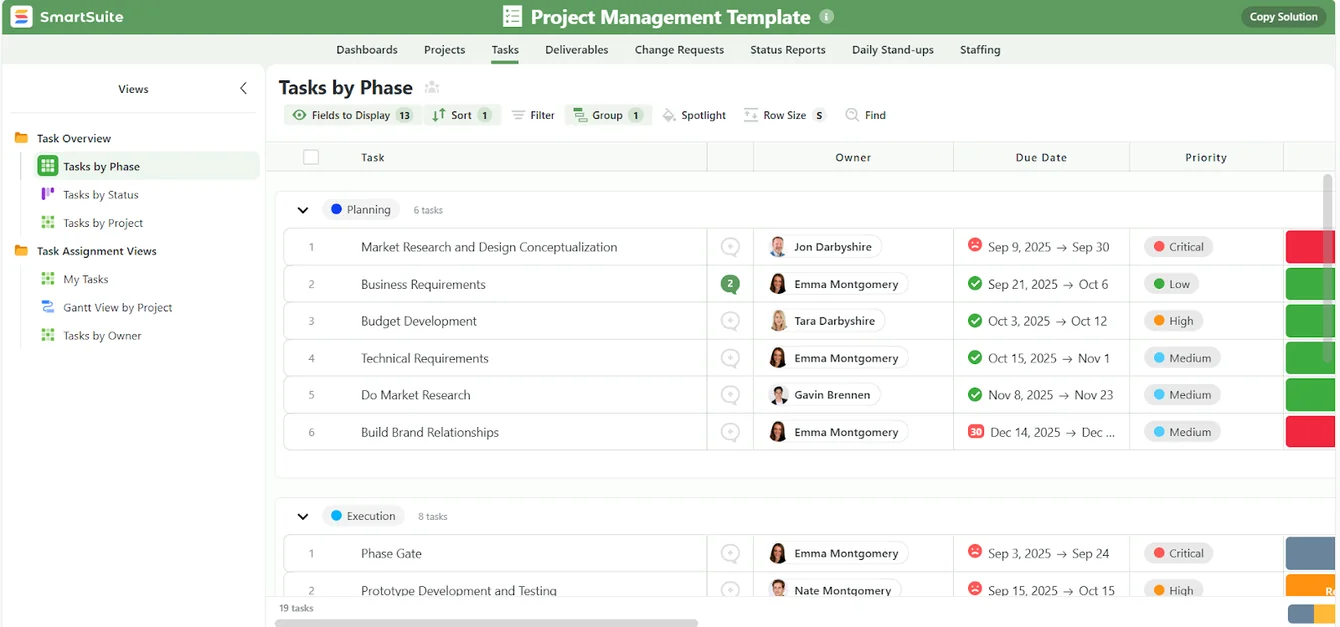
- Organize and prioritize work in one place: Manage tasks, sub-items, checklist steps, and conversations directly within project records, with a dedicated My Work view that consolidates all assigned work across projects.
- Track timelines, milestones, risks, and issues: Visualize progress using phases and milestones, proactively surface risks, and keep execution on track as plans evolve.
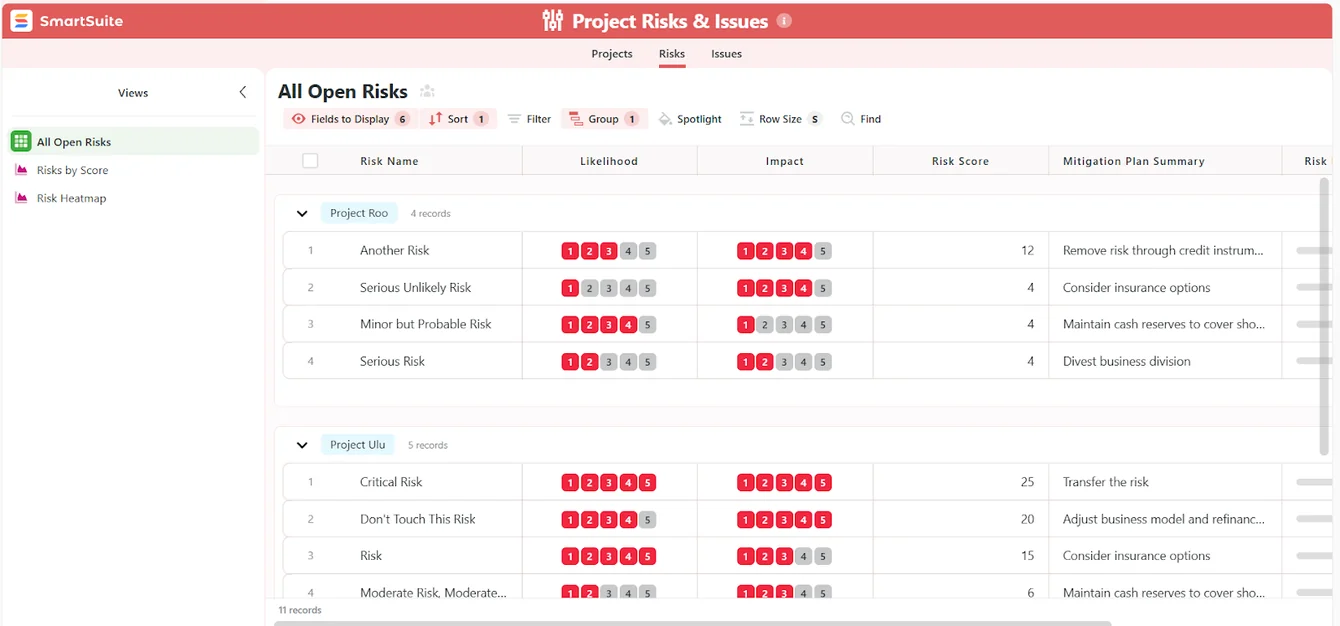
- Manage portfolios and multiple initiatives: Monitor multiple projects at once with dashboards and reports that surface status, budgets, priorities, and workload at a glance.
- Manage resources, time, and deliverables in context: Allocate resources, track time across projects and tasks, and manage files, feedback, and versions directly inside project records.
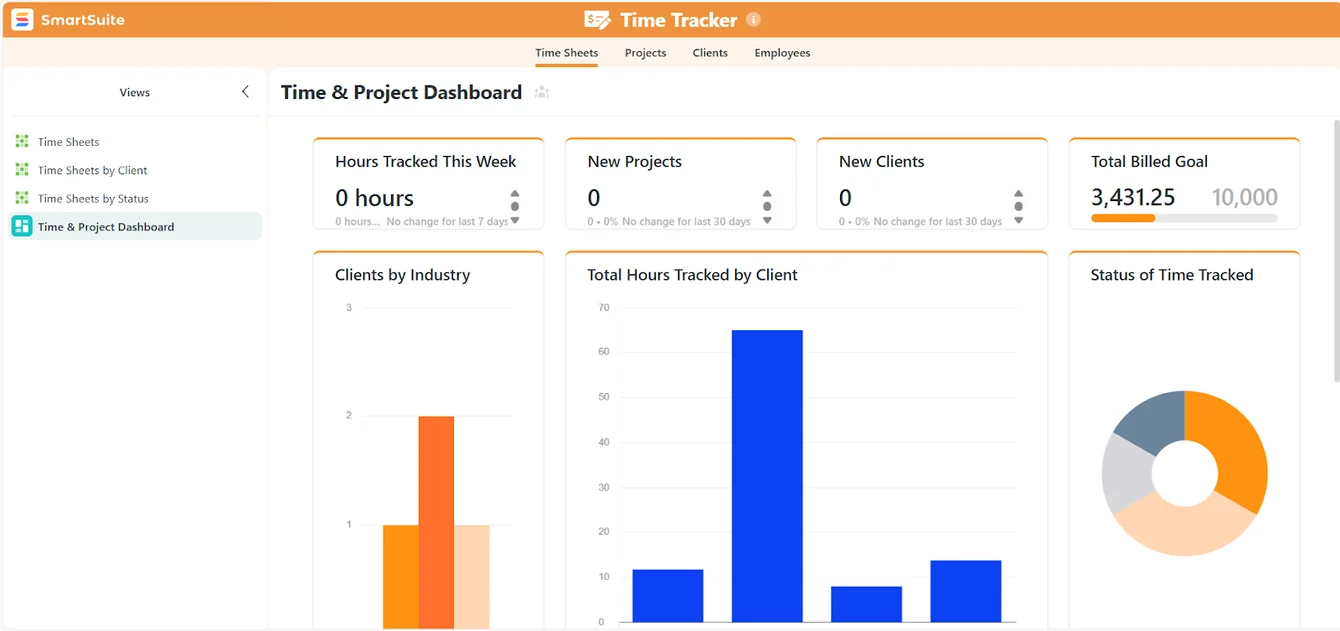
- Switch views without duplicating data: Instantly move between Grid, Kanban, Calendar, Timeline, Gantt, Chart, and Dashboard views using the same underlying records.
This record-based approach gives teams the structure and visibility they need to deliver without the spreadsheet lock-in of Smartsheet or the process-heavy overhead of Workfront.
2. No-code automation teams can own
SmartSuite’s automation is designed to help teams move work forward without turning workflow changes into technical projects.
Instead of relying on scripts, formulas, or enterprise-level configuration, SmartSuite uses clear, no-code rules that are easy to build, understand, and adjust as processes evolve.
SmartSuite lets you:
- Automate routine updates such as status changes, assignments, priority shifts, and due date adjustments when conditions are met.
- Trigger multi-step workflows that move work across stages, notify the right people, or update related records automatically.
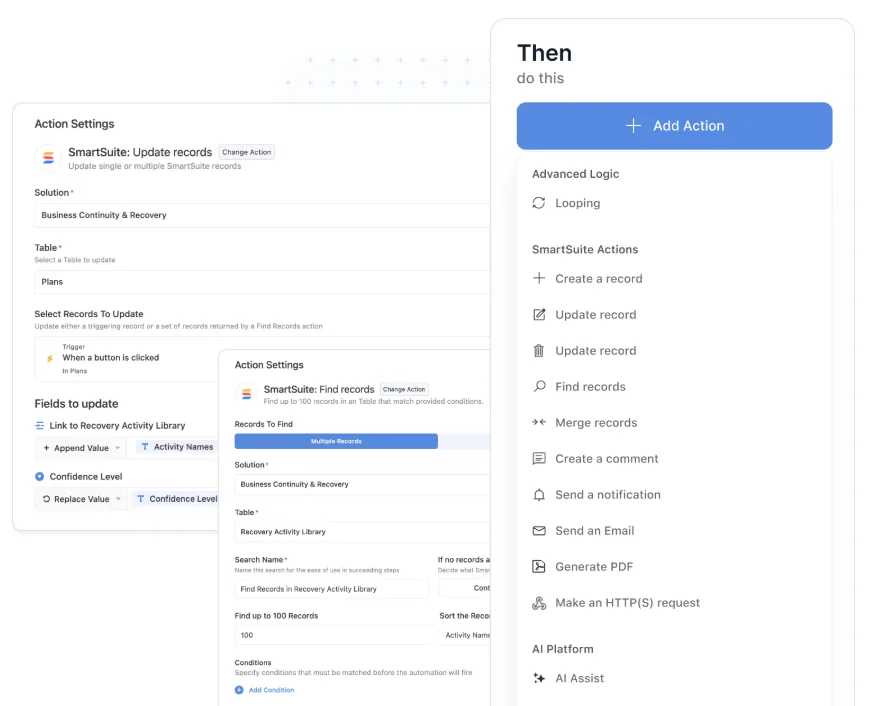
- Keep connected work in sync by automating actions across linked projects, tasks, requests, or records without manual follow-ups.
- Send real-time notifications through SmartSuite, email, Slack, or Microsoft Teams when approvals, deadlines, or changes occur.
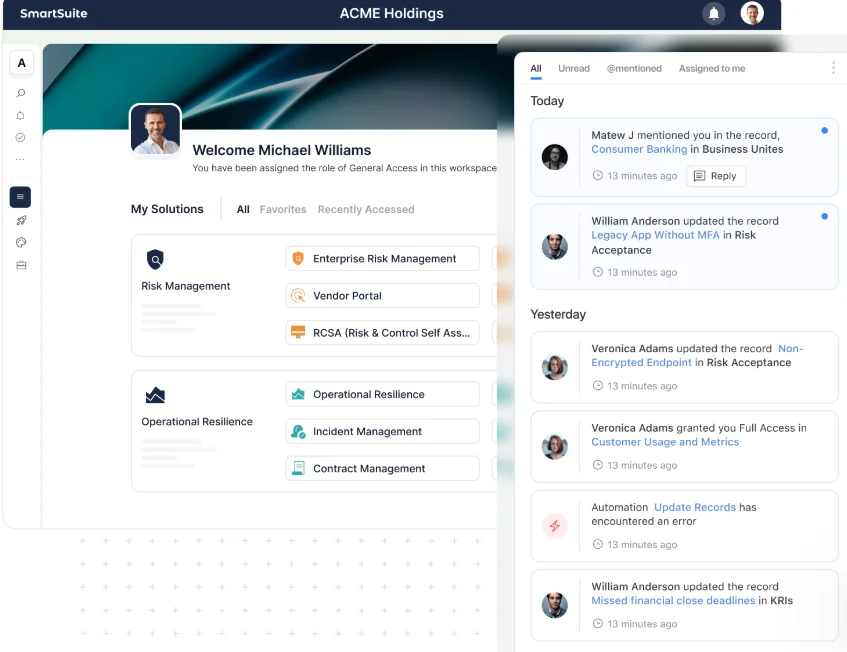
This makes SmartSuite automation more flexible than Smartsheet’s formula-driven logic and far lighter than Workfront’s process-heavy workflows, giving teams control without complexity.
3. Collaboration built into every record
SmartSuite treats collaboration as part of the work itself, not a separate layer teams have to jump between.
Every conversation, update, and decision lives directly inside the record it belongs to, whether that’s a project, task, request, or operational item, so context is never lost.
This means you can:
- Collaborate in context by starting discussions, @mentioning teammates, and sharing files directly inside records, tasks, and projects without relying on external chat threads or email chains.

- Work together across teams in real time using the Member Directory to understand skills, availability, and ownership, making it easier to coordinate complex, cross-functional work.
- Keep email where it belongs by sending and receiving emails directly from records, automatically threading conversations so commitments and attachments stay visible to the whole team.
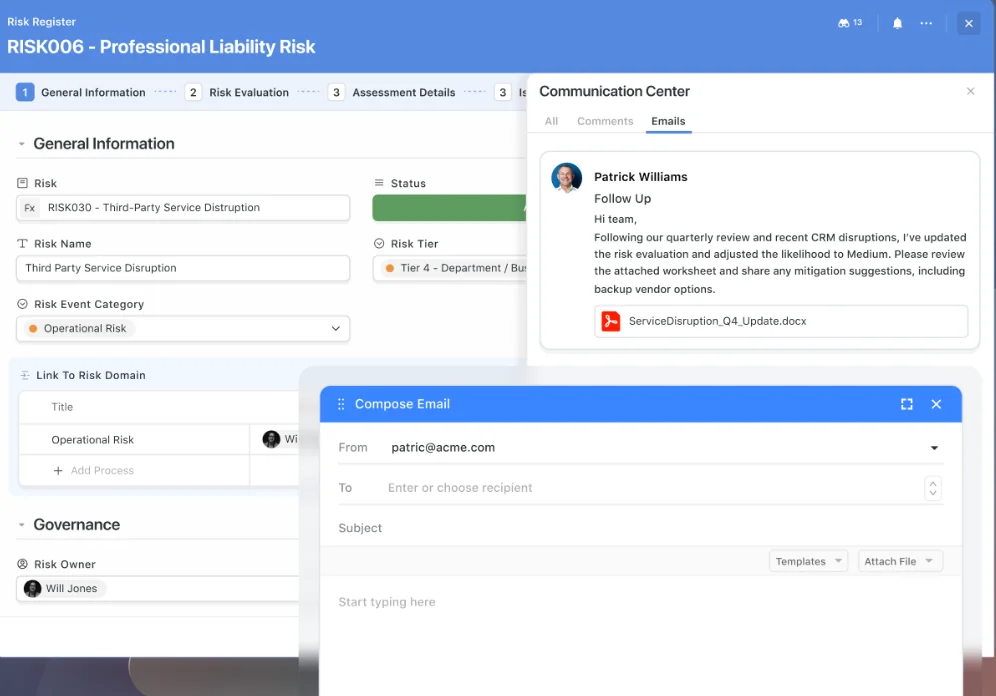
- Turn conversations into action by converting comments into tasks, approvals, or workflow updates with a click.
- Maintain full transparency with complete activity history tracking every comment, change, and decision for onboarding, reviews, or audits.
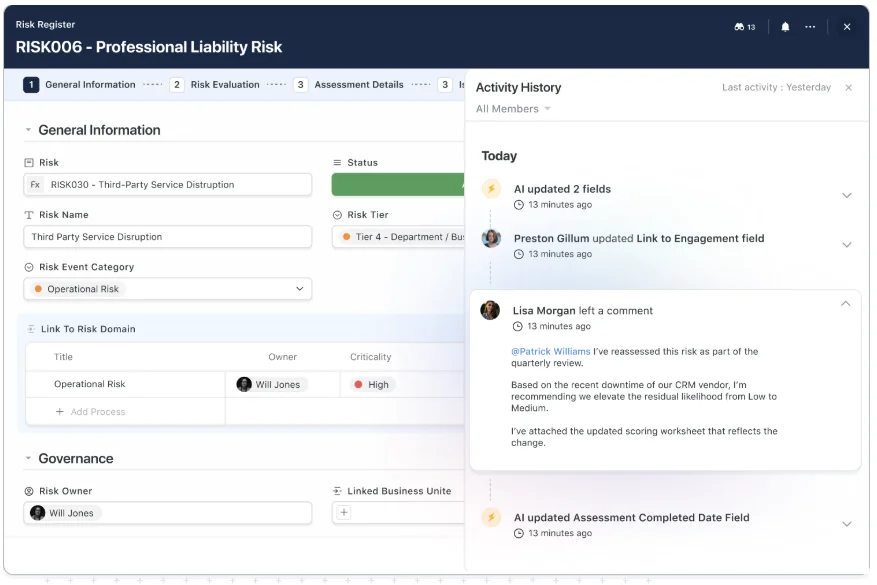
- Stay informed without noise through role-based notifications in Slack or Microsoft Teams, while SmartSuite remains the source of truth.
4. AI woven into daily work
SmartSuite’s AI is designed to support teams where work actually happens, not as a separate setup tool or planning layer, but as part of everyday execution.
Instead of forcing teams to hand work over to AI, it helps them move faster while staying in control.
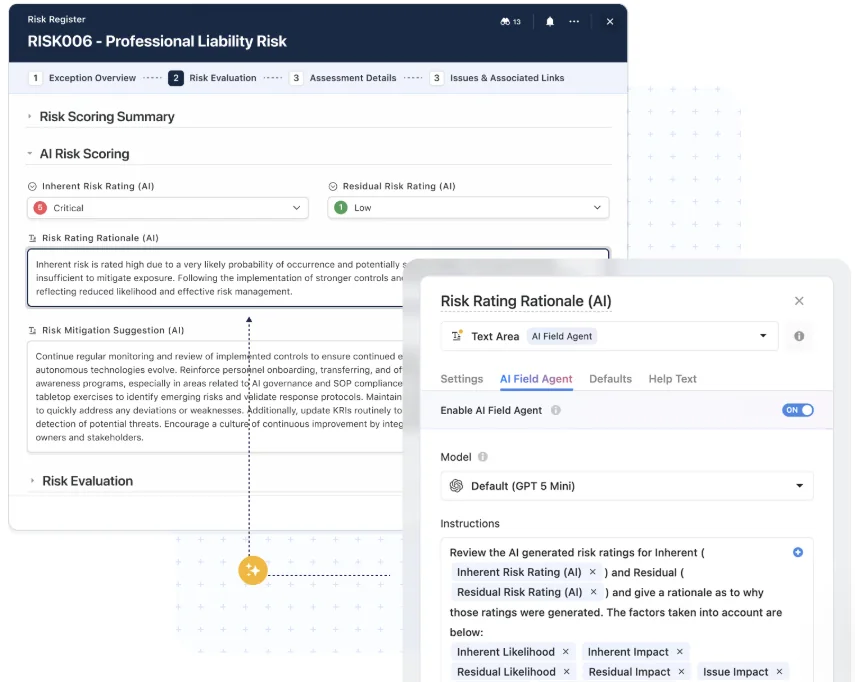
With SmartSuite AI, you can:
- Summarize work instantly by turning long comment threads, updates, or activity histories into clear, shareable status summaries.
- Convert unstructured input into structured records by extracting key details from forms, emails, or requests and automatically populating fields.
- Enhance automation with context-aware AI by analyzing text, intent, or sentiment to route work, suggest next steps, or trigger workflows beyond simple rule logic.
- Maintain data quality at scale by flagging missing information, inconsistencies, or unclear priorities before they create downstream issues.
- Keep humans in the loop by generating suggestions and insights that teams review and approve before changes are applied.
5. Templates and customization without heavy setup
SmartSuite is designed to help you get started quickly without locking you into rigid structures.
Instead of forcing long implementation cycles or starting from a blank workspace, it combines ready-made templates with flexible no-code customization that evolves as work changes.
With it, you can:
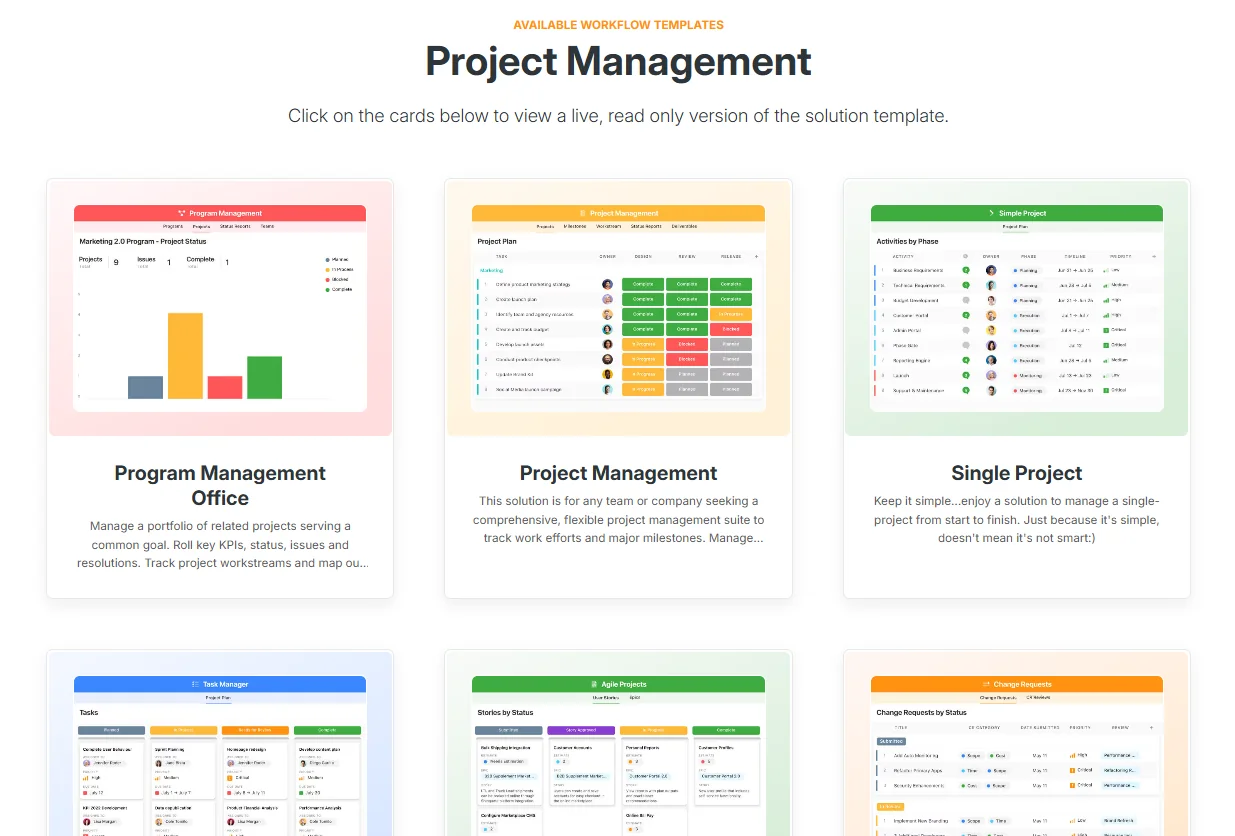
- Start from proven templates for project management, agile delivery, change requests, risk tracking, status reports, and cross-functional operations.
- Customize solutions visually by adding or modifying fields, views, layouts, and workflows without code or technical setup.
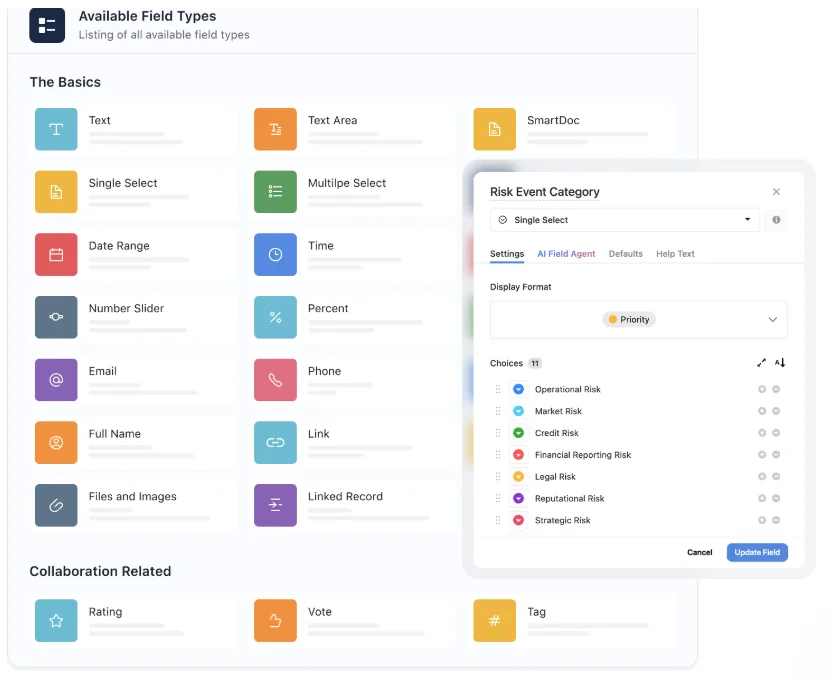
- Control who can view, comment on, or update data based on role or team, keeping collaboration secure as workflows grow.
SmartSuite is ideal if you:
✅ Sit between spreadsheets and enterprise systems and need a flexible platform that can handle projects, processes, and structured data together.
✅ Want to manage real work, including tasks, timelines, risks, requests, and portfolios, without forcing everything into formulas or rigid approval frameworks.
✅ Need no-code automation, in-context collaboration, and AI support that teams can actually use and own day to day.
✅ Value fast setup, reusable templates, and customization that scales without relying heavily on admin or IT support.
SmartSuite isn’t the best option if you:
❌ Depend primarily on advanced spreadsheet modeling and complex formulas as the foundation of how work is managed.
❌ Need deeply specialized, enterprise-grade planning, approval, or governance frameworks tailored specifically to large marketing or creative organizations.
Winner: SmartSuite
When comparing features across Smartsheet, Workfront, and SmartSuite, SmartSuite stands out as the most well-rounded option overall.
It combines flexible record-based work management, no-code automation, in-context collaboration, and AI woven into daily execution, all without requiring heavy setup or ongoing administration.
Integrations: how do Smartsheet, Workfront and SmartSuite compare?
Smartsheet integrations
Smartsheet offers a wide integration ecosystem designed to support enterprise-scale work management across multiple systems and teams.
Its integrations are organized into several key categories, each serving a distinct role in connecting work across the business:
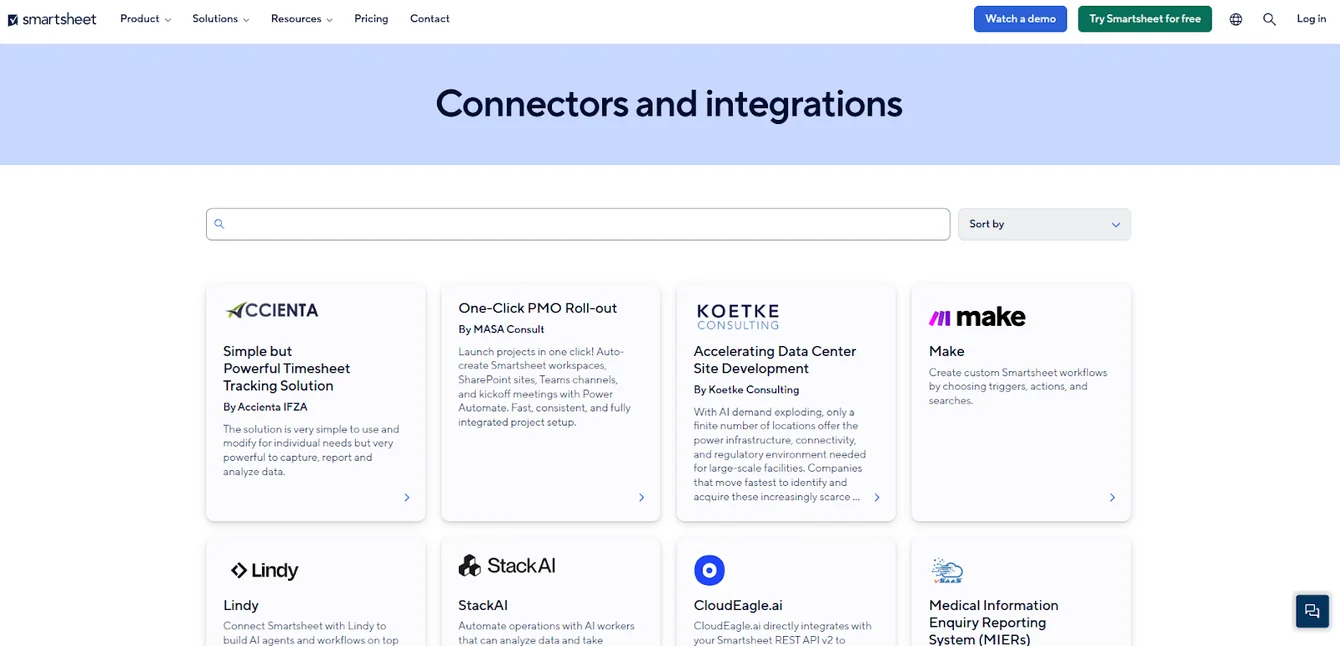
- Enterprise systems & operations: Integrations with tools like ServiceNow, Salesforce, Jira, etc., let you sync data from core systems of record.
- AI integrations: Extend Smartsheet’s capabilities by connecting it to Microsoft Copilot, Atlassian Rovo, and others.
- Messaging & communication: Keep teams aligned by pushing updates, alerts, and approvals into the communication tools they already use, such as Slack, Microsoft Teams, etc.
- Content & collaboration: Connect document management and content platforms like Adobe Creative Cloud or Grammarly, so files, assets, and feedback stay accessible and linked to the right work.
- Workflow automation: Integrate with Zapier, UiPath, and others to orchestrate actions across systems, reduce manual handoffs, and keep processes moving.
- Security & governance: Support enterprise requirements with integrations that help enforce access controls, compliance, and data governance across connected tools.
Together, these integration categories make Smartsheet a strong fit for organizations that need their work management platform to operate as part of a broader enterprise ecosystem.
Workfront integrations
Adobe Workfront’s integrations are built around deep alignment with the Adobe ecosystem and enterprise-scale workflow orchestration.
Rather than offering a broad set of lightweight native integrations, Workfront focuses on tightly connecting planning, execution, and content creation across Adobe products.
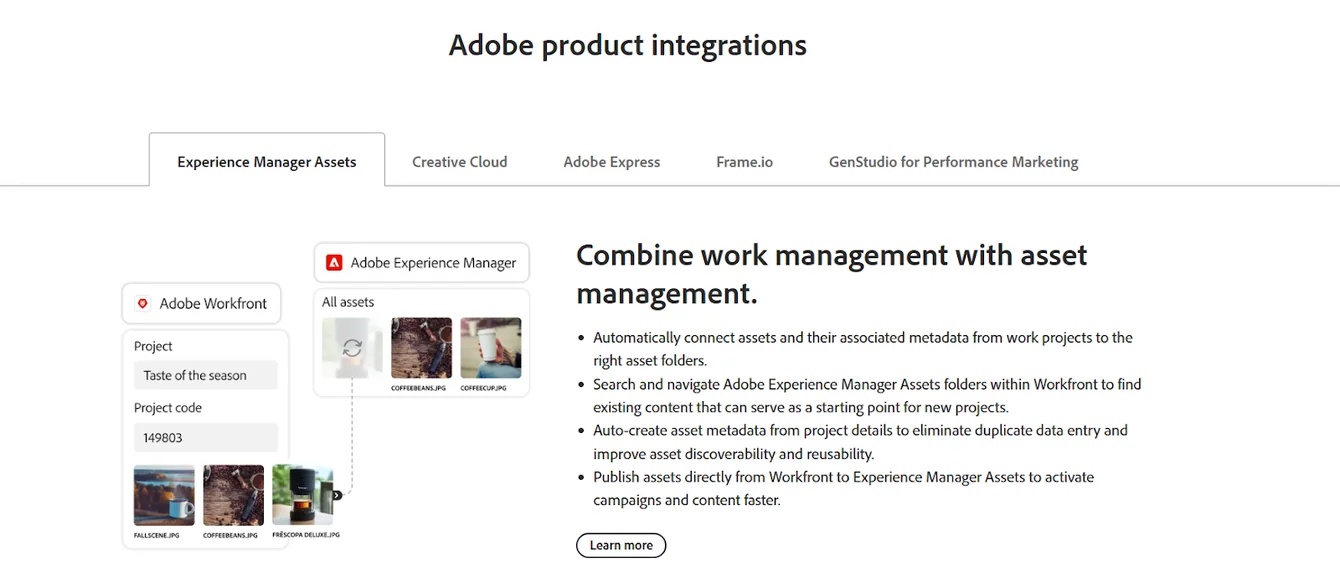
Here’s what it looks like at a glance:
- Adobe product integrations: Workfront integrates natively with Adobe tools like Experience Manager Assets, Creative Cloud, Adobe Express, Frame.io, and GenStudio for Performance Marketing. This allows teams to link projects directly to assets, sync metadata automatically, manage reviews, and activate content faster within a unified content supply chain.
- Collaboration tools: Native integrations with Slack and Microsoft Teams push updates, approvals, requests, and alerts directly into team conversations.
- Design tools: Integrations with tools like Figma help sync design changes, trigger reviews, and create tasks from comments or file updates.
For most third-party tools outside the Adobe ecosystem, though, Workfront relies on Workfront Fusion - a low-code integration platform that connects Workfront to hundreds of business applications via prebuilt connectors or public APIs.
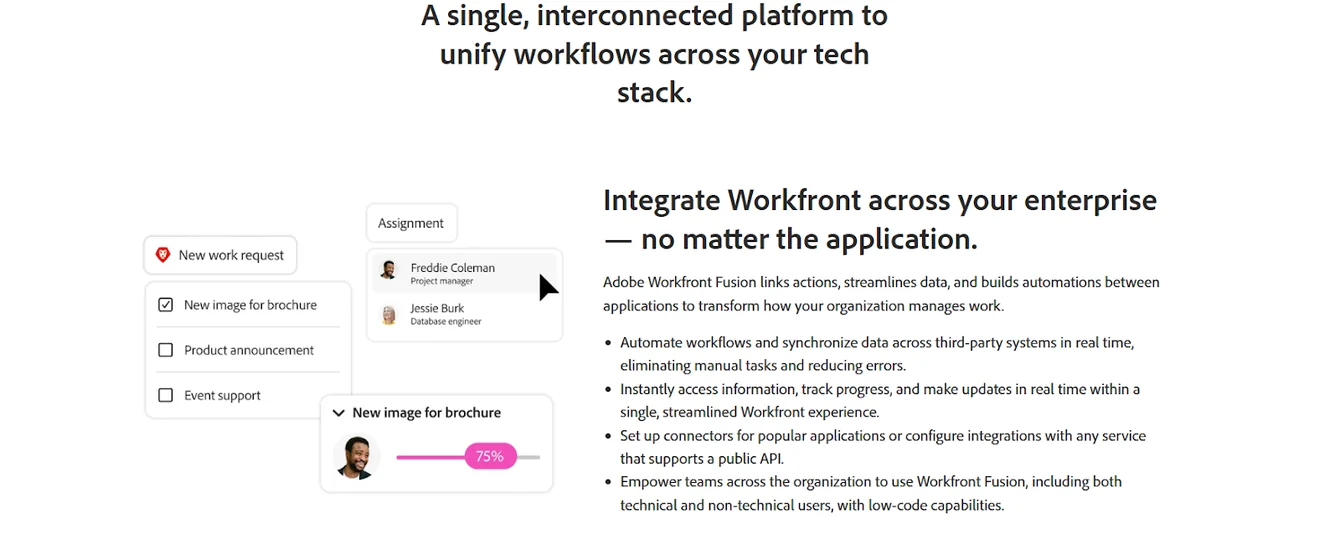
Fusion enables real-time data sync, cross-system automation, and complex workflow orchestration, but adds an additional layer of configuration and ownership.
Overall, Workfront integrations are strongest for organizations deeply invested in Adobe products and willing to manage integrations through a dedicated automation layer.
SmartSuite integrations
SmartSuite’s integration framework is designed to support end-to-end workflows without forcing teams into complex setup or enterprise-only tooling.
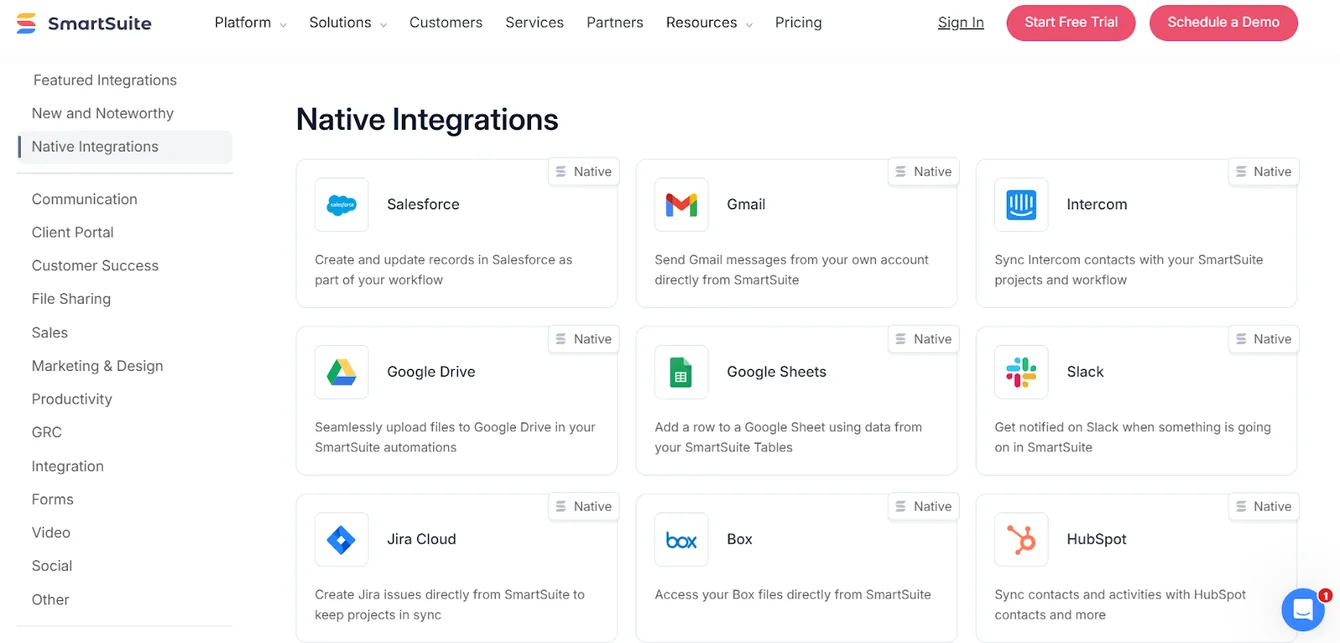
It combines native integrations, no-code connectors, and developer-friendly APIs so organizations can connect systems at the level that fits them best:
- Native integrations: SmartSuite includes a solid range of out-of-the-box integrations with communication tools, CRMs, service platforms, marketing and design solutions, AI providers, etc., allowing you to keep everything in sync without writing code.
- iPaaS and connectors: SmartSuite works with platforms like Make, Zapier, Microsoft Power Automate, Relay, and others, allowing teams to orchestrate multi-step workflows across thousands of SaaS tools using familiar visual builders.
- REST API and webhooks: For more advanced needs, SmartSuite offers a full REST API and webhooks to read and write records programmatically, react to events, and embed SmartSuite into internal tools or applications.
Overall, SmartSuite strikes a balance between simplicity and power, offering broad connectivity without requiring a separate integration platform like Workfront Fusion or heavy enterprise configuration.
Winner: Smartsheet
Smartsheet wins on integrations due to its larger number of native, out-of-the-box integrations across enterprise systems, analytics tools, communication platforms, automation, and governance. It fits naturally into complex tech stacks without requiring an additional integration layer.
Workfront shines inside the Adobe ecosystem but depends heavily on Workfront Fusion for broader connectivity, while SmartSuite offers flexible connectors and APIs with fewer native integrations.
Pricing: Smartsheet vs. Workfront vs. SmartSuite
Smartsheet pricing
Smartsheet offers several pricing tiers designed to scale from small teams to large enterprises:
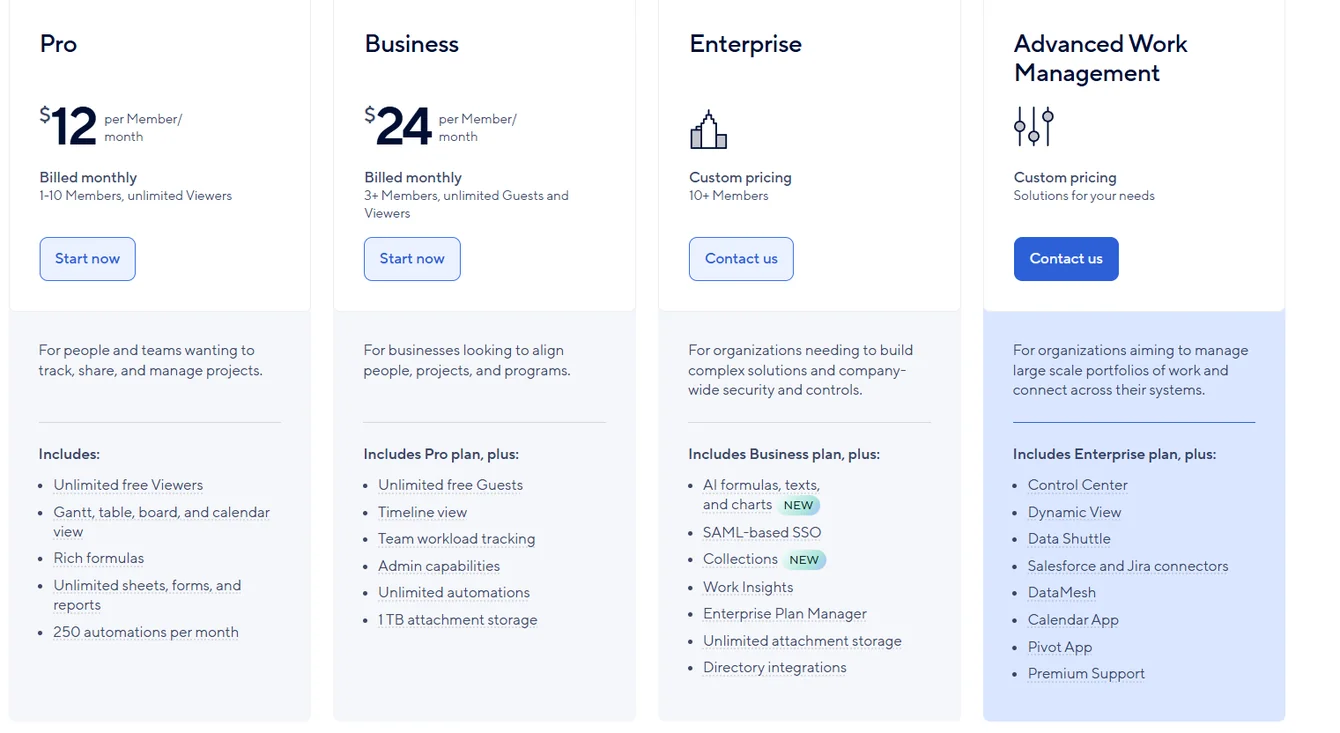
- Pro: $12 per user/month, for 1-10 users, includes Gantt, table, board, and calendar views, rich formulas, unlimited sheets, forms, and reports, plus 250 automations per month.
- Business: $24 per member/month, for minimum 3 members, includes everything in Pro, plus timeline view, team workload tracking, stronger admin controls, unlimited automations, and 1 TB of attachment storage.
- Enterprise: Custom pricing, for teams with more than 10 members that need advanced security and governance controls, includes everything in Business, plus AI-powered formulas, text, and charts, SAML-based SSO, directory integrations, unlimited storage, Work Insights, and enterprise-level management tools.
- Advanced Work Management: Custom pricing, designed for organizations managing large portfolios and complex, cross-system workflows. Includes everything in Enterprise, plus control center, dynamic view, data shuttle, DataMesh, calendar and pivot apps, Salesforce and Jira connectors, and premium support.
Workfront pricing
Adobe Workfront uses a tiered, enterprise-focused pricing model built around three main plans: Select, Prime, and Ultimate.
However, Adobe doesn’t publish pricing for any of the tiers, meaning you’ll have to contact its sales directly for more details.
All tiers include core work management features such as task tracking, demand intake, reporting, collaboration, integrations, and review and approval workflows:
- Select: Covers essential collaboration and execution features, with limited enterprise administration, customization, and sandbox access.
- Prime: Adds full portfolio management, advanced security and compliance controls, and sandbox environments.
- Ultimate: Includes everything in Prime, plus enhanced customization and access to Workfront Fusion and data sync with BI tools.
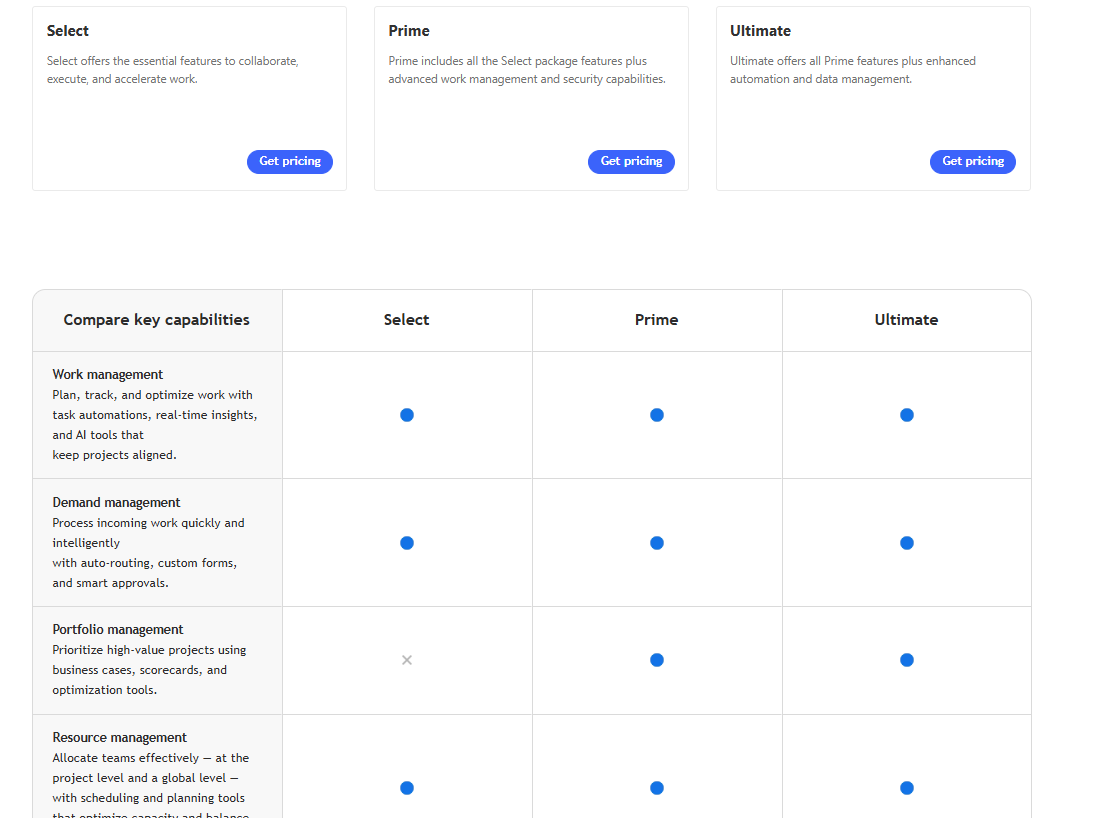
It’s important to note that Workfront Planning is not included by default in any of the core plans and is priced as an optional add-on.
Workfront Fusion can also be added to the first two tiers at an extra cost.
Overall, Workfront pricing is designed for large organizations that need enterprise-grade control and are comfortable with custom pricing and modular add-ons rather than transparent per-user plans.
SmartSuite pricing
SmartSuite follows a transparent pricing model with plans that scale alongside your team’s needs.
You can try it free for 14 days - no credit card required - before choosing a tier.
Here’s a closer look at the available options:

- Team: $15/user/month billed annually ($20 billed monthly, minimum 3 users), includes SmartSuite AI, unlimited solutions, up to 5,000 records per solution, 50 GB of file storage, a 30-day recycle bin, and core collaboration and automation features.
- Professional: $32/user/month billed annually ($36 billed monthly, minimum 5 users), includes everything in Team, plus folders, Gmail and Outlook integrations, advanced permissions, higher record limits (100,000 per solution), 100 GB of storage, and a 45-day recycle bin.
- Enterprise: Custom pricing with no seat minimum, includes everything in Professional, plus SSO, SCIM user provisioning, audit logs, IP restrictions, data loss prevention, European data residency, premium support, and higher limits (400,000 records per solution and 500 GB storage).
- Signature: Custom pricing. A tailored plan for organizations with specific requirements around scale, security, or data architecture.
Winner: SmartSuite
SmartSuite stands out with clear, published per-user pricing, generous feature access across tiers, and no mandatory add-ons for core functionality.
With a free 14-day trial and predictable scaling from Team to Enterprise plans, it’s the most approachable and cost-effective option for teams that want strong capabilities without pricing surprises.
Smartsheet starts affordably, but costs can rise quickly as teams move into higher tiers or need advanced features like Data Shuttle, DataMesh, or enterprise connectors.
Workfront, on the other hand, follows a fully enterprise pricing model with no published rates, modular add-ons, and additional costs for Planning and Fusion, making total spend harder to predict.
What are the customers saying about Smartsheet, Workfront, and SmartSuite?
Key takeaways
- Smartsheet (4.4★ on G2) is loved for its familiar spreadsheet-style workflows, strong collaboration, and practical automation, but users often flag rising licensing costs, performance issues with large sheets, and a steeper learning curve as teams scale.
- Workfront (4.1★ on G2) excels at visibility, governance, and automation for complex, enterprise workflows (especially within the Adobe ecosystem), but many reviewers cite a heavy UI, steep learning curve, and performance friction at scale.
- SmartSuite (4.8★ on G2) earns the highest satisfaction overall thanks to its intuitive UI, fast onboarding, and flexible customization without complexity, with most complaints centered around the mobile app and advanced features still maturing rather than core usability.
Smartsheet reviews
G2 Rating: 4.4/5
What users love:
- Flexible sheet-based workflows that teams can adapt to their own processes without rigid templates.
- Strong collaboration with real-time updates, comments, attachments, forms, and shared visibility for internal and external stakeholders.
- Useful automation and filtering that reduce manual work and help teams stay organized.
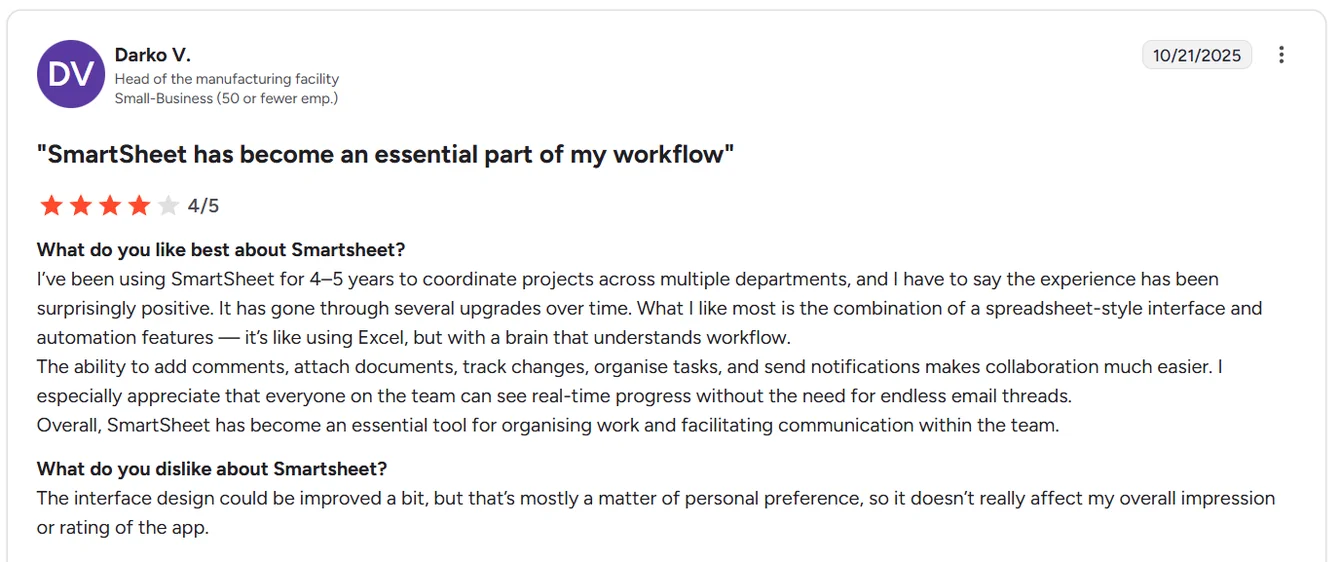
“What I like most is the combination of a spreadsheet-style interface and automation features — it’s like using Excel, but with a brain that understands workflow.
The ability to add comments, attach documents, track changes, organize tasks, and send notifications makes collaboration much easier. I especially appreciate that everyone on the team can see real-time progress without the need for endless email threads.
Overall, Smartsheet has become an essential tool for organizing work and facilitating communication within the team.” - G2 Review
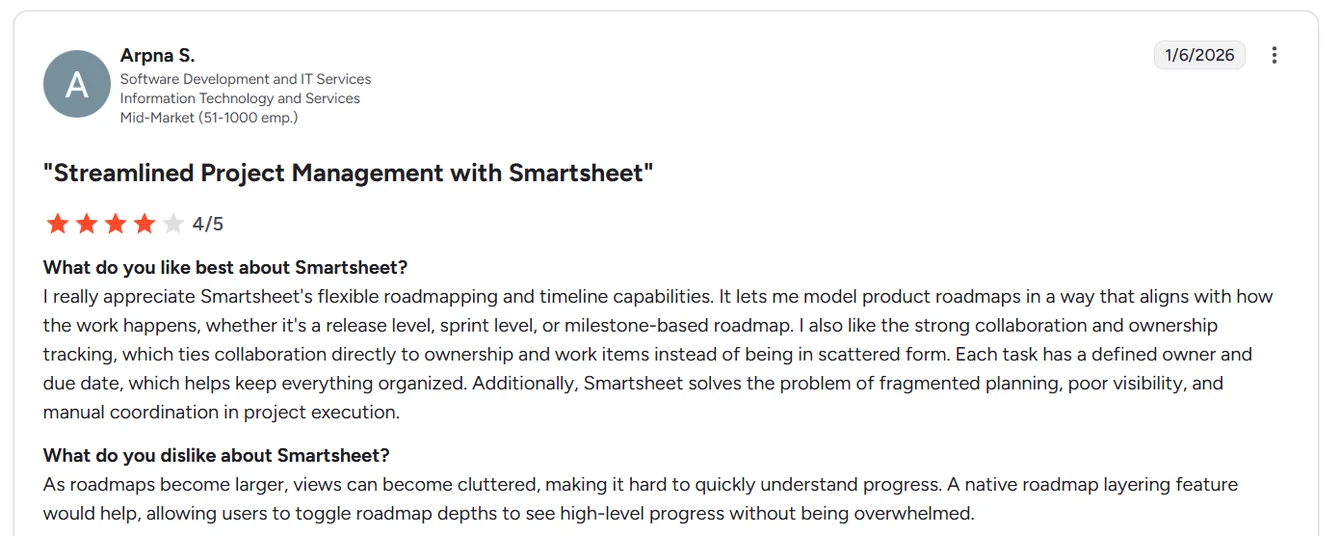
“I really appreciate Smartsheet's flexible roadmapping and timeline capabilities. It lets me model product roadmaps in a way that aligns with how the work happens, whether it's a release level, sprint level, or milestone-based roadmap. I also like the strong collaboration and ownership tracking, which ties collaboration directly to ownership and work items instead of being in scattered form. Each task has a defined owner and due date, which helps keep everything organized. Additionally, Smartsheet solves the problem of fragmented planning, poor visibility, and manual coordination in project execution.” - G2 Review
Common complaints include:
- Licensing and cost increases, particularly after changes to the licensing model that require more paid users, even for light contributors.
- Performance issues with large sheets, including slow load times, glitches, or cluttered views once datasets grow.
- A steeper learning curve for advanced features, such as formulas, automations, dashboards, and premium apps.
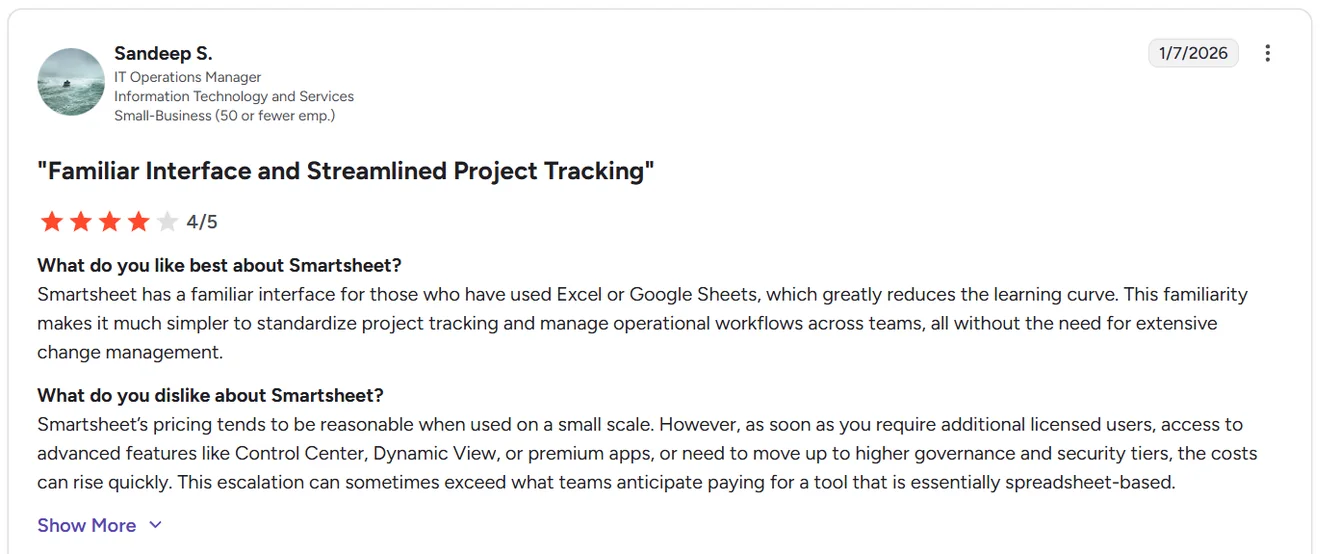
“Smartsheet’s pricing tends to be reasonable when used on a small scale. However, as soon as you require additional licensed users, access to advanced features like Control Center, Dynamic View, or premium apps, or need to move up to higher governance and security tiers, the costs can rise quickly. This escalation can sometimes exceed what teams anticipate paying for a tool that is essentially spreadsheet-based.” - G2 Review
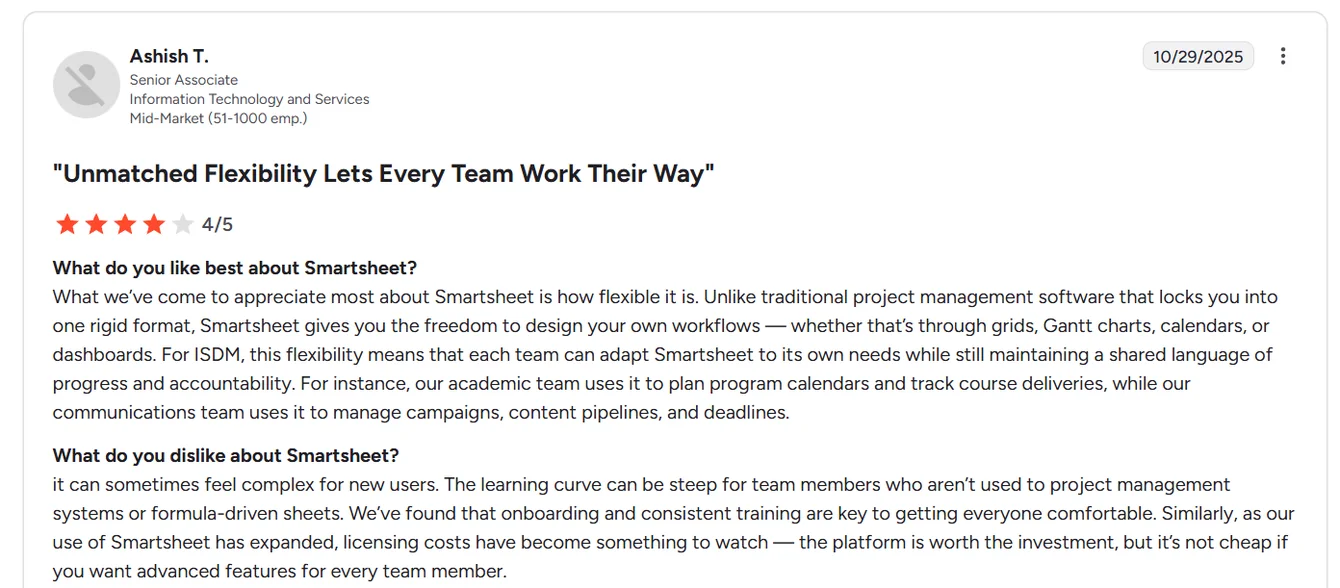
“it can sometimes feel complex for new users. The learning curve can be steep for team members who aren’t used to project management systems or formula-driven sheets. We’ve found that onboarding and consistent training are key to getting everyone comfortable. Similarly, as our use of Smartsheet has expanded, licensing costs have become something to watch — the platform is worth the investment, but it’s not cheap if you want advanced features for every team member.” - G2 Review
Workfront reviews
G2 Rating: 4.1/5
What users love:
- High visibility and accountability, with detailed reporting, dashboards, ownership tracking, and real-time status updates.
- Automation with Workfront Fusion, especially for repetitive tasks and cross-system workflows.
- Deep Adobe ecosystem alignment, particularly for creative, marketing, and content operations.
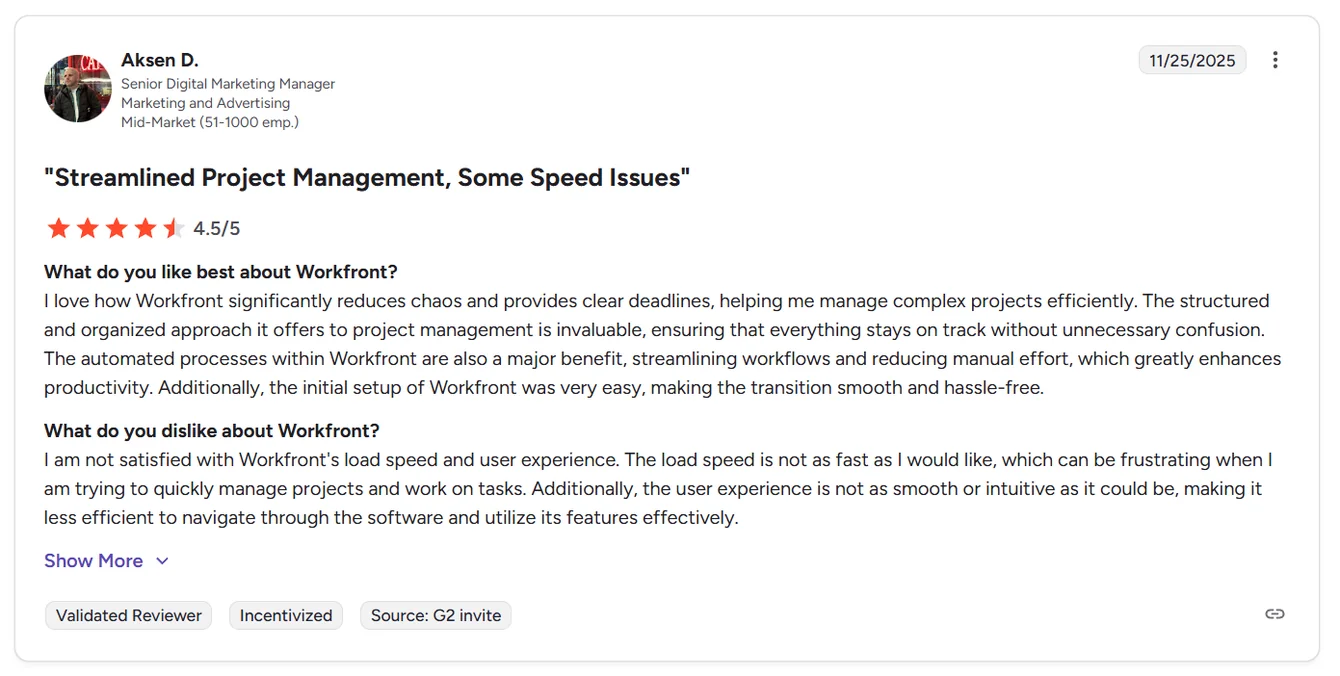
“I love how Workfront significantly reduces chaos and provides clear deadlines, helping me manage complex projects efficiently. The structured and organized approach it offers to project management is invaluable, ensuring that everything stays on track without unnecessary confusion. The automated processes within Workfront are also a major benefit, streamlining workflows and reducing manual effort, which greatly enhances productivity. Additionally, the initial setup of Workfront was very easy, making the transition smooth and hassle-free.” - G2 Review
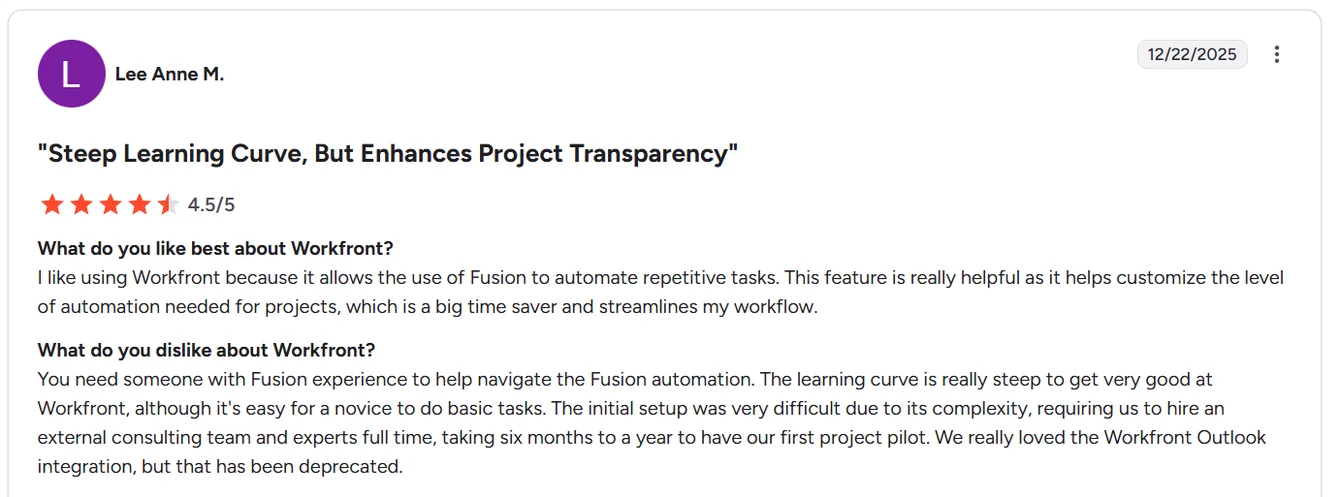
“I like using Workfront because it allows the use of Fusion to automate repetitive tasks. This feature is really helpful as it helps customize the level of automation needed for projects, which is a big time saver and streamlines my workflow.” - G2 Review
Common complaints include:
- Steep learning curve, especially for advanced configuration, reporting, and Fusion-based automation, often requiring dedicated admins or external consultants.
- Outdated or heavy UI, with limited visual customization and workflows that can feel click-heavy or unintuitive for new users.
- Performance issues at scale, including lag during bulk updates or in large projects.
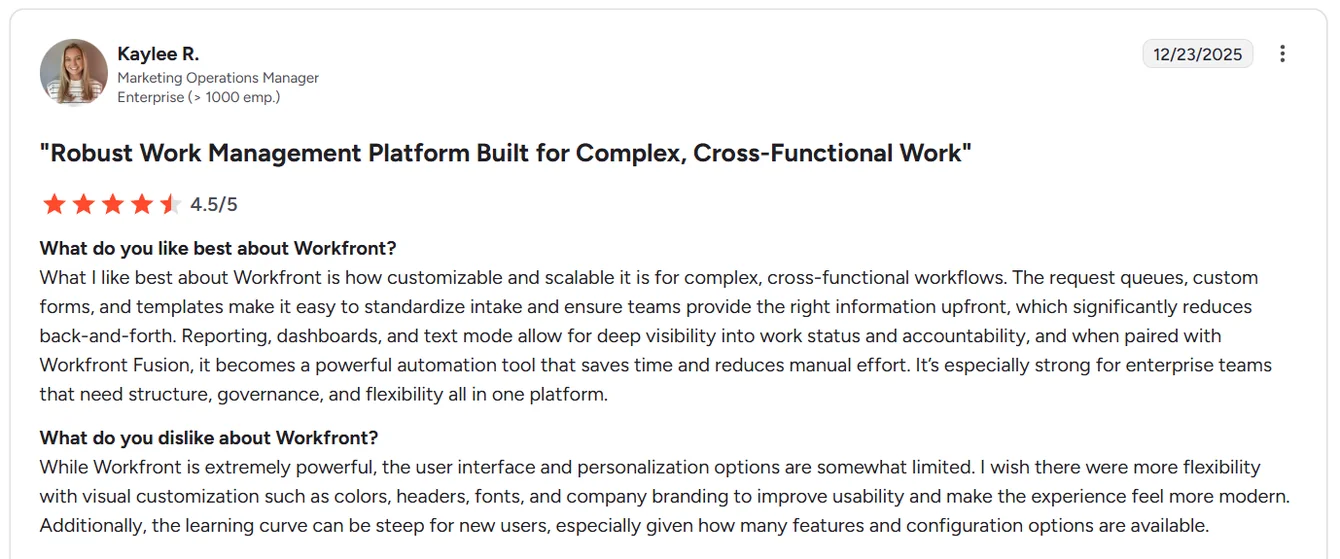
“While Workfront is extremely powerful, the user interface and personalization options are somewhat limited. I wish there were more flexibility with visual customization such as colors, headers, fonts, and company branding to improve usability and make the experience feel more modern. Additionally, the learning curve can be steep for new users, especially given how many features and configuration options are available.” - G2 Review
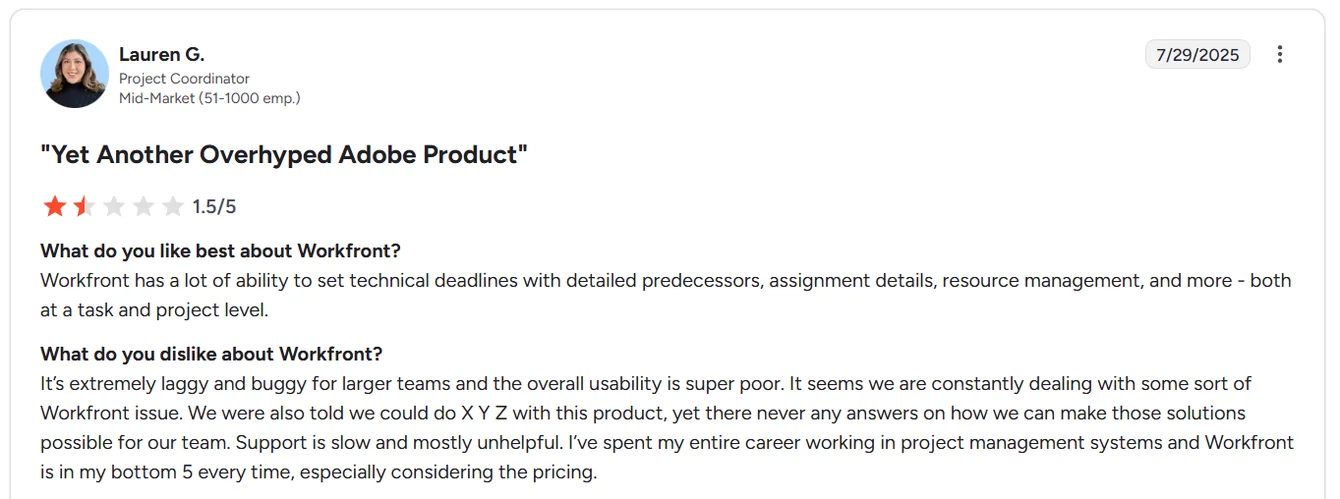
“It’s extremely laggy and buggy for larger teams and the overall usability is super poor. It seems we are constantly dealing with some sort of Workfront issue. We were also told we could do X Y Z with this product, yet there never any answers on how we can make those solutions possible for our team. Support is slow and mostly unhelpful. I’ve spent my entire career working in project management systems and Workfront is in my bottom 5 every time, especially considering the pricing.” - G2 Review
SmartSuite reviews
G2 Rating: 4.8/5
What users love:
- Intuitive UI and fast onboarding, with minimal training needed for most teams.
- Strong customization without complexity, allowing teams to tailor workflows, templates, and layouts to match how they actually work.
- Automation that saves time, especially for teams consolidating processes from tools like Trello and spreadsheets.
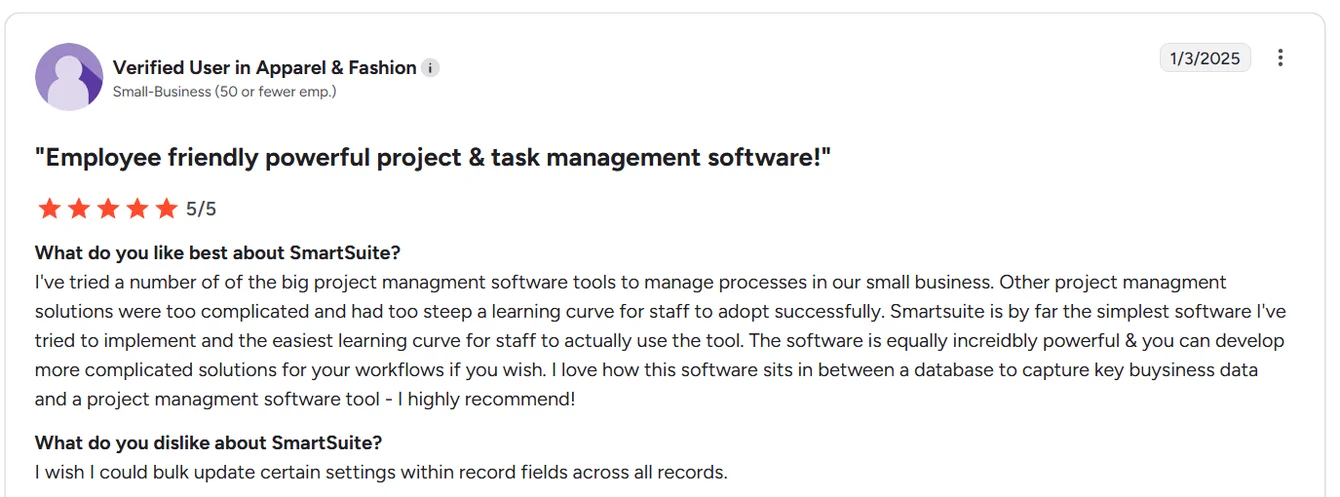
“I've tried a number of the big project management software tools to manage processes in our small business. Other project management solutions were too complicated and had too steep a learning curve for staff to adopt successfully. Smartsuite is by far the simplest software I've tried to implement and the easiest learning curve for staff to actually use the tool. The software is equally incredibly powerful & you can develop more complicated solutions for your workflows if you wish. I love how this software sits in between a database to capture key business data and a project management software tool - I highly recommend!” - G2 Review
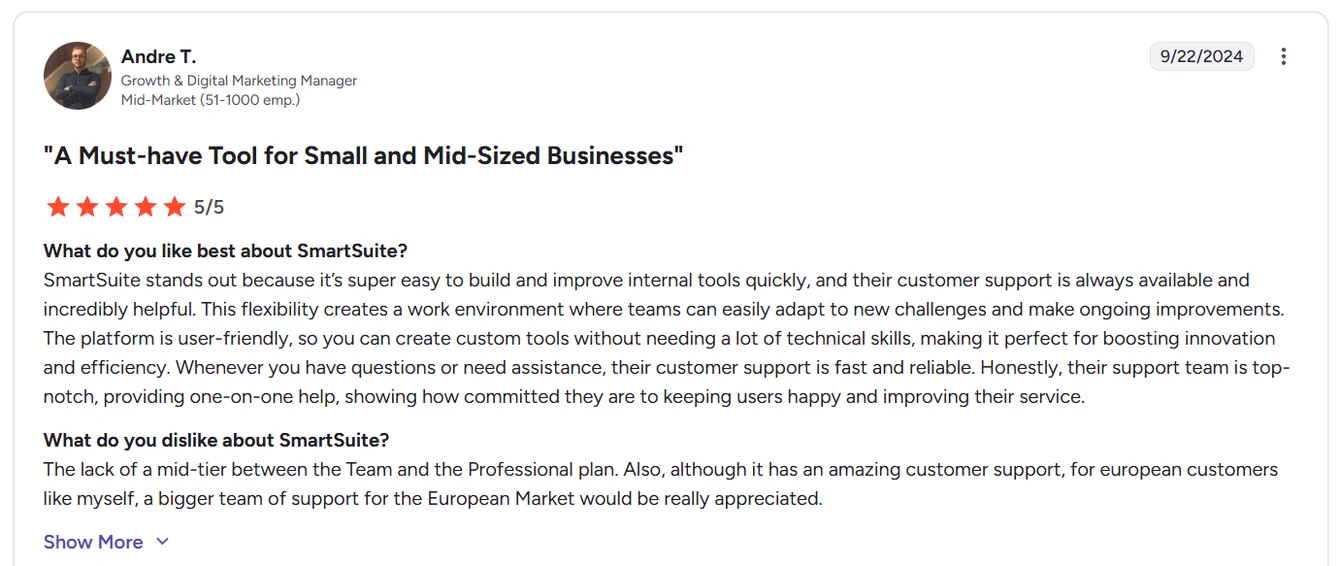
“SmartSuite stands out because it’s super easy to build and improve internal tools quickly, and their customer support is always available and incredibly helpful. This flexibility creates a work environment where teams can easily adapt to new challenges and make ongoing improvements. The platform is user-friendly, so you can create custom tools without needing a lot of technical skills, making it perfect for boosting innovation and efficiency. Whenever you have questions or need assistance, their customer support is fast and reliable. Honestly, their support team is top-notch, providing one-on-one help, showing how committed they are to keeping users happy and improving their service.” - G2 Review
Common complaints include:
- Mobile app experience isn’t as polished as desktop.
- Feature depth still evolving, particularly around more advanced automation capabilities and integrations some teams expect.
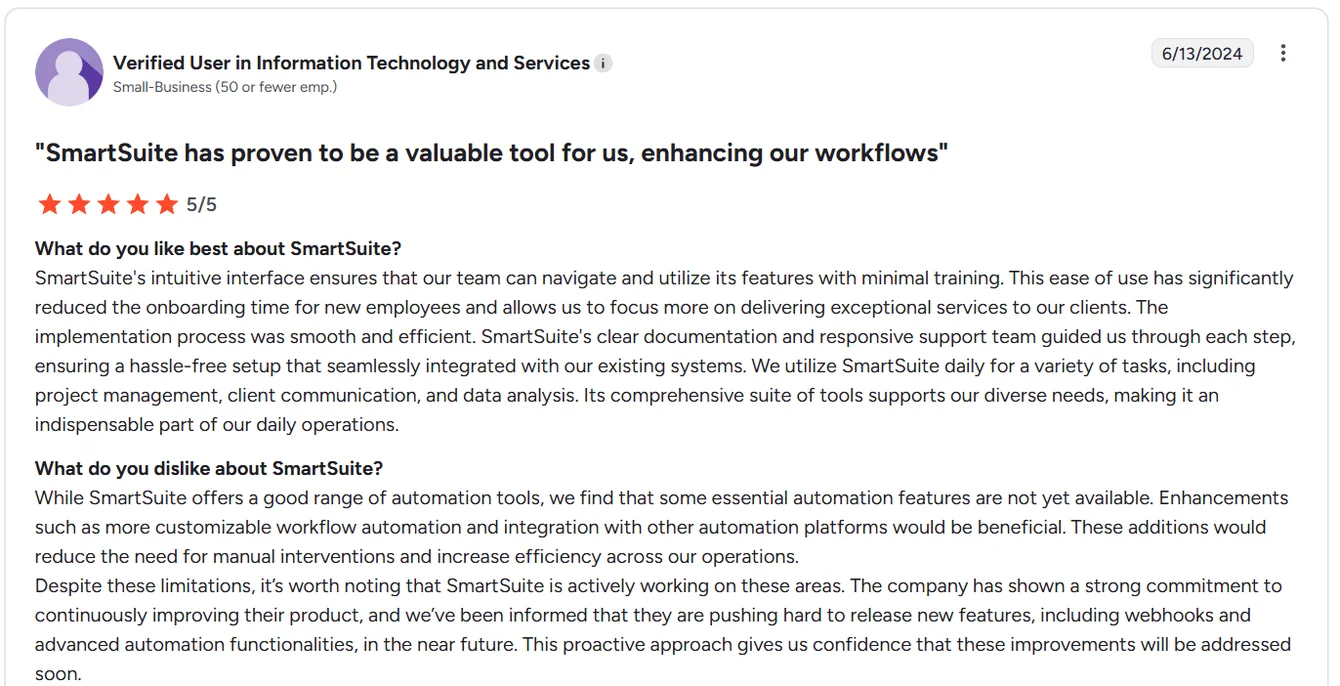
”While SmartSuite offers a good range of automation tools, we find that some essential automation features are not yet available. Enhancements such as more customizable workflow automation and integration with other automation platforms would be beneficial. These additions would reduce the need for manual interventions and increase efficiency across our operations.
Despite these limitations, it’s worth noting that SmartSuite is actively working on these areas. The company has shown a strong commitment to continuously improving their product, and we’ve been informed that they are pushing hard to release new features, including webhooks and advanced automation functionalities, in the near future. This proactive approach gives us confidence that these improvements will be addressed soon.” - G2 Review
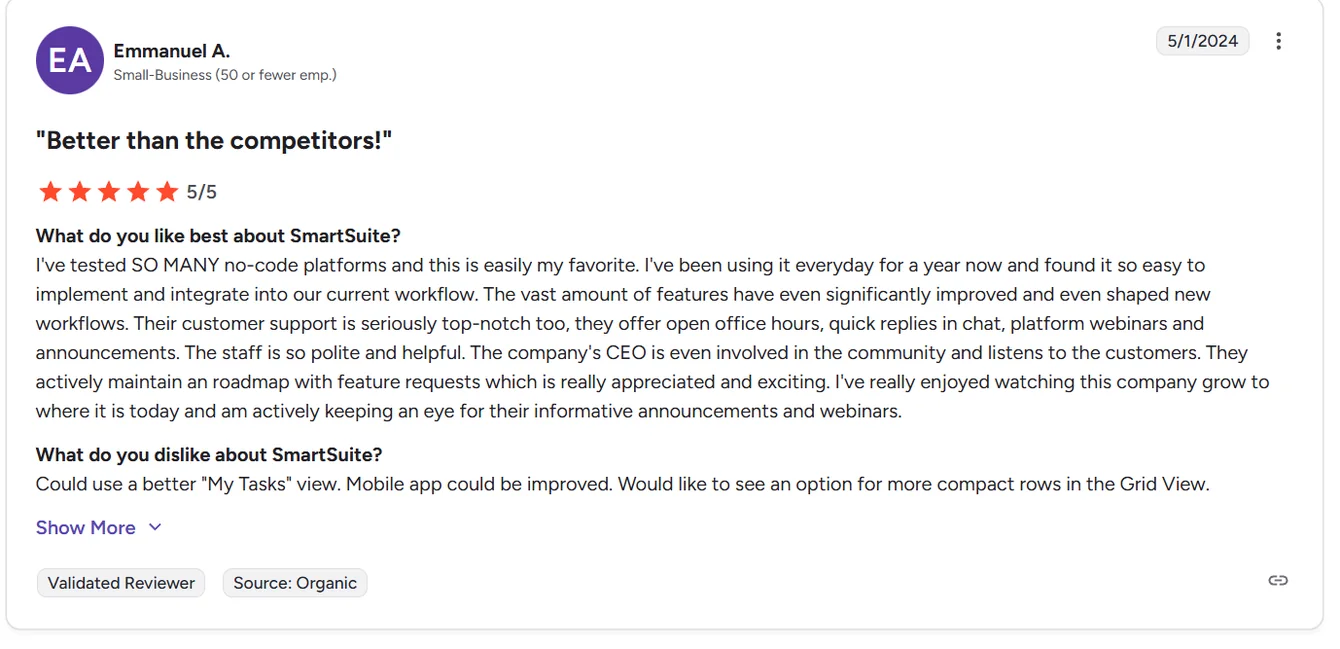
“Could use a better "My Tasks" view. Mobile app could be improved. Would like to see an option for more compact rows in the Grid View.” - G2 Review
Smartsheet vs. Workfront vs. SmartSuite: which should you choose?
| Feature | Smartsheet | Adobe Workfront | SmartSuite |
|---|---|---|---|
| G2 rating | ★ 4.4 / 5 | ★ 4.1 / 5 | ★ 4.8 / 5 |
| Best for | Teams managing data-heavy projects that benefit from spreadsheet-style control, formulas, and reporting | Large enterprises running complex, cross-functional marketing or creative operations that need governance and control | Teams that want a flexible, all-in-one work management platform for real execution without spreadsheets or enterprise overhead |
| Standout feature | Spreadsheet-based project management with formulas, dashboards, and automation | Enterprise-grade planning, intake, approvals, and portfolio visibility, deeply integrated with Adobe’s ecosystem | Balanced work management: record-based execution, no-code automation, in-context collaboration, and AI woven into daily workflows |
| Integrations | Broad native integration ecosystem across enterprise systems, analytics, automation, and governance tools | Deep native Adobe integrations; third-party tools connected primarily via Workfront Fusion | Native integrations plus no-code connectors (Zapier, Make, Power Automate) and a full REST API |
| Free tier | ❌ No (free trial available) | ❌ No free plan or self-serve trial | ❌ No free plan, but 14-day free trial |
| Starts from | $12/user/month | Custom pricing (contact sales) | $15/user/month |
Get started with SmartSuite for free today
Smartsheet and Workfront represent two very different philosophies of work management: spreadsheet-driven execution versus enterprise-grade planning and control.
The challenge is that most teams don’t work exclusively in either mode.
That’s exactly where SmartSuite steps in.
SmartSuite brings projects, processes, data, automation, collaboration, and AI into a single, flexible workspace that adapts as work evolves without forcing spreadsheet logic or long implementation cycles.
It’s capable enough to handle complex workflows, yet intuitive enough for teams to get value quickly.
If you’re looking for a modern work management platform that’s easy to adopt, scales with your needs, and helps teams actually execute, SmartSuite is worth a closer look.
Start a free 14-day SmartSuite trial for hands-on experience (no credit card required), or book a demo to see how it fits your workflows with some expert guidance.
Read more
- 10 Best Project Management Tools & Software In 2026 [Reviewed] - A practical, no-fluff breakdown of the project management tools that actually help teams plan, execute, and scale in 2026.
- Creative Project Management: Everything You Need To Know - Learn how creative teams can manage fast-moving projects, approvals, and feedback without killing momentum or creativity.
- 6 Steps To Create a Project Management Workflow (2026) - A clear, step-by-step guide to building a project workflow that keeps work moving instead of getting stuck in the process.
- Smartsheet vs. Zoho Projects vs. SmartSuite: Which Tool to Pick? [2026] - A side-by-side comparison of three popular platforms and how to choose the right one based on how your team actually works.
- 10 Best Agile Project Management Tools & Software for 2026 - The top agile tools that help teams ship faster, stay aligned, and adapt without constant rework.
- Monday.com vs. Pipedrive vs. SmartSuite: Which Project Management Tool Wins? (2026) - An honest comparison of three very different tools, and which one makes sense depending on your workflow, not the marketing.






Put these ideas to work
Start a free trial, or book a demo and see how it runs in SmartSuite.

