

There is perhaps no relationship more essential to the strength of a financial institution than the one between the CISO and the board.
It is the relationship that determines how cyber risk is understood, how decisions are made, and ultimately how effectively an organization prepares for and withstands disruption.
Yet for decades, this relationship has been strained not by intent or capability, but by language.
Cyber leaders speak in vulnerabilities, threat surfaces, operational dependencies, zero-days, and incident severities.
Boards speak in business continuity, operational loss, regulatory scrutiny, systemic exposure, and enterprise risk.
Both sides are describing the same reality, but they often do so using vocabularies born from different eras, shaped by different disciplines, and supported by different tools.
The result is a translation gap that slows decisions, obscures priorities, and limits the organization’s ability to govern risk with confidence.
Across my career, working with global banks, mid-sized institutions, credit unions, and fast-growing fintech companies, I’ve seen this gap manifest in hundreds of conversations.
I’ve watched brilliant CISOs struggle to convey the urgency of a technical risk in a way that resonates at the board level.
I’ve watched boards try to interpret cyber data that was never designed for executive consumption. And I’ve watched organizations spend enormous effort transforming raw security indicators into meaningful governance insight.
The issue has never been expertise; it has always been communication.
And that communication depends on one thing: a shared risk language.
Why Language Is the Foundation of Effective Cyber Governance
Cyber risk is no longer a technical domain. It is an enterprise risk, a regulatory concern, and a business continuity priority.
Board members increasingly serve in active oversight roles, and regulators now expect meaningful involvement from senior leadership and directors in assessing and directing cyber posture.
Yet these expectations assume something the industry has never truly had: a unified method for describing and evaluating cyber maturity in business terms.
For years, organizations tried to solve this problem through dashboards, hoping visualization alone could create clarity. But charts cannot replace language. And translation cannot replace alignment.
Without shared language, organizations end up with:
- Risk reports that lack context.
- Dashboards that convey activity but not meaning.
- Boards that ask the wrong questions.
- CISOs forced to reframe issues for every audience.
- Leadership conversations that feel circular rather than decisive.
Shared language is not a communication strategy: it is a governance necessity.
The Misalignment That Slows Organizations Down
In many institutions, cyber and board conversations follow a predictable pattern:
The CISO presents severity levels, threat vectors, or vulnerability counts, accompanied by charts generated from monitoring tools.
The board, meanwhile, seeks clarity on business impact, operational readiness, remediation confidence, and regulatory exposure.
Both are looking at the same risk, but they are speaking past one another.
I’ve sat in rooms where CISOs described “medium-severity infrastructure vulnerabilities” while board members urgently asked whether the issue could interrupt customer services.
I’ve seen boards request “control assurance summaries” when CISOs believed they were already providing exactly that, just in technical form.
These misalignments are not misunderstandings; they are symptoms of a missing structure, the lack of a shared language that aligns cybersecurity concepts with governance concepts.
Why the CRI Profile Has Become a Breakthrough
The development of a shared risk language is not theoretical. One of the most important developments in the last decade has been the work of the Cyber Risk Institute (CRI).
What makes the CRI Profile so transformative is not simply its harmonization of regulatory requirements, it is the diagnostic structure that sits behind it. CRI’s diagnostic statements translate cybersecurity, technology risk, third-party risk, and operational resilience expectations into measurable, maturity-based language that:
- CISOs can operationalize.
- Risk teams can evaluate.
- Audit can test.
- Regulators can interpret.
- And boards can understand.
It is the first truly portable language of cyber governance.
In conversations across top financial institutions, I’ve heard leaders describe how CRI has become the backbone of their board discussions, not because it simplifies risk, but because it standardizes it.
When cyber maturity is expressed through structured diagnostic statements, the conversation shifts from technical details to governance outcomes. Instead of asking, “How many critical vulnerabilities exist?” boards can ask:
- Are our diagnostic areas improving or stagnating?
- Which domains present the greatest risk to resilience?
- How does our maturity compare to peers and expectations?
- Where are systemic weaknesses crossing multiple functions?
Shared language replaces translation with substance.
What Happens When CISOs and Boards Finally Align
In institutions that build governance around shared risk language, three transformations consistently occur.
1. The conversation becomes strategic, not technical.
Cyber risk is framed through operational impact, business continuity, and systemic dependencies.
2. Remediation becomes prioritized around outcomes.
Instead of tracking endless lists of technical issues, teams focus on the areas that most influence resilience.
3. Decisions accelerate.
Boards can evaluate posture, resource needs, and readiness without requiring multiple layers of interpretation.
I’ve witnessed these transformations firsthand. Organizations that once spent weeks preparing cyber reports now frame their governance discussions around true maturity measures.
CISOs who once struggled to convey urgency can now articulate it through a structure designed for business leaders. Boards who once felt uncertain now engage with confidence, clarity, and accountability.
Shared language is not a communication enhancement; it is a performance driver.
Why SmartSuite Is Becoming the Operational Layer for Shared Language
Shared language becomes powerful only when it becomes operational.
Frameworks like CRI provide the structure, but platforms must bring that structure into daily workflows.
This is where SmartSuite has been intentionally designed to excel.
Because SmartSuite is workflow-native, diagnostic statements do not remain conceptual. They become:
- Automation triggers.
- Maturity indicators.
- Evidence anchors.
- Issue categories.
- Remediation drivers.
- Board-level reporting attributes.
SmartSuite operationalizes shared language by weaving it into every aspect of cyber and GRC workflows, making it natural for CISOs, risk teams, and boards to navigate the same information from their own vantage points while maintaining alignment with one another.
Shared risk language becomes shared operational truth.
Conclusion: Language Is Infrastructure
Every transformation in risk management begins with a shift in understanding.
Technology enables it.
Frameworks shape it.
But language, shared, consistent, structured language, is what makes it sustainable.
When CISOs and boards speak the same language:
- Decision-making accelerates.
- Confidence grows.
- Reporting strengthens.
- Remediation becomes more purposeful.
- Resilience becomes more achievable.
Shared language is not the final step of maturity; it is the foundation upon which modern cyber governance rests.
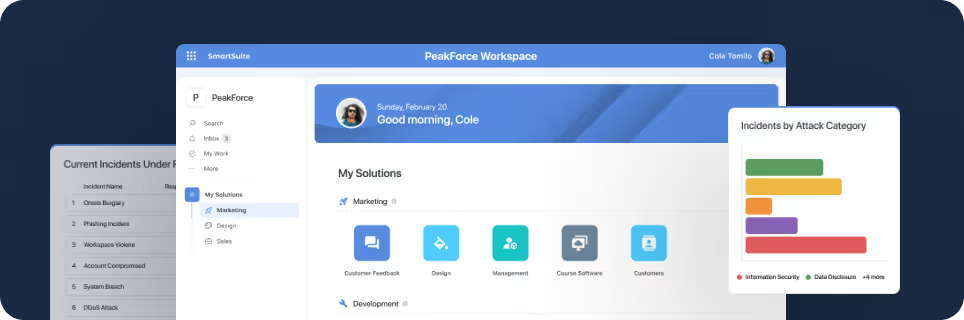
SmartSuite provides work platform for standardizing workflows in the following areas:
- Governance, Risk & Compliance
- IT & Service Ops
- Project / Portfolio Management
- Business Operations