

For nearly two decades, organizations have attempted to modernize risk, compliance, cybersecurity, and operational resilience through a patchwork of tools.
Some were built for assessments, some for evidence, some for monitoring, some for audit, some for continuity, some for vendors. Each tool was useful. Each solved a local problem. But together, they created an architectural reality that has become one of the industry’s biggest obstacles to transformation.
Institutions ended up with applications, not architecture.
And applications don’t scale governance. Architecture does.
The challenge is that most GRC, cyber, and resilience platforms were built around fixed modules. They assumed a world where risk categories were stable and processes were predictable.
But in today’s environment, with hybrid cloud, distributed operations, real-time monitoring, expanding vendor ecosystems, and converging global regulations, that foundation breaks down.
Organizations don’t need more modules, forms, or dashboards. They need workflow architecture, something flexible enough to adapt to change, integrated enough to connect teams, and intelligent enough to keep pace with risk.
This piece explores why the workflow layer is becoming the defining competitive advantage in modern governance, and why the future belongs to platforms that treat architecture, not features, as the product.
The Hidden Flaw in Legacy GRC Design
Most GRC platforms over the last twenty years were built on two assumptions:
- Risk exists in categories: Cyber, compliance, audit, resilience, vendor risk.
- Each category needs its own module: So platforms organized themselves around the category model, building individual modules for IT risk, operational risk, audit, vendor, BCP, compliance, and so on.
But real-world risk has never behaved in categories. It has always behaved in flows.
A vulnerability becomes a resilience issue. A vendor gap becomes a cybersecurity exposure. A control failure becomes an audit observation. A technology outage becomes a governance concern.
Risk moves through the organization as a workflow, not a category.
Yet legacy platforms still reflect the old worldview, forcing teams to:
- Duplicate work across modules.
- Reconcile maturity across categories.
- Reattach evidence for each use case.
- Manually translate one process into another.
These systems don’t break because teams lack capability; they break because the architecture itself is misaligned with the nature of modern risk.
The Shift: From Category-Centric to Workflow-Centric Governance
In every institution I’ve worked with, from top global banks to ambitious fintechs, I’ve observed the same transformation:
Teams are abandoning rigid modules and adopting flexible workflow architectures.
Why?
Because workflows reflect reality:
- They cross teams.
- They connect data.
- They unify evidence.
- They adapt to change.
- They align to processes, not software labels.
- They support maturity models like CRI, DORA, NIST CSF.
- They embed AI and automation naturally.
- They reflect how risk actually moves.
The category-first approach of legacy tools forces organizations to reshape their processes to fit the system. The workflow-first approach allows the system to reflect how the organization really operates.
That difference is architectural, not feature-based, and it changes everything.
Why Architecture Matters More Than Features
Organizations often evaluate platforms based on features:
- Does it have an audit module?
- Does it have a vendor module?
- Does it have a resilience module?
- Does it have automation?
- Does it have dashboards?
But features can be copied. Architecture cannot.
Architecture determines:
- How workflows scale.
- How data connects.
- How maturity is evaluated.
- How evidence moves.
- How fast new processes can be designed.
- How well teams collaborate.
- How deeply frameworks can be integrated.
- How rapidly AI can enhance the system.
- How effectively risk flows across domains.
The workflow layer, not the feature set, is what ultimately determines how well a platform adapts to the next decade of risk.
The platforms winning today are the ones engineered for flexibility, intelligence, and interconnected process flows. The ones losing are those still tied to module-bound logic from the early 2000s.
Why the Workflow Layer Will Win
Here are the structural advantages workflow-native platforms deliver, based on what I’ve seen across dozens of FS institutions:
1. Workflows mirror how risk behaves
Not in categories, but in narratives.
A cyber alert → CRI diagnostic → issue → remediation → evidence → board reporting.
That is a workflow. You cannot do that efficiently inside a category model.
2. Workflows enable rapid adaptation
Regulations change faster than engineering releases. Institutions can’t wait six months for new modules.
Workflow platforms let teams:
- Model new processes.
- Map new frameworks.
- Integrate new signals.
- Adjust diagnostic logic.
…in days, not quarters.
3. Workflows unify teams
Cyber, compliance, risk, audit, and resilience working inside the same system, following the same lifecycle, using the same evidence.
This is impossible in module-based GRC.
4. Workflows operationalize frameworks like CRI
CRI is diagnostic, not modular, which means:
- Diagnostics become automation triggers.
- Evidence aligns naturally.
- Remediation becomes unified.
- Continuous assurance becomes feasible.
- Maturity becomes dynamic.
Only workflow-native platforms can operationalize CRI’s structure in real time.
5. Workflows are the foundation for AI
AI cannot operate effectively in module silos.
It needs:
- Connected data.
- Connected processes.
- Connected evidence.
- Connected logic.
Workflow-native architecture is what makes AI augmentation meaningful, not gimmicky.
6. Workflows reduce total cost of ownership
When everything is a workflow:
- Institutions configure instead of customize.
- Teams collaborate instead of translate.
- Systems integrate instead of compete.
- Assessments reuse evidence instead of recreate.
- Audits evaluate one narrative instead of five.
The architecture pays for itself.
Why SmartSuite Was Designed as a Workflow Engine First, and a GRC Platform Second
SmartSuite wasn’t built to replicate the module-based GRC systems of the past.
It was built to solve the architectural gap that held those systems back.
My unique product DNA, shaped by my experiences as a global partner at EY, founder of ArcherIRM, founder of SmartSuite and more than 25 years working with FS institutions, has led me to a simple belief:
Risk is fundamentally a workflow problem.
Most platforms treat it as a data-entry problem.
SmartSuite reflects this truth through:
- Workflow-native architecture.
- Flexible process modeling.
- Cross-functional visibility.
- Inified evidence flows.
- Diagnostic alignment (CRI, NIST, DORA).
- Automation tied to outcomes.
- AI embedded at the point of work.
- No-code configurability.
- Data connected across domains.
- Real-time maturity movement.
This isn’t a GRC feature set.
It’s a governance architecture.
And architecture is what the next decade will be built on.
What This Means for the Future of GRC
The institutions that win the next era of GRC will be those that:
- Move away from rigid modules.
- Adopt workflow-native systems.
- Embed diagnostics like CRI into daily operations.
- Unify cyber, compliance, audit, resilience, and vendor oversight.
- Embrace continuous assurance.
- Use AI to augment, not replace, human judgment.
- Create a real-time governance narrative.
Platforms that stick to legacy module-centric approaches will struggle to evolve. Platforms that embrace workflows will lead.
The workflow layer will win not because it is elegant, but because it is accurate.
It reflects reality. It supports collaboration. It adapts to change. It aligns to frameworks. It scales across the enterprise. It turns GRC from static reporting into dynamic readiness.
Most importantly, it allows institutions to govern themselves the way risk actually behaves.
Conclusion
The future of GRC will not be defined by dashboards, module libraries, or feature checklists. It will be defined by architecture, specifically, by workflow.
The institutions that embrace workflow-native platforms will gain speed, clarity, alignment, and resilience. Those that don’t will remain trapped in a model that was built for a world that no longer exists.
The workflow layer will win. And the platforms engineered around it will define the next decade of risk governance.
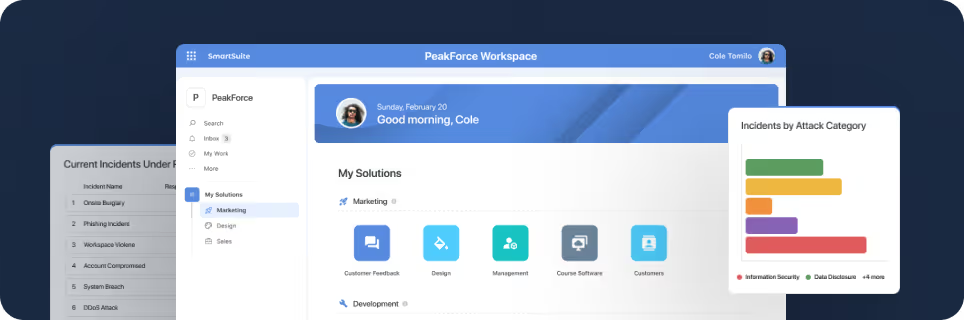
SmartSuite provides work platform for standardizing workflows in the following areas:
- Governance, Risk & Compliance
- IT & Service Ops
- Project / Portfolio Management
- Business Operations