

For years, financial institutions have faced a quiet but costly challenge: the technology powering risk management doesn’t always speak the same language.
- Cyber tools measure vulnerabilities.
- GRC platforms track controls.
- Resilience systems monitor incidents and recovery.
- And each vendor reports in its own format, using different metrics and maturity models.
The result is a patchwork of disconnected data, where insight is lost between systems, integrations are inconsistent, and leadership teams struggle to gain a comprehensive view.
That’s changing.
The Power of a Shared Framework
The Cyber Risk Institute’s CRI Profile is doing more than harmonizing regulations for banks and credit unions.
It’s creating a common language that vendors, partners, and technology platforms can use to collaborate effectively with financial institutions.
By translating thousands of regulatory expectations into roughly 300 diagnostic statements, the CRI Profile gives every stakeholder, from risk teams to product vendors, a shared reference point.
For the first time, product integrations, consulting methodologies, and automation workflows can align to the same baseline of control logic.
This is how ecosystem-wide alignment begins.
Why Vendors Are Paying Attention
The financial services vendor ecosystem is massive and mission-critical.
Institutions rely on dozens (sometimes hundreds) of third-party platforms to manage cyber risk, resilience, and compliance.
Yet until recently, those tools lacked a consistent structure for exchanging data meaningfully.
The CRI Profile changes that by defining the unit of alignment: the diagnostic statement.
When two products both understand “what” they’re measuring and “why,” integration becomes exponentially easier and more valuable.
We’re now seeing leading vendors build CRI-aware integrations that speak this shared language.
At SmartSuite, we’re proud to be leading that charge.
SmartSuite as the Workflow Engine for the Ecosystem
At SmartSuite, we view ourselves not just as a platform, but as the workflow engine that connects the ecosystem.
Where other tools produce data, SmartSuite provides context, orchestrating how that data moves, triggers, and drives action across risk and resilience programs.
Through our collaborations with leading cybersecurity and continuous monitoring providers, we’re enabling financial institutions to:
- Map incoming cyber and monitoring data directly to CRI diagnostic statements.
- Trigger workflow automations when gaps are detected.
- Link control evidence and remediation plans automatically to the underlying CRI Profile element.
- Provide unified dashboards that show performance across multiple integrated vendor systems.

Each of these integrations is made possible by the CRI Profile’s standardized language and by SmartSuite’s ability to operationalize it.
We’re not just connecting APIs; we’re connecting intent.
💡 See how SmartSuite is transforming the way financial institutions approach CRI Profile implementation to replace the FFIEC CAT and modernize a broader GRC integration:
The Categories of Integration That Benefit Most
As this ecosystem matures, several vendor categories are already seeing tremendous value from CRI alignment:
- Continuous Monitoring Platforms, such as control analytics and posture management tools, feed real-time evidence into SmartSuite workflows.
- Cybersecurity & Threat Intelligence Vendors, integrating alerts and mitigation data mapped to CRI controls.
- Cloud Security & Network Platforms, linking compliance posture data to resilience reporting.
- Third-Party Risk & Vendor Management Systems, exchanging due-diligence and assessment data tied to CRI statements.
- Incident Response & SOC Platforms, enabling incident data to automatically update control performance metrics.
- Audit & Assurance Tools, connecting testing results to harmonized CRI-based control catalogs.
As these integrations expand, the financial services industry begins to function as one connected risk ecosystem, with SmartSuite serving as the operational core.
The Bigger Picture: Collaboration at Scale
This moment feels familiar. When I founded Archer IRM, we helped create the concept of an integrated risk platform. That movement brought visibility across silos.
Today, CRI is enabling something even more powerful: visibility across vendors. We’re entering an era where technology providers, consultants, and financial institutions are aligned on a single model of risk and resilience.
The implications are enormous:
- Reduced integration cost.
- Faster implementation cycles.
- Consistent regulator-ready data.
- Continuous collaboration between tools that used to compete.
It’s the first time I’ve seen genuine ecosystem cooperation at this scale in 25 years of GRC innovation.
The Road Ahead
The financial services industry is proving what’s possible when everyone speaks the same language.
As adoption grows, I believe the CRI Profile will become the de facto standard for how technology vendors align with their customers, not just in financial services, but eventually across industries.
And SmartSuite will continue to play the same role we’ve always played: helping organizations turn frameworks into workflows, and standards into action.
The era of connected risk isn’t coming. It’s here.
Jon Darbyshire is CEO and Founder of SmartSuite and previously founded Archer IRM, one of the first enterprise GRC platforms. He continues to work closely with financial institutions, regulators, and technology partners to advance the future of integrated risk management.
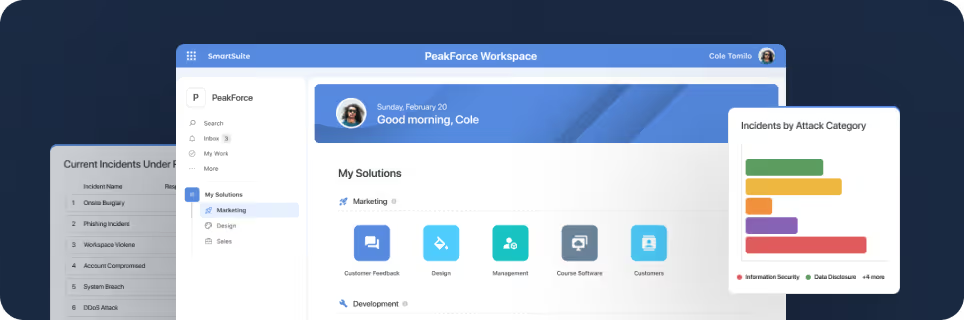
SmartSuite provides work platform for standardizing workflows in the following areas:
- Governance, Risk & Compliance
- IT & Service Ops
- Project / Portfolio Management
- Business Operations