



Maturity Models Are Dead: Move to Dynamic Risk States

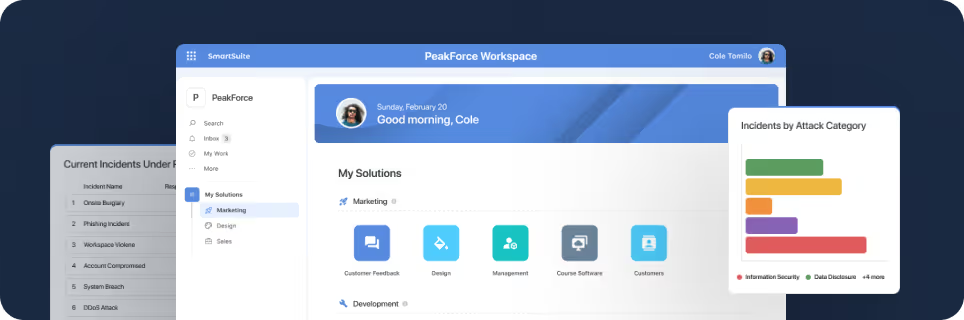
SmartSuite provides work platform for standardizing workflows in the following areas:
- Governance, Risk & Compliance
- IT & Service Ops
- Project / Portfolio Management
- Business Operations

For nearly 20 years, the risk industry has depended on one primary mechanism to understand posture: the maturity model.
Five levels. Defined criteria. Periodic assessments. Annual or quarterly scoring.
Every major framework used some version of this structure, NIST CSF, ISO 27001, FFIEC CAT, internal cyber maturity models, operational resilience heat maps, audit grading systems, vendor scorecards. Institutions built entire governance programs around maturity.
It was simple. It was comfortable. It was familiar. But it no longer reflects reality.
Today, risk doesn’t live in maturity levels. Risk lives in states, fluid, shifting, real-time conditions influenced by cloud drift, identity exposure, vendor disruptions, data movement, geopolitical events, and threat activity.
Maturity is static. Risk is dynamic. The gap between the two has become unmanageable.
Across hundreds of conversations with CISOs, CROs, risk managers, and resilience leaders across global banks, regional institutions, and fintechs, I’ve heard the same frustration:
“Our maturity score says one thing. Our daily reality says another.”
The problem isn’t the people. It’s the model.
And the industry must evolve from static maturity frameworks to dynamic risk states, a more accurate, continuous, and operationally grounded view of risk.
Why Maturity Models No Longer Work
Maturity models fail for reasons deeply embedded in how risk now behaves.
1. They freeze reality into snapshots
Annual or quarterly reviews cannot keep pace with:
- Cloud configuration drift.
- Identity changes.
- Vendor issues.
- Patching gaps.
- Threat intelligence feeds.
- Resilience disruptions.
A maturity score is outdated the moment it’s issued.
2. They create false confidence
A “Level 4” maturity means very little when:
- A critical vendor experiences an outage.
- A ransomware variant emerges.
- A cloud setting was misconfigured yesterday.
- A resilience dependency changes overnight.
Static maturity hides volatility.
3. They reinforce siloed thinking
Cyber has a maturity scale. Risk has a maturity scale. Continuity has a maturity scale. Vendors have a maturity scale. Each tells a different story.
4. They require massive manual effort
Teams spend months preparing assessments that provide… a static score.
5. They don’t reflect interconnectedness
Risk in 2025 is systemic. Maturity models treat it as isolated.
6. Regulators are moving toward continuous readiness
Annual posture no longer satisfies supervisory expectations in:
- DORA.
- UK PRA.
- FFIEC.
- OCC.
- ECB.
- MAS.
Continuous oversight requires continuous insight.
Institutions aren’t failing maturity models; maturity models are failing institutions.
Dynamic Risk States: A Better Model for Modern Governance
The concept of dynamic risk states reflects the reality that risk lives in continuous motion.
A risk state is:
- Real-time.
- Contextual.
- Evidence-linked.
- Diagnostic-based (CRI, NIST, DORA).
- Integrated across teams.
- Influenced by ecosystem signals.
- Constantly updating.
- Tied to workflows.
- Reflective of operational readiness.
Dynamic risk states replace the question:
“What level of maturity do we have?” with “What state are we in right now?”
This shift is profound.
The Five Characteristics of Dynamic Risk States
1. Continuous, not periodic
Risk states update as signals update.
- Monitoring alerts.
- Cloud drift.
- Vendor issues.
- Evidence changes.
- Incident activity.
- Control tests.
Dynamic = now. Maturity = then.
2. Diagnostic, not subjective
Dynamic risk states rely on CRI-like diagnostic models, not broad maturity labels.
This gives teams:
- Clear expectations.
- Consistent scoring logic.
- Cross-functional interpretation.
- Regulatory alignment.
Diagnostics add structure. States add accuracy.
3. Workflow-driven, not module-driven
States move as workflows move.
Issue created → diagnostic impacted.
Evidence updated → state improves.
Signal detected → state degrades.
Remediation completed → state recovers.
This is why workflow-native architecture is essential.
4. Cross-functional, not siloed
Dynamic states incorporate signals from:
- Cyber.
- Risk.
- Audit.
- Continuity.
- Vendor.
- Technology.
- Resilience.
Maturity models hide connections. Risk states reveal them.
5. Explainable, not decorative
Risk states provide narrative, not just numbers.
Boards can understand:
- Why did a state change?
- Which dependencies shifted?
- What actions improved posture?
- What is trending up or down?
Dynamic states become an ongoing storyline: a living governance narrative.
Why AI + Diagnostics Make Dynamic Risk States Possible
Dynamic risk states are not simply a conceptual improvement. They are newly feasible because of two converging forces:
1. Diagnostic frameworks like CRI
They give AI the structure it needs to reason consistently across domains.
2. AI’s ability to interpret signals continuously
AI can correlate:
- Monitoring data.
- Evidence.
- Vendor outputs.
- Control performance.
- Identity signals.
- Resilience metrics.
AI updates risk states as conditions change.
Maturity models cannot do this. Dynamic risk states rely on:
- CRI for structure.
- AI for interpretation.
- Workflows for execution.
This triad represents the future of governance.
How Dynamic Risk States Work in Practice
Imagine an institution using CRI + SmartSuite + AI:
- A configuration drift alert is detected in the cloud.
- AI maps it to the relevant CRI diagnostics.
- SmartSuite triggers an issue workflow.
- Evidence requirements update automatically.
- Diagnostic scoring adjusts in real time.
- The risk state shifts from “Stable” to “Degraded.”
- Once remediation completes, the state elevates.
- The board dashboard updates automatically.
Not quarterly. Not monthly. Not after a workshop. Immediately.
This is what maturity models could never achieve.
What Institutions Gain by Moving to Dynamic Risk States
1. Real-time risk clarity
Executives see posture as it exists, not as it existed months ago.
2. Reduced audit and regulatory friction
Continuous insight demonstrates continuous readiness.
3. Faster remediation cycles
Remediation is no longer driven by annual reports but real-time state changes.
4. Unified cross-functional reporting
Cyber, risk, and continuity stop producing competing narratives.
5. Better board engagement
Boards finally understand what’s happening, when, and why.
6. True continuous assurance
Evidence, diagnostics, and workflows update together.
7. Predictive capability
AI identifies weak signals before they become incidents.
This is not just a more accurate model: it’s a more operational, intelligent, effective one.
Why SmartSuite Is the Workflow Engine Behind Dynamic Risk States
Dynamic risk states require:
- Unified workflows.
- Centralized evidence.
- CRI-aligned diagnostics.
- Continuous signal ingestion.
- Cross-functional issue management.
- Real-time dashboards.
- AI interpretation.
- Flexible process modeling.
SmartSuite was built exactly for this architecture, not as a module-based system but as a workflow-native platform designed to support fluid processes.
This is why SmartSuite can power dynamic risk states in ways legacy GRC systems cannot.
Static modules are incompatible with dynamic states. Workflow engines are built for them.
Conclusion: The Maturity Era Is Over
Maturity models helped institutions for a long time. They provided a shared language, a clear benchmark, and a structured approach to improving cyber and risk posture. But the world has changed, and the governance model must change with it.
Risk is dynamic. Evidence is dynamic. Vendor ecosystems are dynamic. Cloud architectures are dynamic. Threat environments are dynamic. Resilience dependencies are dynamic.
Risk states must be dynamic too.
Moving from maturity models to dynamic risk states is not optional. It is the only governance model that reflects reality.
And the institutions that make this transition early will operate with a level of clarity, speed, and resilience that static frameworks can never achieve.
The future of risk is not maturity. The future of risk is motion.






Put these ideas to work
Start a free trial, or book a demo and see how it runs in SmartSuite.

