Across financial services, few challenges have grown as quickly, or as quietly, as managing the expanding ecosystem of cybersecurity, risk, compliance, and resilience vendors.
Over the past decade, institutions have adopted dozens of tools: continuous control monitoring platforms, threat intelligence feeds, cloud security tools, audit platforms, vendor-risk systems, SOC platforms, identity and access products, and resilience solutions.
Each provides value.
Each solves a specific problem.
But each also introduces complexity.
As the vendor ecosystem expanded, institutions found themselves facing a new kind of fragmentation, one created not by frameworks but by tools, each operating with its own logic, terminology, and data structures.
Across my work with global banks, regional institutions, credit unions, and fintechs, I’ve seen this story play out repeatedly.
Teams adopt tools for legitimate reasons, but over time, the complexity becomes overwhelming:
- Evidence lives in dozens of systems.
- Alerts don’t map to risk categories.
- Remediation workflows multiply.
- Audit trails fragment.
- Control performance becomes difficult to consolidate.
- Third-party signals lack a shared evaluation structure.
- Board reporting turns into a cross-platform translation exercise.
Institutions weren’t struggling because their tools were ineffective; they were struggling because the tools didn’t speak the same language.
The technology ecosystem lacked a common framework to unify its many data streams, maturity models, and lenses of interpretation.
That started to change with the arrival of the Cyber Risk Institute’s CRI Profile.
The Missing Ingredient: A Shared Reference Model
The CRI Profile is not simply a harmonized framework.
It is a translation layer: a way to interpret cyber, risk, and resilience expectations through consistent diagnostic statements.
It creates a lingua franca for the industry, one that can be understood by:
- Cybersecurity platforms.
- Control-monitoring vendors.
- Third-party risk systems.
- GRC tools.
- Resilience platforms.
- Audit functions.
- Boards and regulators.
Frameworks like NIST CSF and ISO 27001 already serve important purposes, but they were not designed as operational connectors for a modern vendor ecosystem.
They can align principles, but they cannot standardize the operational expression of risk across hundreds of vendors with different methodologies.
CRI diagnostic statements do exactly that.
They articulate the underlying intent of regulatory and risk expectations in a form that is structured, measurable, and actionable.
This is why they are so powerful, and so overdue.
Why Vendor Ecosystems Break Without a Standardized Framework
To understand why CRI is so important to the vendor ecosystem, consider what most institutions face today:
- Every vendor labels risk differently.
“What counts as high risk?” “What does coverage mean?” “How do we define evidence?”
Every tool has its own answer.
- Every vendor measures maturity differently.
Monitoring tools think in terms of configuration drift.
Audit tools think in terms of control testing.
Cyber tools think in terms of vulnerabilities and alerts.
Boards need outcomes and trends.
- Every solution expects integration, but defines it differently.
“Integrations” often mean APIs, not understanding.
- Every team interprets alerts and data through its own domain framework.
A cyber alert may not map naturally to resilience. A resilience result may not map to cyber. Vendor risk may not map to either.
- Institutions end up doing translation work that the tools should have done.
The result is unnecessary friction across risk teams.
This fragmentation becomes unmanageable as institutions grow, expand their technology stack, or adopt increasingly sophisticated platforms in their cyber-defence programs.
The industry needed a connector, a shared foundation that vendors could integrate with, allowing tools to complement each other instead of operating in parallel.
CRI is the first framework to fill that role.
How CRI Enables a Truly Connected Vendor Ecosystem
The power of the CRI Profile comes from its diagnostic structure.
Because diagnostic statements articulate intent, not technology, they give vendors something they’ve never had before:
A shared target
Vendors can align their outputs to the same diagnostic expectations.
A shared meaning
Tools can describe their findings in ways that risk and compliance teams can interpret consistently.
A shared maturity model
Institutions can evaluate vendors not by feature lists, but by how their outputs support diagnostic outcomes.
A shared integration path
Systems can finally map data to the same backbone, enabling unified dashboards and workflows.
A shared operational vocabulary
CISOs, CROs, compliance teams, resilience leaders, and vendor platforms can all speak in the same structure.
This changes everything.
- Instead of institutions forcing tools to align, vendors begin aligning themselves.
- Instead of governance teams translating outputs from dozens of systems, tools begin aligning their outputs to the same diagnostic structure.
- Instead of integration meaning “data moved from A to B,” it begins to mean “insight aligned to a shared maturity model.”
That is the difference between a multi-vendor landscape and a connected ecosystem.
The Shift From Vendor Sprawl to Vendor Synergy
In many boardrooms today, concerns about “vendor sprawl” have increased.
But the issue is not the number of vendors; it is the lack of integration meaning.
CRI turns vendor sprawl into vendor synergy by giving institutions the ability to:
- Consolidate multiple data sources into unified workflows.
- Connect evidence across vendors into a single control lifecycle.
- Translate different outputs into the same maturity score.
- Align cyber, vendor risk, and resilience data into a unified structure.
- Replace redundant tools with complementary ones.
- Evaluate vendors based on their diagnostic alignment, not marketed features.
This shift unlocks new kinds of value:
- Continuous monitoring maps directly into CRI maturity.
- Cloud security posture management maps into CRI governance and control areas.
- Identity tools map into diagnostic expectations around access, privilege, and governance.
- Resilience platforms map into continuity and impact diagnostics.
- Vendor risk systems map into third-party oversight diagnostics.
- Audit and assurance systems map into the testing of the same diagnostic indicators.
It turns fragmented insights into one story.
Why SmartSuite Is the Workflow Engine Behind This Ecosystem
A shared language (CRI) creates alignment. A shared workflow platform, such as SmartSuite, turns alignment into action.
CRI diagnostic statements become operational when they are:
- Tied to controls.
- Connected to evidence.
- Embedded into issue management.
- Mapped to vendor signals.
- Linked to remediation.
- Placed inside unified risk and resilience dashboards.
- Automated through workflow actions and triggers.
Because SmartSuite is workflow-native, it can ingest outputs from multiple vendors, cloud security, continuous monitoring, identity governance, vulnerability tools, resilience platforms, and translate them into actionable workflows anchored in CRI diagnostics.
CRI provides the meaning. Vendors provide the signals. SmartSuite provides the movement.
Together, they form the first truly connected operational ecosystem the industry has needed.
Conclusion: A New Era of Vendor Interoperability
Financial institutions will continue to rely on best-of-breed tools. The goal is not fewer tools, it is better-connected tools.
The CRI Profile gives the industry a shared structure. SmartSuite gives institutions a workflow engine that unifies the work.
Vendor platforms now have a stable foundation to integrate against. This combination creates something the industry has never had before:
A connected vendor ecosystem capable of supporting continuous assurance, unified maturity, and integrated resilience.
This isn’t just progress. It’s the foundation for the next decade of cyber governance in financial services.
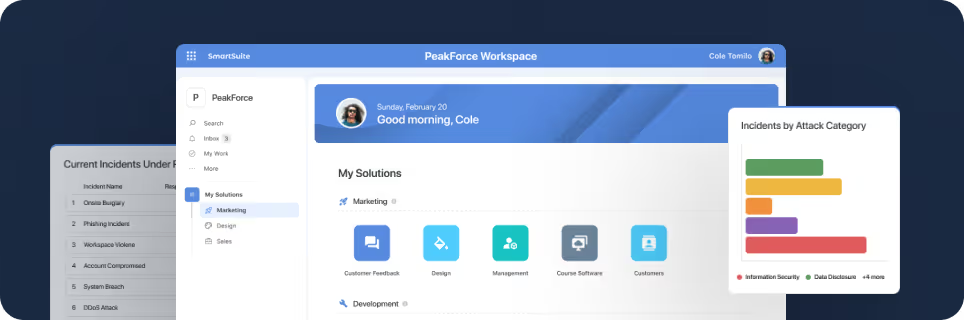
SmartSuite provides work platform for standardizing workflows in the following areas:
- Governance, Risk & Compliance
- IT & Service Ops
- Project / Portfolio Management
- Business Operations