

Are you looking for the best Secureframe alternatives to obtain and maintain compliance with global information security standards?
Secureframe delivers an enterprise-grade compliance automation platform that centralizes security controls, evidence collection, risk management, and audit workflows for SOC 2, ISO 27001, and HIPAA compliance.
However, some customers of the platform have not been happy with the time-intensive initial setup, price tag for its maturity stage, and flexibility in reporting and data access.
In this buyer guide, I’ll go over the 10 best Secureframe alternatives for GRC in 2026 that can help you better manage your compliance workflows.
TL;DR
- SmartSuite offers the best alternative to Secureframe with its true no-code automation, flexible GRC workflows, and ready-to-use templates that let teams scale compliance, risk, and vendor management fast without rigid reporting or admin bottlenecks.
- Enterprise GRC platforms like LogicGate, OneTrust, and ServiceNow are ideal for large organizations that need deep configurability, AI-enabled insights, multi-framework support, and cross-department risk management, despite higher cost and complexity.
- On the other hand, tools like Vanta, Drata, Hyperproof, and Onspring help teams implement audit-ready compliance faster, automate controls, and manage multiple frameworks with simpler setups and clearer pricing.
Before I begin, I wanted to cover the reasons why some compliance leaders have been looking to switch from Secureframe: ⤵️
Why are some compliance leaders looking to switch from Secureframe?
Secureframe has built a strong reputation as an automation-first compliance platform.
Teams consistently praise its clean dashboard, guided onboarding, automated evidence collection, and ability to make complex compliance frameworks understandable for non-technical stakeholders.
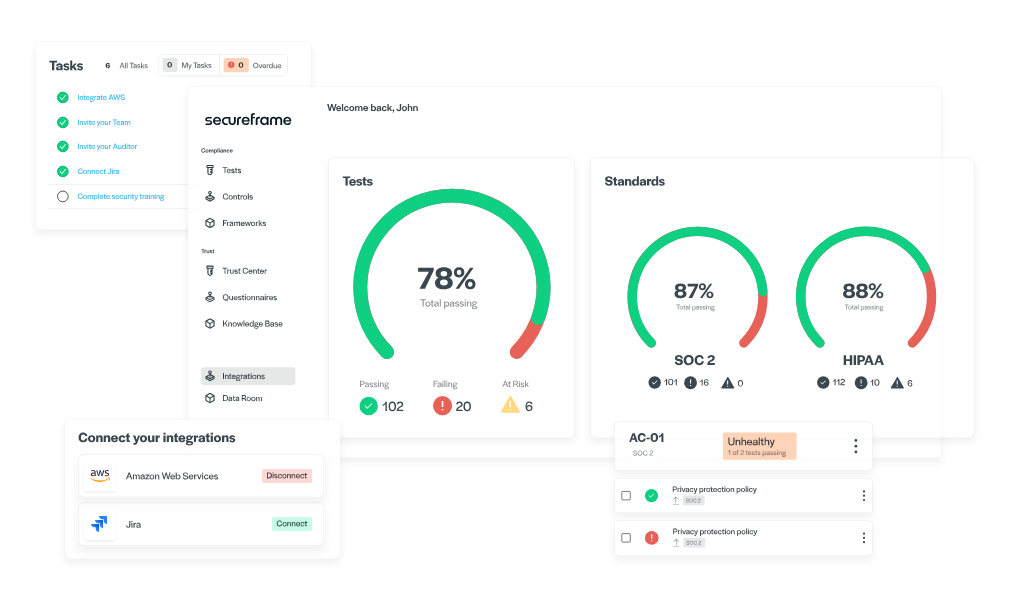
For mid-market companies, I’ve noticed that it significantly reduces the manual burden of staying audit-ready and tracking vendor risk.
That said, as compliance programs scale in complexity and maturity, several recurring limitations begin to surface around the tool’s configuration, price point, and flexibility in reporting and data access.
I wouldn’t say that these make Secureframe a weak product. They simply suggest that it may not evolve at the same pace or depth that some organizations expect, as their compliance, reporting, and data access needs become more advanced.
Here are the most common reasons compliance teams start exploring Secureframe alternatives:
#1: Time-intensive initial setup and configuration
Even though I saw Secureframe consistently being praised for simplifying ongoing compliance, several reviewers point out that the initial setup can be time-consuming, especially when aligning multiple frameworks or departments at once.
Users mention spending significant effort upfront configuring controls, mapping frameworks, onboarding teams, and fine-tuning risk models before the platform truly “clicks.”
For reference, the average time to implement Secureframe, as reported on G2, is 2 months.
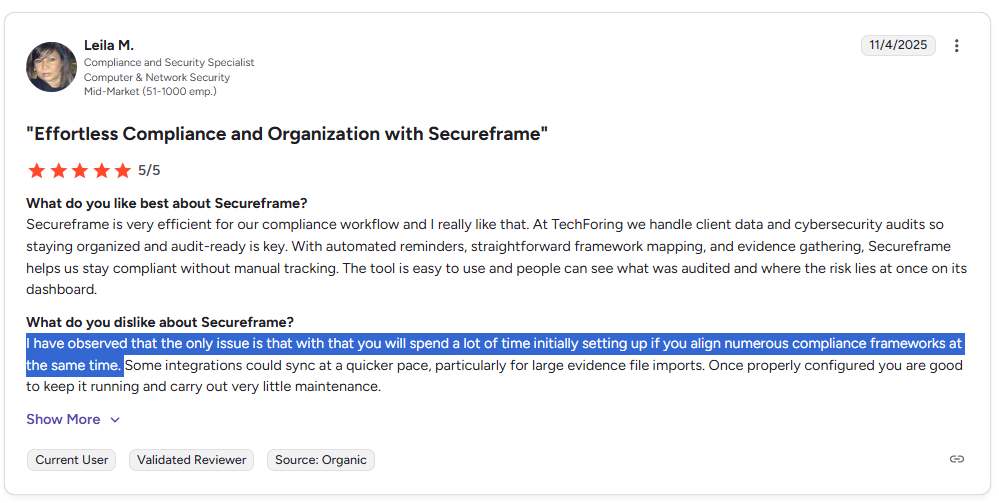
“You will spend a lot of time initially setting up if you align numerous compliance frameworks at the same time.” – G2 Review.
#2: Same price point as alternatives while being less mature
Next up, despite Secureframe’s compliance management capabilities, some users perceive it as offering similar pricing to established competitors without the same level of platform maturity.
➡️ For buyers evaluating multiple GRC or compliance automation tools at the same price point, expectations naturally extend beyond baseline compliance workflows to include deeper reporting, more flexible integrations, and more refined customization options.
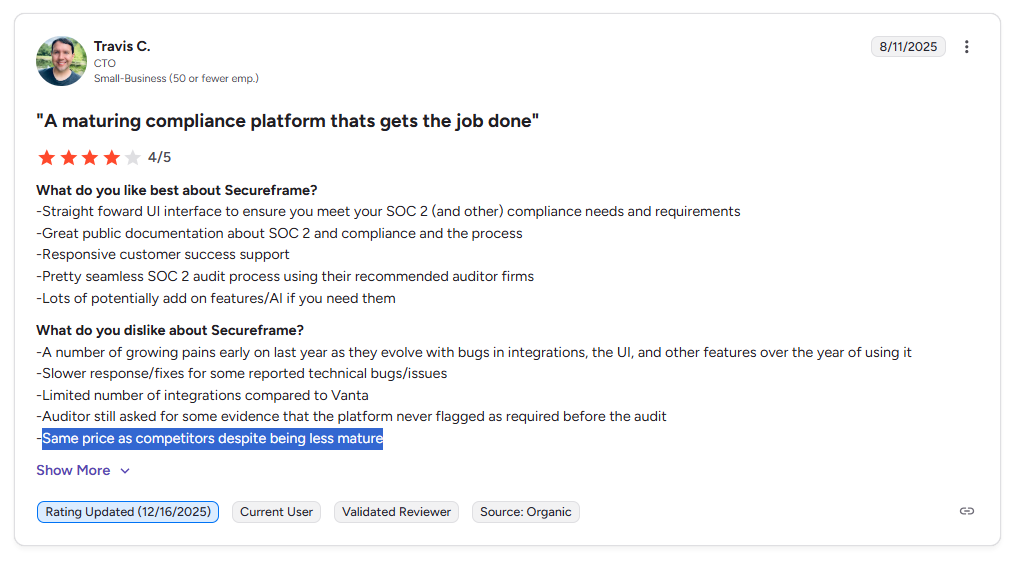
‘’Same price as competitors despite being less mature.’’ – G2 Review.
#3: Limited flexibility in reporting and data access
Last but not least, some users mention Secureframe’s limited reporting flexibility, particularly when it comes to custom exports, admin-only permissions, and pulling data from integrations or APIs.
Multiple customers report friction when attempting to customize reports, export specific views, or integrate third-party data without administrator access or manual workarounds.
API limitations also come up for teams that rely on internal dashboards or advanced vendor risk analytics.
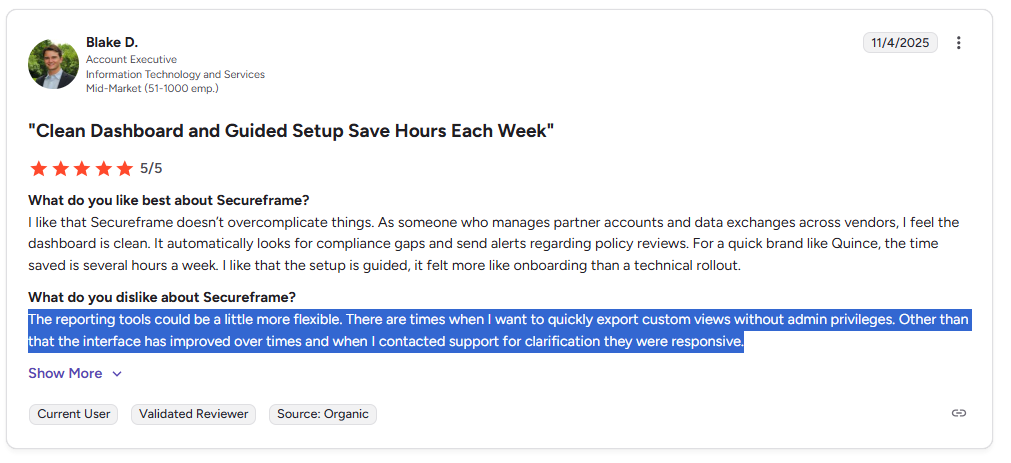
‘’The reporting tools could be a little more flexible. There are times when I want to quickly export custom views without admin privileges. Other than that the interface has improved over times and when I contacted support for clarification they were responsive.’’ – G2 Review.
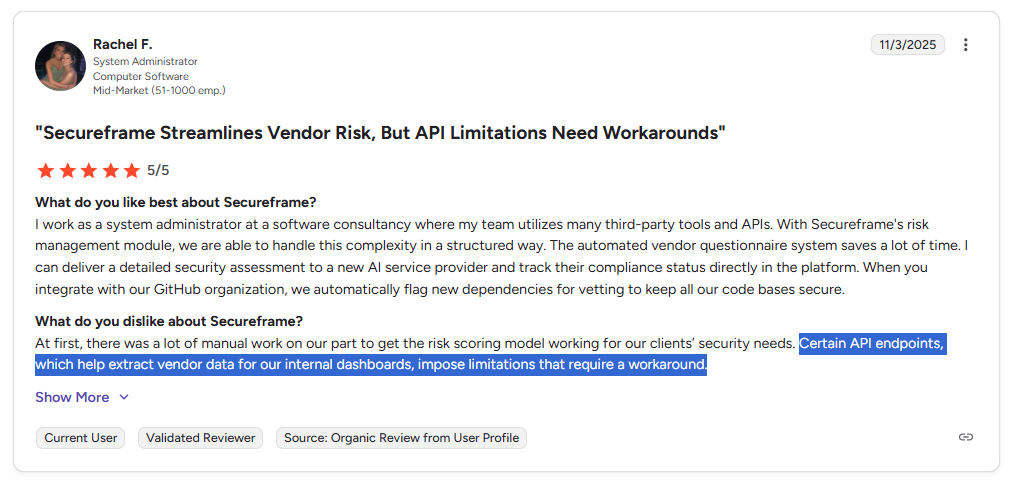
‘’Certain API endpoints, which help extract vendor data for our internal dashboards, impose limitations that require a workaround.’’ – G2 Review.
What are the best alternatives to Secureframe for GRC in 2026?
The best alternatives to Secureframe are SmartSuite, Vanta, and LogicGate.
Here’s my final shortlist of the top 10 Secureframe alternatives on the market for compliance management after evaluating 30+ platforms on the market:
#1: SmartSuite
SmartSuite is the top Secureframe alternative in 2026 for compliance teams looking to get started in days with our easy-to-use interface.
Our platform is a fully configurable, end-to-end governance operating system that connects risk, compliance, internal controls, incidents, vendors, and remediation work into one live, automated platform.

SmartSuite helps you move faster, manage policies smarter, and adapt easily, without having to get dedicated training on how to use the tool.
💡 We’ve also recently partnered with the Cyber Risk Institute to deliver a CRI profile for U.S. Banks' compliance needs.
Find more about how SmartSuite is transforming the way financial institutions approach CRI Profile implementation to replace the FFIEC CAT and modernize a broader GRC integration:
Let’s go over the features that make SmartSuite the best option for compliance leaders looking to switch from Secureframe: 👇
All-In-One GRC
Tools like Secureframe make it so that best-in-class compliance software can be accessible only to the biggest of companies.
However, I believe compliance should be simple, automated, and accessible to all financial institutions, regardless of their size.
SmartSuite’s no-code, easy-to-use tool empowers compliance managers and CISOs to automate all GRC processes with ease.
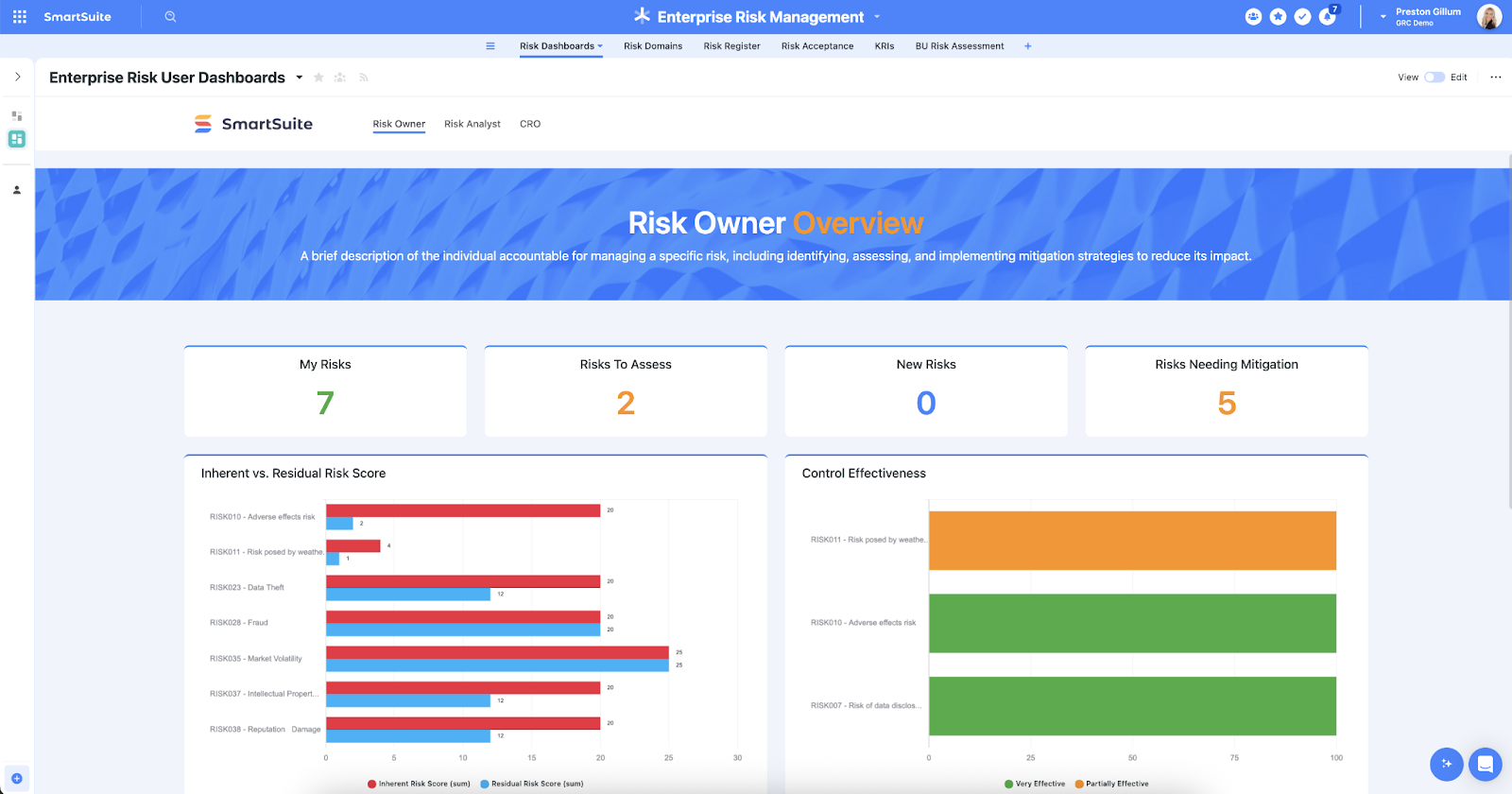
Our tool helps you achieve and maintain compliance without the costs and difficulty of adapting legacy GRC solutions to accommodate new compliance requirements.
Here are the use cases that you’ll get with SmartSuite:
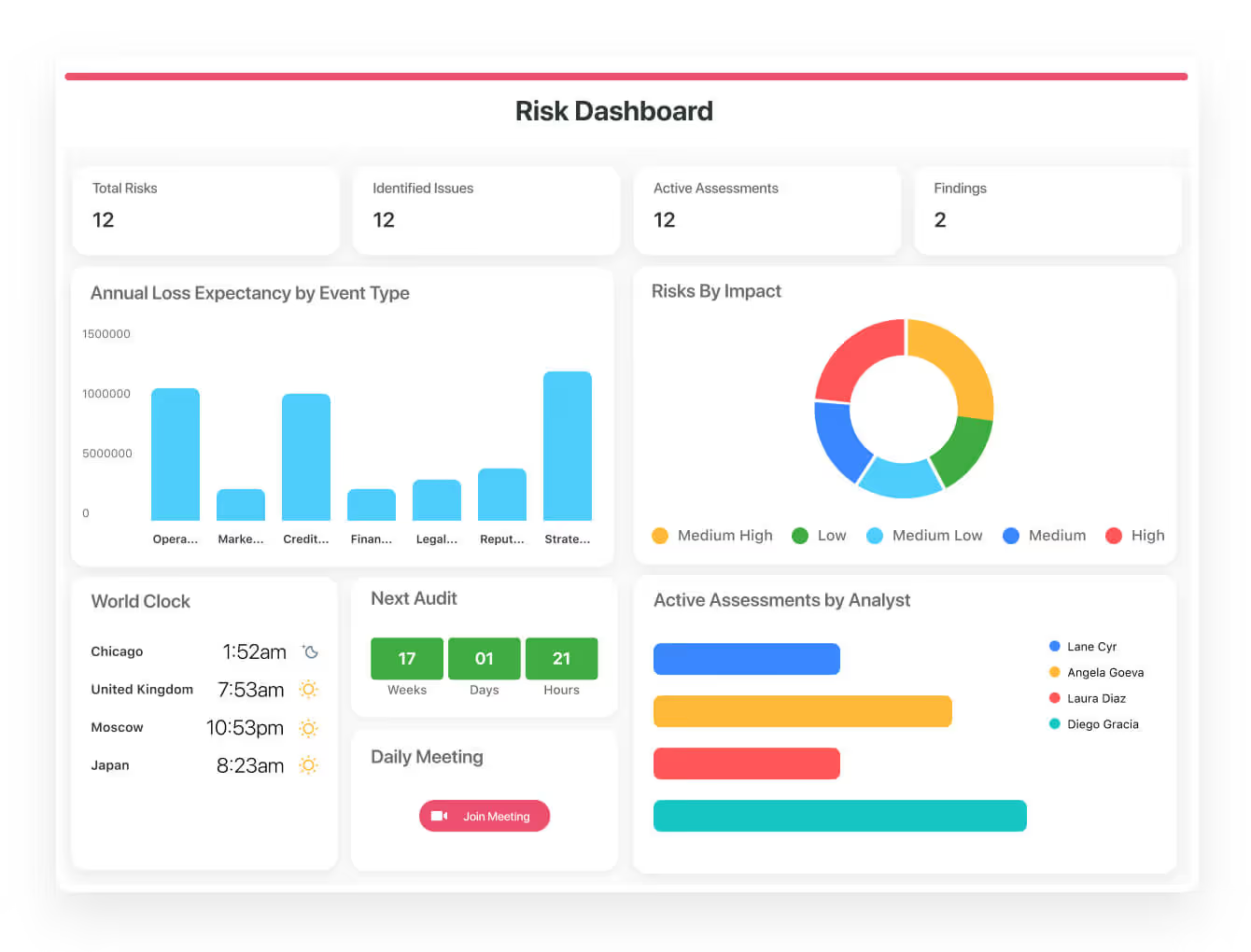
- Create reports and dynamic dashboards: You’ll be able to monitor executive views into your organization's overall risk profile with powerful charting and metrics widgets.
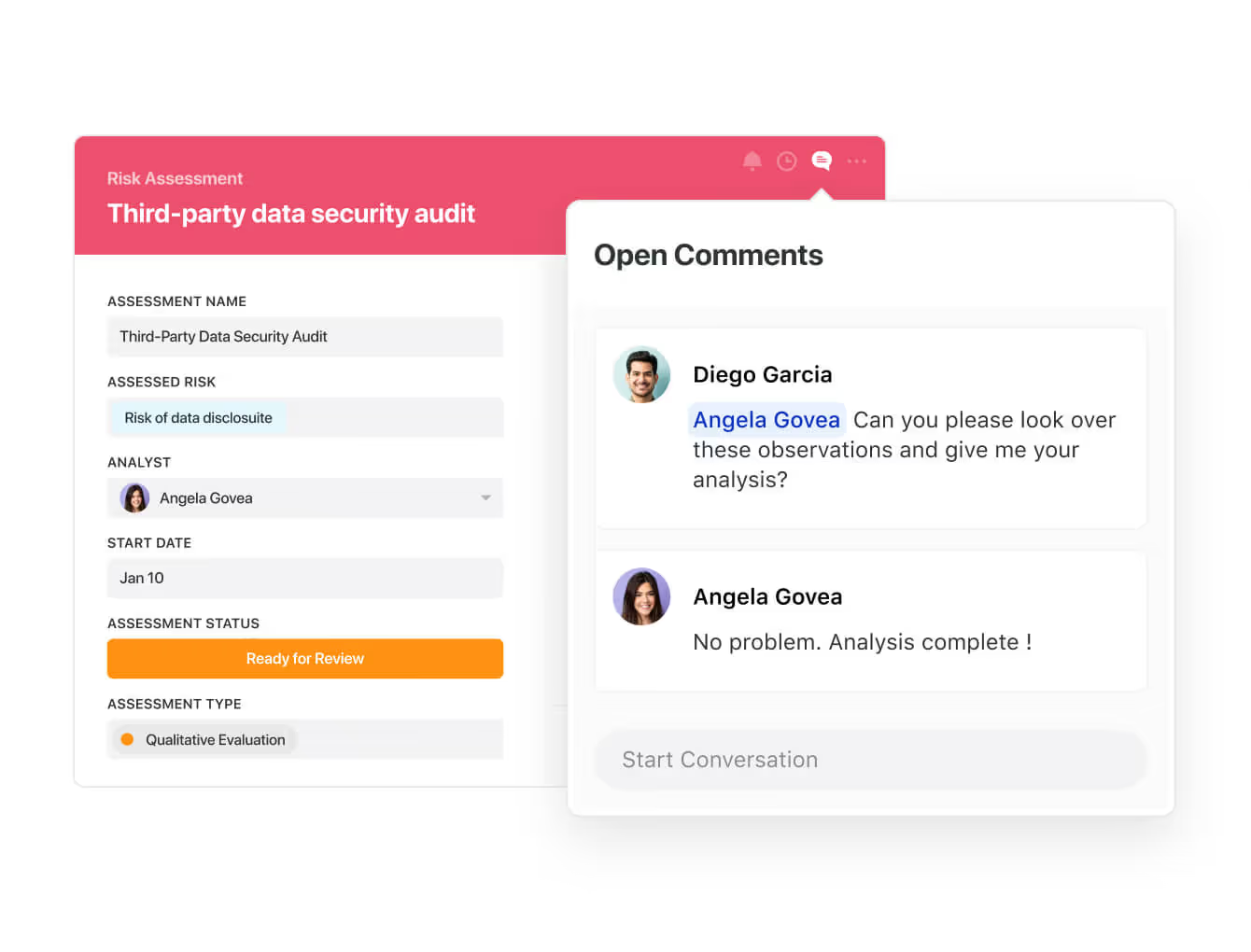
- Collaborate and respond to risks in real-time: Instantly engage key stakeholders in a real-time discussion of potential threats or vulnerabilities.
Our tool will also let you get immediate updates when critical information is available.
- Automate policy creation, real-time approval, and control assessments: Streamline risk management by building an integrated program on a single platform.
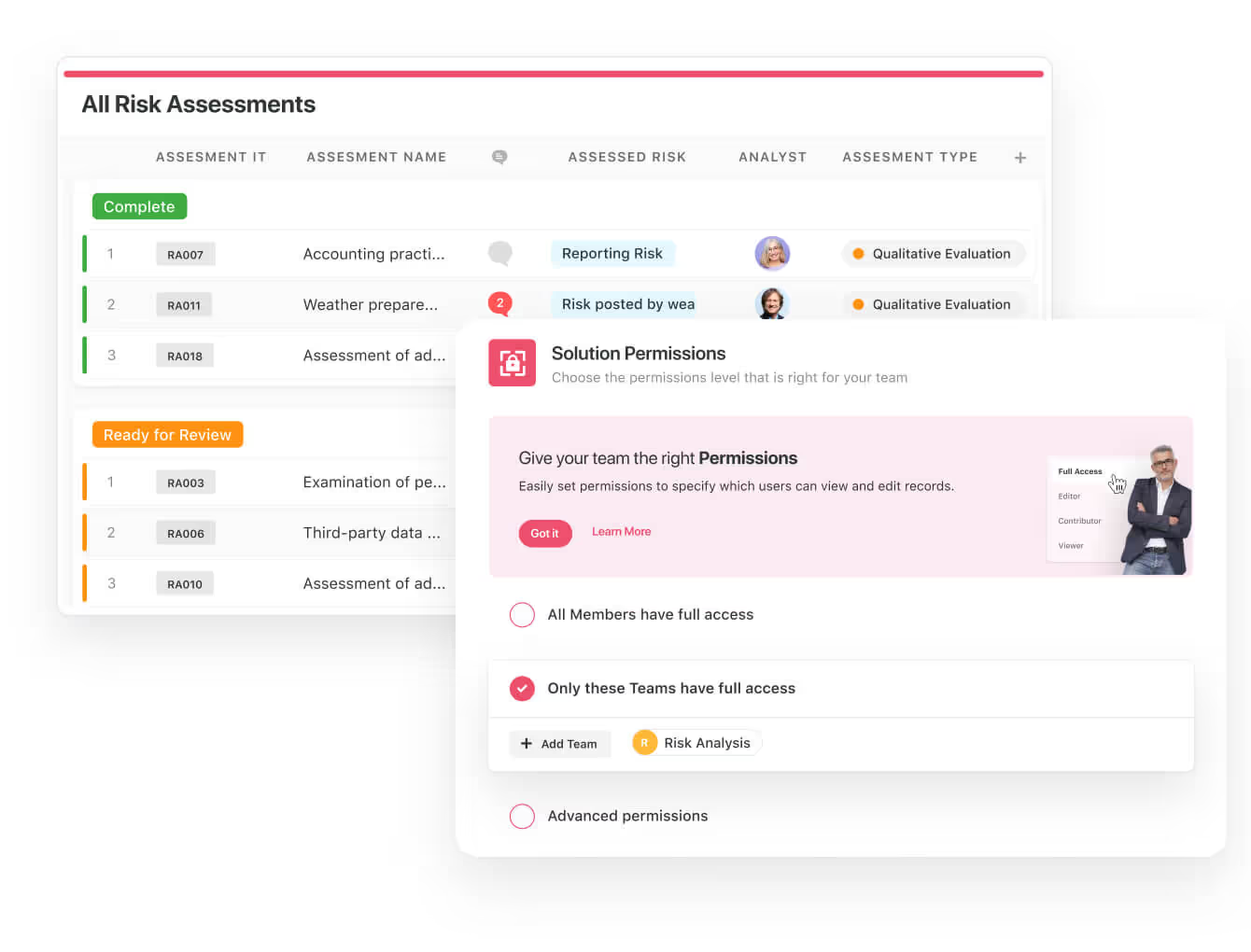
- Keep risk and compliance data secure: Define your teams and manage access to information across all GRC practice areas.
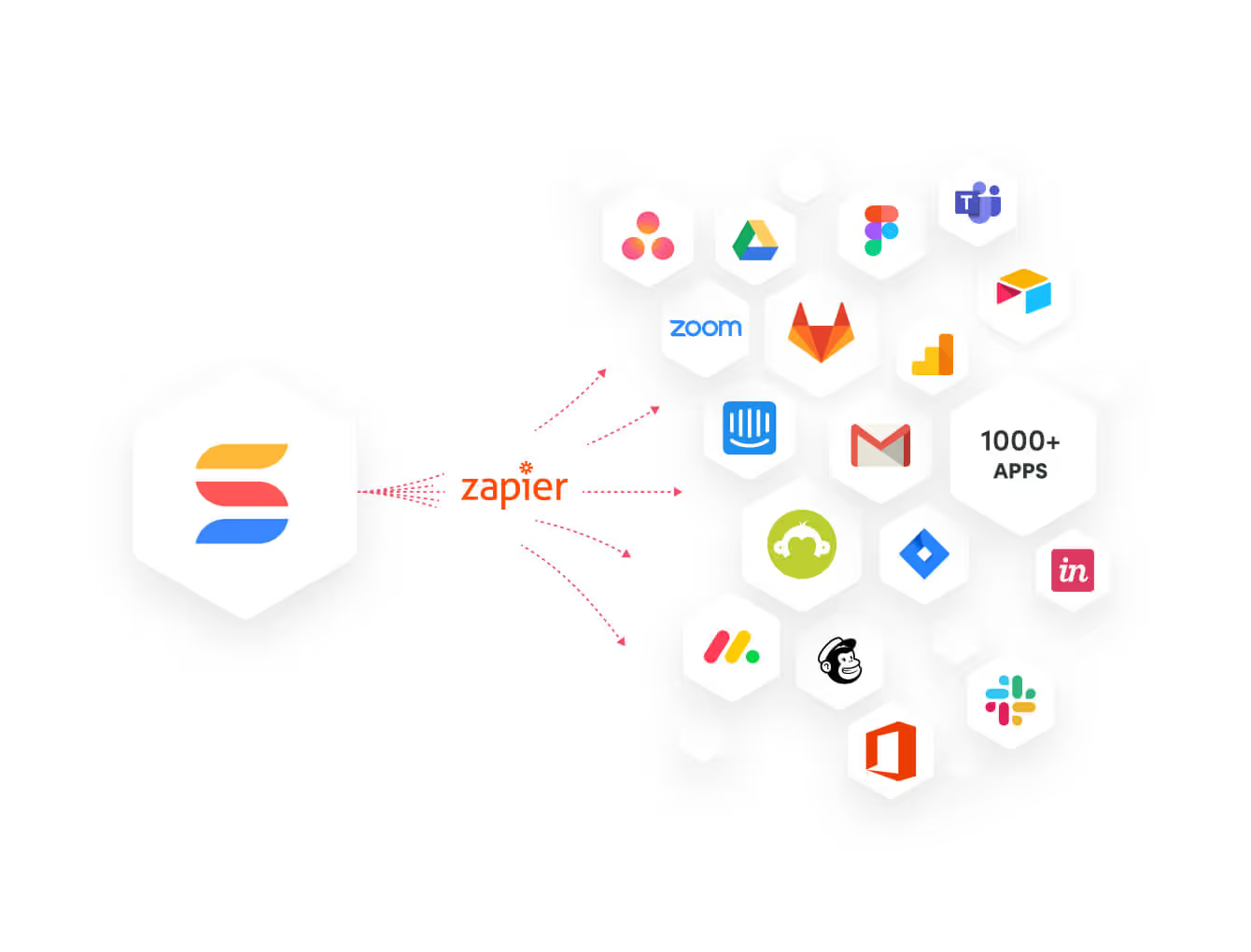
- Integrate with your existing systems: Our GRC software lets you integrate with existing systems and data to consolidate and centralize your data.
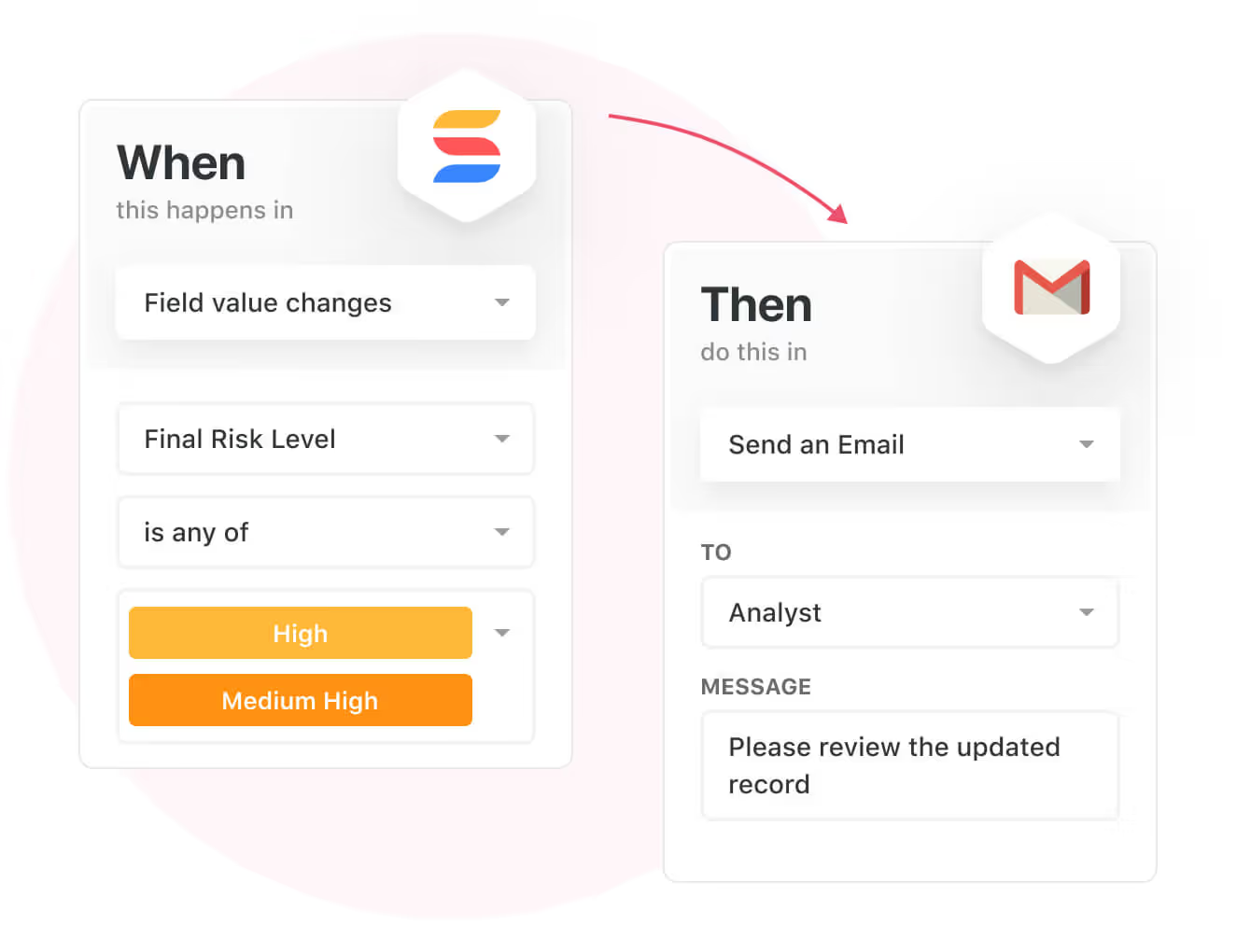
- Automate for accuracy and efficiency: Remove inefficiencies and the chance for human error by automating repeatable workflows.
SmartSuite's no-code automation builder provides you with a visual interface that makes it easy to respond to events and take action.
That means your compliance team can customize your GRC workflows without technical resources.
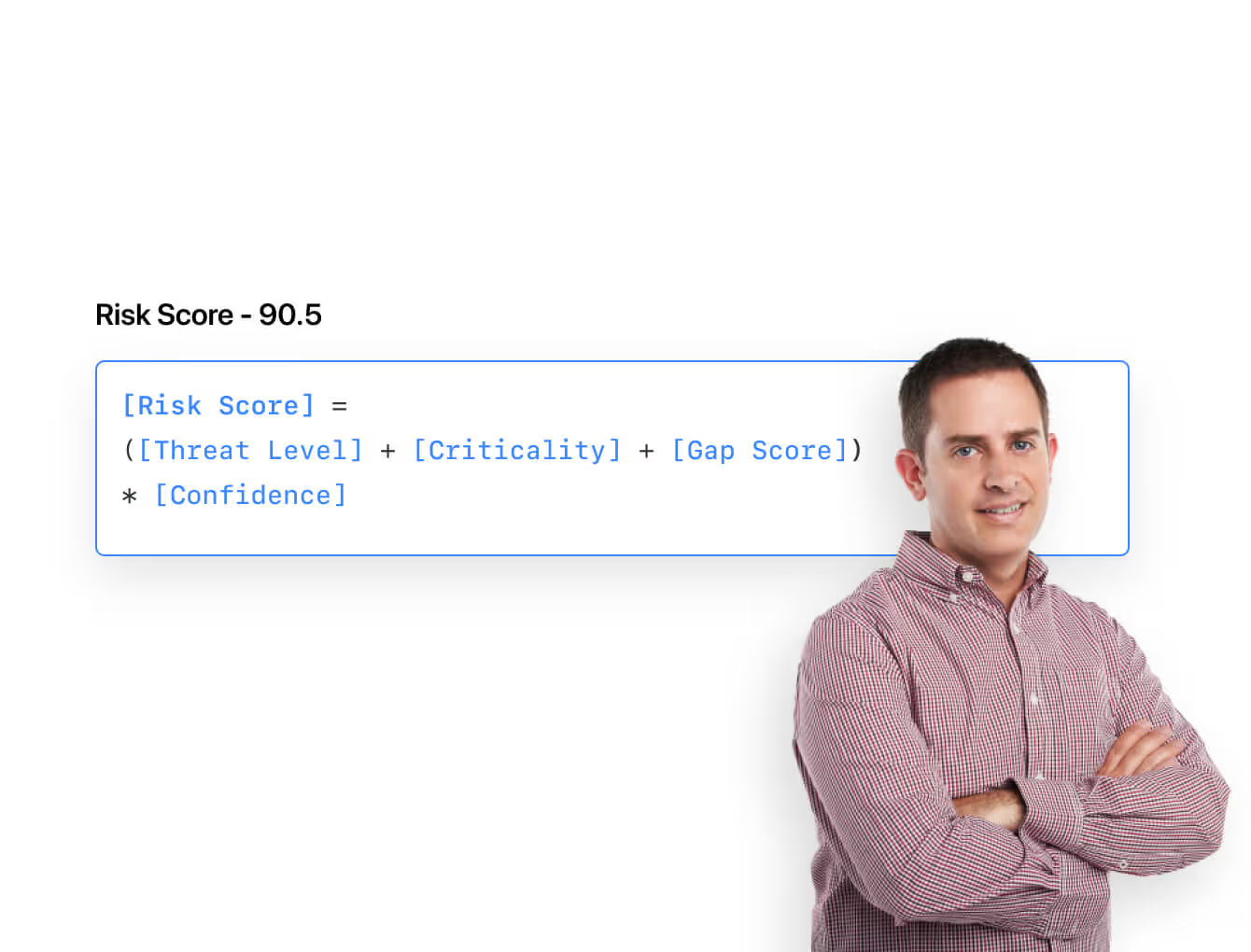
- Monitor, measure and score: Create risk calculations and metrics to evaluate every aspect of risk.
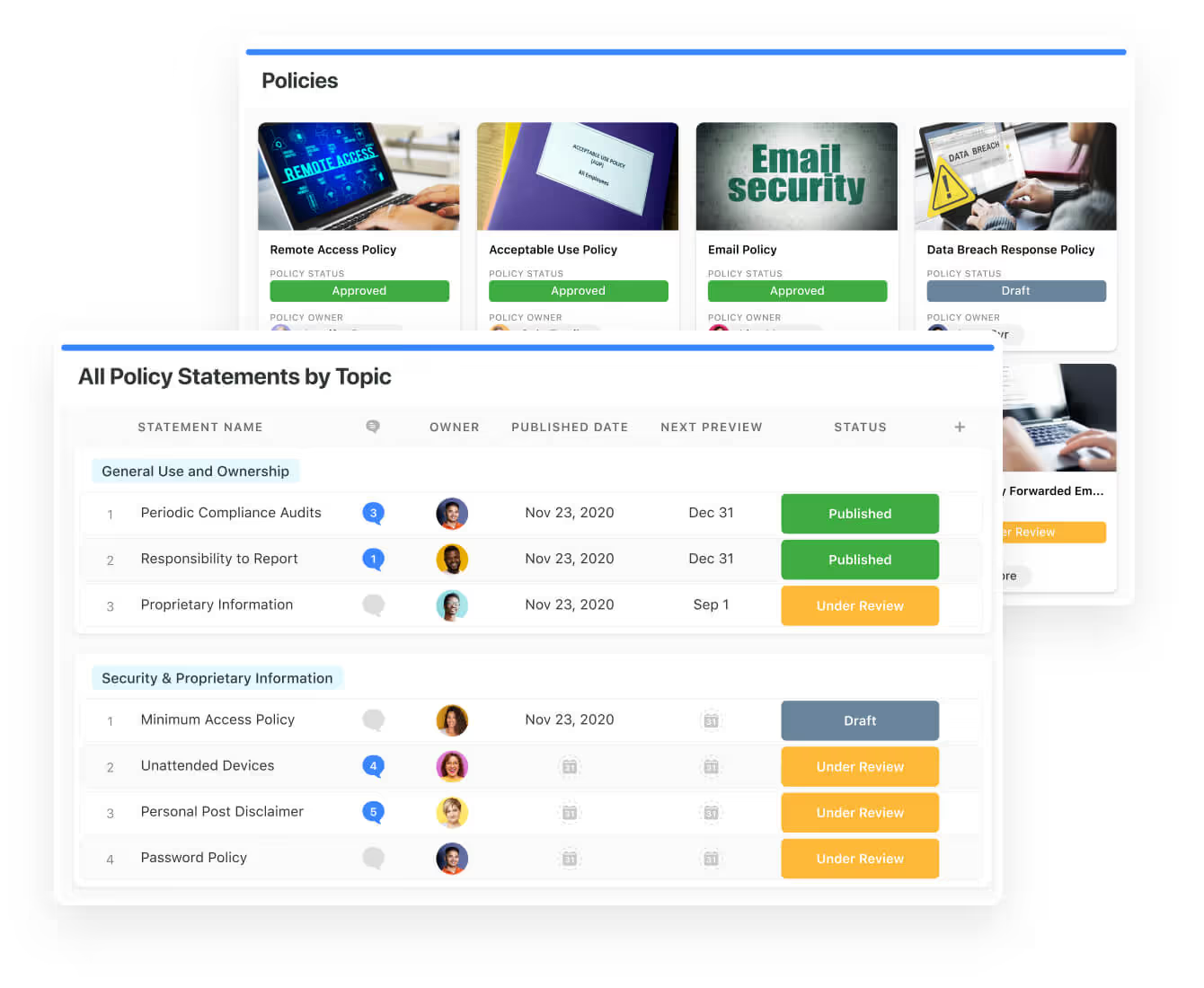
- Policy management: It’s possible to establish a strong foundation from the get-go with streamlined and flexible policy management.
You’ll be able to assign ownership, manage revisions, and ensure your policies consistently align with key business initiatives and regulatory requirements.
- PSTOS Compliance Tracker: Designed for regulatory compliance and built on SmartSuite.
This solution focuses on data security as the core of compliance frameworks with services such as compliance readiness, virtual CISO, and IT security implementation.
Learn more about it from this webinar that we did on the topic:
Prioritize & Mitigate Risks
With SmartSuite, your team can create a centralized risk register to effectively identify potential risks to your organization.
You can also properly assess threats and establish risk mitigation strategies inside SmartSuite.
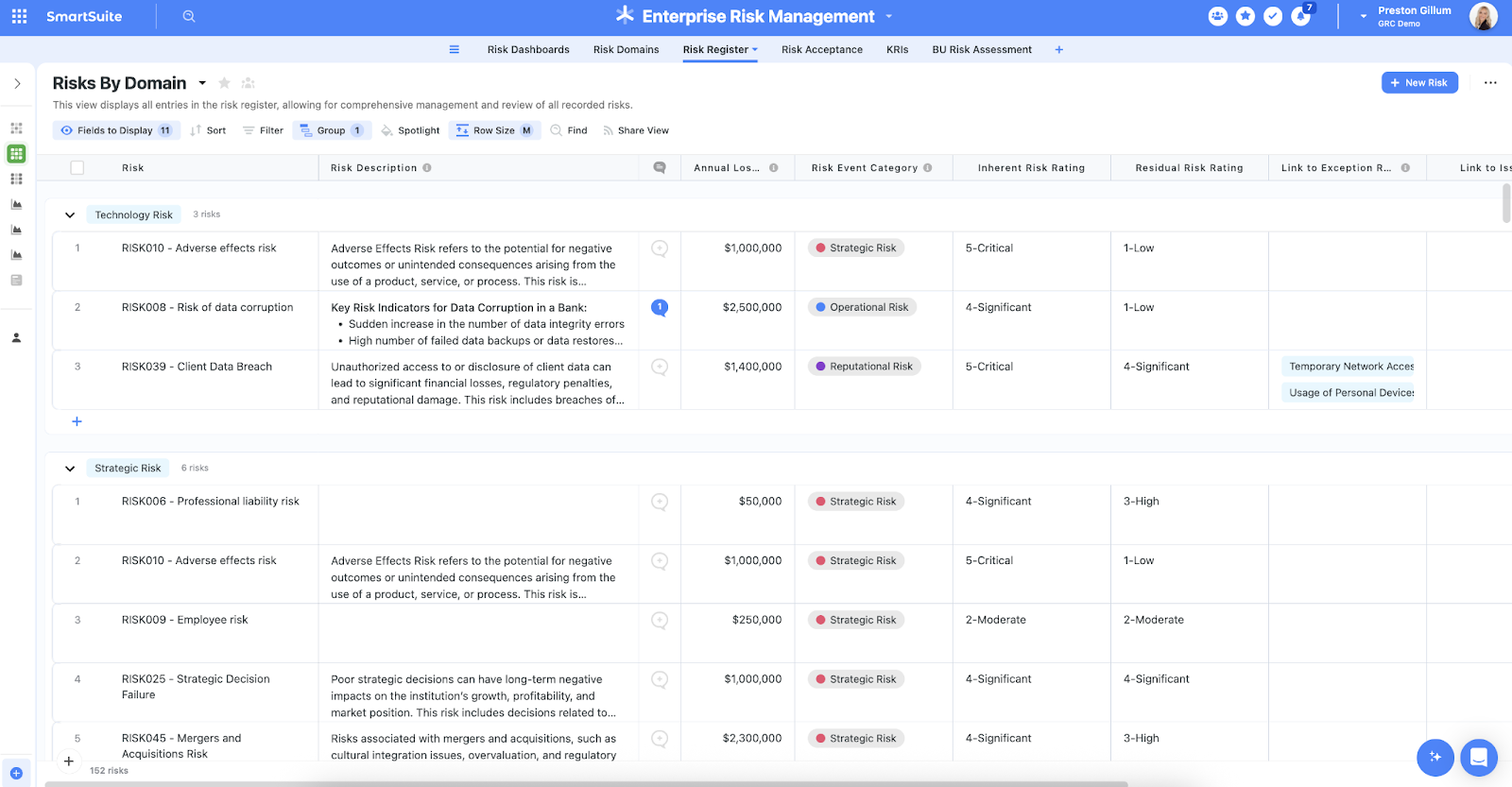
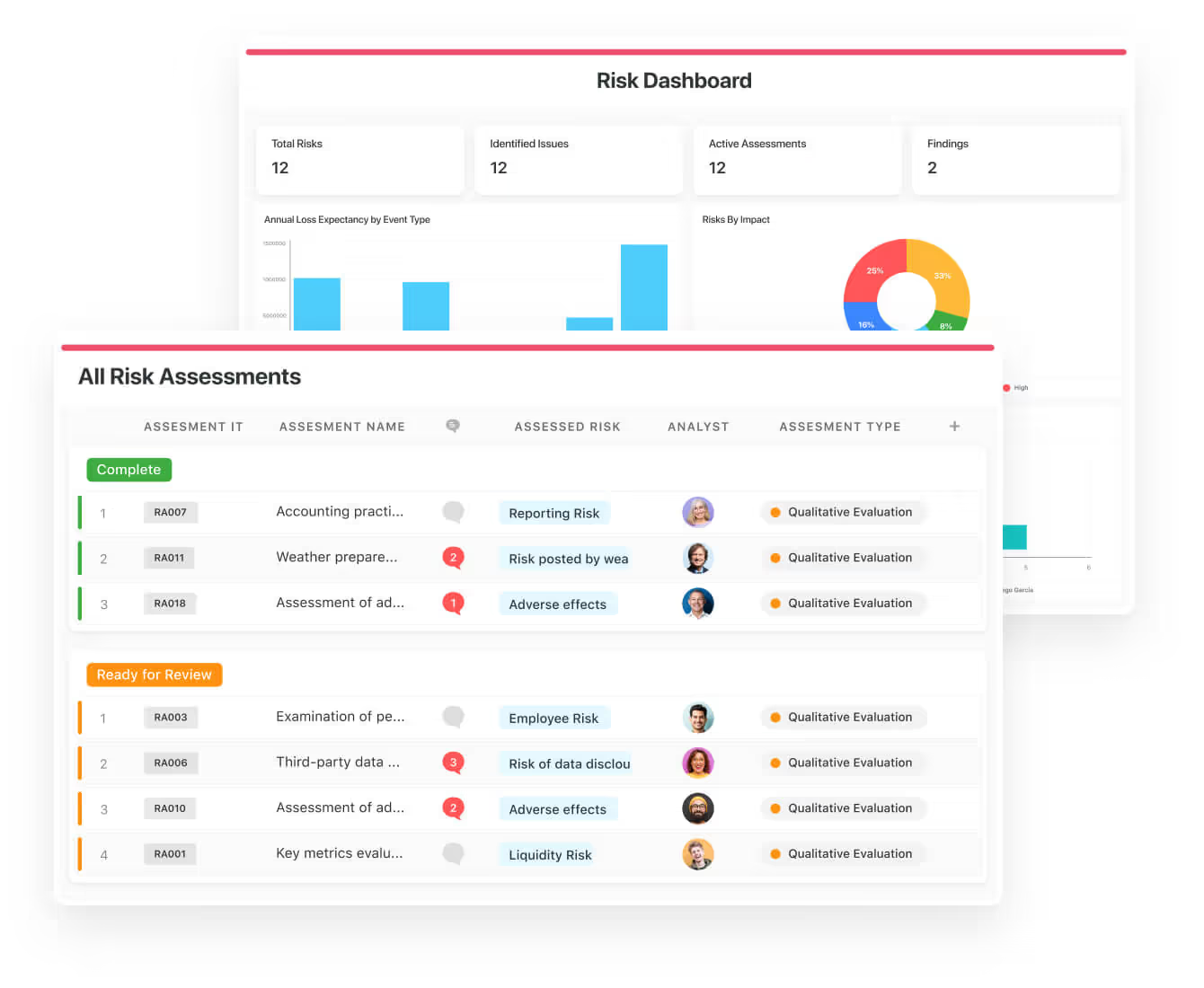
Your team can ensure that the appropriate controls are in place and measure their effectiveness by evaluating risk indicators and displaying results in SmartSuite’s rollup reports and dashboards.
💡 Pro Tip: Teams that use our platform use automation to move tasks through defined workflow stages that comply with their policies and procedures.
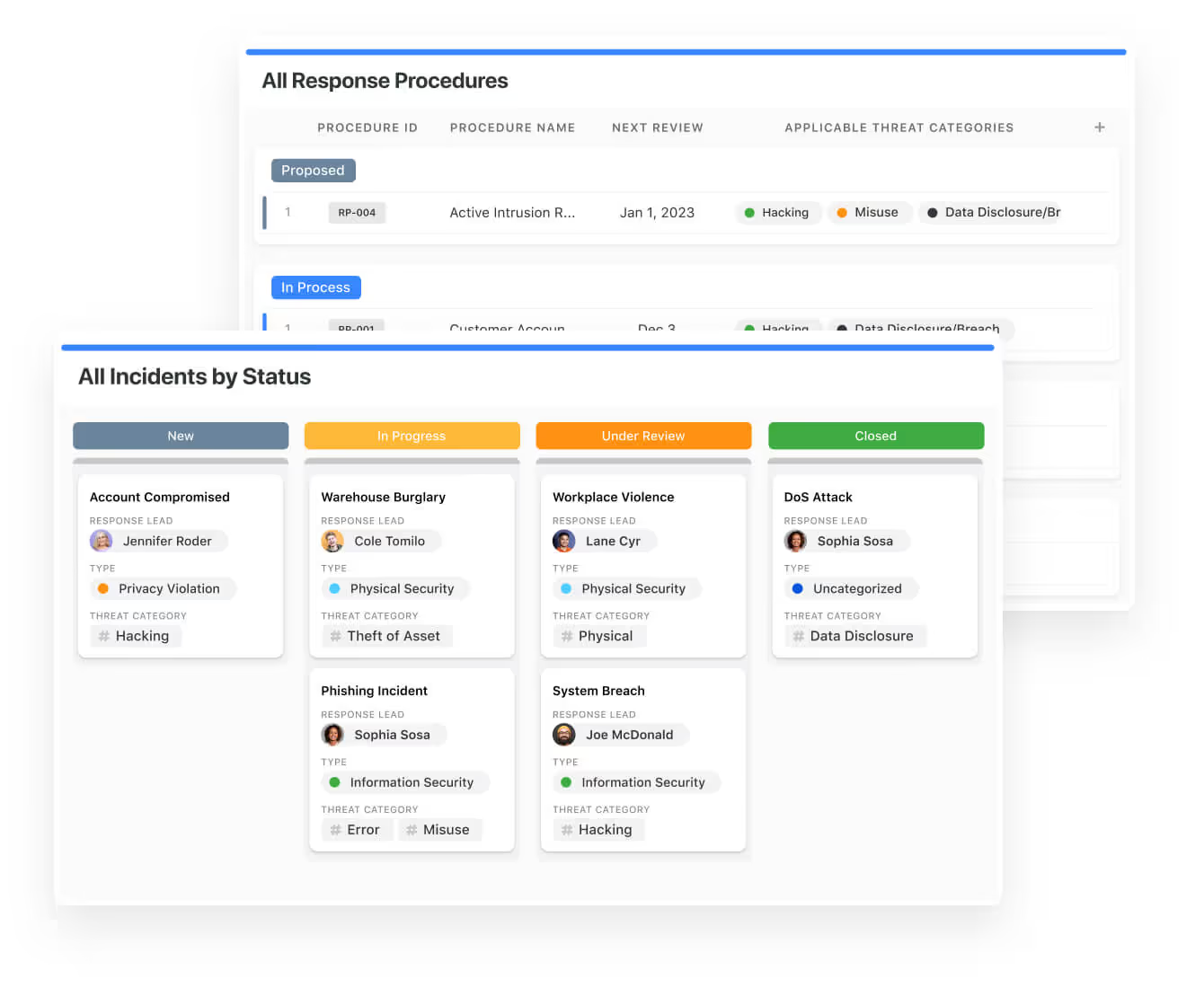
We understand how crucial threat management is and the need to respond quickly to incidents.
SmartSuite lets you centralize incident response and threat mitigation by linking incidents to assets and organizational data to offer context during your investigations.
Your compliance team can also set up automation with our no-code automation builder to escalate critical events to make sure that your team is aware of active risks to your organization.
Ready-To-Use GRC Templates
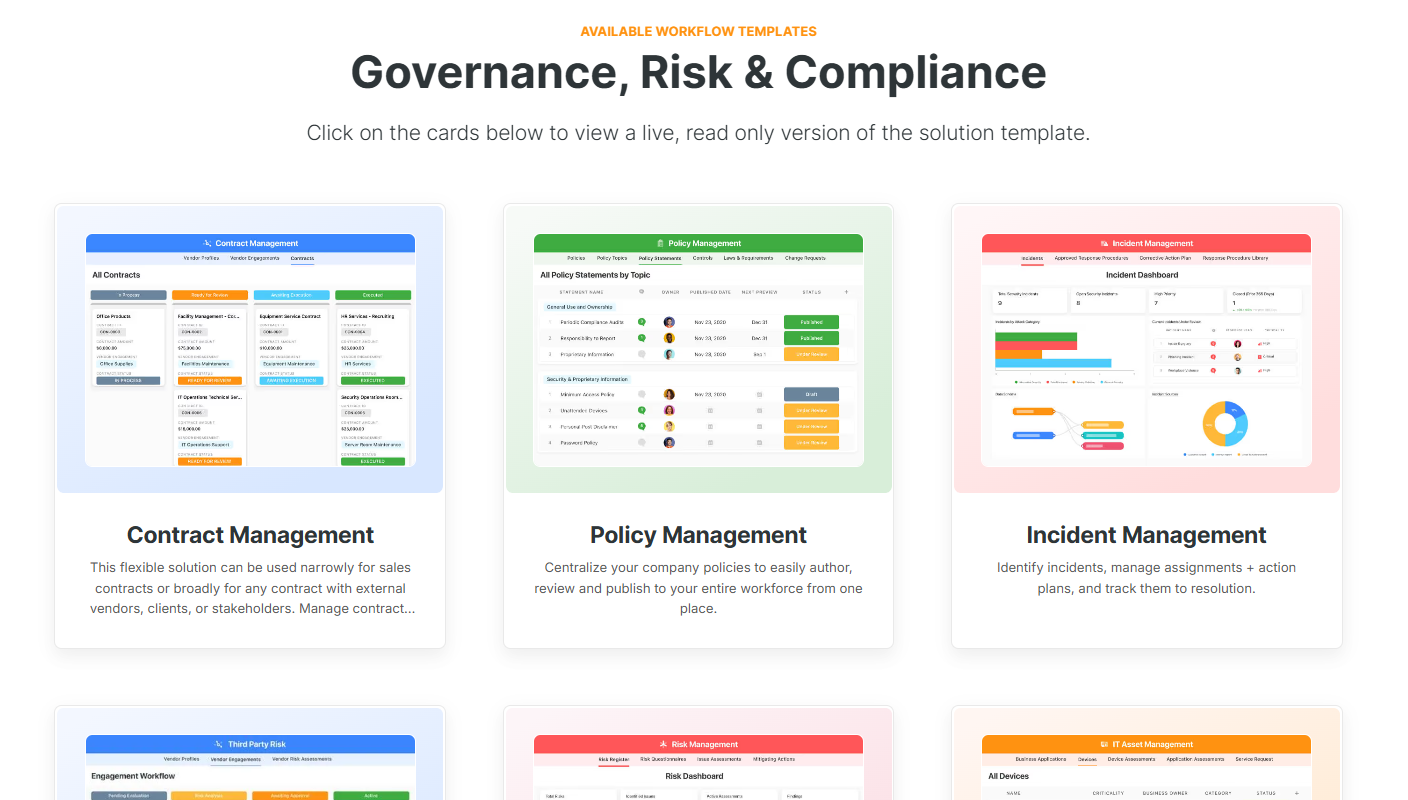
Our team has prepared a few GRC templates for compliance teams looking to get started right away, instead of building everything from scratch.
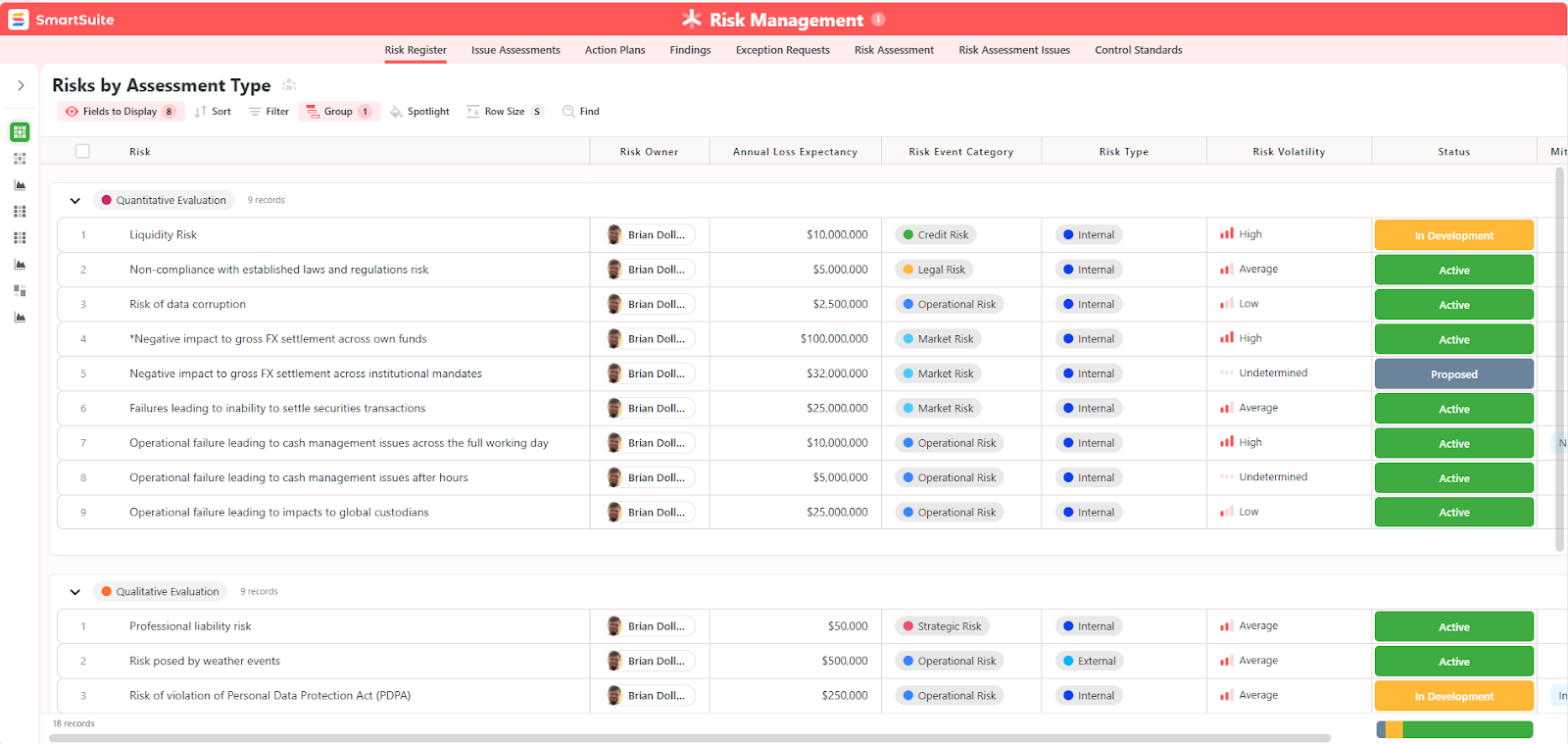
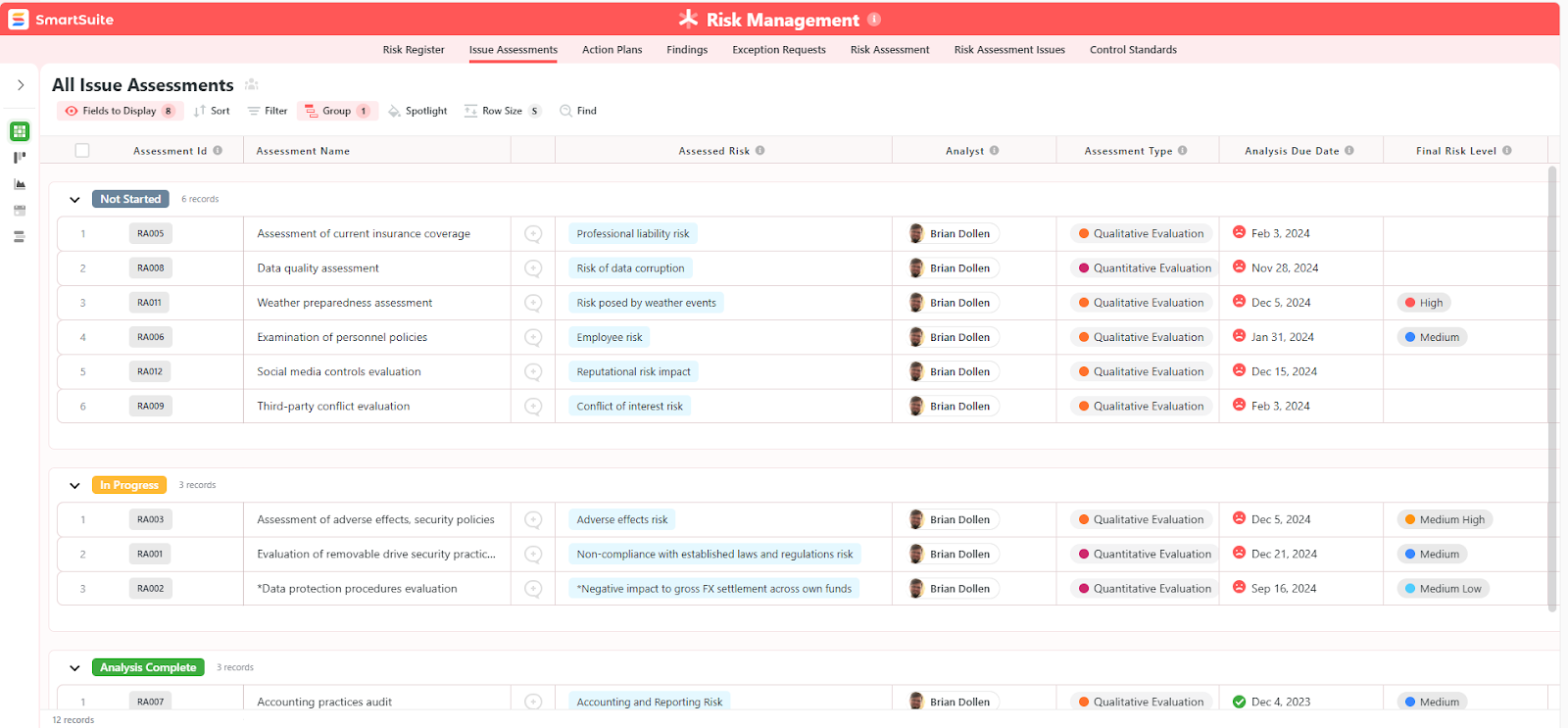
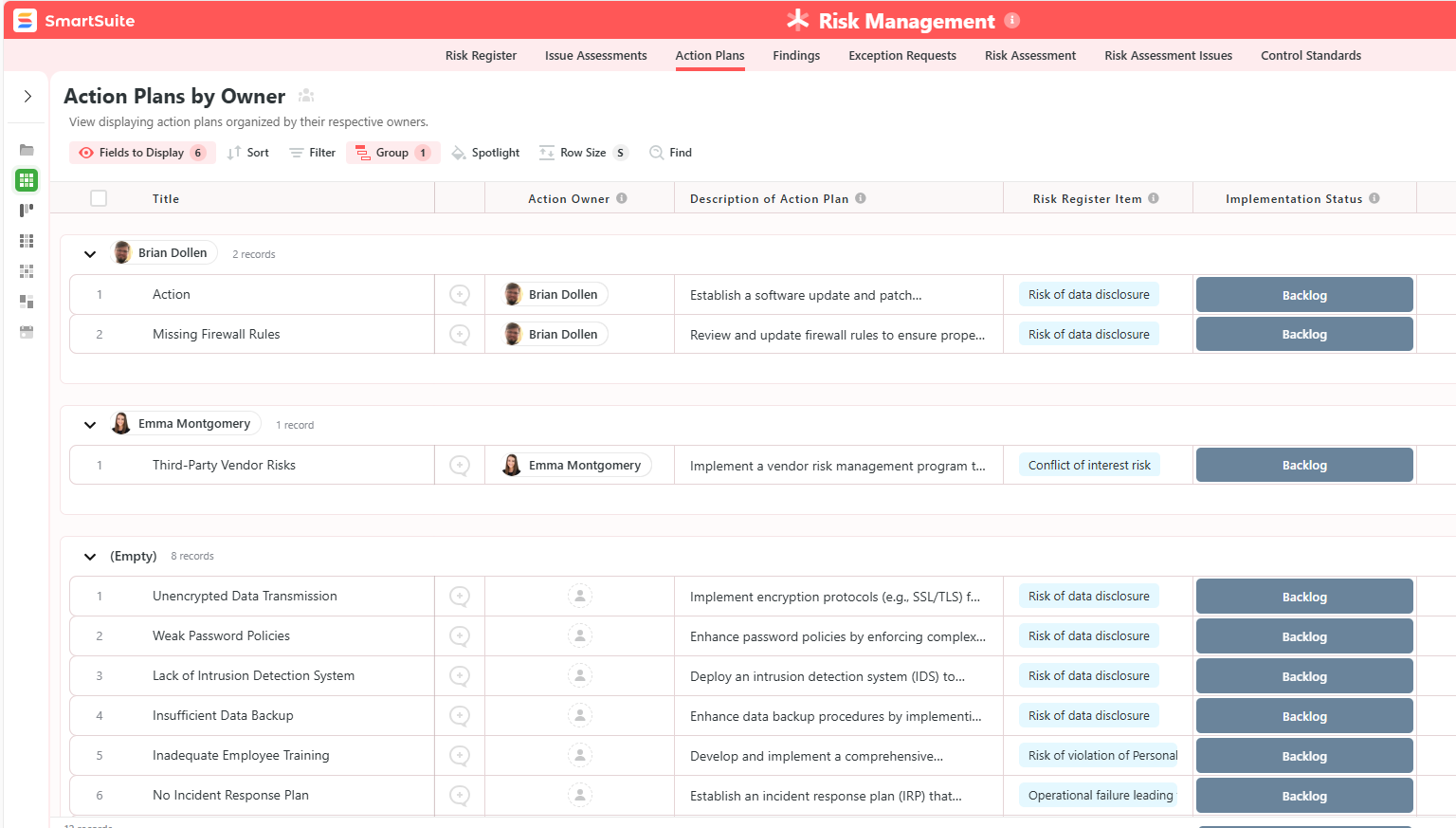
Our general risk management template includes:
- Risk register, where you can break down the risks, the risk owner, the annual loss expectancy, risk event category, risk type, volatility, and status.
- Issue assessments, where you’ll be able to see a comprehensive breakdown of each risk.
- Action plans, where you can describe the actions (best practices) to mitigate the risks.
- A separate tab for control standards, your findings, exception requests, risk assessment by type, and risk assessment issues.
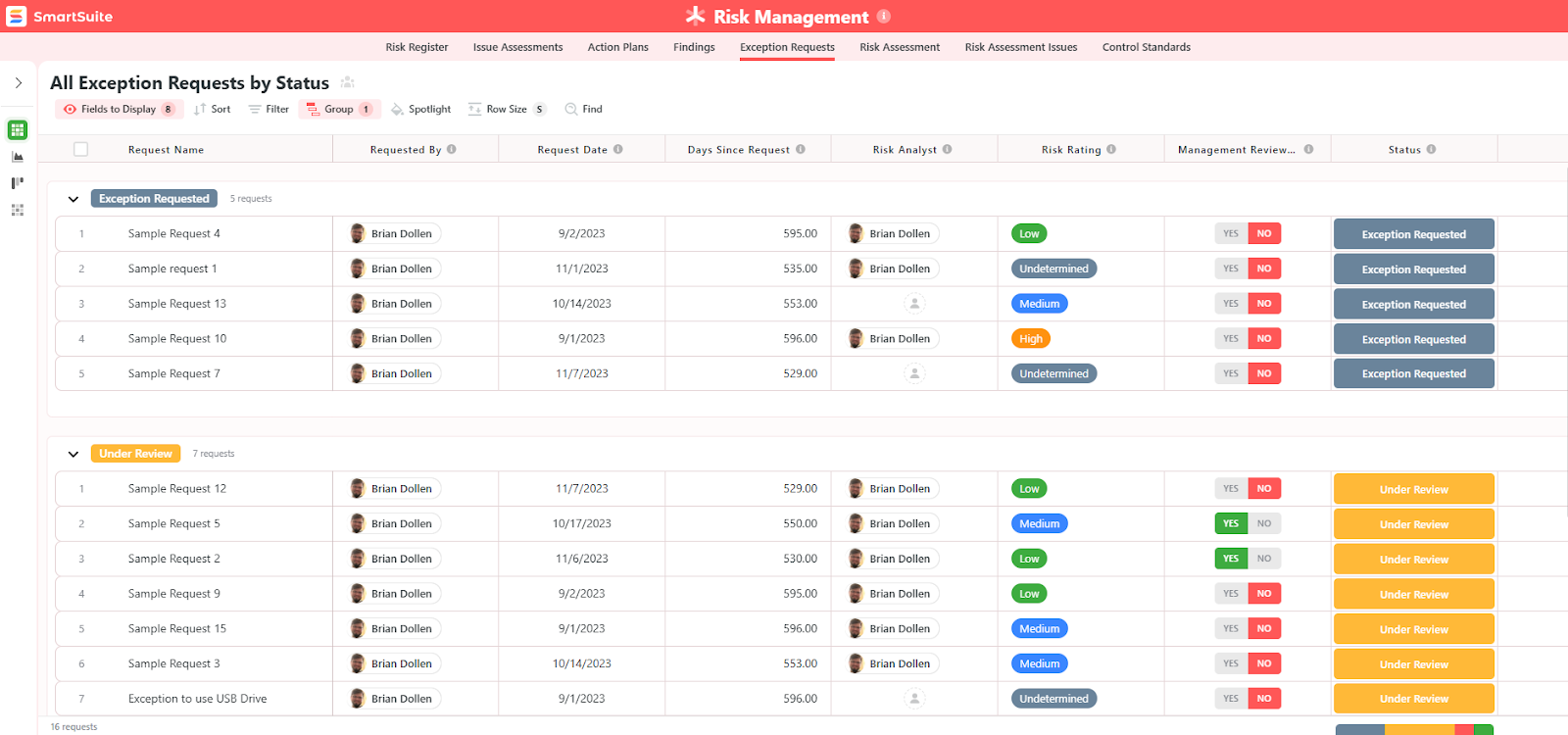
You can customize our risk management template here.
Alternatively, check out and customize our 14 other risk management templates for various use cases, such as contract management, policy management, and incident management.
How does SmartSuite compare to Secureframe?
Secureframe delivers a compliance-first platform focused on automating audit readiness, evidence collection, and framework mapping for standards like SOC 2 and ISO 27001.
It’s a strong fit for mid-market companies that want guided onboarding, automated reminders, and a structured path to staying audit-ready without building processes from scratch.
SmartSuite, on the other hand, offers a true no-code automation platform with flexible compliance and risk templates that let teams design, modify, and scale policy management, vendor risk, and audit workflows without being locked into a single compliance model.
I’d consider SmartSuite to be a better fit for teams that want to set up shop in days (not months), expect their compliance program to evolve over time and need customizable dashboards, a centralized risk register, and automated workflows that adapt as requirements grow, without added platform complexity or pricing surprises.
💡 Case Study: Learn how MediaLab transformed operations, minimized risk, and saved $40,000+ per year by cutting software costs.
SmartSuite’s Pricing
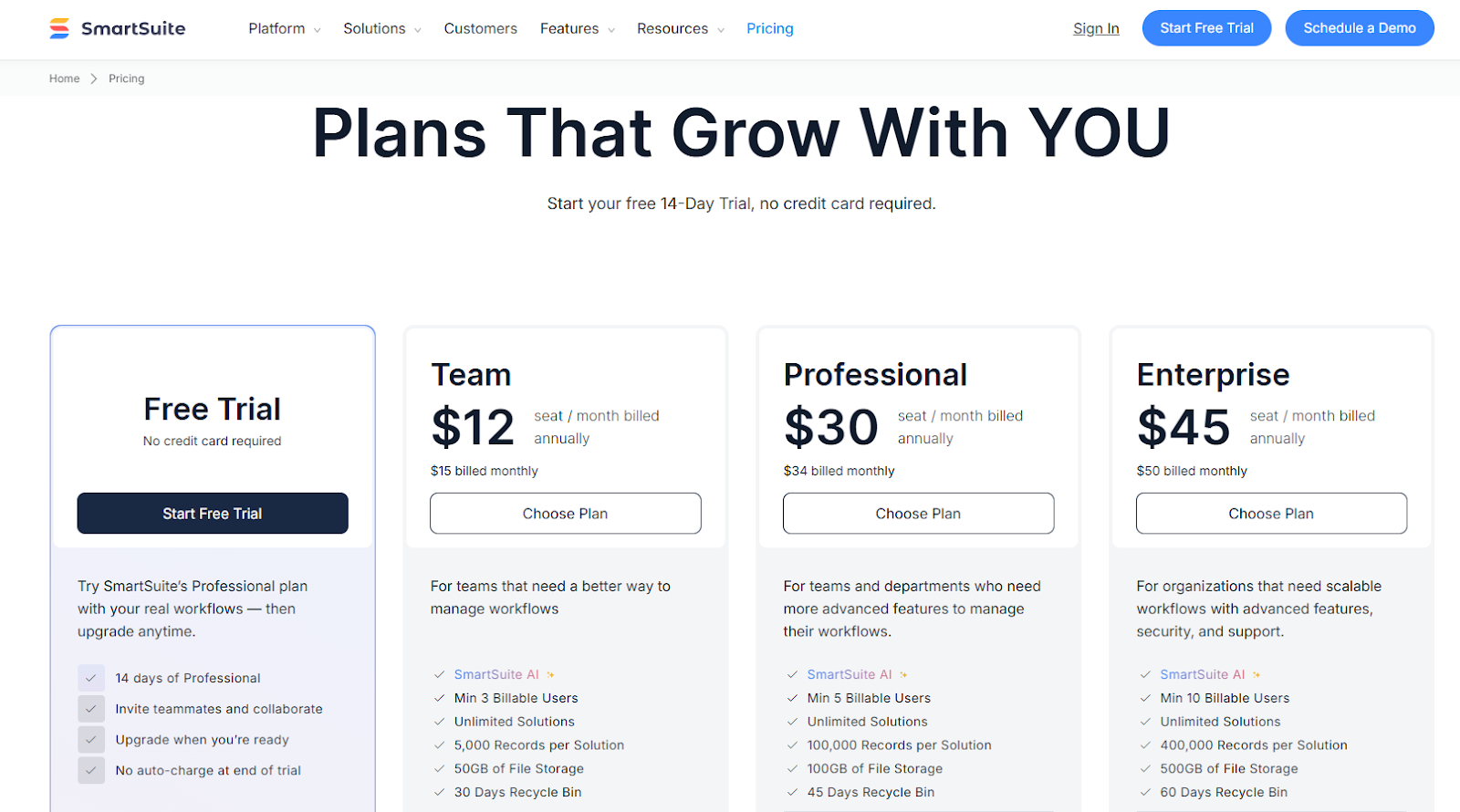
SmartSuite doesn’t have a free plan for its project management platform.
We do, however, have a 14-day free trial of our Professional plan, where you can invite teammates and collaborate.
There are four paid plans that you can choose from:
- Team: Starts at $12/user/month when billed annually, including SmartSuite AI, 8+ dashboard views, 5,000 automation runs, time tracking, and collaborative SmartDocs.
- Professional: Starts at $30/user/month when billed annually, including two-factor authentication, Gmail & Outlook integrations, and unlimited editors.
- Enterprise: Starts at $45/user/month when billed annually, including audit logs, data loss prevention, and 50,000 API calls monthly.
- Signature: Customized plan tailored to your organization’s needs and team size.
Pros & Cons
✅ 15 pre-built GRC templates for various use cases.
✅ Dynamic dashboards and reports that are easy to build and navigate, unlike some alternatives that require you to hire consultants to do it.
✅ All-in-one document and file management.
✅ Automate risk scoring, compliance tracking, audits, and vendor reviews.
✅ A modern solution with an intuitive user interface.
❌ Fewer native integrations when compared to other tools in this list.
#2: Vanta
Best for: Mid-market companies that want to automate compliance and build trust fast via continuous monitoring.
Similar to: Drata.
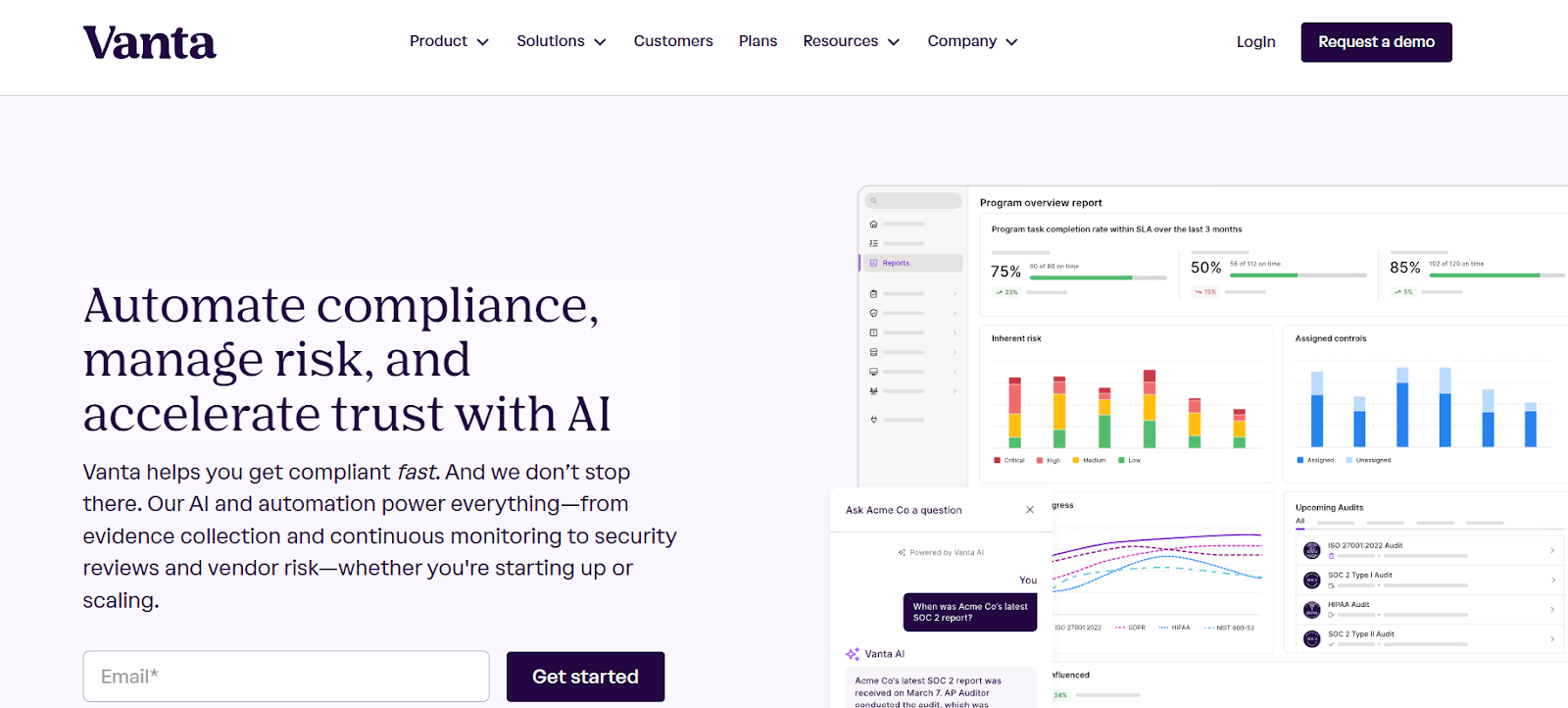
Vanta centralizes compliance operations with its automated control monitoring and continuous evidence gathering across your entire tech stack.
This real-time visibility is what I think makes it a viable Secureframe alternative, as it helps organizations adopt a scalable compliance workflow.
Features
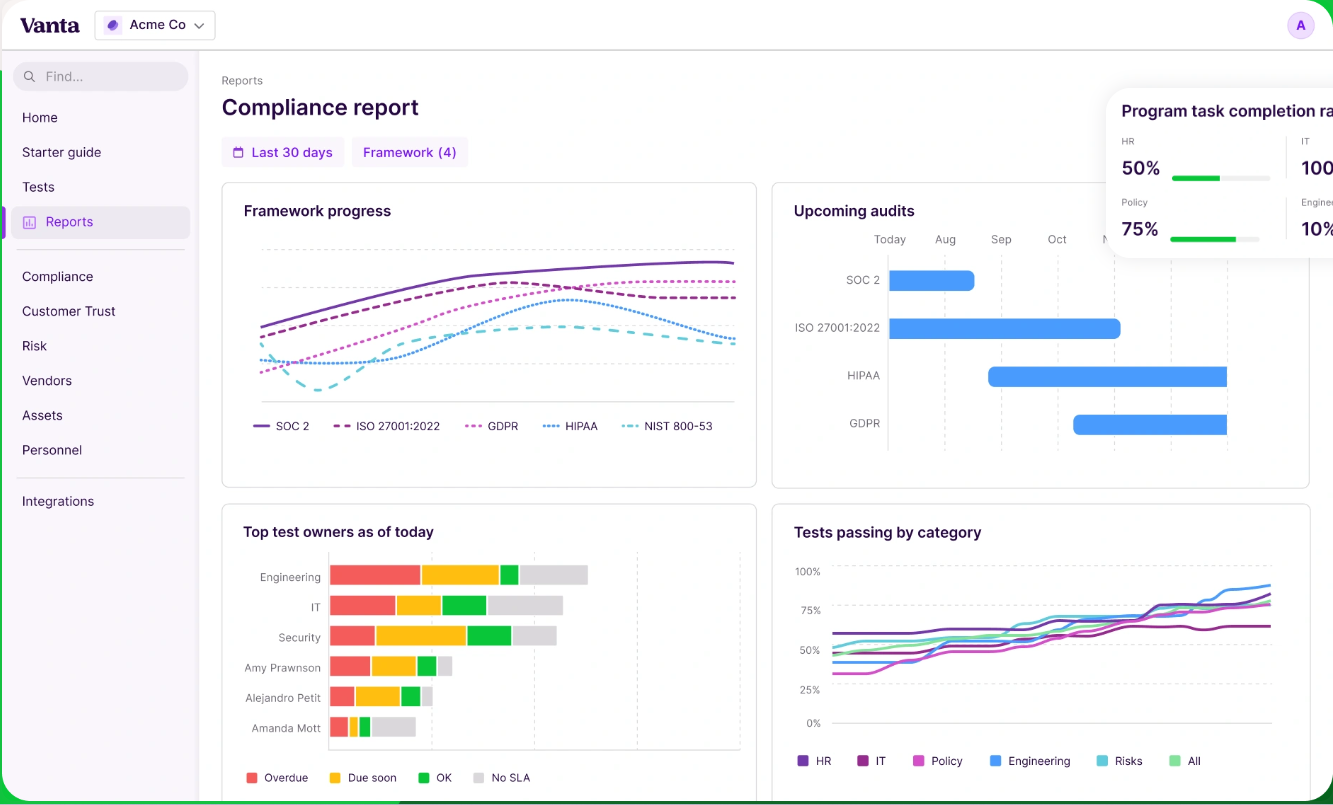
- The tool continuously tests controls, pulls evidence, and lets you cross-map requirements across 35+ pre-built frameworks (or your custom ones).
- You can segment your own controls, risks, and workflows within the same account, so that distributed teams can customize compliance while staying centrally governed.
- Your team can log issues, assign owners, collaborate on fixes, and track remediation to closure.
Pricing
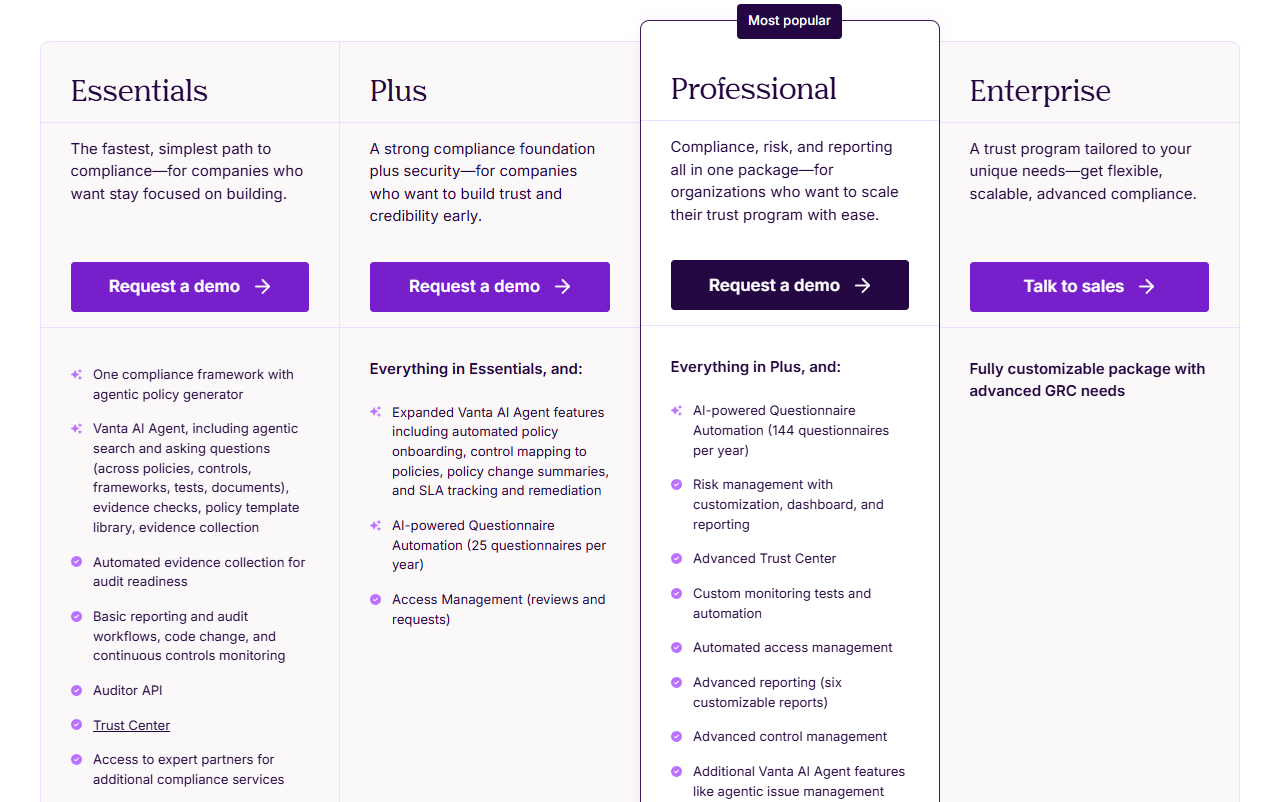
While Vanta doesn’t publish fixed pricing on its website, it offers four clearly defined packages designed for teams of various sizes and compliance needs.
All tiers include Vanta AI, continuous monitoring, automated evidence collection, templates, and core audit workflows, with higher tiers unlocking more automation, customization, and scale.
Here’s how the plans break down:
- Essentials: Includes one compliance framework, automated evidence collection, Vanta AI Agent (policy generation, search, evidence checks), continuous monitoring, basic reporting, auditor API access, and a standard Trust Center.
- Plus: Includes everything in Essentials plus expanded Vanta AI features (automated policy onboarding, control mapping, policy change summaries), SLA tracking, Access Management, and 25 AI-powered questionnaire automations per year.
- Professional: Includes everything in Plus plus full Risk Management with dashboards and reporting, Advanced Trust Center, custom monitoring tests, automated access management, six customizable reports, and 144 AI-powered questionnaire automations per year.
- Enterprise: A fully customizable package tailored for organizations with complex, multi-framework, or global GRC requirements.
If you want the full breakdown, you can feel free to read our complete guide to Vanta’s pricing.
Pros & Cons
✅ Powerful Trust Center that helps streamline customer reviews and strengthen security transparency.
✅ Clean and easy to use interface.
✅ A comprehensive range of integrations when compared to other tools on the market.
❌ Pricing is on the higher side, especially as companies grow or need add-ons like pentesting, vendor risk, or additional questionnaire automation.
❌ A reported steep learning curve starting from the onboarding.
#3: LogicGate
Best for: Enterprises that need a configurable, no-code GRC platform that is capable of scaling across risk, vendor, audit, policy and regulatory domains.
Similar to: OneTrust.
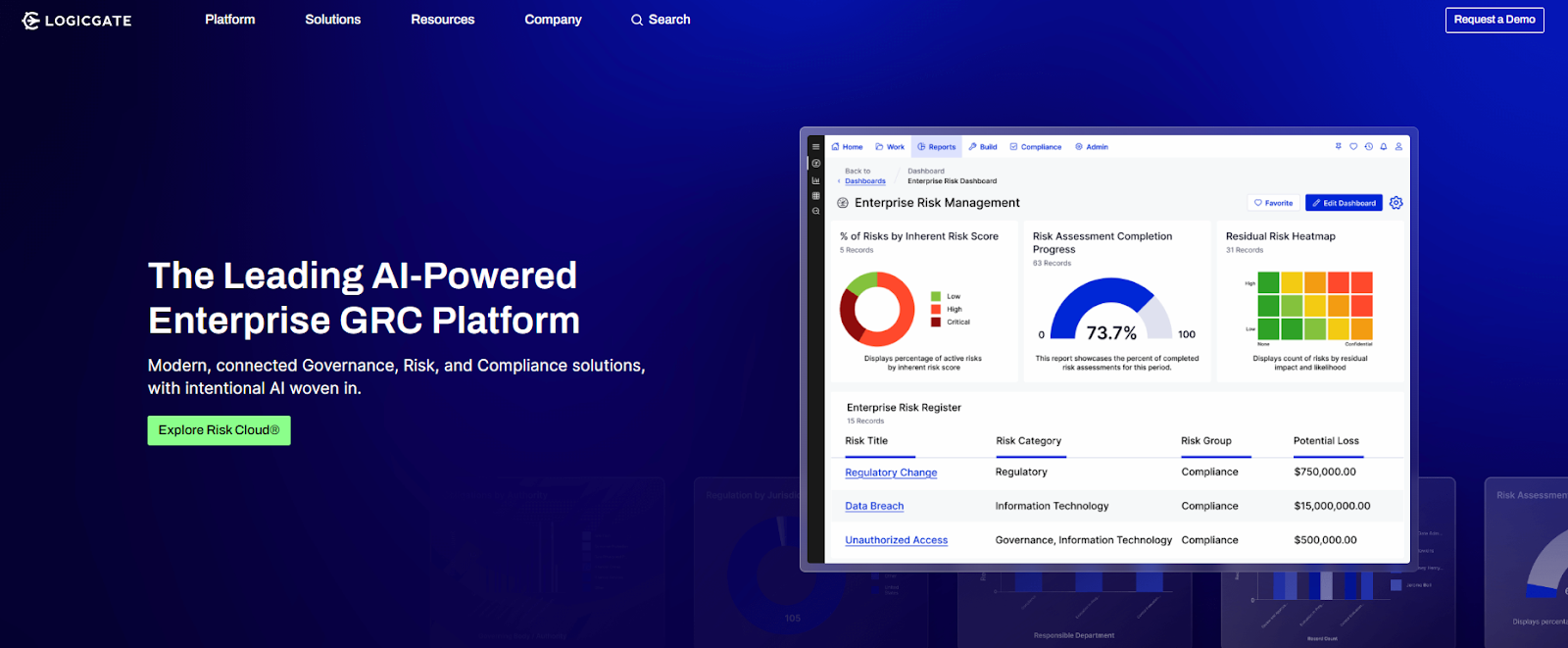
LogicGate stood out to me as a compelling alternative to Secureframe, as it combines no-code configurability with strong automation, real-time analytics, and AI-enabled features.
It’s built for companies with mature or evolving GRC needs that require a platform capable of adapting quickly as programs expand.
Features
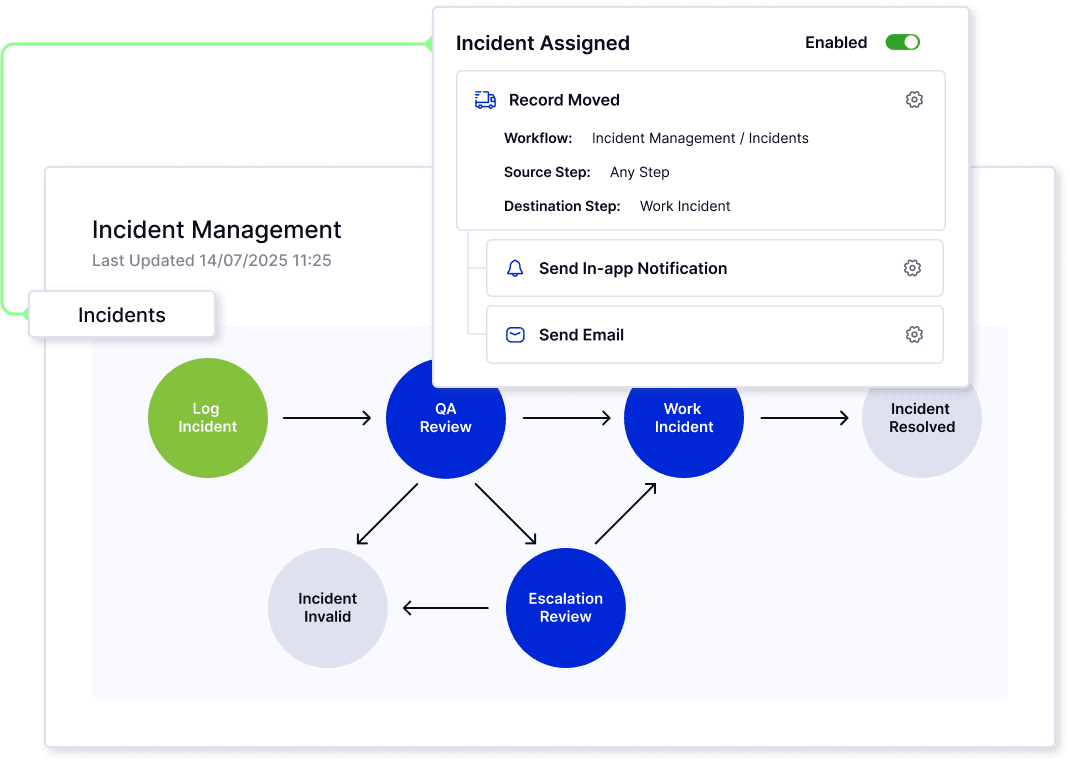
- No-code graph database and workflow builder that lets your team quickly model and modify complex GRC processes without relying on IT.
- Built-in AI (Spark AI) and automated evidence collection that helps analyze data, generate insights, and automate evidence gathering.
- LogicGate’s dashboards, heat maps, and Monte Carlo & Open FAIR models translate technical risks into clear insights that you can act on.
Pricing
LogicGate uses a fully custom pricing model that you’ll need to get in contact with them to learn more about and get a quote.
For context and typical pricing ranges, you can refer to our full LogicGate pricing review.
Pros & Cons
✅ Strong automation features.
✅ Highly configurable no-code environment.
✅ Built-in AI and automated evidence collection.
❌ Gaps in evidence automation, as some users note that automated evidence collection isn’t as robust as in some competitor platforms.
❌ The platform can get expensive for the full solution.
#4: OneTrust
Best for: Enterprises looking for best-in-class privacy, third-party risk, and compliance automation within a unified GRC framework.
Similar to: LogicGate.
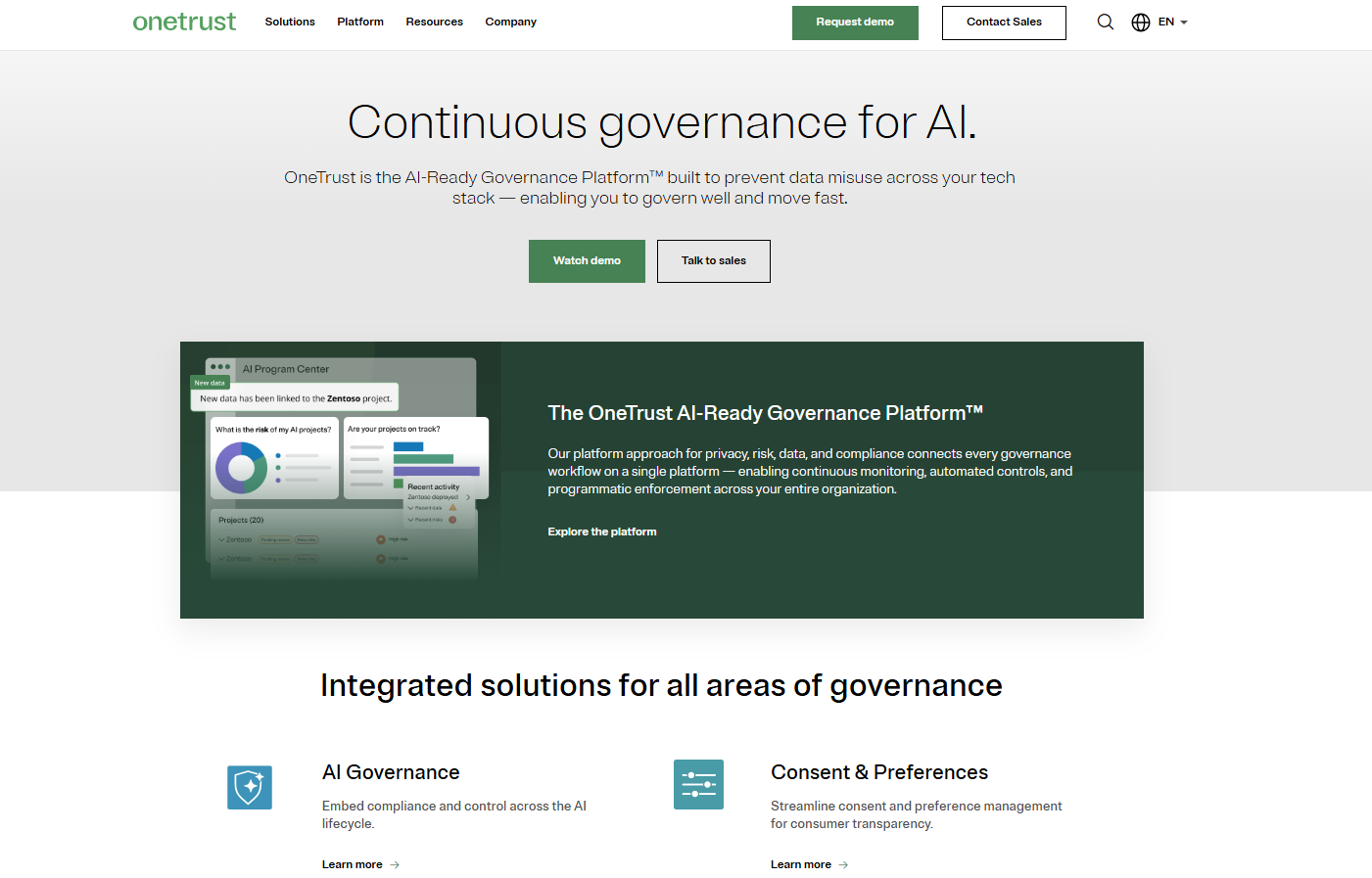
OneTrust is a platform that centralizes risk, compliance, privacy, and third-party workflows, empowering teams to automate controls, map regulatory frameworks, and embed governance across data and operations.
I’d recommend OneTrust as a Secureframe alternative for companies looking for a broader trust solution that integrates modules for AI governance, ethics, and consent management.
Features
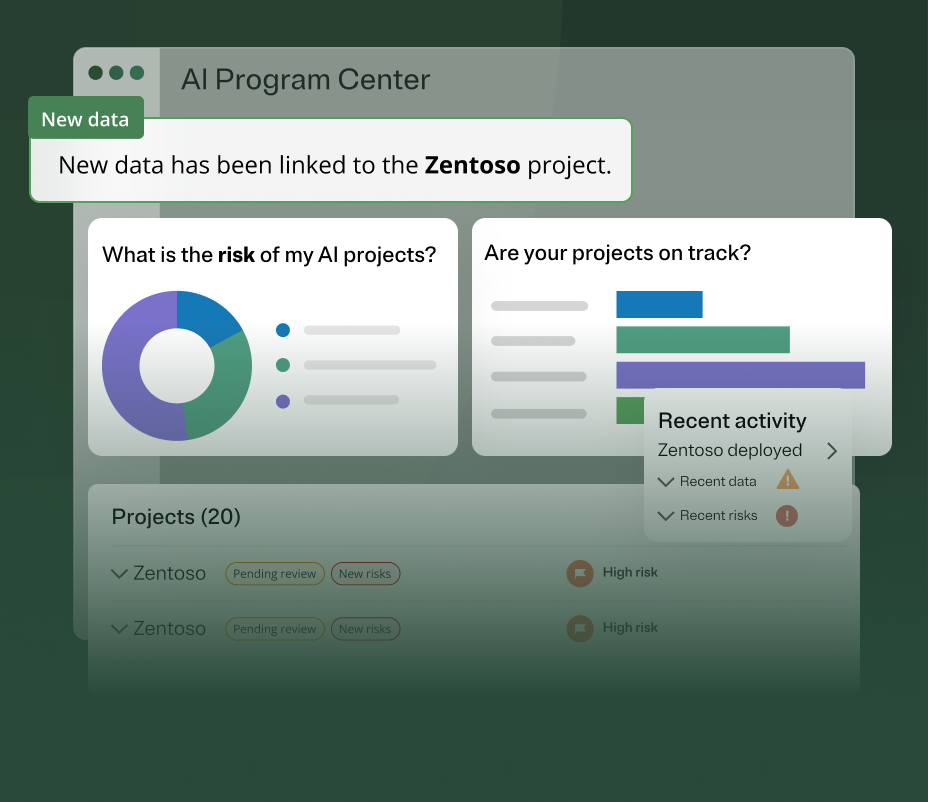
- Centralizes oversight of your organization’s AI activities by automating risk assessments, tracking model performance throughout the lifecycle, and continuously mapping compliance, ensuring transparent, ethical, and compliant AI use.
- Supports automation across 50+ frameworks (e.g. GDPR, NIST, ISO) with built-in mapping and scoping tools.
- End-to-end privacy operations automation to help you scale compliance and accelerate responsible data use.
Pricing
OneTrust has several major product packages, some of which have more than one tier:
- Consent & Preferences:
- Consent Management Platform: Pricing based on average daily visitors aggregated across all channels and properties.
- Universal Consent & Preference Management: Pricing based on total data subject profiles captured.
- Privacy Automation (Pricing based on users and privacy asset inventory for both plans):
- Base.
- Suite.
- Third-Party Risk Management (Pricing based on admin users and third-party inventory for both plans):
- Base.
- Suite.
- Tech Risk & Compliance: Pricing based on admin users and asset inventory.
- AI Governance: Pricing based on admin users and AI inventory.
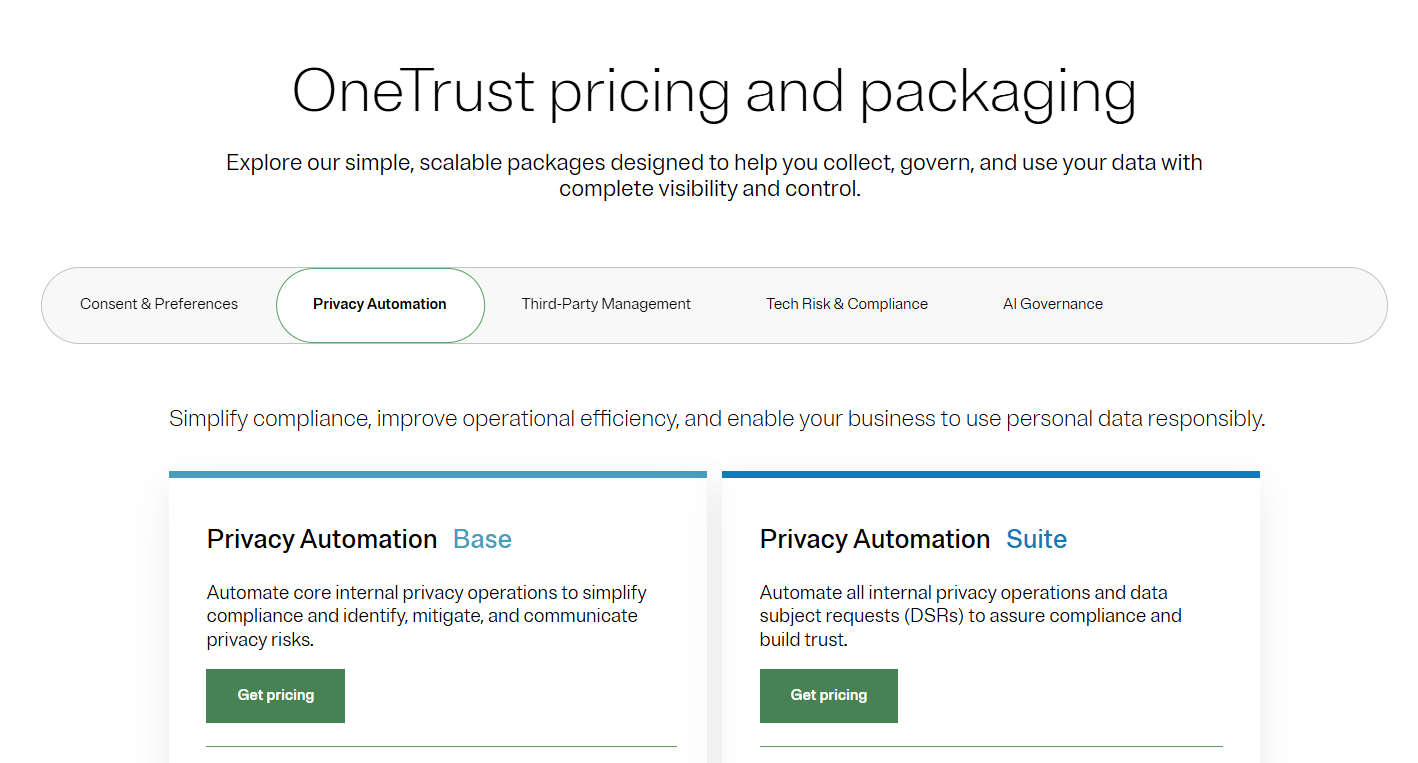
There are no prices disclosed for any of the plans, so you’ll have to contact its sales team or check out our in-depth OneTrust pricing guide.
Pros & Cons
✅ Strong automation and regulatory support.
✅ Clean, intuitive UI.
✅ Supports automation across 50+ frameworks, including GDPR, NIST, and ISO.
❌ Custom pricing and modular fees can make budgeting harder.
❌ Limited reporting capabilities, as users would like to see better out-of-the-box reporting from the platform with more options in their Dashboards.
#5: Workiva
Best for: Companies that want to combine financial reporting, audit, ESG, and risk management into one solution.
Similar to: Protecht.
Workiva is a cloud-native tool that unifies GRC and reporting workflows so that your team no longer has to juggle disconnected tools.
What I like about the platform is that it’s designed to give you one shared workspace for control testing, audit-ready documentation, and real-time transparency.
Features
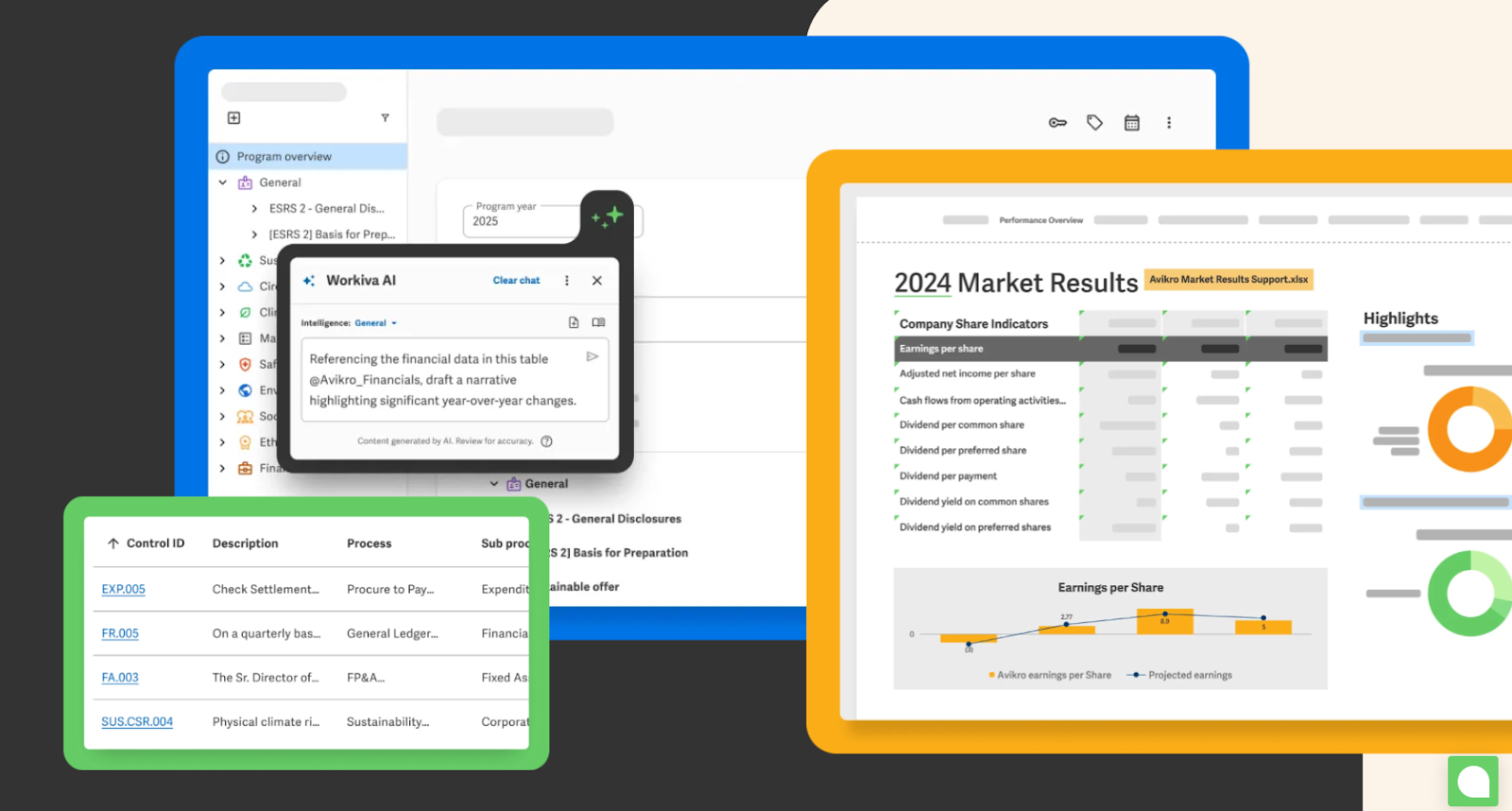
- Lets you effortlessly explore its entire Workiva workspace by locating key data points within files, cells, and slides to accelerate reporting and decision-making.
- Workiva AI transforms GRC operations with its built-in intelligence that automates risk analysis, enhances compliance assurance, and delivers audit-ready insights instantly.
- The platform delivers role-based dashboards and audit trails across all workflows to provide you with a centralized risk view.
Pricing
Workiva doesn’t publish standardized pricing, as costs probably depend on scope, modules, user counts, and deployment needs.
You’ll need to request a quote to see how licensing and costs scale for your use case, or take a look at our in-depth pricing guide that breaks down all the details.
Pros & Cons
✅ Intuitive and user-friendly interface.
✅ Seamless collaboration with real-time co-editing, version control, and built-in audit trails that eliminate email chains and manual reconciliation.
✅ Audit trails across all workflows, covering for one complaint of Secureframe where an auditor still asked for some evidence that the platform never flagged as required before the audit.
❌ The platform requires a significant investment to get up and running.
❌ Some users mention that they’ve experienced bugs that relate to link capabilities, formatting, task processes, and exporting.
#6: Protecht
Best for: Companies looking for a highly configurable, enterprise-grade GRC platform where risk, controls, compliance, audit and incident workflows are unified.
Similar to: ServiceNow GRC.
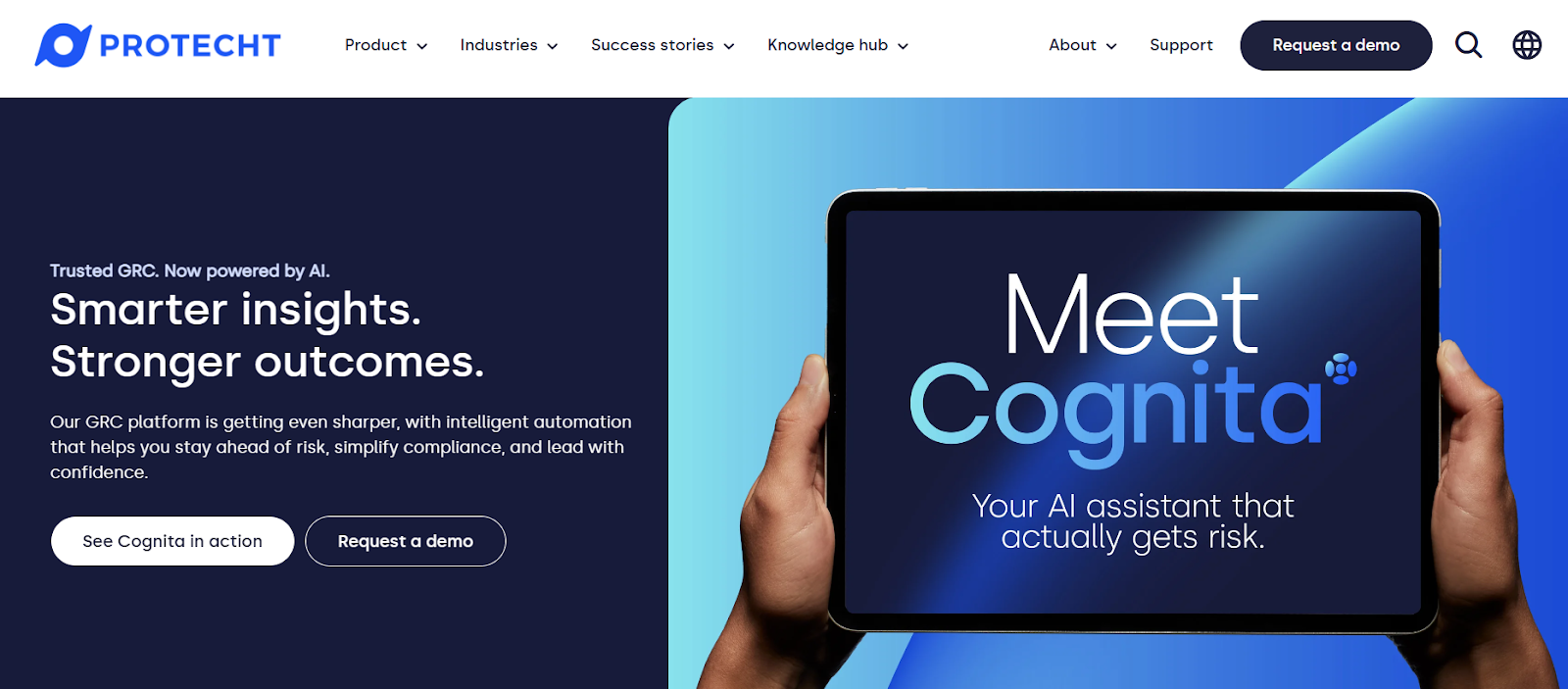
Protecht offers a single, scalable GRC solution that lets you capture, assess and respond to risk across the entire organization, helping link risks to controls, incidents, KRIs and business objectives.
What I like about the tool is that it’s designed for teams that want deep flexibility without being locked into rigid workflows or coding-heavy customizations.
Features
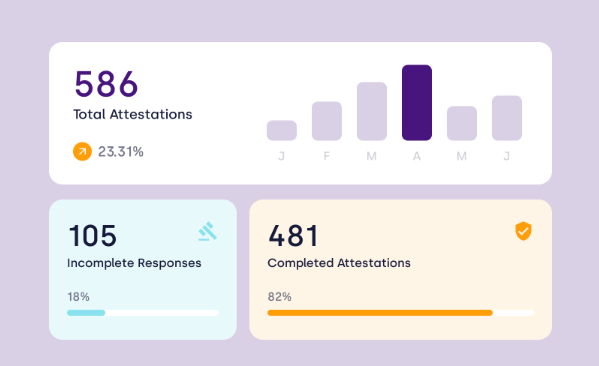
- Cognita: Protecht’s AI-powered risk assistant that blends deep risk expertise with automation.
- Connected risk lifecycle view: Protecht ties together risk appetite, risk registers, incidents, controls, KRIs and issues into one structured system.
- You can build data capture forms, workflows, taxonomies, dashboards and reports without technical support.
Pricing
Protecht doesn’t list public pricing tiers or predefined packages.
Instead, it uses a custom-quote model, with annual licensing fees determined by the number and type of users in your organization.
Extra charges apply for advanced modules - like Operational Resilience or pre-built templates from the Protecht Marketplace - depending on your configuration needs.
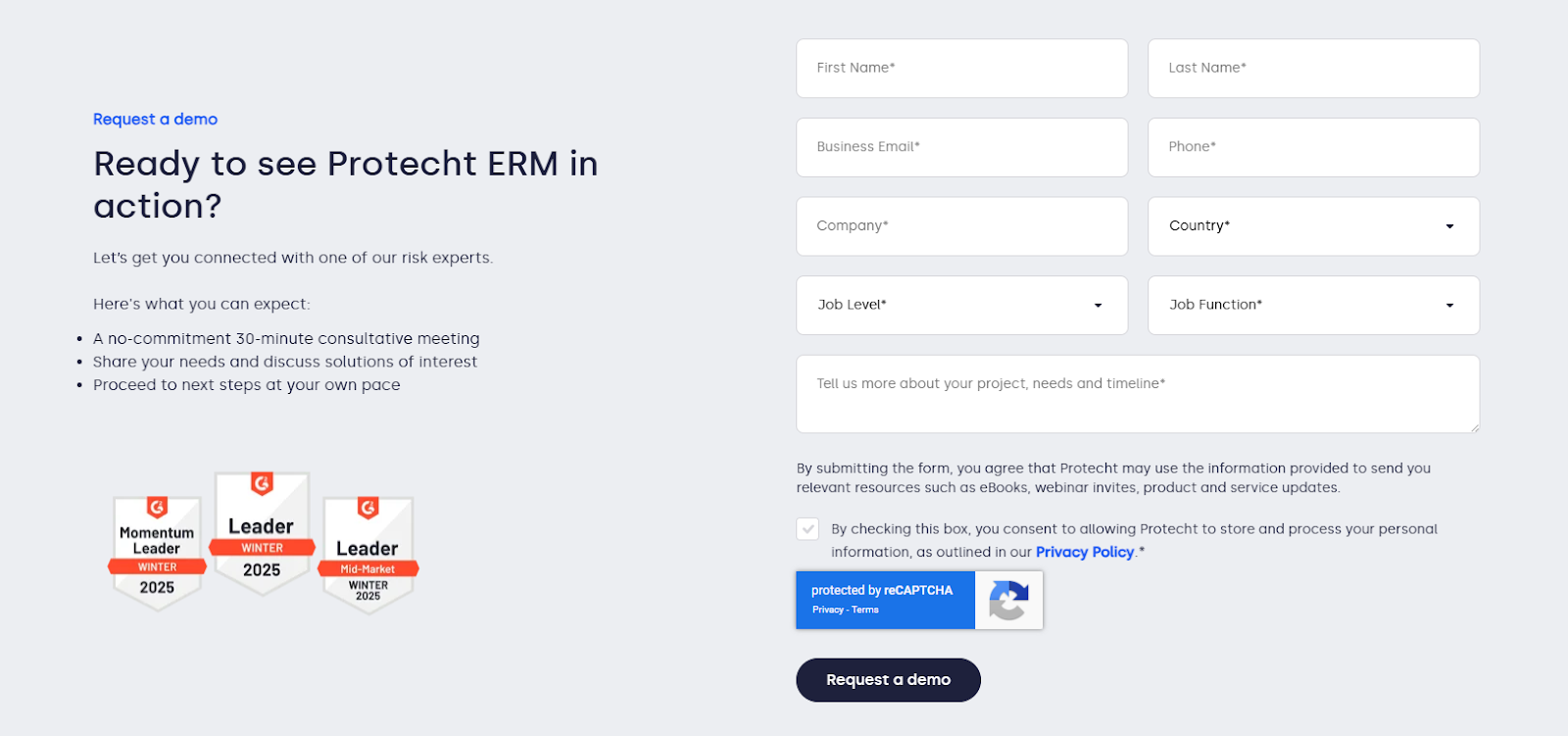
To get more information, you can request a demo from its team or take a look at our in-depth Protecht pricing review.
Pros & Cons
✅ Highly customizable and flexible without coding.
✅ Offers a variety of customizable dashboards that give stakeholders clear visibility into risk exposure and performance.
✅ An AI-powered risk assistant that combines deep risk expertise with automation.
❌ Steep learning curve and dated UI: the tool’s customization, which comes with hidden complexity.
❌ Dashboards and reporting require extra setup or cost.
#7: ServiceNow GRC
Best for: Enterprises already using ServiceNow that want GRC deeply integrated with operational workflows.
Similar to: Hyperproof.
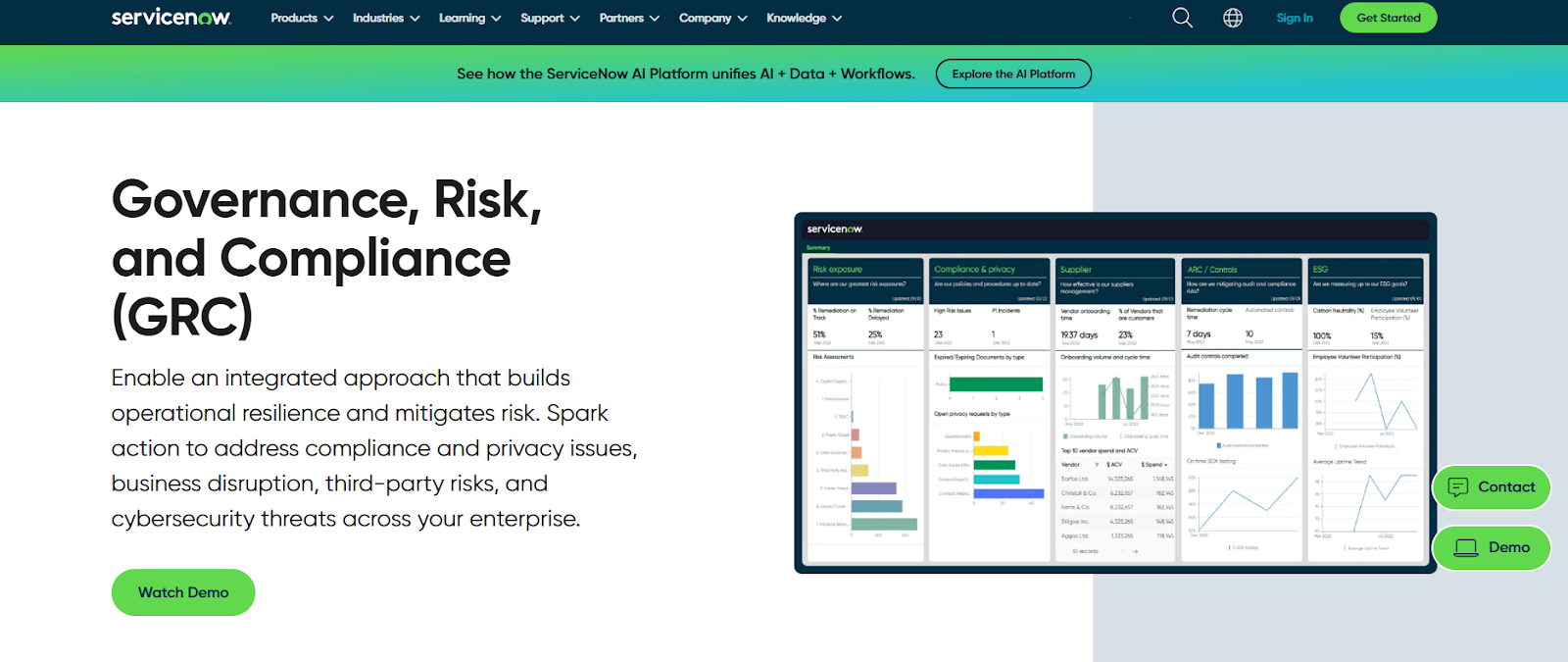
ServiceNow brings GRC into the wider ServiceNow platform so risk, control and compliance processes are embedded in the same workflows that run IT, security and business ops.
The tool’s strength is cross-workflow automation and enterprise scale, turning risk signals into actions across teams, making it a solid alternative to Secureframe.
Features
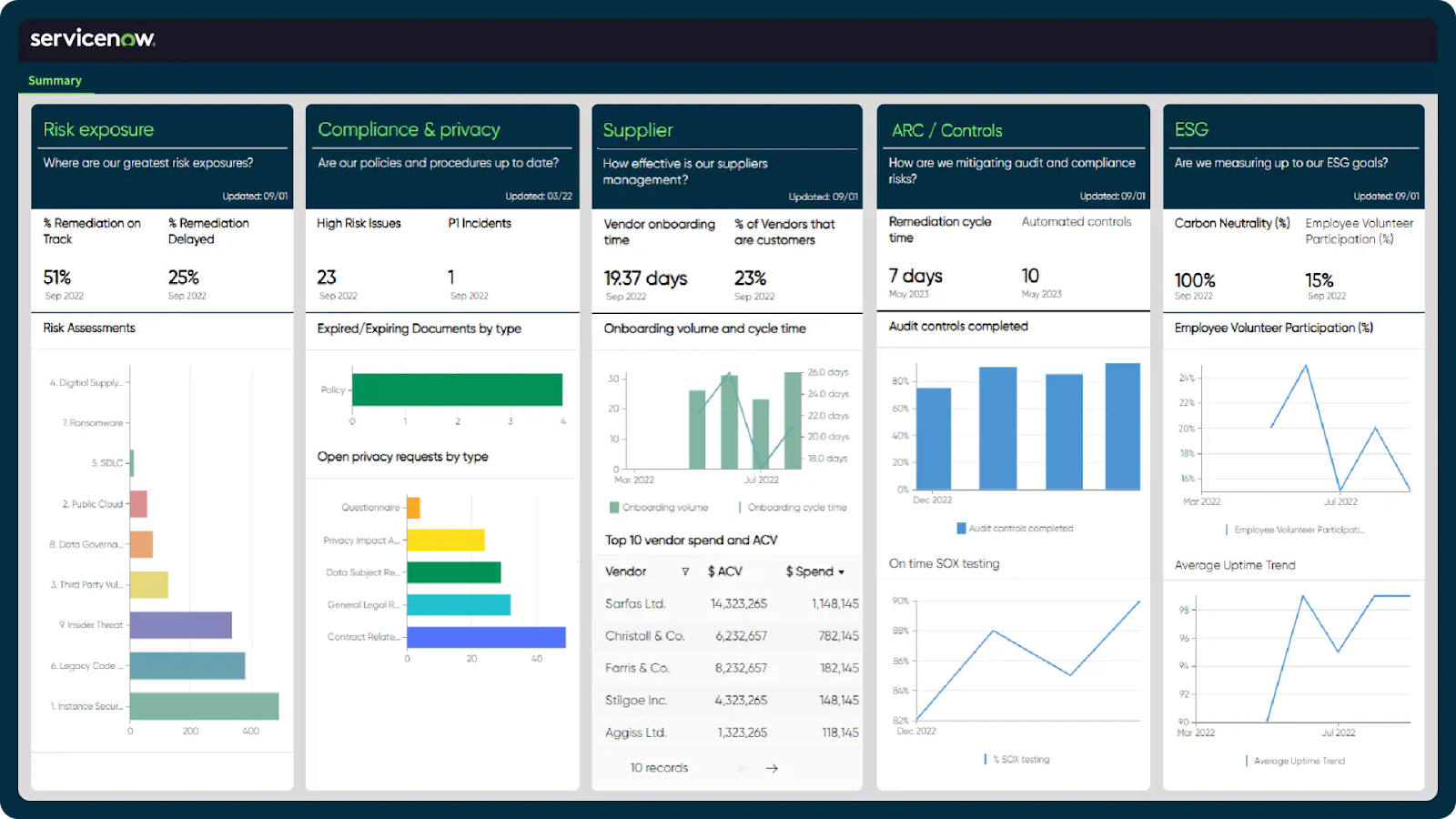
- Automated, workflow-driven risk and compliance orchestration that connects issues, audits, and remediation tasks into one traceable lifecycle.
- The GRC solution operates on ServiceNow’s Now Platform, which enables seamless data sharing and real-time collaboration across all GRC products.
- Third-party risk management that lets your team identify and mitigate risks from external vendors and partners.
➡️ Learn more about ServiceNow in our in-depth ServiceNow review.
Pricing
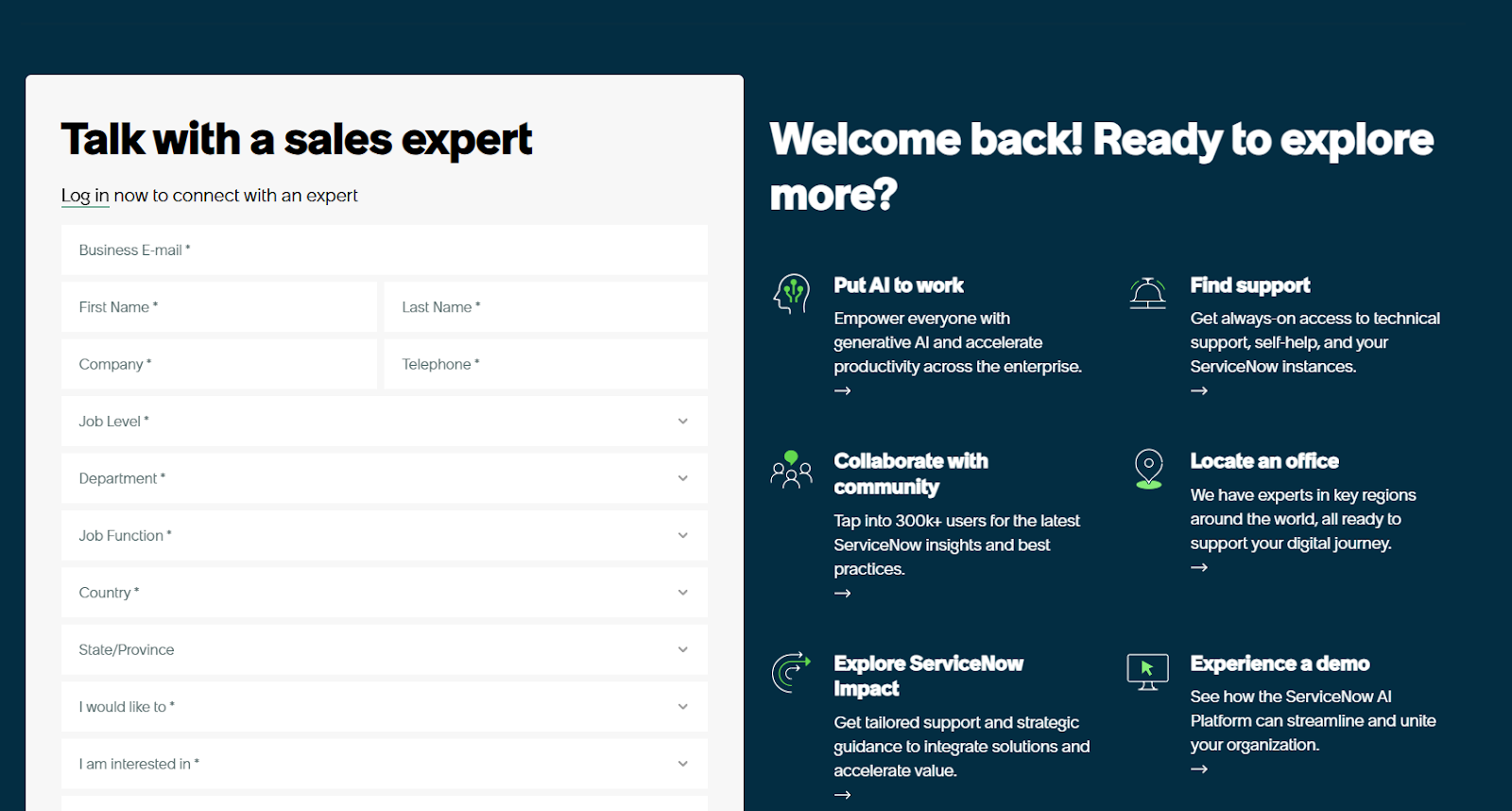
ServiceNow’s pricing is not currently disclosed, so you’d have to book a demo with their team.
However, we looked at ServiceNow customer and public reviews, which show that the average cost of ServiceNow contracts can range between $50,000 and $500,000 annually.
The pricing structure depends on the number of licenses, features, and other configuration requirements.
Pros & Cons
✅ Comprehensive GRC management capabilities that are covering for the weaknesses of 360factors.
✅ Real-time risk monitoring and prioritization.
✅ A comprehensive range of native integrations with other tools.
❌ Steep learning curve and complexity, unlike some ServiceNow alternatives.
❌ Training, skills development, and ongoing support can be expensive.
#8: Drata
Best for: Compliance teams that need to automate controls, manage multiple frameworks, and scale their GRC program with deep real-time visibility.
Similar to: Vanta.

Drata is a cloud-native compliance and GRC automation solution that’s a viable alternative to Secureframe for teams that want continuous control monitoring, audit readiness, and a single pane of glass across frameworks like SOC 2, ISO 27001, HIPAA and GDPR.
From automated evidence collection to customizable risk scoring and control mapping, Drata positions itself as a modern upgrade from manual or checklist-based compliance workflows.
Features
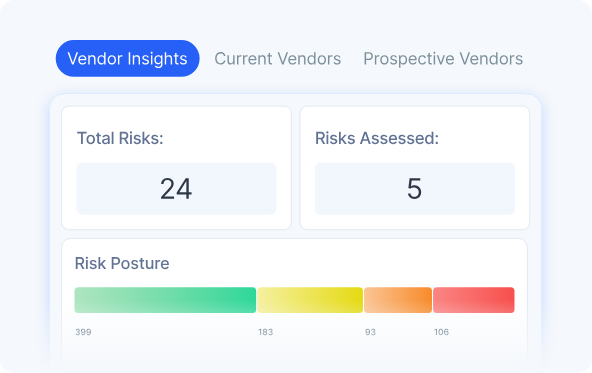
- Automated control monitoring & evidence collection: Drata connects to hundreds of systems (cloud providers, ID-providers, HRIS, DevOps tools) and automatically maps configurations such as MFA, access reviews or encryption status to compliance controls.
- Real-time dashboards & auditor collaboration: With live control health dashboards, an audit hub for external reviewers, and direct evidence access, Drata enables teams to stay audit-ready and provide stakeholders with visibility into compliance posture.
- Multi-framework support & scale: The yool supports a wide range of frameworks (e.g., SOC 2, ISO 27001, HIPAA, GDPR, NIST 800-53) and lets you scale from one compliance framework to many.
Pricing
Drata doesn’t publish its pricing structure.
You can request a demo to get more details about its modules and costs, or look into our in-depth Drata pricing guide.
Pros & Cons
✅ Best-in-class compliance automation capabilities.
✅ Connects easily with tools like AWS, Microsoft 365, Intune, and other core business systems, keeping compliance fully embedded in daily operations.
✅ Centralize your GRC and assurance into a single platform.
❌ Limited customization of various GRC templates.
❌ The platform is not as intuitive as you’d expect.
#9: Hyperproof
Best for: Mid-sized organizations looking for a modern, flexible compliance and GRC solution that supports multiple frameworks and scales risk & audit management.
Similar to: Onspring.
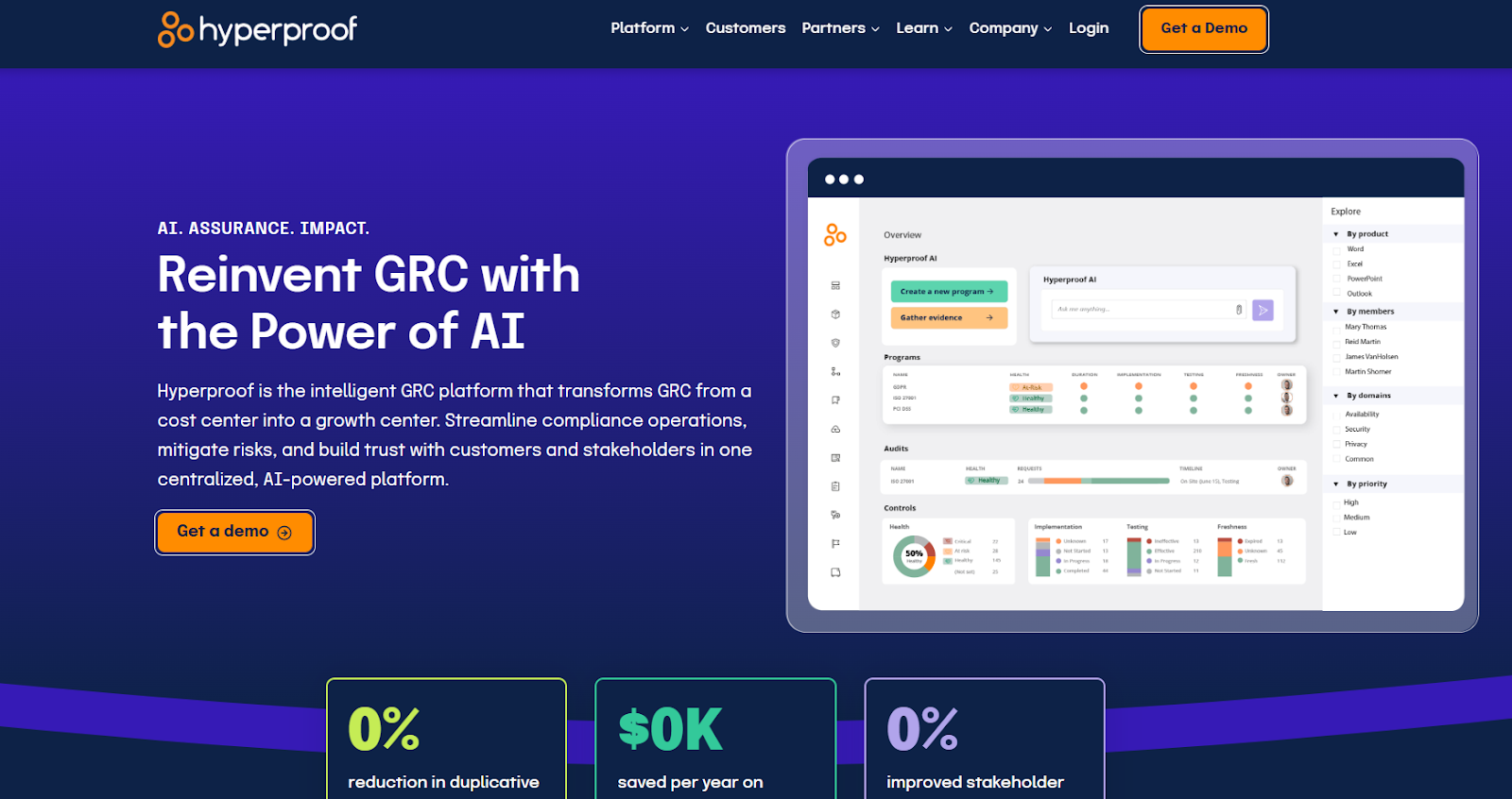
Hyperproof is built as a unified compliance-operations platform designed to reduce the burden of managing multiple regulations, audits, risks, and controls.
It combines ease of use with enterprise-capable features: clean UI, strong integrations, and a modern workflow engine.
At the same time, what I like about the tool is that it supports risk, audit, vendor, and control workflows, making it a strong contender for GRC teams looking for a Secureframe alternative.
Features
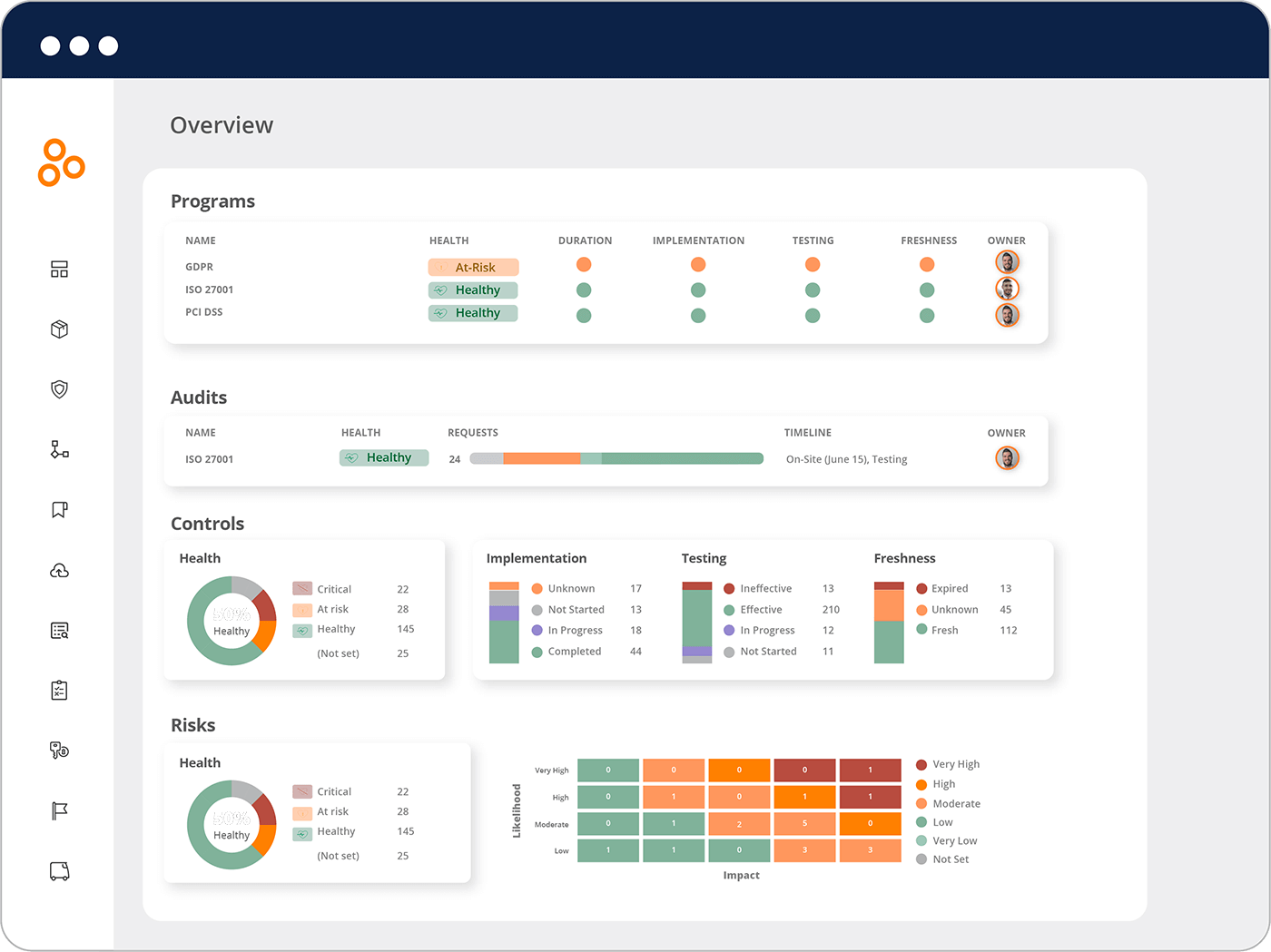
- Hyperproof makes it easier to map a single control to multiple regulations (e.g., ISO, SOC 2, NIST) so you avoid duplication and achieve efficiency.
- The platform provides visibility of your compliance posture, showing which controls are in the red, tasks overdue, risks rising, and audit readiness at a glance.
- Hyperproof automates parts of the evidence and proof gathering to help you reduce manual audit prep.
Pricing
Hyperproof doesn’t disclose its pricing.
To understand how Hyperproof fits your budget, you can book a personalized demo or review our full Hyperproof pricing guide - it covers everything you need to know before making a decision.
Pros & Cons
✅ Clean, intuitive interface.
✅ Built-in task assignment and workflow tools help decentralize compliance ownership.
✅ Visibility of your compliance posture
❌ Limited dashboard customization.
❌ The platform can get really expensive for the full GRC solution.
#10: Onspring
Best for: Enterprise teams who need flexibility and quick configuration without custom development.
Similar to: ArcherIRM.
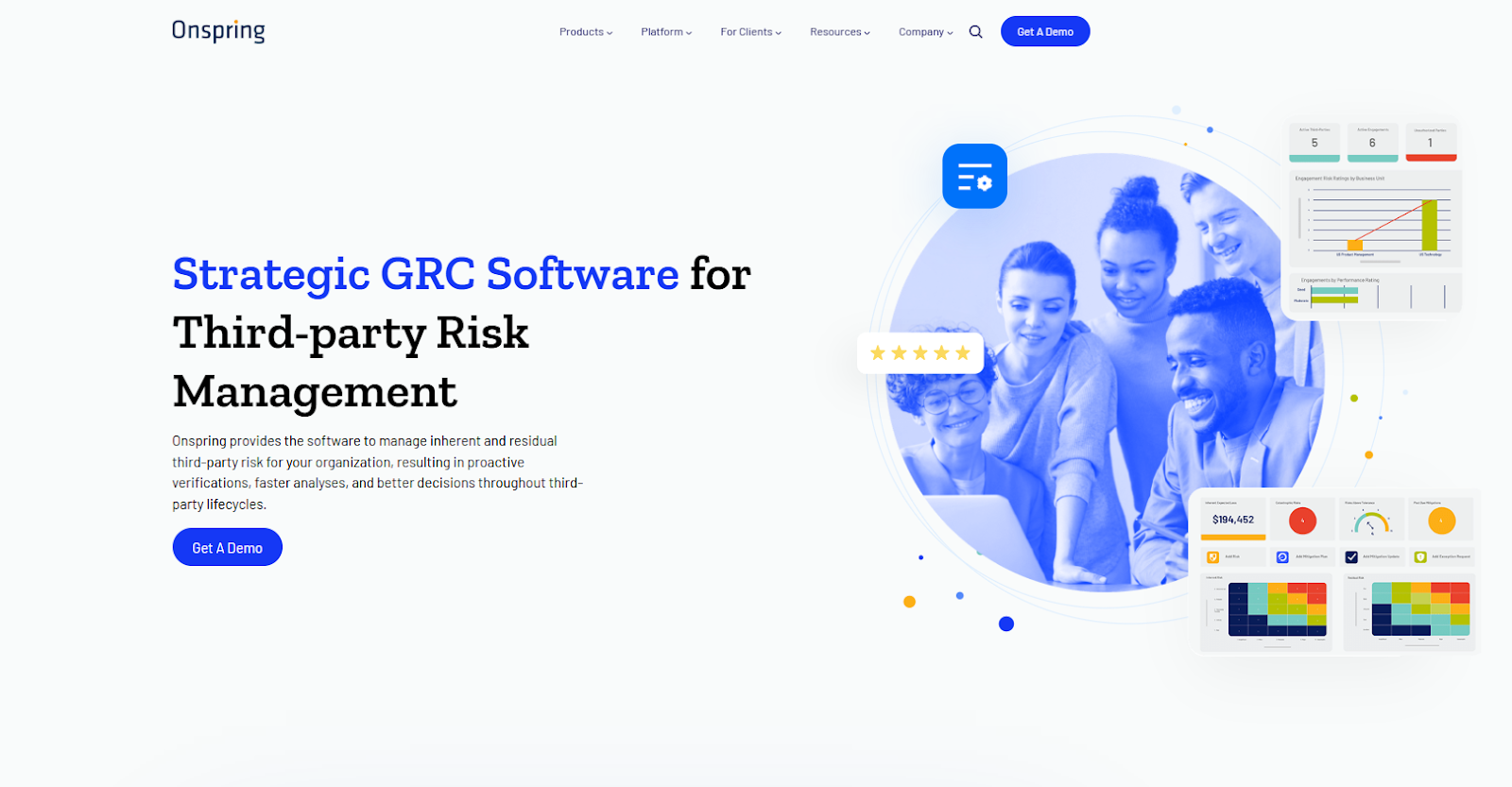
Onspring is a viable Secureframe alternative when you want a highly configurable, no-code GRC system that teams can tailor quickly.
The tool stands out with its quick configuration, workflow automation, and dashboards, so you can build the processes you need and iterate fast.
Features
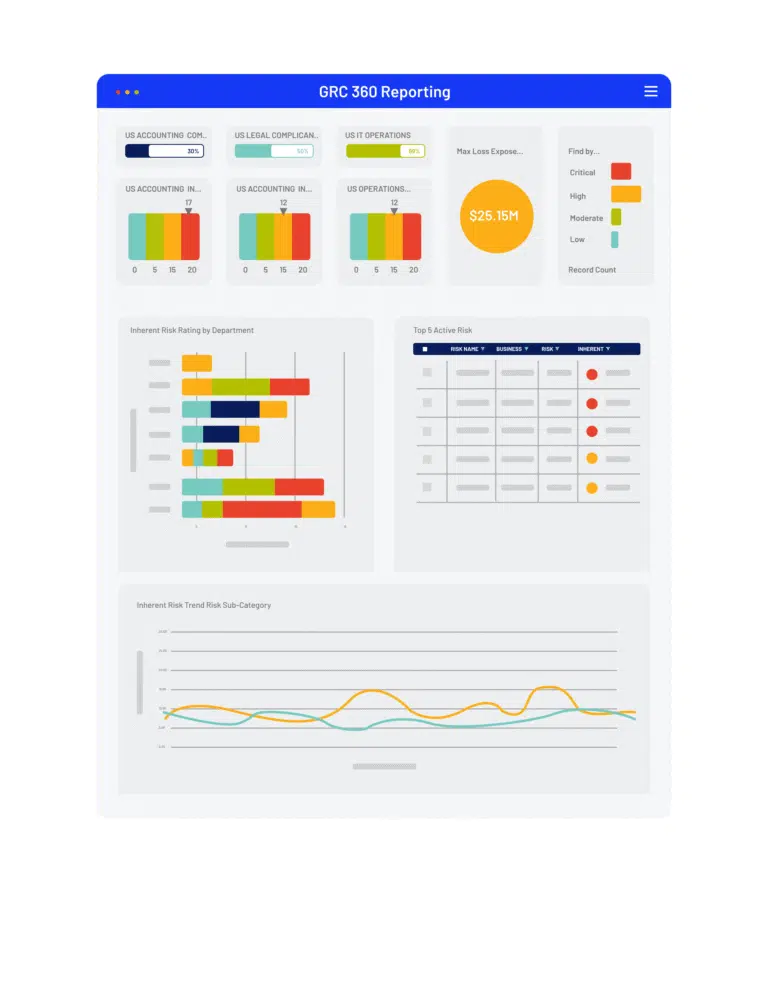
- No-code configuration and workflow automation that lets compliance teams build custom processes and dashboards without IT.
- You can assess, tier, and track vendors and integrate criticality ratings from cyber and financial monitoring services.
- Advanced reporting that helps you gauge performance with live dashboards of key metrics, risk scores, and audit activity status.
Pricing
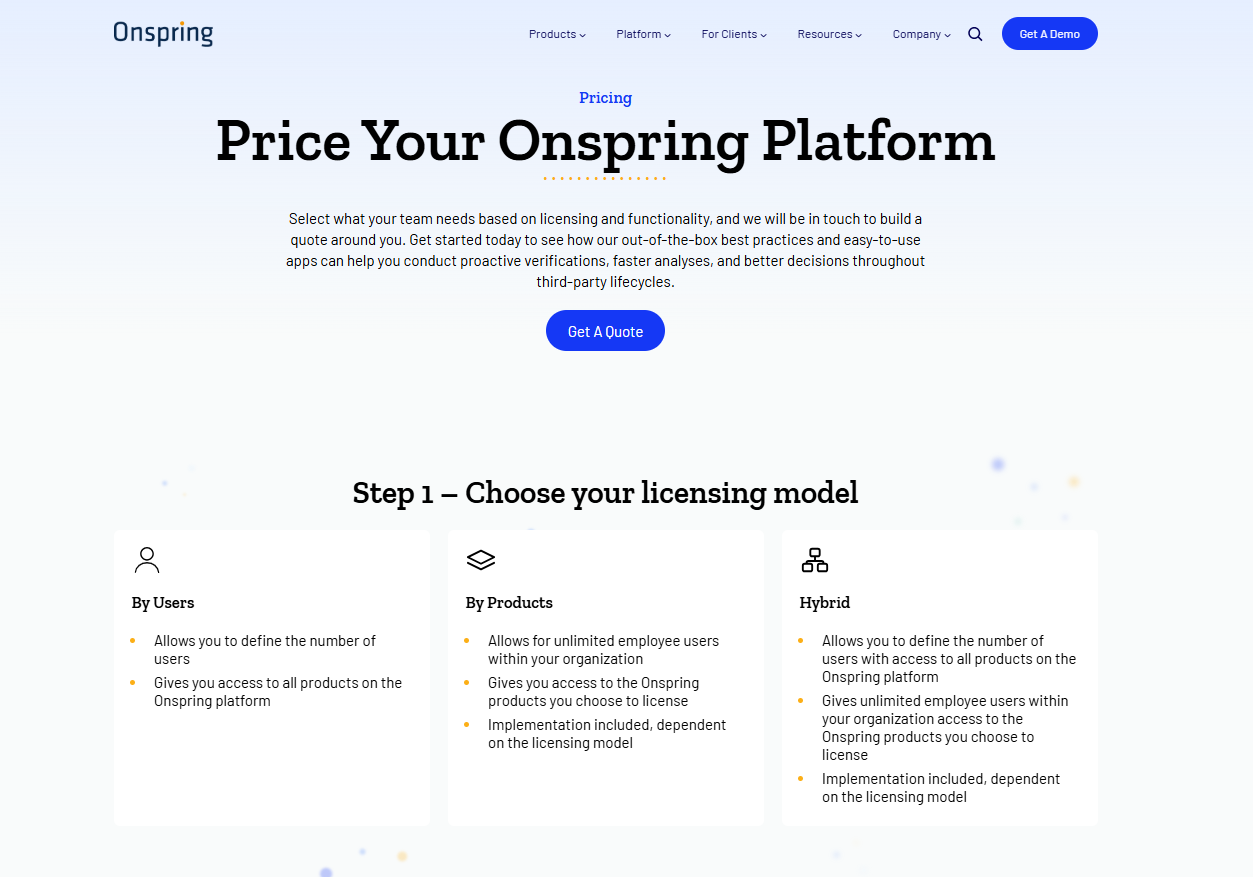
Onspring has 3 different pricing models that you can choose from based on which one better fits your needs:
- Pricing per user seat, where all users get access to all products on the Onspring platform.
- Pricing by product, where your team (with unlimited users) selects only a portion of the features to access.
- A hybrid model, where some users have unlimited access to the platform, while other users have limited access to other features.
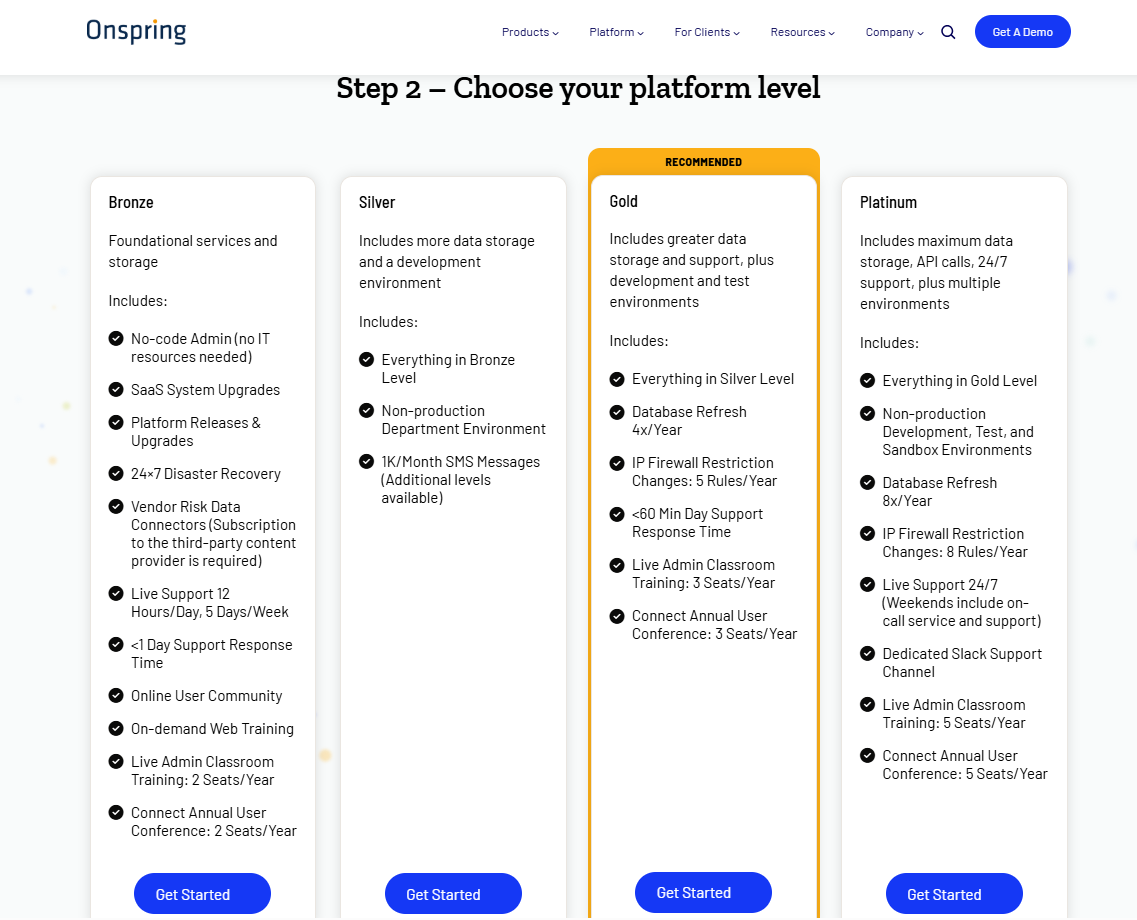
After choosing your pricing structure, Onspring offers four paid tiers, Bronze, Silver, Gold, and Platinum, each adding more capacity and features:
- The Bronze plan includes core no-code workflow tools, basic reports, and modest storage limits.
- Upgrading to Silver and Gold adds increased database & attachment storage, extra API call capacity, additional admin training seats, and development/test environments.
- The Platinum tier provides maximum storage, the highest API limits, priority support, and all non-production environments (dev, test, sandbox).
Pros & Cons
✅ Configurable and quick to deploy for specific GRC processes.
✅ The tool is easy to learn, and the no-code build makes it easier to set up the solution.
✅ Best-in-class reporting with live dashboards.
❌ Expensive per-seat pricing, according to reviews on G2, which is why some compliance leaders have been looking for Onspring alternatives.
❌ The platform has an outdated interface that can be hard to use for some users.
Get started with smartSuite & our pre-built GRC templates for free
If you’ve outgrown or are not willing to invest in Secureframe, you’re definitely not short on alternative options.
From compliance-first platforms like Vanta to GRC suites like LogicGate and risk-centric tools like OneTrust, there are plenty of vendors promising more automation, deeper reporting, and broader integrations than what you’re getting today.
However, if you’re looking for a platform that actually helps your team scale compliance workflows, adapt processes on the fly, and centralize risk and vendor management without rigid reporting, admin bottlenecks, or unexpected pricing, you can give SmartSuite a chance with our free trial and out-of-the-box GRC templates.
SmartSuite’s tool offers just the right customization, native collaboration capabilities and a library of 200+ project management templates to help compliance teams create and maintain a project management workflow.
Here’s what's in it for your team when you try SmartSuite:
- No-code automation builder to set up to 500,000 trigger/action workflows.
- Built-in productivity tools, including time tracking, status tracking, and checklists.
- Team collaboration and planning tools such as whiteboards and SmartSuite docs.
- Resource management across projects and teams.
- 40+ field types, including the option to add your custom fields.
Get a 14-day free trial to explore all its amazing features.
Or, if you’d like to talk to our team of experts, schedule a demo.
Read More
- 10 Best Riskonnect Alternatives For GRC In 2025
- Riskonnect Pricing: Is It Worth It In 2025?
- 10 Best MetricStream Alternatives for GRC in 2025
- MetricStream Pricing: Is It Worth It In 2025?
- Top 10 Compliance AI Alternatives & Competitors
- Compliance AI Pricing: Is It Worth It?
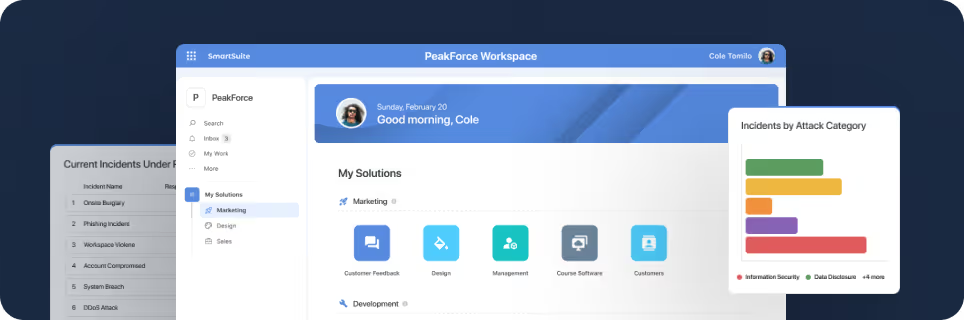
SmartSuite provides work platform for standardizing workflows in the following areas:
- Governance, Risk & Compliance
- IT & Service Ops
- Project / Portfolio Management
- Business Operations