



CRI’s Role in the Next Decade of FS Supervision

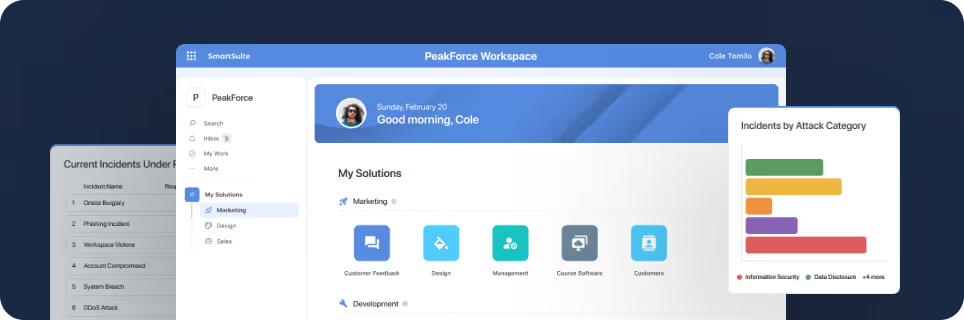
SmartSuite provides work platform for standardizing workflows in the following areas:
- Governance, Risk & Compliance
- IT & Service Ops
- Project / Portfolio Management
- Business Operations

Every decade or two, financial services experiences a regulatory shift so significant that it quietly reshapes how the entire industry thinks about governance, cybersecurity, operational resilience, and risk.
We are in the middle of one of those shifts. Around the world, from the U.S. to the EU, the UK, APAC, and beyond, supervisory bodies are converging on a shared insight:
The stability of the financial sector now depends on the cyber maturity and operational resilience of its institutions.
Supervisory expectations have evolved from compliance checklists into something far more comprehensive:
- Continuous oversight.
- Integrated cyber + resilience governance.
- Vendor ecosystem accountability.
- Increased board involvement.
- Harmonized maturity models.
- Operational readiness under stress.
It is no longer sufficient to simply “be compliant.” Regulators now expect institutions to demonstrate coherence: consistent controls, consistent evidence, consistent maturity, and consistent readiness.
And this is why the Cyber Risk Institute (CRI) Profile is becoming one of the most strategically important frameworks in the next decade of supervision.
It provides regulators and institutions with something they’ve both been missing: a unified diagnostic model for evaluating cyber and operational resilience maturity across institutions, regions, and supervisory bodies.
Why Supervisors Needed a Model Like CRI
As financial services digitized, the supervisory environment became more complex:
- Frameworks multiplied
- Expectations diverged
- Exam processes varied by regulator
- Institutions built their own internal harmonization
- Evidence structures fragmented
- Maturity models conflicted
- Cross-border institutions struggled to keep consistency
- Vendor oversight became unwieldy
Supervisors recognized this fragmentation and have increasingly encouraged, implicitly and explicitly, harmonized approaches to cyber governance, resilience, vendor oversight, and continuous assurance.
CRI is the first framework to give them that harmonization.
Here’s why:
1. CRI harmonizes thousands of regulatory expectations
It aggregates and unifies guidance from FFIEC, OCC, NIST, ISO, EBA, DORA, BoE/PRA, MAS and more into one diagnostic structure.
2. CRI simplifies regulatory interpretation
Instead of mapping dozens of frameworks, institutions evaluate maturity through one consistent set of expectations.
3. CRI improves comparability across institutions
Supervisors can evaluate maturity across different banks using the same diagnostic model.
4. CRI reduces examination friction
Findings, evidence, and remediation map into the same structure examiners use.
5. CRI aligns with global regulatory convergence
DORA in the EU, PRA/BoE expectations in the UK, OCC/FFIEC guidance in the U.S., all increasingly share the same logic.
6. CRI provides a backbone for continuous assurance
Real-time diagnostic alignment supports the regulatory shift toward ongoing oversight.
CRI is not just a framework: it is becoming the supervisory “Rosetta Stone” of financial services.
How CRI Is Quietly Reshaping Supervisory Strategy Globally
Based on patterns I’m seeing across regulators, consulting partners, and institutions, CRI is influencing FS supervision in five significant ways:
1. Shift From Checklist-Based Exams to Diagnostic-Based Exams
Examiners increasingly want to understand:
- Maturity
- Evidence quality
- Governance oversight
- Incident readiness
- Resilience posture
CRI enables examiners to evaluate institutions using consistent diagnostic criteria instead of interpretive checklists.
2. Consistency Across Examiners, Regions, and Regulatory Bodies
CRI becomes the “common denominator” that exam teams can reference regardless of:
- Regulatory home country
- Size of institution
- Internal frameworks
- Vendor ecosystem
This is critical for global banks who must satisfy overlapping supervisory regimes.
3. Faster Regulatory Reviews and Lower Friction
Because CRI diagnostics map cleanly to controls, evidence, issues, and remediation, institutions spend less time preparing for exams and more time strengthening posture.
Supervisors appreciate:
- Consistent documentation
- Unified reporting
- Transparent maturity scoring
- Easier cross-check validation
It creates a shared language between regulator and institution.
4. Strengthening of Board Accountability
Boards are increasingly expected to understand cyber, resilience, and vendor risk in terms of:
- Maturity
- Diagnostic weakness
- Systemic dependencies
- Critical business service exposure
- Readiness under stress
CRI gives boards a diagnostic view that is:
- Clear
- Actionable
- Comparable
- Repeatable
Supervisors will expect this level of clarity.
5. Foundation for Continuous Supervision
Regulators are moving toward “near-real-time” oversight, not just annual or biennial reviews.
CRI’s diagnostic structure supports this shift:
- Continuous monitoring signals → diagnostic updates
- Evidence changes → maturity changes
- Vendor events → impact on diagnostics
- Remediation progress → real-time posture
This is the evolution supervisors have been signaling for years.
CRI makes it structurally possible.
What the Next Decade of FS Supervision Will Look Like
Based on the direction of global supervisory bodies, I believe the next decade will be defined by the following trends:
1. Diagnostics will become the new regulatory currency
Supervisors will rely on diagnostic-based reporting rather than control lists.
2. Maturity will become globally comparable
Institutions in the U.S., EU, and UK will be measured through frameworks that share similar logic.
3. Evidence will become continuous rather than periodic
Static repositories will give way to workflow-integrated evidence.
4. Vendor oversight will become standardized
Third-party and fourth-party vendors will be expected to align to diagnostic models.
5. Resilience will be inseparable from cybersecurity
Regulators will increasingly treat cyber and operational resilience as one governance domain.
6. Boards will be required to understand diagnostic narratives
Supervisory bodies will demand board-level literacy in cyber and resilience maturity.
7. AI will accelerate the examiner model
AI will reason over diagnostic structures for:
- Risk identification
- Maturity comparison
- Evidence evaluation
- Pattern recognition
8. Continuous assurance will become the industry standard
Supervisors will expect the ability to view posture in real time.
CRI is the backbone that supports all of these shifts.
Why CRI Is Fundamentally Aligned With Supervisory Philosophy
Across global regulatory expectations, five philosophical themes consistently appear:
- Outcome-over-prescription
- Cross-functional integration
- Evidence-based governance
- Resilience under stress
- Board accountability
CRI operationalizes these five philosophies better than any framework in the market.
And supervisors recognize it: implicitly and increasingly explicitly.
Where SmartSuite Fits Into the Future of Supervision
If CRI is the governance language, SmartSuite is the governance engine.
SmartSuite provides the operational layer regulators will expect institutions to demonstrate:
- Unified workflows
- Continuous evidence
- Consistent remediation
- Risk + cyber + resilience integration
- Diagnostic alignment
- Cross-functional insight
- Audit trails
- Connected assurance
Where CRI provides diagnostic clarity, SmartSuite delivers:
- Execution
- Motion
- Traceability
- Transparency
- Automation
- Real-time maturity
Together, they represent the most modern, structural approach to satisfying, and thriving under, future supervisory regimes.
Conclusion: CRI Is Becoming the Framework the Future Will Be Built On
Supervision in the next decade will not reward fragmented frameworks, siloed maturity models, static assessments, or inconsistent narratives.
It will reward:
- Consistency
- Evidence
- Diagnostic clarity
- Cross-domain integration
- Resilience under stress
- Continuous assurance
- Coherent board narratives
CRI provides the structure. SmartSuite provides the operationalization. AI provides the acceleration.
This is the future of regulatory alignment, and the institutions that adopt CRI as their diagnostic backbone will be better positioned for the next decade of supervision than those who cling to legacy models.
CRI is not simply the framework of today. It is becoming the framework of the future.






Put these ideas to work
Start a free trial, or book a demo and see how it runs in SmartSuite.

