

![Privacy Management: What Is It & Why You Should Care [2026]](https://cdn.prod.website-files.com/60db0944651d4b59a704ef93/6ab36c6ca3b212ae54cb60ef_6a103a3dc7aa211c9630abdf_privacy_management_-_what_is_it___why_you_should_care_-_large.avif)

In this guide, I'll walk through what privacy management actually involves, why it's become a board-level topic, and how to run a privacy program that holds up under real regulatory and customer scrutiny.
Key takeaways
- Privacy management is operational work, not a legal filing exercise. It covers data inventories, lawful bases, rights requests, breach response, and the controls that hold everything together.
- Privacy programs cover several domains at once, including customer data, employee data, vendor data, and product telemetry. Each one carries its own obligations.
- The right approach scales to the sensitivity of your data and the breadth of jurisdictions you operate in. Not every company needs an enterprise privacy stack.
- Frameworks like GDPR, CCPA, HIPAA, ISO 27701, and the NIST Privacy Framework cover overlapping but distinct ground. Most mid-market programs blend two or three.
- Connected work management platforms like SmartSuite let you run ROPAs, DPIAs, DSARs, incidents, and evidence in one workspace.
What is privacy management?
Privacy management is the ongoing work of knowing what personal data your company collects, why it's collecting it, where it goes, who can touch it, and what happens when someone asks you to delete it.
However, that definition is denser than it looks.
I've yet to meet a privacy lead whose first real horror story wasn't a DSAR they couldn't fulfill on time, because the data lived in seven systems, and three of them didn't have search.
Other versions of the same horror story:
- A vendor questionnaire that asks where data lives, and three people give three different answers.
- A product launch that quietly trained a model on customer support transcripts.
- A working privacy program builds the muscle to answer those questions before someone forces the issue.
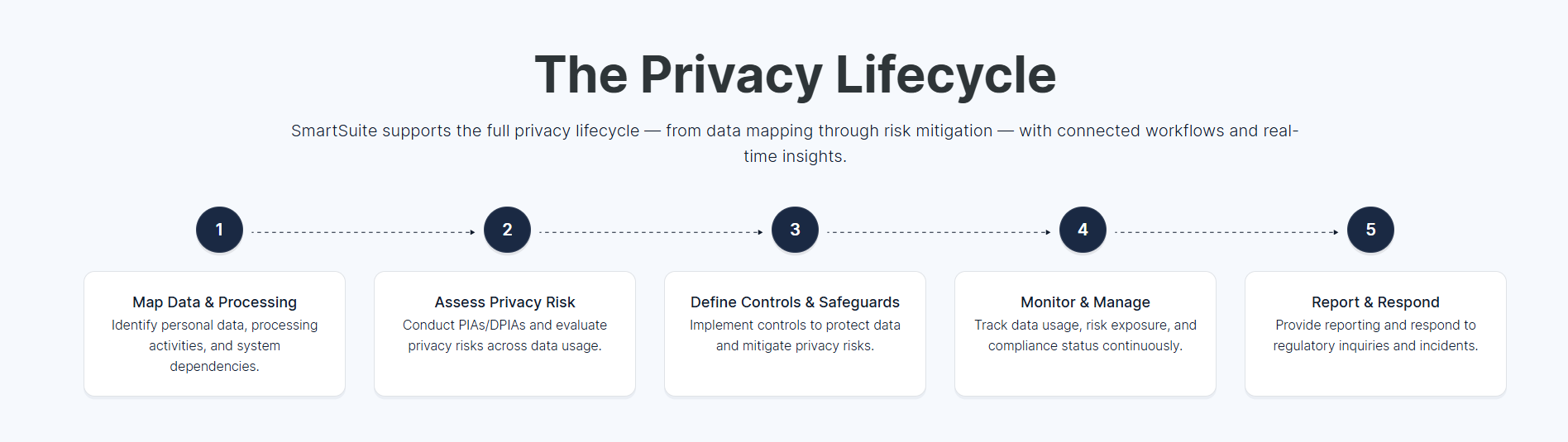
It connects four pieces of work that usually live in separate spreadsheets:
- A record of what data you process and why.
- A set of assessments that evaluate the risk of new processing.
- A workflow for handling individual rights requests.
- A response plan for when something goes wrong.
When those four pieces stay disconnected, privacy work gets reactive and expensive.
When they're tied together, the same record of processing that feeds your DPIA also informs your incident response and your DSAR fulfillment.
What are the different types of privacy management?
Privacy management isn't one thing.
It splits into a few overlapping domains, each with its own owners, regulators, and operational rhythm:
- Customer privacy is the most visible domain.
Your marketing team collects emails, your product captures behavior, and your support team stores conversation logs. At the same time, your sales team’s tools enrich and segment that data.
GDPR, CCPA, the new state laws in Texas, Oregon, and the rest are mostly aimed here.
This is where consent banners, preference centers, DSAR portals, and cookie compliance all live.
- Employee privacy gets less attention but more complaints from regulators.
HRIS data, monitoring tools, time tracking, performance records, background checks: all of it carries obligations.
Under GDPR, most employee processing has to ride on legitimate interest or contractual necessity rather than consent, because employees can't freely consent to their employer.
That makes the documentation bar higher than most teams expect.
- Vendor and processor privacy covers your obligations as a controller when you hand data to processors.
DPAs, transfer mechanisms, sub-processor approvals, and audit rights all sit here.
If a vendor breaches, you're often the one notifying customers and explaining yourself to a regulator.
- Operational and technical privacy is the engineering side.
Retention enforcement, encryption, access controls, anonymization, and privacy-by-design in product features.
Why is privacy management important?
The main reason why privacy management is important is that not having a program is now expensive, as GDPR enforcement keeps pulling in nine-figure fines for the household names.
Meta's €1.2 billion fine in 2023 remains the record, and Uber was fined €290m for personal data transfer.
A single mistake echoes long after the executives who made it have left.
But regulatory exposure is only part of it.
The deeper reason privacy management has become a board-level topic is that data underpins almost every product decision now.
- AI features train on user inputs.
- Personalization engines run on behavioral data.
- Sales tools pull from enrichment vendors.
- Customer support workflows increasingly feed conversation logs into model retraining.
When that pipeline isn't governed, you're one mistake away from a public incident, a class action, or a partnership falling through because the customer's vendor risk team flagged your data practices.
Companies that documented their data flows in 2023 had a clear advantage in 2025 when state privacy laws started being enforced in parallel.
What are the benefits of privacy management?
A working privacy program returns value in places that aren't always obvious from the outside:
- Faster sales cycles: Enterprise buyers and regulated customers can ask hard privacy questions during procurement.
A team with a current ROPA, documented DPIAs, and a clear answer on international transfers closes deals faster than one that's still searching for who owns the answer.
- Lower breach impact: When an incident happens, response cost drops sharply if you already know what data was exposed, who needs to be notified, and which regulators care.
- Better product decisions: Privacy reviews built into the product development cycle catch design problems early, when fixes are cheap.
- Cleaner audits: SOC 2 Type II and ISO 27701 audits go from an annual fire drill to a routine evidence pull when privacy controls are connected to the same workspace that runs them day to day
- Customer trust: This one's harder to measure, but customers and partners increasingly judge companies on how they handle data.
Brands that get privacy right see it show up in retention and partnership opportunities, while brands that don't end up in news stories with their CEO's photo above an unflattering headline.
How can you approach privacy management?
There's no one way to run privacy.
A 50-person startup operating in one state has nothing in common with a 5,000-person fintech operating in 14 countries, and trying to apply the same program design to both is how privacy budgets balloon while the actual risk picture stays the same.
The honest answer is that two things shape what your program needs to look like: how sensitive the data is, and how many places it touches.
Names and work emails carry one bar.
Health records, biometric identifiers, financial accounts, and children's data carry a much higher risk.
The more sensitive the data, the more rigor you owe it:
- Stricter access controls.
- Shorter retention.
- Mandatory impact assessments.
- Encryption at rest and in transit.
- Tighter rules around international transfers.
Reach is the other lever. A company processing 5,000 records in two states answers to maybe two regulators.
A company processing millions across 30 jurisdictions answers to dozens, each with their own rules on consent, opt-out signals, DSAR deadlines, sensitive data categories, and breach notification windows.
In practice, this produces a recognizable spectrum of programs.
At one end sit the global fintechs, healthcare networks, and consumer platforms with biometric features.
They need a documented privacy program with named owners, regular impact assessments, formal incident response, dedicated tooling, and outside counsel on retainer.
In the middle: regional banks, specialty clinics, B2B products handling sensitive industry data.
Strong controls on the specific data they handle, structured assessments for new processing, but the program is contained.
Tooling matters, but doesn't need to cost six figures.
A step down from that: most mid-market SaaS companies.
Lots of records across lots of jurisdictions, but the data itself is mostly contact info, behavioral logs, and account history.
The bar here is operational efficiency.
- Handle DSARs at volume.
- Keep the data inventory current as features ship.
- Run quick assessments when product launches change what gets collected.
At the light end: small B2B services, early-stage startups, regional service businesses. A privacy notice, a request process, basic controls.
The program can stay lean as long as the data stays low-risk.
💡 The mistake I keep seeing: companies in the light-end bucket buying tools built for the global fintech bucket. The tooling looks responsible, but the actual exposure doesn't change.
How to conduct a privacy management assessment
A privacy management assessment is a structured look at what data you have, what risk it carries, and whether your current controls match those risks.
In practice, the work doesn't run sequentially.
It cycles, because new product features land, vendors get added, regulations shift, and the assessment has to keep up with all of it.
The starting point is always inventory.
You can't assess what you can't see, so the first hard piece of work is building a current record of your data:
- What you collect
- Where it comes from.
- Where it lives.
- Who has access.
- What you do with it.
- When it gets deleted.
- Which vendors touch it along the way.
Most of the content comes out of interviews with product, engineering, marketing, HR, finance, and customer support owners.
Discovery tools (network scans, API logs, and classification scanners) can pick up the rest.
Once you can see the data, the next question is risk.
For each processing activity:
- How sensitive is the data?
- What's the lawful basis?
- What could plausibly go wrong if something breaks?
A DPIA formalizes that question for the activities that need it most, which usually include special category data, automated decisions, large-scale profiling, and anything novel enough that nobody has run the playbook yet.
The output is a prioritized list where some processing activities need immediate controls, some only need monitoring, and some are fine as they sit.
Owners get assigned to the work that matters, mitigations get scheduled, and evidence gets attached so the assessment isn't just a memory in someone's head.
Then comes the part most programs skip: actually running the program day to day.
- DSARs come in and get fulfilled, and the response timing tells you whether your discovery process works in the wild.
- Incidents happen, get investigated, and the root cause analysis tells you whether your controls held up.
- Vendor reviews surface new processors that need to land in the ROPA, and product launches trigger fresh assessments.
The work loops back on itself constantly.
An incident in week 12 changes the priority of an assessment scheduled for week 18, and a new state law in week 6 forces a re-review of consent practices everywhere.
What are the different Privacy management frameworks?
Here are the main privacy management frameworks that you should be aware of:
- GDPR (General Data Protection Regulation) is the regulatory anchor most global programs start from.
Technically a law, but it functions as a framework because it defines lawful bases, data subject rights, accountability principles, and breach notification rules that almost every other regime borrows from.
If you process EU residents' data, you don't get to skip it.
- CCPA, expanded by CPRA, is California's privacy regime.
It introduced opt-out rights, sensitive personal information categories, and the California Privacy Protection Agency as a dedicated enforcer.
- HIPAA (Health Insurance Portability and Accountability Act) applies if you handle U.S. protected health information.
It's specific and unforgiving on breach notification: 60 days, with HHS publication for breaches affecting 500 or more individuals.
- ISO 27701 is the international standard for privacy information management.
It extends ISO 27001 with privacy-specific controls and gives you a certifiable framework you can show to customers and regulators. It can be useful when buyers want proof beyond a SOC 2 report.
- NIST Privacy Framework is the U.S. National Institute of Standards and Technology's voluntary framework.
It is structured around five functions: Identify, Govern, Control, Communicate, and Protect, and it is especially useful for organizations already running NIST CSF for cybersecurity, because the two share vocabulary and structure.
- Nymity Privacy Management Accountability Framework (PMAF) is a more operational layer that some teams adopt on top of the regulatory anchor.
It breaks privacy work into 13 management categories and over 130 activities, which is useful for program maturity assessments.
It’s heavier than what most mid-market programs need, but it exists and is worth knowing.
What kinds of tools can you use for Privacy management?
Privacy tooling falls into a few buckets, and which one fits depends on where your program is today and where it's heading:
- Spreadsheets: Most privacy programs start here. A ROPA in Excel, a DSAR tracker in Google Sheets, and a DPIA template in Word.
It works when the program is small; however, it cracks the moment you need cross-team visibility, audit trails, or someone to back you up while you're on PTO.
- Dedicated privacy platforms: Tools like OneTrust, TrustArc, Securiti, and BigID were built specifically for enterprise privacy operations.
They give you consent management at scale, automated DSAR fulfillment, deep data discovery and classification, and pre-built workflows for every major regulation.
- GRC platforms with privacy modules: Vanta, Drata, Sprinto, and Secureframe have all added privacy capabilities on top of their core compliance automation.
They're strong on certifications (SOC 2, ISO 27001, HIPAA) and decent at privacy basics.
They might be weaker on full DSAR workflows, data flow mapping, consent management, and the breach response playbook than the dedicated privacy players.
- Connected work management platforms: A newer category where privacy workflows live alongside the rest of operations in one no-code system.
This approach fits mid-market companies that want ROPAs, DPIAs, DSARs, incidents, and evidence connected to actual business work, not isolated inside a specialty tool that only one person knows how to operate.
SmartSuite (that’s us) approaches privacy from a structural angle rather than a feature-by-feature one:
Most privacy tools treat data inventories, DPIAs, DSARs, and incidents as separate modules that occasionally talk to each other.
SmartSuite ties them together as linked records, where one processing activity in the ROPA threads through the systems it lives on, the vendors that handle it, the controls that protect it, the risks that surround it, and any incident that touched it.
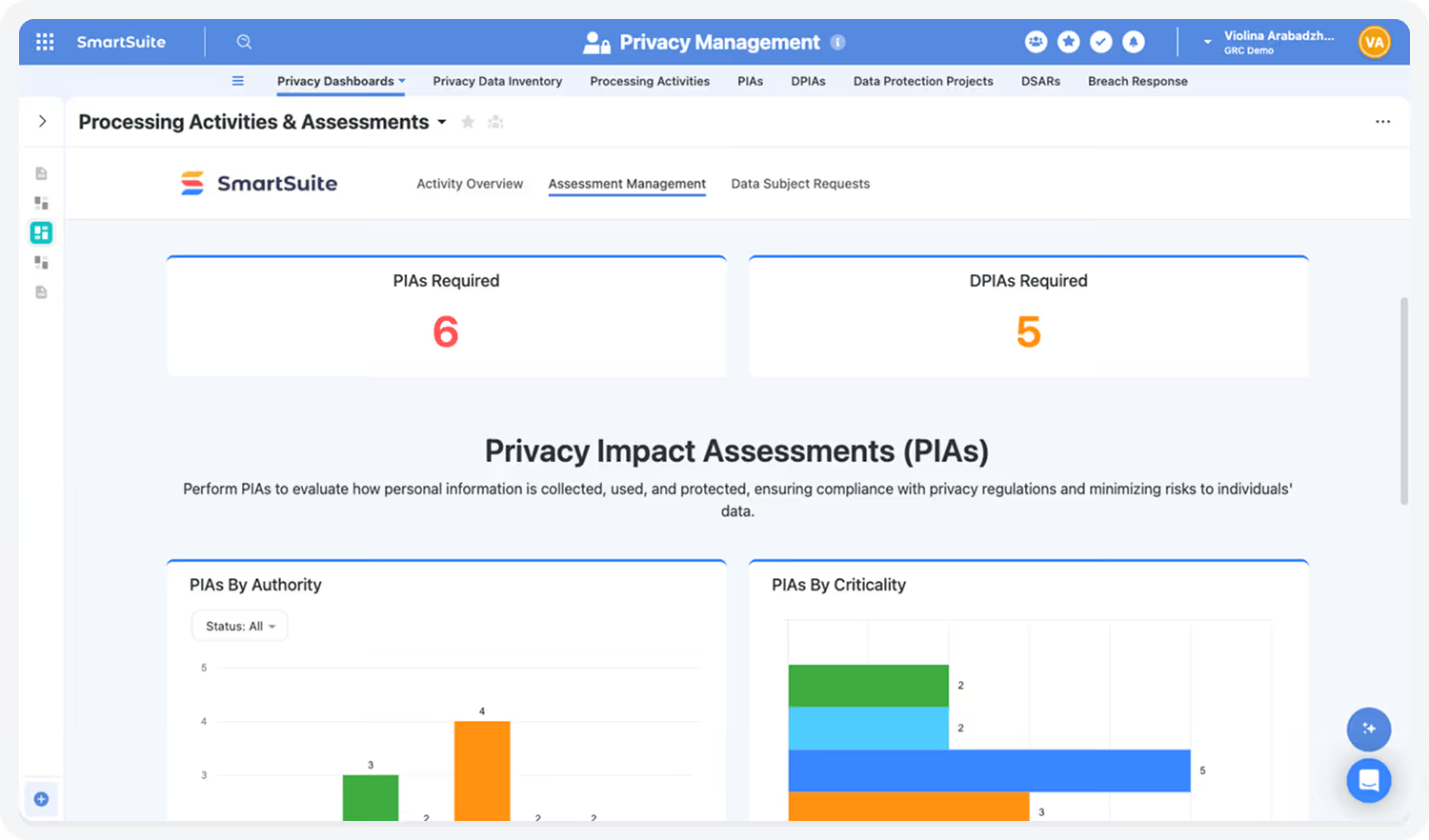
When a regulator asks why something is lawful, the audit trail is already there.
The operational layer covers the full privacy workflow on top of that foundation:
ROPAs and data inventories, DPIAs and impact assessments, DSAR intake with SLA management, incident and breach logging, third-party processor oversight with linked DPAs, regulatory obligation tracking across GDPR, CCPA, HIPAA, and FERPA, plus real-time dashboards for DSAR volume, DPIA backlog, incident trends, and overall compliance posture.
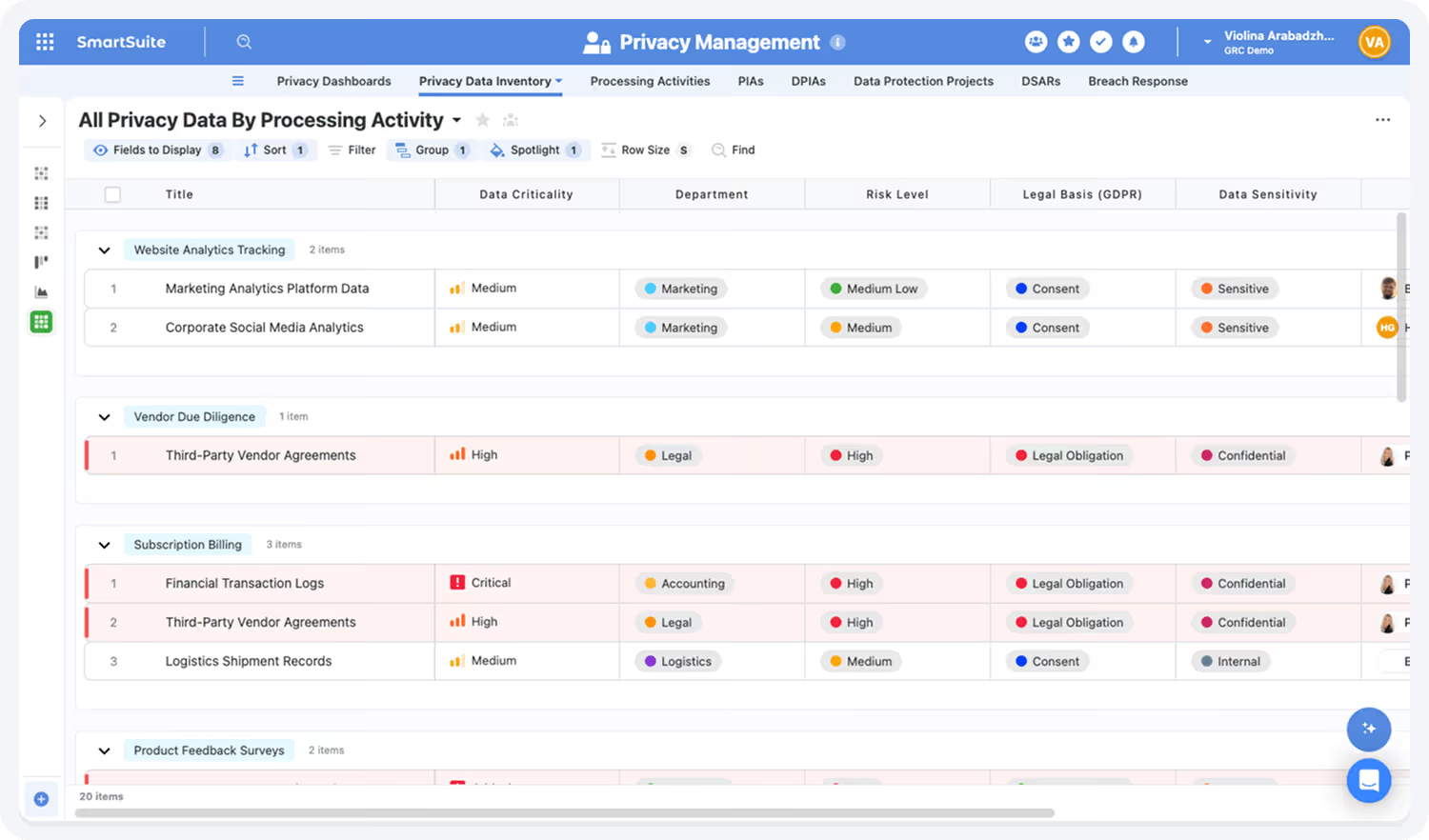
No-code configuration means the program reflects the business, not a vendor's idea of what a privacy program should look like.
Workflow automation takes the recurring tasks out of anyone's manual queue, including DSAR SLA timers, overdue assessment escalations, vendor review schedules, and deadline routing to legal and security.
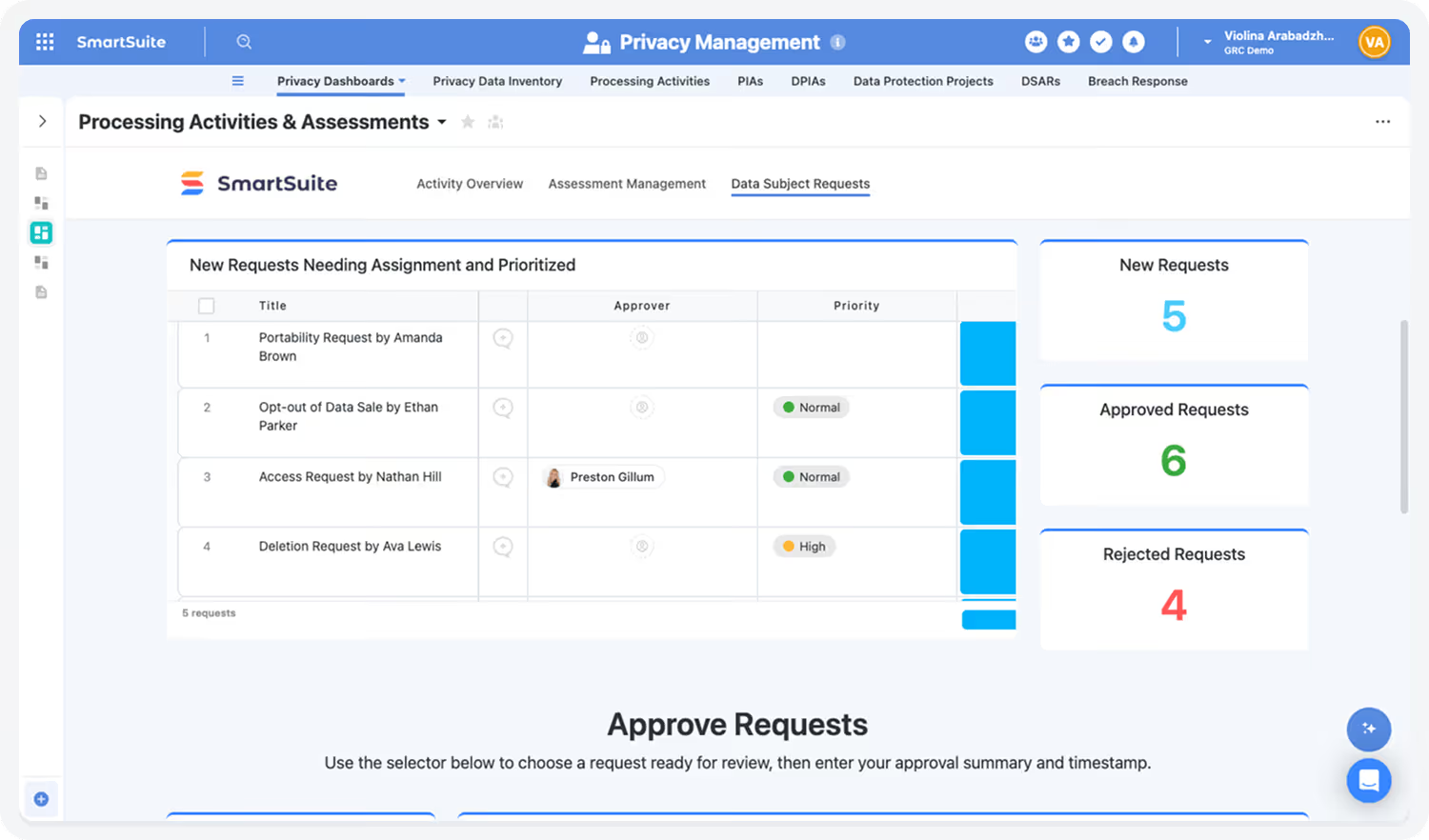
For AI work, SmartSuite AI generates DPIA risk narratives, summarizes vendor questionnaires, drafts DSAR closure responses, and surfaces gaps in incident reports. The judgment calls stay with the privacy team.
See how SmartSuite works for privacy management:
Privacy teams running on SmartSuite report 33% faster DPIA completion, 30% less manual evidence work, 32% better visibility into privacy risks and processing activities, and 36% stronger alignment between legal, security, and compliance.
The right buyers tend to be Chief Privacy Officers, DPOs, and compliance managers at mid-market companies and growing SaaS businesses.
These are organizations where privacy has to coordinate with AI governance, enterprise risk, third-party reviews, and incident response on a daily basis, and where a siloed privacy tool just creates more work.
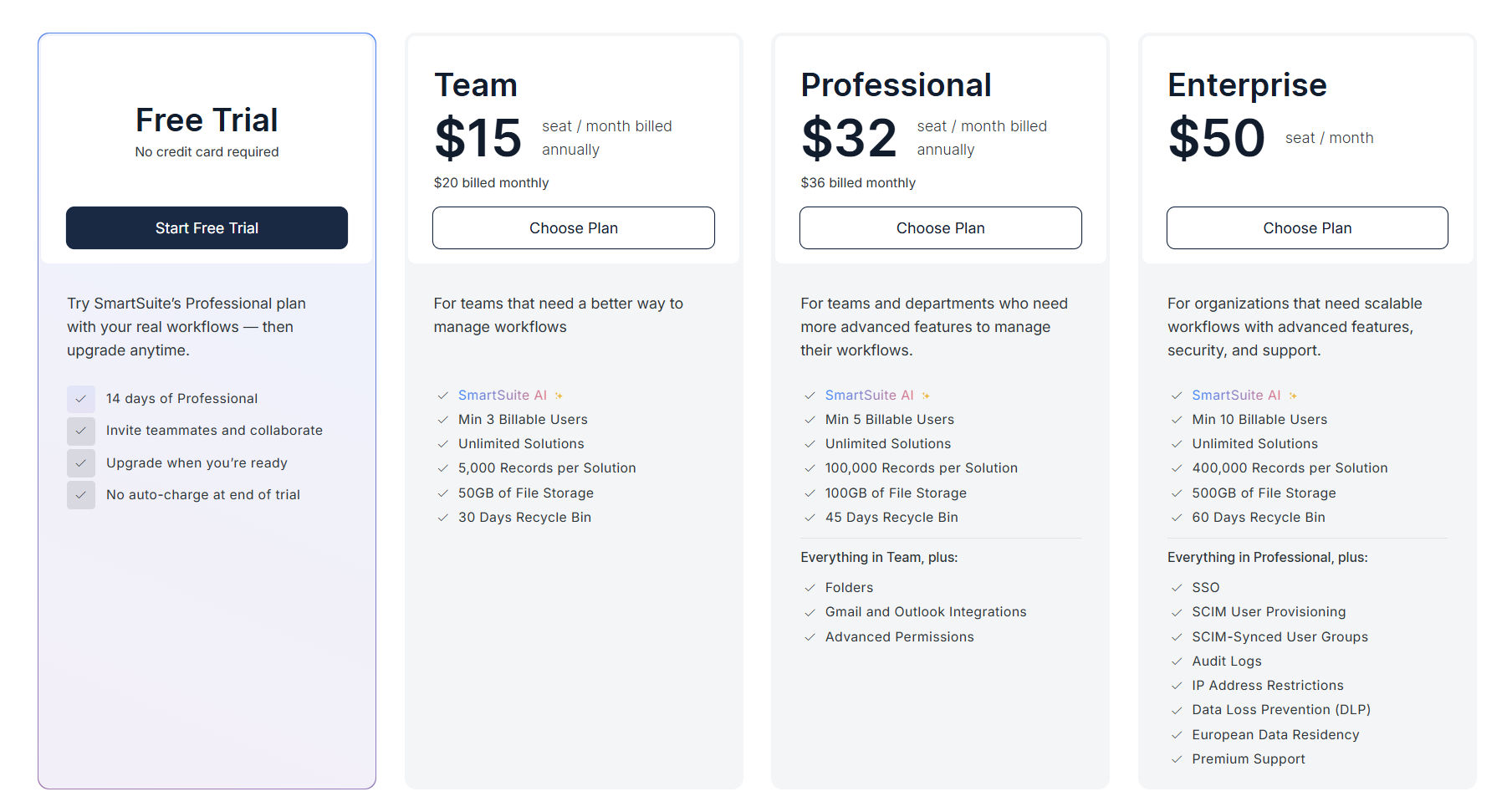
On pricing, the Team tier opens at $15/seat/month billed annually.
Larger teams move up to Professional or Enterprise plans, and organizations that need licensing by department or regulatory scope can use solution-based pricing instead.
Run your privacy program on a platform built for it
Each of the tools above handles a slice of privacy management.
- Dedicated privacy management platforms are built for global enterprises with deep privacy operations teams and budgets to match.
- Compliance automation does strong work on certifications but stay lighter on the operational privacy workflows (DSARs, DPIAs, ROPAs, consent) that grow as a program matures.
- Spreadsheets work for early programs and break when the program gets real.
For mid-market companies and the ops or privacy leads building out a real program for the first time, the sweet spot is a platform that handles data inventories, assessments, rights requests, incidents, vendor oversight, and evidence in one place, and fits the rest of your work.
SmartSuite gives you flexibility and governance in the same workspace: a no-code environment where the privacy team can shape the program however it needs, backed by audit logs, role-based permissions, and AI assistance for the slow work.
Privacy doesn't sit in a silo: it ties into AI governance, enterprise risk management, third-party oversight, compliance assessments, policy management, and incident response, so the same record that documents a processing activity also feeds the risk register, the vendor review, and the audit evidence pull.
ROPAs, DPIAs, DSARs, incidents, vendors, and remediation work all sit in one governed workspace, with live dashboards that update as the work happens.
➡️ Start a free SmartSuite trial or book a demo to see how your team can manage governance, risk, and compliance in one place.
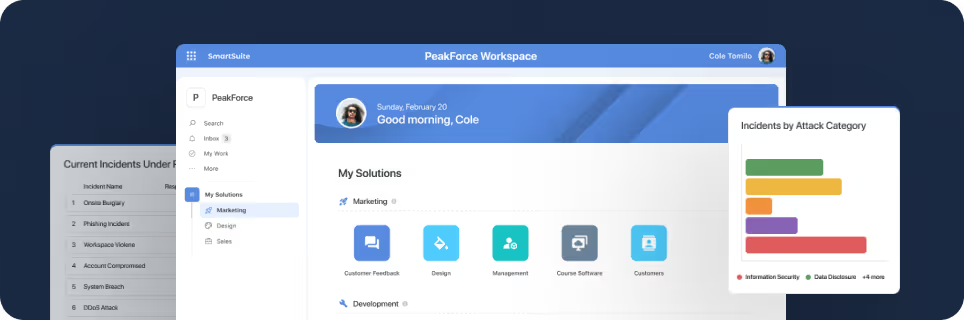
SmartSuite provides work platform for standardizing workflows in the following areas:
- Governance, Risk & Compliance
- IT & Service Ops
- Project / Portfolio Management
- Business Operations