
Every decade or so, the financial-services industry experiences an inflection point, a shift not driven by technology alone, but by the regulatory alignment that shapes how institutions define, evaluate, and govern risk.
We are now in one of those moments.
In the United States, the Cyber Risk Institute (CRI) Profile has become the de facto harmonized diagnostic model for cyber and resilience oversight across major regulatory expectations.
In Europe, the Digital Operational Resilience Act (DORA) has emerged as one of the most comprehensive and far-reaching frameworks of the last decade, redefining operational resilience, ICT risk management, third-party governance, and incident reporting across the EU.
For years, institutions treated these regulatory structures as separate worlds, one American, one European, one cyber-focused, one operationally focused. But something fundamental has shifted.
These frameworks are now converging.
Not in terms of identical wording, but in terms of intent, governance philosophy, expected outcomes, and diagnostic maturity. And that convergence presents one of the biggest opportunities the industry has had in years: the ability to build truly global, unified governance models supported by harmonized workflows, shared expectations, and consistent board-level narratives.
This is not FS fragmentation. This is FS convergence. And it is accelerating.
Why CRI and DORA Are Seen as “Siblings” Across Institutions
As I work with global banks, multinational institutions, cross-jurisdictional fintechs, and technology providers servicing the financial sector, I hear a recurring observation:
“CRI and DORA are more aligned than they appear.”
This alignment reveals itself in several ways.
1. Both frameworks emphasize outcomes, not prescriptive control lists.
They describe what good looks like rather than how to implement it.
2. Both elevate operational resilience to a governance imperative.
Resilience is no longer a continuity function, it is a board-level mandate.
3. Both demand increased transparency, evidence quality, and cross-functional maturity.
They expect alignment across cyber, technology, risk, compliance, audit, and resilience.
4. Both position third-party oversight as a critical pillar of systemic safety.
Vendors are treated as part of the institution’s operational footprint, not external providers.
5. Both emphasize continuous, not periodic, readiness.
Real-time, dynamic, and adaptive governance is no longer optional.
The more institutions work with both frameworks, the more clear the overlap becomes.
While their origins differ, CRI driven by U.S. institutions working with regulators, DORA emerging from EU legislative action, their destination is remarkably similar.
What Makes DORA a Transformative European Framework
In conversations with European institutions preparing for or already implementing DORA, I’ve observed consistent commentary: DORA is not simply another regulation. It is a paradigm shift.
DORA elevates:
- ICT governance.
- Threat-led penetration testing.
- Operational resilience.
- Incident reporting.
- Business service mapping.
- Third-party oversight.
- ICT contract management.
- And systemic continuity requirements.
…into a single, unified framework with clarity and force.
Financial institutions across the EU, and global institutions operating within the EU, now face:
- Higher expectations.
- Broader accountability.
- Deeper transparency.
- More connected oversight.
- Stricter contractual standards.
But they are also benefiting from increased regulatory coherence.
DORA doesn’t compete with CRI. It mirrors it, through a European lens.
Why CRI and DORA Are Creating a Global Governance Backbone
Despite their different origins, CRI and DORA are converging in ways that matter deeply for global financial institutions.
1. A Shared Vision of Integrated Cyber + Resilience Governance
Both frameworks reject the old model where cyber and operational resilience are separate concerns. Both demand integrated evaluation.
2. A Shared Maturity Philosophy
Both use outcome-oriented expectations that support diagnostic evaluation rather than checkbox compliance.
3. A Shared Emphasis on Critical Business Services
DORA requires service mapping and impact tolerance; CRI aligns cyber and resilience maturity to operational outcomes.
4. A Shared Demand for Third-Party Alignment
Vendors must align to institutional expectations, not run parallel.
5. A Shared Focus on Evidence Quality & Immediate Readiness
Both frameworks view readiness as continuous.
6. A Shared Expectation of Board-Level Clarity
Governance is no longer an operational exercise, it is a strategic one.
In many ways, CRI and DORA are two halves of the same global model: risk and resilience harmonized through diagnostic maturity expectations.
What This Convergence Means for Global Financial Institutions
Across global FS organizations, this convergence unlocks several capabilities:
1. A unified global control framework
Institutions can build one maturity structure mapped simultaneously to CRI and DORA.
2. Consistent maturity assessments across regions
U.S. and EU teams can evaluate themselves through the same diagnostic logic.
3. Reusable evidence across regulatory regimes
Artifacts collected for CRI often satisfy significant portions of DORA, and vice versa.
4. Unified third-party oversight
Vendor contracts, monitoring, and assessments can map to one backbone.
5. Integrated resilience programs
Resilience capabilities across global operations align to the same outcomes.
6. Streamlined executive reporting
Boards receive a cohesive global narrative instead of region-specific summaries.
7. Regulatory clarity
Supervisors increasingly recognize harmonized diagnostic structures. This is not theoretical alignment, institutions are already doing it.
Why SmartSuite Operationalizes CRI + DORA Better Than Legacy GRC Tools
Compliance platforms struggle when frameworks evolve. Legacy GRC tools struggle even more when frameworks converge.
Because SmartSuite is workflow-native and framework-agnostic, it can:
- Map CRI diagnostics and DORA requirements into the same workflow.
- Tie evidence directly to both frameworks simultaneously.
- Align vendor assessments to unified expectations.
- Unify remediation workflows.
- Support continuous maturity updates.
- Generate board reporting grounded in both models.
- Support cross-regional governance at scale.
Where CRI provides structure, and DORA provides regulatory force, SmartSuite provides workflow interoperability.
You built SmartSuite for this exact future, one where “framework” stops meaning “module” and starts meaning “operational backbone.”
The Road Ahead: Toward a Global Diagnostic Standard
Based on patterns I’ve observed:
- U.S. institutions are adopting CRI and mapping it to DORA.
- European institutions are adopting DORA and mapping it to CRI.
- Global institutions are unifying both into one operating model.
- Regulators are increasingly referencing each other’s expectations.
- Vendors are aligning their products to CRI-like diagnostic statements.
- Boards are expecting a single global view.
If this trajectory continues (and all signs suggest it will), we may see: the first true global diagnostic model for financial services cyber and resilience.
CRI and DORA are leading the way, not because they are identical, but because they are architected around the same philosophy:
- Harmonization.
- Diagnostic clarity.
- Integrated resilience.
- Continuous assurance.
- Vendor alignment.
- Regulatory coherence.
This is the global future of FS governance.
Conclusion: Convergence Is No Longer a Hypothesis, It’s the Direction
CRI and DORA did not begin as coordinated frameworks. But their philosophies, expectations, and structures are converging in a way that gives financial institutions something they have never had before:
the possibility of a unified, global maturity model.
For CISOs, CROs, operational resilience leaders, auditors, risk committees, and boards, this represents a rare moment of strategic clarity, a chance to build governance programs that transcend regional boundaries and operate on diagnostic consistency instead of framework fragmentation.
The convergence of CRI and DORA is not the end of the journey. It is the beginning of global alignment.
And institutions that embrace it now will be positioned to lead the next decade of cyber and resilience governance.
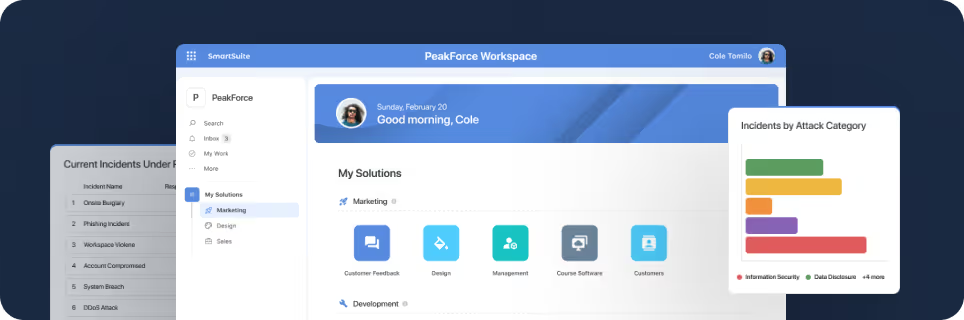
SmartSuite provides work platform for standardizing workflows in the following areas:
- Governance, Risk & Compliance
- IT & Service Ops
- Project / Portfolio Management
- Business Operations