
The Shift From Periodic Assurance to Continuous Confidence
For decades, financial institutions have evaluated cyber and resilience posture through periodic cycles. Annual control assessments, quarterly reviews, yearly audits: these rhythms shaped how organizations understood their risk readiness. But the world that created those rhythms no longer exists.
Today, digital infrastructure changes hourly. Threats evolve by the minute. Vendor dependencies shift daily. Cloud configurations drift in real time.
Risk is not a periodic event: it is a living, continuous state.
Over the past several years, I’ve watched institutions attempt to adjust, layering automated monitoring tools, cloud security posture platforms, vulnerability management systems, and resilience dashboards on top of legacy GRC practices.
These tools provided visibility, but they rarely provided confidence, because the underlying governance structures were still tied to periodic cycles of evaluation, translation, and remediation.
The missing piece was never the data.
The missing piece was the framework that could unify these signals into a real-time understanding of control effectiveness.
That piece arrived with the Cyber Risk Institute’s CRI Profile.
Why CRI Is the Foundation for Continuous Assurance
When institutions talk about “continuous assurance,” they typically mean one of three things:
- Continuous control monitoring.
- Continuous evidence collection.
- Continuous insight into risk posture.
All three matter. But none can succeed without a unifying framework that transforms data into meaning.
Monitoring tools generate signals. Assessment tools generate reports. Audit tools generate findings. Resilience tools generate readiness metrics.
But without a shared structure behind them, these signals don’t add up to assurance: they add up to noise.
CRI changes that by providing the first diagnostic model built to unify cyber, risk, resilience, and technology expectations under a single, consistent structure.
Its diagnostic statements articulate:
- What needs to be monitored.
- Why it matters.
- How maturity should be evaluated.
- How evidence should align.
- How remediation should be categorized.
- How readiness should be communicated.
This diagnostic model is what turns data into governance.
Continuous assurance is not about collecting information faster. It is about interpreting information consistently.
CRI finally gives institutions the structure to do exactly that.
Why Periodic Assessment No Longer Works
Across global banks, regional institutions, credit unions, and fintech companies, the limitations of periodic assurance are becoming increasingly visible.
Institutions often face:
1. Assessment lag
By the time a control test is completed, the environment has changed, sometimes materially.
2. Evidence gaps
Evidence collected once a year doesn’t reflect daily reality.
3. Inconsistent maturity scoring
Annual evaluations cannot account for real-time indicators like configuration drift, patch delays, or vendor outages.
4. Out-of-sync remediation
Issues raised in one cycle may already be outdated by the next.
5. Slow regulatory response
Periodic assurance leaves institutions unprepared to demonstrate real-time posture during supervisory reviews.
6. Board frustration
Leaders increasingly want live understanding, not retrospective summaries. Institutions don’t need faster assessments, they need continuous governance. CRI provides the vocabulary and structure to enable it.
CRI Is the Diagnostic Backbone of Continuous Assurance
The brilliance of the CRI Profile lies in its diagnostic design.
Each diagnostic statement describes an outcome, not a control. A maturity indicator, not a task. A condition to be assessed continuously, not annually.
This allows signals from monitoring tools, identity platforms, cloud security engines, vendor-risk systems, and resilience tools to flow naturally into the same model.
Because CRI diagnostics are:
- Measurable.
- Observable.
- Evidence-driven.
- Framework-harmonized.
- Maturity-linked.
- Regulator-recognized.
- Outcome-focused.
They can serve as the anchor point for continuous assurance.
With CRI, continuous assurance becomes:
- Consistent.
- Connected.
- Explainable.
- Defensible.
- Automated.
Instead of dozens of separate dashboards, institutions finally have one structure to tie them all together.
Continuous Assurance Requires a Workflow Engine, Not a Module
Frameworks create alignment, but only workflows create motion.
This is where most GRC systems fall short. They store evidence; they don’t connect it. They record assessments; they don’t operationalize them.
They track issues; they don’t unify remediation. They map controls; they don’t bring continuous data into the lifecycle.
A workflow-native platform, like SmartSuite, is what turns CRI diagnostics into continuous assurance processes.
Here’s how.
How SmartSuite Operationalizes CRI for Continuous Assurance
1. Diagnostics become triggers
Every diagnostic can be tied to:
- Monitoring alerts.
- Control changes.
- Configuration drift.
- Vendor signals.
- Resilience events.
Meaning assurance updates as the environment updates.
2. Evidence becomes continuous
SmartSuite ties evidence directly to the:
- Diagnostic.
- Workflow.
- Owner.
- Timestamp.
- Automation.
- Remediation lifecycle.
Evidence stops being static. It becomes alive.
3. Remediation becomes unified
Instead of separate remediation processes across cyber, audit, compliance, and resilience, SmartSuite creates:
- One issue.
- One workflow.
- One owner.
- One validation path.
- One closure lifecycle.
This is the heart of continuous assurance, unfragmented response.
4. Maturity becomes dynamic
As evidence changes, issues arise, and monitoring signals adjust, maturity can update automatically.
Boards no longer rely on outdated snapshots. They see motion.
5. The story becomes coherent
Continuous assurance is not just about data flow, it is about narrative. SmartSuite ties diagnostics to dashboards, outcomes, resource needs, and resilience impacts.
Boards finally get the visibility they’ve wanted for years:
- What changed today?
- What hasn’t changed in months?
- What is improving?
- What is deteriorating?
- What needs investment?
Continuous assurance turns posture into a story, not a static report.
Why This Matters for the Future of Financial Services
Continuous assurance is more than a tooling upgrade; it is a governance evolution.
The institutions that embrace it will operate with:
- Faster insight.
- Cleaner evidence.
- Reduced audit burden.
- Stronger compliance posture.
- Earlier detection.
- More effective remediation.
- Increased regulator confidence.
- Greater resilience.
Those that remain tied to periodic assurance will fall behind.
Not because they lack controls, but because they lack visibility.
In a world where risk moves continuously, assurance must move continuously too.
CRI provides the “why.” SmartSuite provides the “how.”
Together, they enable the real-time control confidence the industry has needed for years.
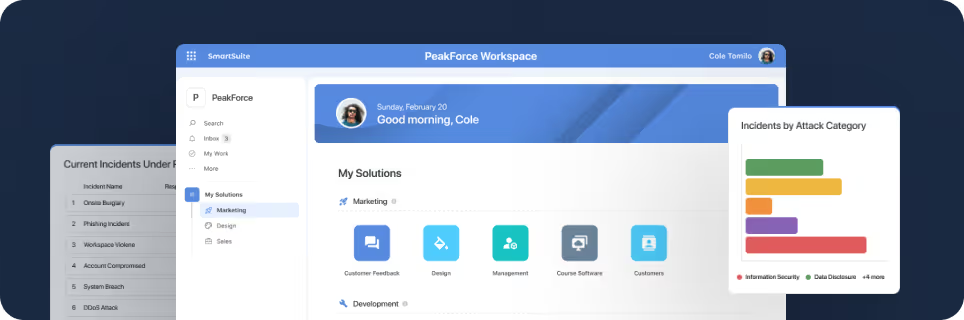
SmartSuite provides work platform for standardizing workflows in the following areas:
- Governance, Risk & Compliance
- IT & Service Ops
- Project / Portfolio Management
- Business Operations