For years, boards of directors have asked their CISOs and Chief Risk Officers a simple question: “How secure are we?”
It’s a question that should inspire confidence, but too often triggers confusion.
Spreadsheets, dashboards, and heat maps flood the boardroom. One framework says “high maturity,” another says “moderate,” and a recent audit flags “material findings.” The narrative changes depending on which department tells it.
The result is an illusion of control, lots of data, but little understanding. The good news: that’s changing.
The Board’s New Reality
Boards are under unprecedented scrutiny. Regulators, shareholders, and customers now expect directors to play an active role in overseeing cyber and operational risk.
New SEC disclosure rules, the EU’s DORA framework, and the global emphasis on resilience have all placed risk squarely on the board agenda.
But with that responsibility comes a new expectation: transparency.
Not just reporting, but comprehension, an ability to explain how risks are identified, managed, and mitigated across the organization.
The problem? Most reporting systems weren’t built for clarity. They were built for compliance.
The Transparency Gap
In many institutions, risk information moves upward through layers of translation:
- Control owners log issues in one system.
- Risk managers summarize findings in another.
- Compliance teams align them to frameworks.
- Executives condense them into board slides.
By the time data reaches the board, context is gone, and confidence along with it.
What boards really need isn’t more data. They need connected insight: a way to see how governance, risk, and resilience interlock to protect business performance.
Why Frameworks Like CRI Matter
The Cyber Risk Institute’s CRI Profile is doing more than simplifying compliance. It’s redefining how risk maturity is communicated.
By translating thousands of regulatory expectations into clear diagnostic statements, the CRI Profile creates a consistent lens through which both management and boards can measure progress.
Instead of hearing “we’re 80% compliant,” directors can see:
- Which controls support which business objectives.
- How cyber posture aligns with resilience goals.
- Where resource gaps exist, and what’s improving over time.
That’s not reporting. That’s understanding.
💡 Check out how SmartSuite is transforming the way financial institutions approach CRI Profile implementation to replace the FFIEC CAT and modernize a broader GRC integration:
A Common Language for Executives
Every board presentation should answer three questions:
- Where are we today?
- How are we improving?
- What could disrupt our progress?
Frameworks like CRI make it possible to answer those questions in the same language across departments and across institutions.
The rise of risk taxonomies and maturity models means directors can now benchmark themselves against peers, understand trends, and track progress over time.
This shared understanding fosters a new kind of conversation: one that shifts from “Are we compliant?” to “Are we resilient?”
Technology Is Closing the Loop
Transparency doesn’t come from better PowerPoints; it comes from connected systems.
At SmartSuite, we’ve designed our GRC Solution Suite to make this visibility real:
- Unified data model: risk, compliance, and resilience records connect automatically.
- Embedded CRI Profile: directors can see maturity across domains using a common lens.
- Executive dashboards: real-time metrics translate control data into strategic insights.
When boards and executives can trace every policy, incident, and control back to business objectives, risk oversight becomes proactive rather than reactive.
It’s not about simplifying the story; it’s about making the story accurate.
The Shift from Reporting to Readiness
The most advanced financial institutions are embracing a new mindset: the board isn’t the last stop in the reporting chain; it’s part of the control system itself.
This evolution changes everything:
- Risk appetite becomes measurable.
- Scenario testing moves from tabletop to analytics.
- Resilience metrics become as familiar as financial KPIs.
In short, boards stop asking “How secure are we?” and start asking “How prepared are we?” That’s the right question.
Building Trust Through Clarity
I believe that, ultimately, transparency isn’t about data: it’s about trust.
When boards understand the “why” behind risk metrics, they make better decisions, allocate resources more effectively, and support leadership in strengthening culture.
Trust is earned when everyone, from control owners to directors, operates from the same facts, the same framework, and the same mission: resilience.
We’re entering a new era where governance and technology converge, where board meetings are guided by insight, not instinct, and where clarity becomes the ultimate measure of maturity.
That’s what boards really want.
Jon Darbyshire is CEO and Founder of SmartSuite and previously founded Archer IRM, one of the first enterprise GRC platforms. He continues to work closely with financial institutions, regulators, and technology partners to advance the future of integrated risk management.
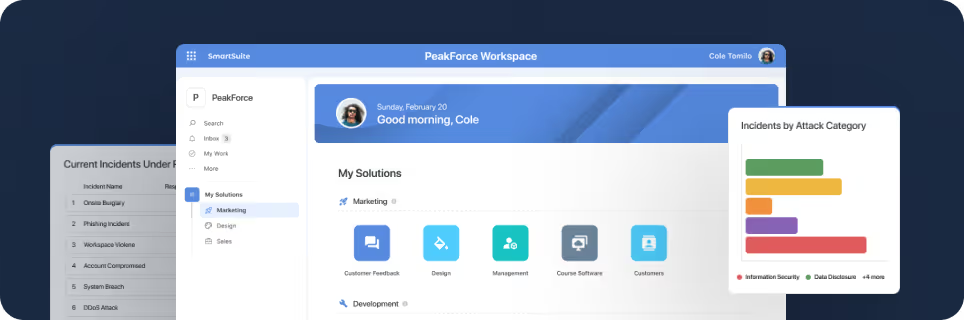
SmartSuite provides work platform for standardizing workflows in the following areas:
- Governance, Risk & Compliance
- IT & Service Ops
- Project / Portfolio Management
- Business Operations