
When the Cyber Risk Institute (CRI) Profile was first introduced, it was designed to solve a very specific problem: create a unified cybersecurity and resilience framework for the financial-services sector: an industry defined by regulatory intensity, operational complexity, and systemic importance.
And it worked. In ways few frameworks ever have.
Over the past several years, I’ve watched global banks, regional institutions, credit unions, and emerging fintech companies embrace CRI as the backbone of their cyber maturity, operational resilience, and governance models.
It has become a shared diagnostic language that connects cyber, risk, audit, compliance, and resilience teams, something the industry has needed for decades.
But as adoption has grown, something interesting has happened: leaders in other industries have started paying attention.
Healthcare, energy, manufacturing, retail, government agencies, and even technology companies are all beginning to ask a variation of the same question:
“Why doesn’t our industry have a CRI Profile?”
And after spending years studying how institutions across sectors manage risk, I believe the question is well-founded, and the opportunity is real.
The CRI Profile may have been born in financial services, but its underlying design philosophy is industry-agnostic. Its greatest strength, a unified diagnostic structure that harmonizes complex regulatory environments, is exactly what other industries now desperately need.
The future of CRI may extend far beyond banking.
Why CRI’s Core Design Is Universal
CRI succeeds not because of the specific regulations it harmonizes, but because of the model behind it. That model is universally applicable in any complex, regulated environment.
Across industries, several truths hold:
- Cybersecurity is inseparable from operational resilience.
- Third-party ecosystems create systemic risk.
- Regulatory expectations overlap, conflict, and evolve.
- Executives and boards need clear, consistent maturity reporting.
- Teams speak different operational languages.
- Evidence is scattered across systems and functions.
- Organizations struggle to communicate risk coherently.
These conditions don’t belong to financial services: they belong to modern business.
CRI’s diagnostic structure addresses these challenges in a way that transcends the original sector:
- It’s diagnostic rather than prescriptive.
- It defines outcomes instead of dictating controls.
- It creates harmonized clarity from fragmented requirements.
- It supports continuous monitoring and assurance.
- It gives executives and boards a common risk language.
- It maps naturally into workflow-based governance platforms.
In other words: CRI is not a banking framework. CRI is a model, one that just happened to find its first home in banking.
The Oversized Impact of a Harmonized Framework
Across my work with top-tier institutions, one insight has become increasingly clear:
When an industry shares a single diagnostic language, everything moves faster.
With a harmonized model:
- Vendors integrate more easily.
- Evidence becomes reusable.
- Assessments become comparable.
- Remediation becomes consistent.
- Maturity becomes measurable.
- Supervisory relationships improve.
- Board reporting becomes coherent.
- Technology platforms can connect meaningfully.
These benefits are not financial-services specific, they are universal.
And they would be transformational in industries like:
Healthcare
Where HIPAA, NIST, HITECH, FDA requirements, and third-party risk expectations often conflict.
Energy & Critical Infrastructure
Where NERC CIP, DOE guidelines, and supply chain risks create complex interdependencies.
Manufacturing & Industrial
Where OT/IT convergence, safety requirements, and supply chain controls lack unified frameworks.
Government
Where agencies operate under multiple overlays like FISMA, CISA, NIST SP frameworks, and sector-specific mandates.
Retail & Payments
Where PCI, data-privacy requirements, fraud controls, and cyber resilience must merge.
Each of these industries faces the same fragmentation problem CRI solved for banking, just at different scales.
Why CRI Resonates Across Sectors
The more I’ve studied governance models across industries, the more I’ve realized that CRI’s success stems from structural attributes rather than sector-specific ones.
1. CRI aligns deeply technical work with governance outcomes.
Boards, executives, and practitioners all use the same diagnostic statements.
2. CRI harmonizes overlapping frameworks.
It eliminates confusion caused by competing standards.
3. CRI provides a maturity model that is explainable, defensible, and comparable.
4. CRI supports continuous assurance.
Because diagnostics map easily to real-time monitoring signals.
5. CRI provides a foundation for vendor ecosystem alignment.
Tools can integrate around a shared structure.
6. CRI serves as a unifying architecture.
It aligns cyber, risk, audit, compliance, and resilience.
These capabilities are not unique to financial services. They are the capabilities every modern industry needs.
Patterns I’ve Observed Across Industries
Across years of working with organizations outside financial services, I’ve seen the same structural challenges that existed in banking before CRI was introduced:
- No shared maturity model across cyber, operational risk, and resilience.
- Redundant assessments across frameworks.
- Limited ability to reuse evidence.
- Lack of interoperability between security tools.
- Difficulty producing consistent board reporting.
- Fragmented remediation workflows.
- Conflicting interpretations of regulatory expectations.
- Lack of a unified diagnostic structure.
- Slow movement from periodic to continuous assurance.
Every one of these challenges maps naturally to CRI’s design. This is why I believe CRI is not merely an FS framework, it is a blueprint.
What a Cross-Industry CRI Evolution Could Look Like
If CRI were to expand into other sectors, I believe it would follow a familiar pattern:
Phase 1: Harmonization of existing frameworks
Map sector-specific standards (e.g., HIPAA, NERC CIP) into a diagnostic structure.
Phase 2: Alignment of regulatory expectations
Establish common maturity diagnostics across agencies.
Phase 3: Vendor ecosystem alignment
Security tools begin integrating directly to the diagnostics.
Phase 4: Workflow operationalization
Platforms like SmartSuite embed diagnostics into:
- Assessments.
- Evidence.
- Issues.
- Remediation.
- Continuous assurance.
- Executive reporting.
Phase 5: Industry benchmarking
Shared diagnostics create a foundation for peer comparison.
Phase 6: Board-level adoption
Diagnosed maturity becomes the new standard for governance reporting. This model works, because it already worked in the most complex sector of all: financial services.
Why SmartSuite Is Positioned to Support Cross-Industry Expansion
SmartSuite was built around workflows, not modules, which makes it uniquely suited for frameworks built around diagnostics.
Whether CRI extends into healthcare, energy, manufacturing, or government, SmartSuite’s workflow-native architecture allows:
- Diagnostics → to become automation triggers.
- Evidence → to follow workflows.
- Controls → to map across domains.
- Issues → to align to maturity expectations.
- Vendors → to integrate against a unified structure.
- Dashboards → to reflect continuous state of readiness.
SmartSuite is not tied to FS frameworks; it is tied to process, which is universal.
If CRI expands, workflow-native platforms will be the operational backbone that brings it to life across industries.
Conclusion: CRI Is Not the End of a Story: It’s the Beginning of One
The CRI Profile has already reshaped cyber governance across financial services. But its greatest contribution may be yet to come.
CRI has demonstrated that harmonized diagnostics can unify:
- Cyber.
- Risk.
- Audit.
- Compliance.
- Resilience.
- Vendors.
- Boards.
- Regulators.
No other framework has achieved this.
And the need for this kind of unity is not confined to financial institutions.
Every complex industry now faces the same ecosystem of risk, the same regulatory fragmentation, the same need for continuous assurance, and the same demand for board-level clarity.
That is why I believe the future of CRI, or CRI-inspired diagnostic models, extends far beyond financial services.
Because the model works. Because the need is real. Because the world is ready for harmonization, not fragmentation.
And because resilience, trust, and governance depend on it.
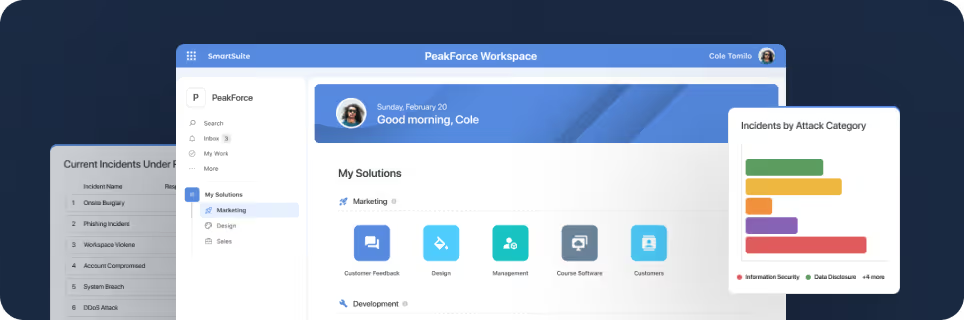
SmartSuite provides work platform for standardizing workflows in the following areas:
- Governance, Risk & Compliance
- IT & Service Ops
- Project / Portfolio Management
- Business Operations