

For decades, assurance programs in financial services have been built on a simple premise: evaluate controls periodically, validate evidence retrospectively, and report on maturity episodically.
This process made sense in an era when systems were slower, architectures were centralized, risks were more contained, and regulatory expectations evolved gradually.
But institutions no longer operate in that world. Cloud environments change hourly. Vendors change weekly. Threats evolve daily. Incidents unfold in real time. Continuity dependencies shift constantly.
Data moves at a velocity the old assurance model was never designed to support.
Periodic assurance is out of step with continuous risk.
In conversations across global banks, credit unions, mid-sized institutions, and fintech companies, I’ve seen the same theme emerge: organizations want insight that reflects today, not last quarter. They want confidence in controls, not just documentation of them. They want to discover weak signals before they become failures. And they want assurance that adapts as quickly as their environments do.
They want connected assurance, an approach that reflects the interconnected, always-changing nature of risk.
This model is now becoming possible thanks to two developments:
- The CRI Profile, which harmonizes diagnostic expectations across cyber, resilience, and governance.
- Workflow-native platforms like SmartSuite, which operationalize assurance as a continuous, connected process.
Together, these forces are ushering in a new era, one where assurance is not periodic, manual, and reactive, but continuous, unified, and built directly into daily operations.
Why Assurance Must Evolve
The limitations of periodic assurance are becoming more visible each year.
1. Controls drift between assessments
Configuration changes, vendor updates, and cloud migrations can render prior assessments inaccurate within days.
2. Evidence becomes stale as soon as it’s collected
Artifacts captured annually or quarterly rarely reflect real-time posture.
3. Assurance becomes detective, not preventive
Issues are identified long after they can be avoided.
4. Teams operate in silos
Cyber conducts technical validation, audit performs testing, and resilience teams run continuity checks, often without shared context.
5. Leadership only sees snapshots
Boards receive assurance that reflects historical posture, not current readiness.
6. Regulators now expect real-time awareness
Supervisory expectations are increasingly aligned to ongoing, not periodic, control validation.
The industry hasn’t lacked talent, effort, or intent, it has simply lacked the structural foundation for connected assurance.
Assurance Has Always Been Connected: Tools Just Hid the Connections
Assurance is inherently interconnected.
A control failure in cybersecurity often reveals governance oversight weaknesses.
A resilience issue frequently exposes technology or vendor gaps.
An audit deficiency may reflect cybersecurity misalignment.
A vendor misconfiguration may threaten operational continuity.
But assurance tools, built as modules for cyber, risk, resilience, and audit, hid these connections.
Each module produced its own narrative.
Each function collected its own evidence.
Each team tracked its own issues.
Each system reported its own maturity.
The result was a fragmented assurance fabric, a set of disjointed checks in a world that demands systemic visibility.
Connected assurance emerges from acknowledging that assurance is not a set of separate disciplines.
It is a single governance process, expressed through multiple lenses.This is precisely where the Cyber Risk Institute’s CRI Profile becomes transformative.
CRI: The Backbone of Connected Assurance
CRI did not set out to be an assurance framework, but that is exactly what its diagnostic structure enables.
CRI creates a unified set of diagnostic statements that span cybersecurity, technology risk, operational resilience, governance, and third-party oversight. Because each diagnostic is structured, interpretable, and outcome-oriented, it becomes the perfect anchor for continuous assurance.
Diagnostic statements define:
- What needs to be assured.
- What maturity looks like.
- What evidence should demonstrate.
- What resilience requires.
- What governance expects.
- What regulators will interpret.
This structure turns fragmented assurance practices into a single diagnostic system.
Cyber can evaluate controls using the same diagnostic indicators as compliance.
Audit can test evidence using the same criteria used for risk scoring.
Resilience teams can map continuity expectations into the same diagnostic framework.
Leadership can evaluate readiness through one unified lens.
CRI collapses parallel assurance processes into one harmonized structure.
What Connected Assurance Looks Like Inside an Institution
Across institutions moving toward connected assurance, I’ve seen several consistent shifts, all of them positive, and all of them significant.
Assurance becomes continuous, not periodic
Monitoring signals automatically update diagnostic maturity.
Evidence becomes reusable across teams
Audit, cyber, and resilience teams reference the same evidence artifacts.
Remediation becomes unified
One issue → one workflow → one closure path → one narrative.
Controls become contextual
A control is not “effective” or “ineffective”, it is evaluated relative to diagnostic expectations and resilience impact.
Reporting becomes coherent
Boards see one story, not five reconciled summaries.
Insights become predictive
Connected assurance highlights patterns across vendors, controls, systems, and processes.
Regulatory interactions become smoother
Supervisors respond more favorably when institutions can demonstrate real-time diagnostic alignment.
Connected assurance does not simplify risk, it clarifies it.
Why Workflow-Native Platforms Make Connected Assurance Possible
While CRI defines the structure for connected assurance, technology determines whether that structure becomes real.
Traditional GRC platforms cannot support connected assurance because they were built for static, module-based workflows that reflect periodic processes, not continuous ones.
Connected assurance requires:
- Real-time signal ingestion.
- Workflows that cross domains.
- Unified evidence repositories.
- Integrated remediation.
- Dynamic dashboards.
- Automated diagnostic mapping.
- Cross-functional transparency.
- End-to-end audit trails.
- Continuous maturity movement.
This is why SmartSuite is particularly suited for connected assurance: it was built around workflow, not modules, and around process, not categories.
SmartSuite operationalizes CRI diagnostics by:
- Mapping monitoring signals directly to diagnostic statements.
- Turning evidence into living artifacts rather than static files.
- Unifying issues across cyber, audit, compliance, and resilience.
- Converting remediation into a connected, cross-functional lifecycle.
- Generating real-time maturity updates.
- Presenting cohesive board-level narratives.
- Supporting continuous oversight, not periodic review.
CRI provides the “why.” SmartSuite delivers the “how.”
The Strategic Value of Connected Assurance
The organizations adopting connected assurance are already seeing structural benefits that periodic models could never provide.
1. Clarity for decision-makers
Boards and executives finally get a real-time understanding of readiness.
2. Consistency across domains
Cyber, audit, compliance, and resilience stop contradicting each other.
3. Efficiency in evidence
Teams reuse validated evidence instead of re-creating it.
4. Speed in remediation
Issues follow one path, not five.
5. Predictive insight
Connected assurance highlights weak signals before failures occur.
6. Audit readiness
Institutions can demonstrate control effectiveness at any moment.
7. Stronger regulatory posture
Supervisors increasingly prefer institutions with cohesive diagnostic structures.
Connected assurance becomes a competitive differentiator, not just a risk-management strategy.
Conclusion: The Future of Assurance Is Interconnected
The financial services industry is entering a new era, one where assurance must match the real-time, interconnected nature of risk. The CRI Profile provides the unified diagnostic structure required to align teams, tools, and frameworks. Workflow-native platforms like SmartSuite make that alignment operational.
Together, they turn assurance into a continuous, connected process that reflects the true complexity, and urgency, of modern financial services.
This is the future of assurance.
And the institutions that embrace it now will lead the next decade of resilience.
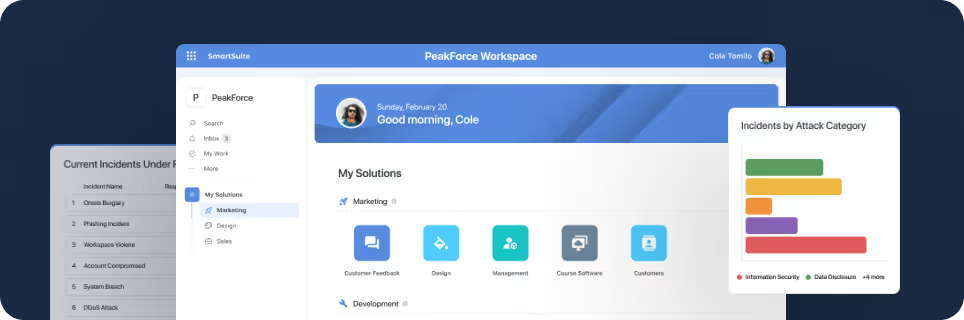
SmartSuite provides work platform for standardizing workflows in the following areas:
- Governance, Risk & Compliance
- IT & Service Ops
- Project / Portfolio Management
- Business Operations