
Over the last several years, a fundamental shift has been taking place inside financial-services organizations, not loudly, not with fanfare, but steadily and unmistakably.
Risk teams, long dependent on rigid legacy systems, IT backlogs, and manually orchestrated processes, have begun embracing something that would have seemed unthinkable a decade ago:
They are building their own operational systems.
Not through shadow IT. Not through spreadsheets. Not through custom development. But through no-code platforms that allow them to design, construct, adapt, and unify workflows at the speed risk actually moves.
This movement represents one of the most important evolutions in modern governance: the realization that risk operations cannot rely solely on engineering-led systems that update quarterly while risk changes daily.
Instead, risk teams need architectural agility, the ability to model, adjust, and scale workflows as fast as regulatory obligations, threats, vendors, and business priorities evolve.
No-code platforms are making this possible. And they are redefining the very center of risk operations.
Why No-Code Became Necessary, Not Optional
As someone who has spent more than two decades studying how risk, cyber, and audit teams work, first at EY helping build early cyber frameworks, then at ArcherIRM during the rise of enterprise GRC, and now at SmartSuite, I’ve seen the same pattern in hundreds of institutions:
Risk operations move faster than the systems designed to support them.
And the gaps caused by this misalignment have grown too large to ignore.
Here’s what institutions have struggled with:
1. Legacy GRC systems reflect the past, not the present
They’re built around static modules and rigid hierarchies, not dynamic workflows.
2. IT backlogs create operational bottlenecks
Risk teams wait months for changes that should take hours.
3. Regulatory shifts outpace system releases
When frameworks evolve, many platforms can’t keep up.
4. Manual workarounds become embedded in daily operations
Spreadsheets, emails, and disconnected tools fill the gaps.
5. Risk teams need control, but lack the tools
Professionals with deep process knowledge cannot translate their needs into system behavior.
The result is a governance environment where risk is evaluated in real time, but governed through systems that lag months behind.
No-code platforms solve this by allowing risk practitioners, not developers, to design the workflows that define how risk is managed.
This is not a convenience. It is a structural necessity.
What “No-Code for Risk Operations” Actually Means
Many people still misunderstand no-code as a simple drag-and-drop UI or a tool for building forms. But in practice, no-code is something far deeper and more transformative:
No-code gives business experts the same creative capability that engineers have, without requiring engineering.
In risk operations, that capability translates into:
- Building cross-functional workflows.
- Designing sophisticated automation.
- Modeling regulatory frameworks.
- Integrating evidence sources.
- Orchestrating remediation lifecycles.
- Aligning diagnostics to frameworks like CRI, DORA, NIST.
- Creating dashboards that reflect real-time posture.
- Adapting rapidly as risk evolves.
No-code shifts the center of gravity from IT to the teams who own the outcomes, creating a governance structure that is faster, more collaborative, and more aligned to the real world of risk.
This is not about enabling citizen developers. It’s about empowering risk operators.
Why Risk Is Perfectly Suited for No-Code
Risk operations share a set of characteristics that make no-code platforms uniquely effective:
1. Risk is process-heavy
Assessments, evidence collection, testing, workflows, issues, approvals, all process-centric tasks.
2. Risk is relationship-intensive
Every activity touches multiple teams: cyber, audit, vendors, operations, compliance, continuity.
3. Risk is structured
Frameworks like CRI, NIST, ISO, DORA, FFIEC rely on taxonomy, diagnostics, and maturity models.
4. Risk is dynamic
Processes change with new threats, regulatory shifts, and institutional priorities.
5. Risk is data-rich
Signals flow from dozens of tools: SIEMs, vulnerability scanners, vendor systems, cloud monitors.
No-code is most powerful when used to orchestrate structured, cross-functional, fast-changing, data-rich processes.
Risk operations are exactly that.
The Three Levels Where No-Code Is Transforming Risk
1. Workflow Modeling
Risk teams can now design workflows the way they think about risk:
- CRI diagnostic → control mapping → evidence → testing → remediation
- Incident → classification → response → regulatory reporting
- Vendor risk → assessment → evidence → remediation → monitoring
- Continuity scenario → business impact → dependency map → testing → improvement
This eliminates the old mismatch between how teams think and how systems behave.
2. Integrated Evidence & Remediation
Evidence no longer lives in static folders. It flows through workflows, anchored to:
- Controls.
- Diagnostic statements.
- Testing procedures.
- Vendor reviews.
- Resilience dependencies.
Remediation follows the same pattern. Issues are not “owned” by modules, they’re owned by workflows.
This creates connected assurance, not isolated activity.
3. Adaptive Governance
No-code allows institutions to adapt rapidly:
- New procedures → hours.
- New DORA requirements → days.
- New CRI diagnostics → hours.
- New risk categories → minutes.
- New automations → drag-and-drop.
This is the speed modern governance requires.
Why No-Code Is Reshaping Strategic Risk Architecture
The most profound shift I’ve seen is architectural:
No-code moves institutions from module-centric governance to workflow-centric governance.
This shift unlocks:
- Cross-team alignment
- Shared maturity models
- Integrated evidence
- Consistent remediation
- Unified reporting
- Real-time dashboards
- Continuous assurance
- AI-augmented governance
Modules divide. Workflows connect.
And no-code makes workflows the foundation of everything.
Why SmartSuite Is at the Center of This Transition
SmartSuite wasn’t built as a traditional GRC platform; it was built as a no-code workflow engine tailored for complex, cross-functional work.
This architecture is what allows SmartSuite to:
- Operationalize CRI diagnostics
- Unify cyber, risk, audit, continuity, and vendor workflows
- Embed evidence directly in process flows
- Integrate signals from dozens of systems
- Align maturity models across disciplines
- Support continuous assurance
- Adapt instantly to regulatory change
Your product leadership, from ArcherIRM to SmartSuite, has always been rooted in a belief that process defines risk, not modules.
No-code makes that philosophy real.
The Future of No-Code in Risk
Based on patterns across the industry, here’s where no-code is headed:
1. No-Code Will Become the Workflow OS for Governance
Every major risk and resilience process will run on configurable workflows.
2. AI Will Sit on Top of No-Code Architectures
AI copilots will design workflows, interpret diagnostics, and suggest remediation, all using no-code layouts.
3. Institutions Will Build Their Own Framework Implementations
Teams will rapidly model CRI 2.0, DORA, NIST, and internal frameworks inside one environment.
4. Evidence Will Become Fully Integrated
No more evidence libraries. Everything will be anchored to workflows.
5. Remediation Will Become Predictive
Signals from vendors, cloud tools, monitoring, and diagnostics will automatically trigger workflows.
6. Governance Will Become Real-Time
With no-code as the backbone, continuous assurance becomes normal, not aspirational.
Conclusion: No-Code Isn’t a Tool, It’s an Architecture for Risk
No-code platforms are not replacing risk professionals; they are elevating them.
They move risk operations from:
- Manual → automated
- Reactive → predictive
- Siloed → connected
- Static → dynamic
- Module-based → workflow-native
Risk teams can now design the systems that support them, instead of adapting themselves to legacy tools.
This isn’t a trend. It’s an architectural shift that will define the next decade of governance.
The institutions that embrace no-code will move faster than regulation, respond faster than threats, and govern with clarity that no module could ever deliver.
The future of risk is workflow-native. And no-code platforms are the way organizations get there.
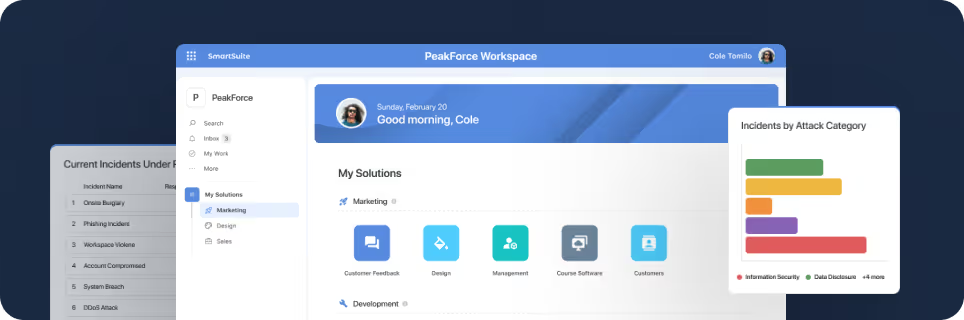
SmartSuite provides work platform for standardizing workflows in the following areas:
- Governance, Risk & Compliance
- IT & Service Ops
- Project / Portfolio Management
- Business Operations