
Introduction: A Turning Point for FS Cyber Governance
When the Cyber Risk Institute (CRI) first released its Profile, it gave financial institutions something they’d lacked for decades: a single, harmonized structure for evaluating cyber and resilience maturity across regulatory expectations. It unified frameworks, aligned teams, and created a diagnostic model that CISOs, risk managers, auditors, resilience leaders, boards, and regulators could all interpret consistently.
But frameworks cannot remain static.
As technology evolves, threats accelerate, and regulatory expectations expand, institutions need diagnostic models that reflect the world they operate in today, not the world they operated in a decade ago.
CRI Profile 2.0 represents that next evolution.
Through collaborative work across banks, regulators, industry associations, and cybersecurity leaders, CRI has modernized its diagnostic structure to reflect:
- Cloud-native operating models.
- Continuous monitoring and assurance expectations.
- Third-party ecosystem expansion.
- Operational resilience mandates.
- Convergence of cyber + technology + operational risk.
- New regulatory guidance across global jurisdictions.
CRI 2.0 is not a minor revision. It is a structural upgrade, one that strengthens the Profile’s position as the most influential diagnostic model in financial services.
Why a 2.0 Version Was Necessary
Across my work with FS institutions of all sizes, four patterns consistently emerged that signaled the need for a refreshed CRI Profile.
1. Cloud fundamentally changed the control landscape
Legacy frameworks were built for data centers, not distributed architectures.
2. Continuous monitoring became the norm
Institutions needed diagnostics that supported real-time signals — not periodic checks.
3. Resilience and cybersecurity fully converged
Boards and regulators increasingly treat cyber events as resilience failures.
4. Vendor ecosystems exploded
Third-party risk became one of the largest systemic risks across institutions.
CRI Profile 2.0 responds with a diagnostic structure built for these realities, not for the world that existed when many cyber frameworks were originally authored.
What’s New in CRI Profile 2.0
CRI 2.0 introduces enhancements across five major dimensions.
Below is an overview written to be clear, narrative, and accessible, while still conveying deep insight for practitioners.
1. Stronger Alignment With Global Regulatory Expectations
The financial-services community is experiencing a wave of regulatory activity across:
- U.S. federal regulators.
- UK PRA/BoE requirements.
- EU DORA mandates.
- APAC supervisory expectations.
- Emerging global cyber-resilience rules.
CRI 2.0 updates diagnostic statements to more explicitly harmonize these global requirements, ensuring that:
- Evaluations are cross-regulator compatible.
- Institutions avoid duplicative oversight structures.
- Diagnostic maturity maps cleanly to global exam expectations.
- Supervisors can rely on CRI outputs without translation.
This is one of the most important upgrades in CRI 2.0, it positions the Profile as the “translation layer” regulators increasingly want.
2. Expanded Diagnostic Coverage for Cloud & Modern Architectures
Cloud adoption is universal in financial services, and diagnostic models must reflect this shift.
CRI 2.0 introduces enhancements around:
- Cloud governance.
- Configuration and posture management.
- Identity and privilege in hybrid environments.
- Cloud-resilience readiness.
- Distributed logging and monitoring.
- API governance.
- Container security.
- Multi-cloud complexity management.
Legacy cyber frameworks struggled to capture these nuances. CRI 2.0 does not.
These diagnostics now connect directly to real-world operating models across global banks and cloud-native fintechs.
3. Integration of Operational Resilience as a First-Class Diagnostic Theme
Regulators, especially the UK PRA and EU DORA, have made clear that resilience cannot be treated as a separate discipline.
CRI 2.0 reflects this shift with expanded diagnostics around:
- Impact tolerance.
- Disruption scenarios.
- Continuity dependencies.
- Critical business services.
- Recovery governance.
- Mapping technology to operational outcomes.
This creates alignment across cyber, tech-risk, and resilience functions, something I have seen institutions struggle with for years.
CRI 2.0 brings these worlds together intentionally.
4. Clearer Expectations for Third-Party Risk
Third-party ecosystems are now the source of significant operational and cyber risk.
CRI 2.0 enhances diagnostics around:
- Vendor oversight.
- Supplier resilience.
- Off-boarding and concentration risk.
- Fourth-party dependencies.
- Cloud service provider alignment.
- Continuous vendor monitoring signals.
These upgrades make CRI one of the strongest frameworks available for governing third-party ecosystems, a critical need in the modern FS landscape.
5. Structural Improvements for Continuous Assurance
One of the most notable evolutions in CRI 2.0 is its readiness for continuous assurance.
Diagnostics now more naturally support:
- Real-time monitoring tools.
- Identity governance systems.
- Cloud drift detection.
- Continuous evidence collection.
- Unified issue lifecycle workflows.
- Dynamic maturity scoring.
- Automated assurance triggers.
This aligns CRI 2.0 with the pace of modern risk, and with the architectural direction regulators and boards are moving toward.
Why CRI 2.0 Matters for Institutions
Beyond feature updates, CRI 2.0 introduces deeper and more consequential capabilities.
It improves clarity
Diagnostics are now cleaner, more interpretable, and more action-oriented.
It improves alignment
Teams across cyber, compliance, audit, and resilience share a stronger, more unified structure.
It improves governance
Boards can read a CRI 2.0 maturity narrative without needing translation.
It improves comparability
Peer benchmarking becomes more credible and meaningful.
It improves operationalization
Diagnostic structure aligns more naturally with workflows, automation, and evidence collection.
It improves regulatory conversations
Supervisors increasingly recognize CRI as a mature, harmonized interpretation model.
CRI 2.0 strengthens everything the Profile was already doing well, and corrects areas where the original model began to show its age.
CRI 2.0 and SmartSuite: Operationalization Meets Intelligence
CRI 2.0 defines the structure of connected governance. SmartSuite provides the workflow architecture that brings that structure to life.
Inside SmartSuite:
- CRI 2.0 diagnostics become workflow triggers.
- Evidence anchors directly to diagnostic requirements.
- Remediation follows a unified lifecycle.
- Maturity updates dynamically with signals.
- Vendor insights map cleanly to diagnostic expectations.
- Dashboards reflect real-time posture.
- Assurance becomes continuous rather than periodic.
CRI 2.0 provides clarity. SmartSuite provides motion.
This combination positions institutions to operate with a level of consistency, transparency, and confidence that was extremely difficult, if not impossible, under legacy GRC models.
Conclusion: CRI 2.0 Is Not Just an Update, It’s an Inflection Point
The CRI Profile has been the most significant harmonization effort in financial-services cybersecurity and resilience. CRI 2.0 strengthens that foundation and positions it for the next decade.
It answers the needs of modern FS institutions:
- Cloud-native architectures.
- Continuous assurance.
- Integrated resilience.
- Vendor ecosystems.
- Global supervisory alignment.
It also answers the needs of boards:
- Clarity.
- Consistency.
- Comparability.
- Confidence.
CRI 2.0 marks the moment when harmonized governance shifts from helpful to essential.
This is more than a framework update.
It is the blueprint for the next era of cyber governance, one that finally matches the pace, complexity, and interconnected nature of risk.
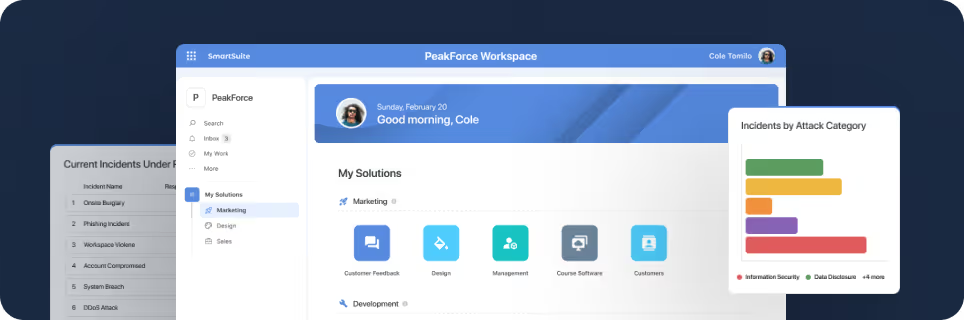
SmartSuite provides work platform for standardizing workflows in the following areas:
- Governance, Risk & Compliance
- IT & Service Ops
- Project / Portfolio Management
- Business Operations