Every industry reaches a moment when the world around it changes so rapidly that the systems built to manage it simply cannot keep up.
Governance, Risk, and Compliance (GRC) is facing that moment right now. Over the next five years, and culminating by 2030, financial institutions will undergo a transformation more profound than anything we’ve seen since the introduction of enterprise risk management two decades ago.
Cyber risk has become operational risk. Operational risk has become business continuity risk. Business continuity risk has become resilience risk. Resilience risk has become systemic risk. And systemic risk is now a board-level obligation.
The boundaries between these disciplines have collapsed.
The threats have accelerated.
The regulatory expectations have converged.
The digital ecosystem has expanded across hundreds of vendors, cloud providers, and interconnected platforms.
GRC is no longer a reporting function.
It is no longer a compliance checklist.
It is no longer an audit routine.
It is the operating system for institutional reliability.
And the institutions that thrive by 2030 will be the ones that understand this shift now, and begin shaping their future around it.
This article outlines what I believe the next decade of GRC will look like based on:
- Nearly 25 years of building systems for the world’s largest financial institutions.
- Firsthand observation of the early GRC era.
- Architecting one of the first enterprise no-code workflow platforms.
- Participating in the CRI movement.
- Watching thousands of workflows across cyber, compliance, audit, resilience, and operational teams.
- Studying regulatory convergence across regions.
- Seeing how AI is reshaping process-driven industries.
- And understanding the barriers that have prevented true alignment for decades.
This is my vision for GRC 2030, where we’re going, what will define the leaders, and how institutions must evolve.
Maturity Models Will Be Replaced by Dynamic Risk States
For years, institutions depended on annual maturity models to evaluate their cyber and risk posture, often producing carefully crafted reports that were outdated the moment they were finalized.
By 2030, this model will be gone.
The new reality: dynamic, continuously updating risk states.
Risk states will update automatically based on:
- Monitoring signals.
- Cloud configuration drift.
- Identity and access activity.
- Third-party disruptions.
- Resilience dependencies.
- Evidence changes.
- Remediation movement.
- AI-predicted weak signals.
Boards will no longer ask, “What level of maturity are we at?”
They will ask: “What state are we in right now?”
This shift will be foundational. Static governance is incompatible with a dynamic threat landscape.
Framework Harmonization Will Become Non-Negotiable
By 2030, institutions will not be able to maintain separate frameworks across cyber, resilience, audit, vendor risk, and compliance. It’s too slow, too expensive, and too fragile.
One harmonized diagnostic model will become the norm.
CRI will be a major part of that. DORA will continue to shape European alignment. PRA/BoE will anchor UK expectations. NIST will remain an architectural reference.
But institutions will need a shared diagnostic layer that ties all of this together: a single interpretive backbone.
Harmonization isn’t a convenience. By 2030, it will be a supervisory expectation.
Connected Assurance Will Replace Periodic Assurance
Today, assurance is periodic. Institutions test controls annually or quarterly. Evidence is collected in snapshots. Audit findings lag real-world changes. Resilience is evaluated through scheduled exercises.
By 2030, this will be obsolete.
Connected assurance will dominate: real-time, workflow-driven, evidence-linked, automatically updating.
- Monitoring signals update diagnostics
- Evidence becomes living, not static
- AI flags weak signals early
- Boards see posture in real time
- Regulators expect continuous readiness
GRC will move from after-the-fact validation to continuous verification.
The Workflow Layer Will Become the New Enterprise Architecture
Legacy GRC systems were module-based. Risk lived in categories. Controls lived in libraries. Issues lived in silos. Evidence lived in folders.
None of that survives in 2030.
The workflow layer becomes the operating system of risk.
Institutions will design workflows that reflect real operations:
- Incident → diagnostic → remediation → evidence → reporting
- Vendor → control → issue → resilience dependency → board visibility
- Cloud drift → monitoring → diagnostic → remediation workflow
Workflows will not belong to “modules.” Workflows will become the architecture.
This is where SmartSuite is already ahead, because workflow-native systems are the only ones capable of scaling into 2030.
AI Will Become the Governance Co-Pilot, but Only for Aligned Institutions
AI will not replace risk teams. It will augment them, massively.
By 2030, AI will:
- Interpret diagnostics
- Map vendor signals
- Propose remediation
- Update risk states
- Identify dependencies
- Write board summaries
- Surface anomalies
- Unify evidence
- Benchmark institutions
But AI will only work where information is structured.
AI cannot reason over:
- Inconsistent maturity models
- Fragmented frameworks
- Evidence spread across 12 systems
- Controls with different definitions
- Vendor outputs with incompatible scoring
This is why CRI matters so much. CRI gives AI something to reason over.
AI + CRI + workflow-layer architecture is the governance engine of 2030.
Vendor Ecosystems Will Become Regulated Through Diagnostic Alignment
Today’s vendor ecosystem is massive. Institutions are reliant on:
- Cloud providers
- SaaS platforms
- Infrastructure vendors
- Analytics tools
- Identity systems
- Monitoring platforms
- Resilience suites
- TPRM tools
By 2030, regulators will expect vendor alignment with harmonized frameworks.
Vendors will need to map their outputs to diagnostic models like CRI.
Institutions will stop accepting arbitrary vendor scoring.
Vendor ecosystems will be evaluated based on CRI-aligned maturity.
This is already happening quietly. By 2030, it becomes explicit.
Resilience Becomes the Lens for All Risk
Cyber risk will be interpreted through resilience. Technology risk will be interpreted through resilience. Vendor risk will be interpreted through resilience. Business continuity will be interpreted through resilience.
Resilience becomes the meta-framework.
By 2030, the most important question governing bodies will ask is:
“Can we continue delivering our critical services under stress?”
Every diagnostic, every workflow, every metric will map to this question.
Board Governance Will Be Built on Diagnostic Narratives
Boards will become far more sophisticated in evaluating cyber and operational resilience.
By 2030, they will expect:
- Diagnostic movement summaries
- Real-time posture
- Comparisons to peers
- Business-service risk
- Dependency mapping
- Continuous assurance insights
- Dynamic risk states
Boards will no longer accept 60-page decks once a quarter. They will expect the governance version of real-time telemetry.
CRI gives them that structure. SmartSuite gives them that lens.
GRC Becomes a Strategic Capability, Not a Risk Constraint
Today, GRC is often viewed as cost, overhead, or compliance burden.
By 2030, GRC becomes:
- A differentiator
- A competitive advantage
- A trust driver
- A governance enabler
- A resilience engine
- An operational backbone
Institutions that can demonstrate dynamic risk states, CRI-aligned diagnostics, continuous assurance, vendor ecosystem maturity, and workflow-native architecture will earn trust from regulators, boards, and customers.
GRC moves from “necessary expense” to strategic infrastructure.
The Institutions That Win by 2030 Will Have Five Characteristics
Based on everything I’ve observed across institutions, regulators, vendors, and industry leaders, the organizations leading by 2030 will share these traits:
1. Harmonized frameworks (CRI at the core)
Diagnostic, not prescriptive.
2. Workflow-native architecture
Risk operated like a living system, not a module stack.
3. AI interpreting diagnostic structures
AI becomes meaningful only where workflows and diagnostics align.
4. Continuous assurance
Real-time posture, not static reporting.
5. Integrated resilience governance
Cyber + risk + continuity + vendor + operations → one narrative.
This is not an aspirational future. It is already emerging, and accelerating.
Conclusion: GRC 2030 Is Closer Than It Seems
2030 is not far away. But in governance terms, it is a lifetime.
Institutions that wait will be playing catch-up for a decade. Institutions that embrace this shift now will become the models others look to, the institutions that regulators trust, boards value, partners respect, and customers rely on.
GRC 2030 is defined by:
- Diagnostic clarity
- Workflow-native execution
- AI augmentation
- Continuous assurance
- Vendor ecosystem alignment
- Resilience-first governance
- Unified risk states
This is the blueprint for the next decade of governance. And the institutions that follow it will define the future of financial services.
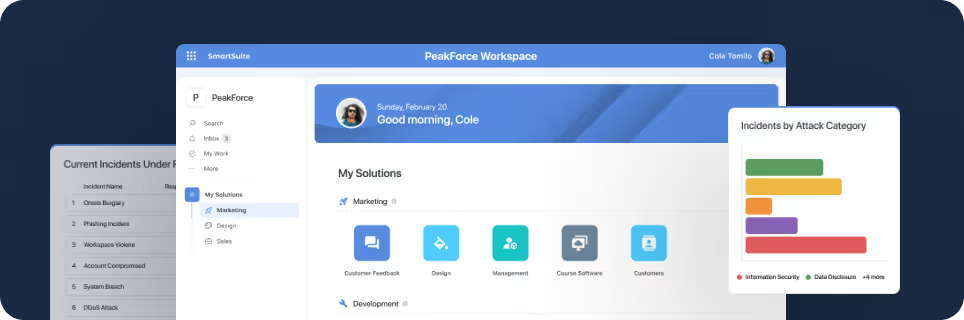
SmartSuite provides work platform for standardizing workflows in the following areas:
- Governance, Risk & Compliance
- IT & Service Ops
- Project / Portfolio Management
- Business Operations