This article explains what regulatory change management is, how it works, and what to look for in the tools that support it.
TL;DR
- Regulatory change management is the discipline of tracking new and updated rules, figuring out which parts of your business they touch, and getting your controls and policies updated.
- It splits into a few flavors: proactive horizon scanning, reactive response to enacted rules, and the cross-border kind where one operation answers to several regulators at once.
- The cost of getting it wrong is rising: Missing a change window now means fines, findings, and a very bad conversation with the board.
- A real assessment maps the change to your obligations, scores the impact on specific controls, assigns owners, and tracks remediation to closure with an audit trail you can actually show someone.
- Tools range from email-and-spreadsheets to dedicated GRC suites and connected work management platforms. The right pick depends on whether you want compliance kept in its own silo or wired into how the rest of the business runs.
What is regulatory change management?
Regulatory change management is how an organization keeps up with the rules that govern it.
The reality is that laws shift, standards get revised, and a regulator publishes new guidance on a Tuesday and your control library is suddenly out of date.
This is why regulatory change management exists: the structured way you catch those shifts, decide what they mean for you, and update your policies and controls so you stay compliant.
If I were you, I’d think of it as a pipeline:
- At one end, regulatory updates come in from agencies, standards bodies, and industry groups.
- At the other end, your controls, policies, and evidence reflect the new reality.
It is the work in the middle that most teams underestimate.
A change comes in. Someone has to read it, understand it, and decide whether it applies.
If it does, they figure out which controls it touches, who owns those controls, and what has to change.
Then they track the work until it's done and keep a record proving it happened.
Done well, none of this feels dramatic.
Changes get absorbed quietly, and audits become a matter of pulling up the trail.
Done badly, it's a fire drill every time something new gets published, and the gaps only surface when an examiner finds them first.
What are the different types of regulatory change management?
Regulatory change management is not one single activity.
It tends to break into a handful of recognizable patterns, and most programs run more than one at the same time:
- The first is proactive (horizon scanning).
Here you're watching for what's coming before it lands. Draft rules, consultation papers, proposed amendments.
The goal is lead time, so you can prepare calmly and skip the scramble later.
- The second is reactive (enacted change).
A rule is now in force, and you have to respond. This is the version most teams know best, partly because deadlines force the issue.
- Then there's cross-jurisdictional change management.
If you operate in more than one country or state, the same business activity might answer to several regulators with conflicting requirements. Keeping all of them straight at once is its own kind of work.
- A fourth pattern worth naming is internal policy change management.
After all, not every change comes from outside.
Sometimes a new regulation forces you to rewrite a policy, and that rewrite has to cascade through training, attestations, and control updates. The trigger is external, but a lot of the work is internal.
Most mature programs blend these.
You scan the horizon for what's coming, react to what's already here, and manage the spread across whatever jurisdictions you operate in.
Why is regulatory change management important?
The short version: the cost of missing a change has gone up, and the volume of changes hasn't slowed down.
Let’s take a recent example.
The EU's Digital Operational Resilience Act became applicable on 17 January 2025, after a two-year runway that started when the regulation entered into force back in 2023.
Any in-scope financial entity that wasn't ready by that date wasn't waiting on a grace period. The clock had already run.
The same pressure shows up in the United States.
Under the SEC's cybersecurity disclosure rules, a public company that determines a cyber incident is material has just four business days to file an Item 1.05 Form 8-K.
That's not a lot of runway if your incident response, your disclosure process, and your control documentation aren't already aligned.
A few reasons it pays to handle this well:
- For one, fines and enforcement are real and getting steeper: A missed deadline is rarely just a missed deadline. It tends to come with findings, remediation orders, and scrutiny that lingers.
- There's also the operational drag of doing it badly: When changes are tracked in someone's inbox, work gets duplicated, deadlines slip, and nobody can say with confidence whether a given rule is handled. Auditors notice that.
- And then there's reputation: Regulated industries run on trust.
A bank or a healthcare provider that keeps getting caught flat-footed by rule changes sends a signal to customers, partners, and the board that nobody wants to send.
Good regulatory change management turns a recurring crisis into routine maintenance. That's the whole point.
Who actually owns regulatory change management?
More often than teams tend to admit, ownership causes more friction than the rules themselves.
Many teams can tell you what a regulation requires long before they can tell you who's responsible for acting on it.
- Compliance usually owns the overall process. They're the ones scanning for changes and deciding what applies.
But they rarely own the controls that need updating, so they can't fix anything alone.
- Legal weighs in on interpretation. They're the ones deciding whether a rule actually binds you and what the real obligation is.
That reading shapes everything downstream, and getting it wrong early means the whole response is built on a bad foundation.
- The control owners are the people who do the real updating.
A change to data retention rules might land on IT, and a change to vendor oversight might land on procurement.
These are often people who don't think of themselves as compliance staff at all.
The main takeaway I want you to take away from this section is that regulatory change management is a team sport played across functions that don't always talk to each other.
This is why the programs that work best give one function clear ownership of the process while making it simple for everyone else to see their piece and act on it.
How to conduct a regulatory change management assessment?
An assessment is what happens after a change lands on your desk and before anyone touches a control. It's the part where you figure out what the change actually means for you.
The work moves through a few stages:
Start with intake and identification
Capture the change, where it came from, its effective date, and a plain-language summary of what it requires.
This sounds obvious, but a surprising number of changes get lost simply because nobody wrote them down in a consistent place.
Next comes applicability screening
Plenty of changes simply won't touch you, and you want to know that early.
A rule covering crypto-asset service providers doesn't matter to a company that isn't one.
Filtering the noise out at the front keeps your team from drowning in it.
Then you reach impact analysis
This is where the real work concentrates.
For each change that applies, you trace it to the specific controls, policies, processes, and systems it affects.
A single change might touch one control or twenty.
The point is to know exactly which ones, because that's what tells you the size of the job.
After that, gap and risk evaluation
Compare what the rule now requires against what you currently do.
Where you fall short is a gap, and you score each gap by how much risk it carries and how soon the deadline hits.
Finally, remediation planning and tracking
This is where you assign owners, set due dates, and track the work until every gap is closed.
Then keep the record, as the assessment itself is evidence, and an examiner may ask to see it.
What does a good regulatory change management assessment look like in practice?
It's one thing to list the stages. It's another to know what separates an assessment that holds up from one that falls apart under questioning.
A strong assessment is traceable end to end.
You can take any change and follow it all the way to the controls it touched and the work that closed the gaps.
No dead ends and no "I think Sarah handled that."
Ownership is the next marker.
Every gap gets a name attached and a date, because work without an owner is work that doesn't happen, and "the compliance team" is not an owner.
Then there's honest scoring.
Not every gap is a five-alarm fire, and treating them all as equal just burns out your team.
The good assessments rank by real risk and real deadlines, so attention goes where it matters most.
The last marker is freshness.
An assessment from eighteen months ago describing controls you've since changed is worse than useless, because it hands you false confidence.
The reliable ones get revisited as the underlying rules and controls evolve.
The hidden cost of "we'll track it in a spreadsheet"
Almost every program starts the same way. Someone sets up a spreadsheet, and it works for a while.
Then it doesn't.
The trouble with a spreadsheet is not the spreadsheet. It's everything the spreadsheet can't do:
- A spreadsheet won't warn you that the control you just flagged for update is the same control three other regulations quietly depend on.
- Deadlines come and go without anyone getting pinged.
- And when an auditor wants a clean trail of who did what and when, the spreadsheet just shrugs.
So the work happens around the spreadsheet, in email threads and side conversations and a shared drive nobody fully trusts.
The record of truth fragments. When the auditor asks "how do you know this change was handled," the answer is often unclear.
There's a quieter cost too. People stop trusting the system, so they build their own shadow versions. Now you have three half-accurate trackers and no single answer.
I'm not saying spreadsheets are evil. For a tiny program with two regulations and one person, fine.
But the moment you're juggling multiple frameworks across multiple owners with real deadlines, the spreadsheet stops being a tool and becomes a liability you have to manage on top of the actual work.
That's usually the point where teams start looking for something built for the job.
What are the kind of tools can you use for regulatory change management?
Tooling for regulatory change management spans a wide range, and the right choice depends on how complex your obligations are and how connected you want compliance to be with the rest of your operation:
General-purpose tools
General-purpose tools include spreadsheets, shared drives, email, and basic project trackers.
They’re cheap, familiar, and fine for a small program, but they break down once you have multiple frameworks and owners, as covered earlier.
Dedicated GRC platforms
Dedicated GRC platforms are tools built specifically for governance, risk, and compliance.
Many bring regulatory intelligence feeds, control libraries, and change-tracking workflows out of the box.
Archer IRM, MetricStream, and SureCloud belong to this group, and they're capable systems for organizations whose compliance programs are deep and mature.
MetricStream, for one, can flag regulatory updates and tie them back to the policies and controls they affect, while others focus on configurable workflows across risk and audit domains.
A third option is compliance automation tools
Vanta, Drata, and similar platforms shine at continuous monitoring and audit readiness for frameworks like SOC 2 and ISO 27001.
They're excellent at what they do, though their center of gravity is often certification, and not really broad cross-domain regulatory change.
Connected work management platforms
Then there's the connected work platform, which comes at the problem from a different angle.
Here, compliance stays wired into the rest of the business, so regulatory change management never gets stranded off on its own island.
SmartSuite (that’s us) is one example of that approach.
Our AI-native work platform lets teams manage governance, risk, and compliance while keeping those workflows linked to everyday operations.
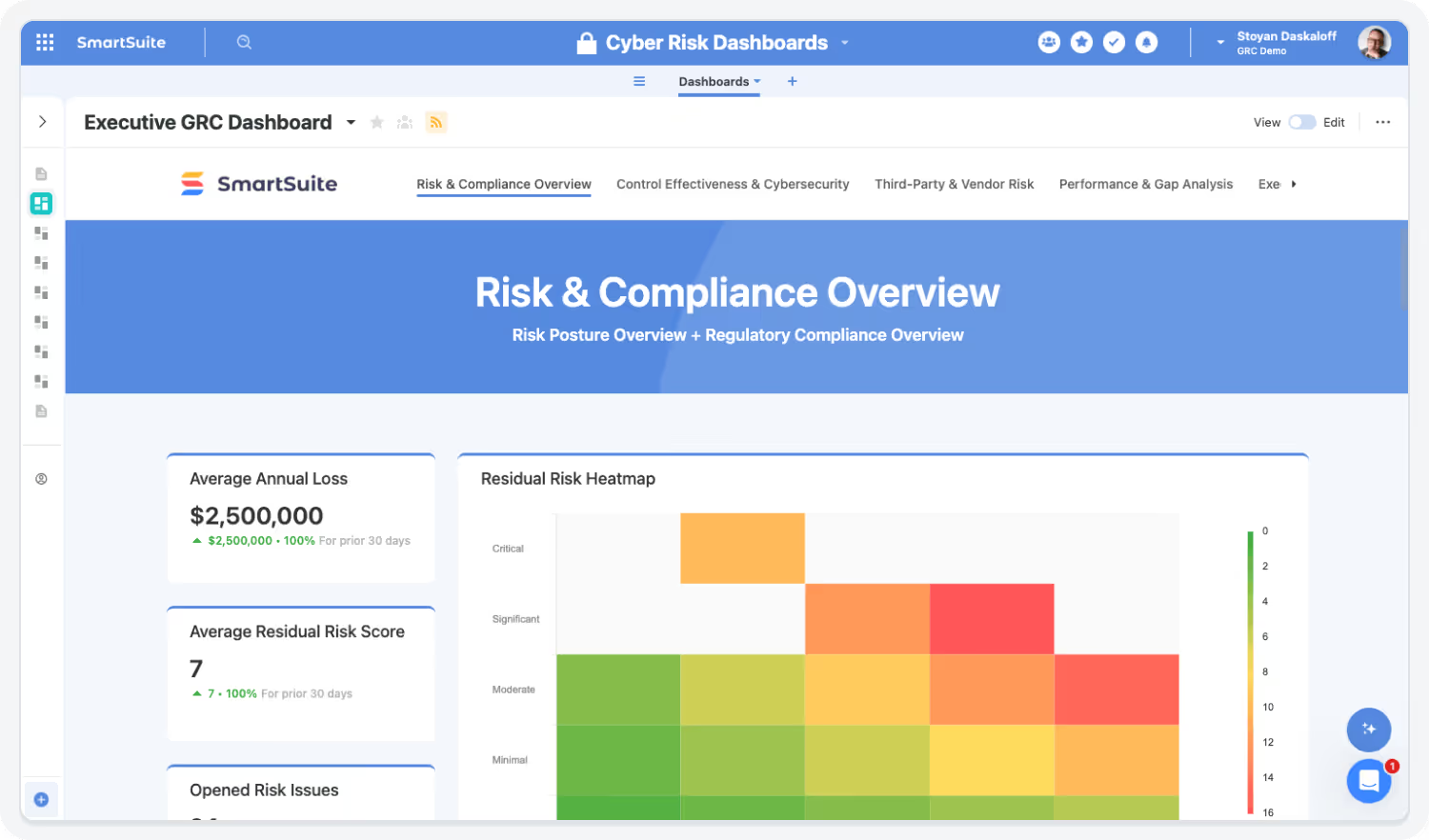
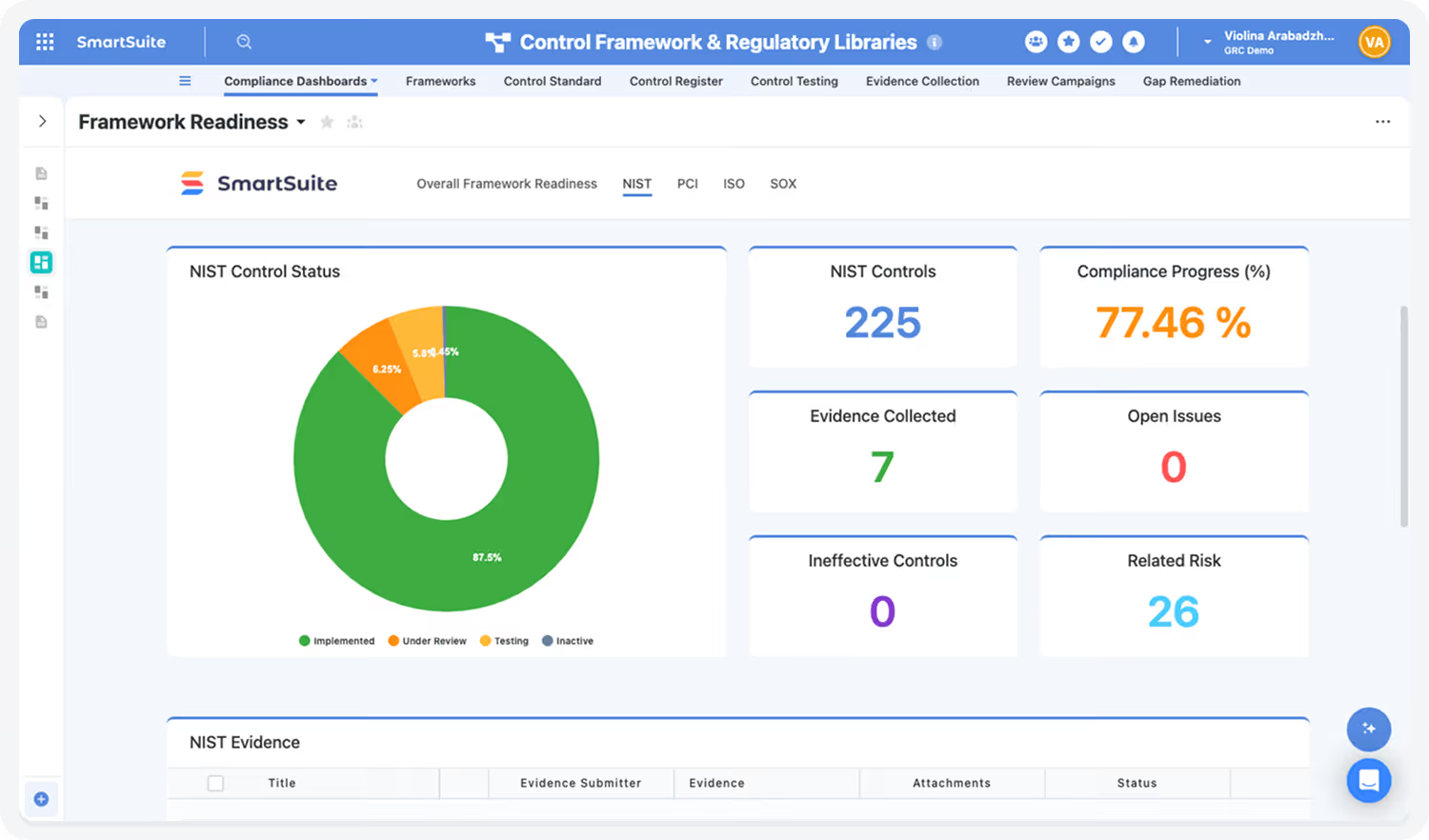
For regulatory change specifically, you can build a change register, map each change to the controls and policies it affects through linked records, and trigger review reminders automatically before a deadline arrives.
SmartSuite’s no-code builder means a compliance lead can adapt a change management workflow without waiting on engineering, and role-based dashboards give executives, auditors, and control owners each their own view of the same live data.
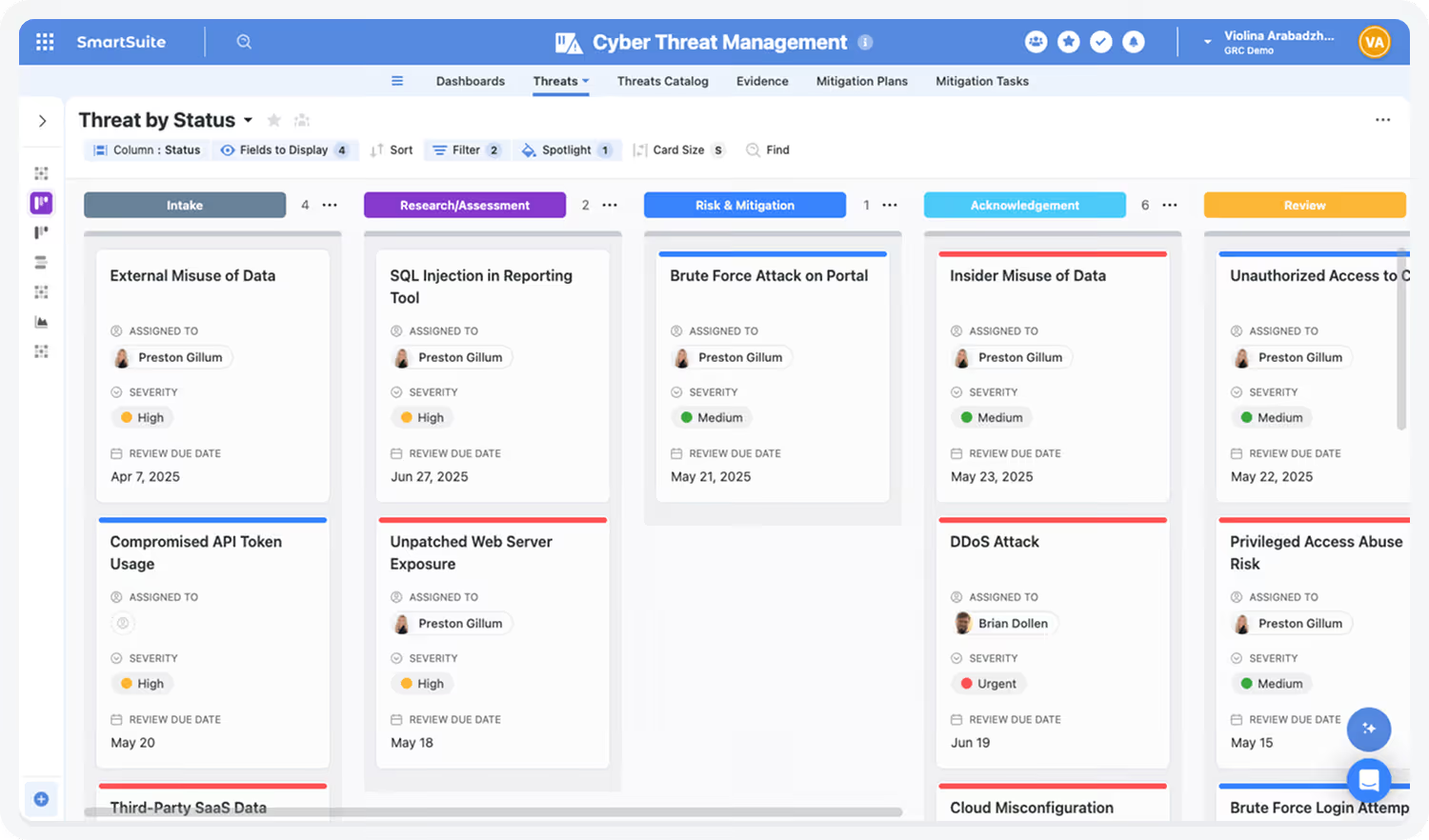
Automation handles the routine chasing, firing alerts in Slack or Microsoft Teams when a control test fails, or a policy review comes due, with every run logged for traceability.
It's a strong fit for mid-market and regulated teams that want compliance connected to broader operations, and a weaker one if you need a pure certification-automation tool or a vendor with a decade of Fortune 500 references.
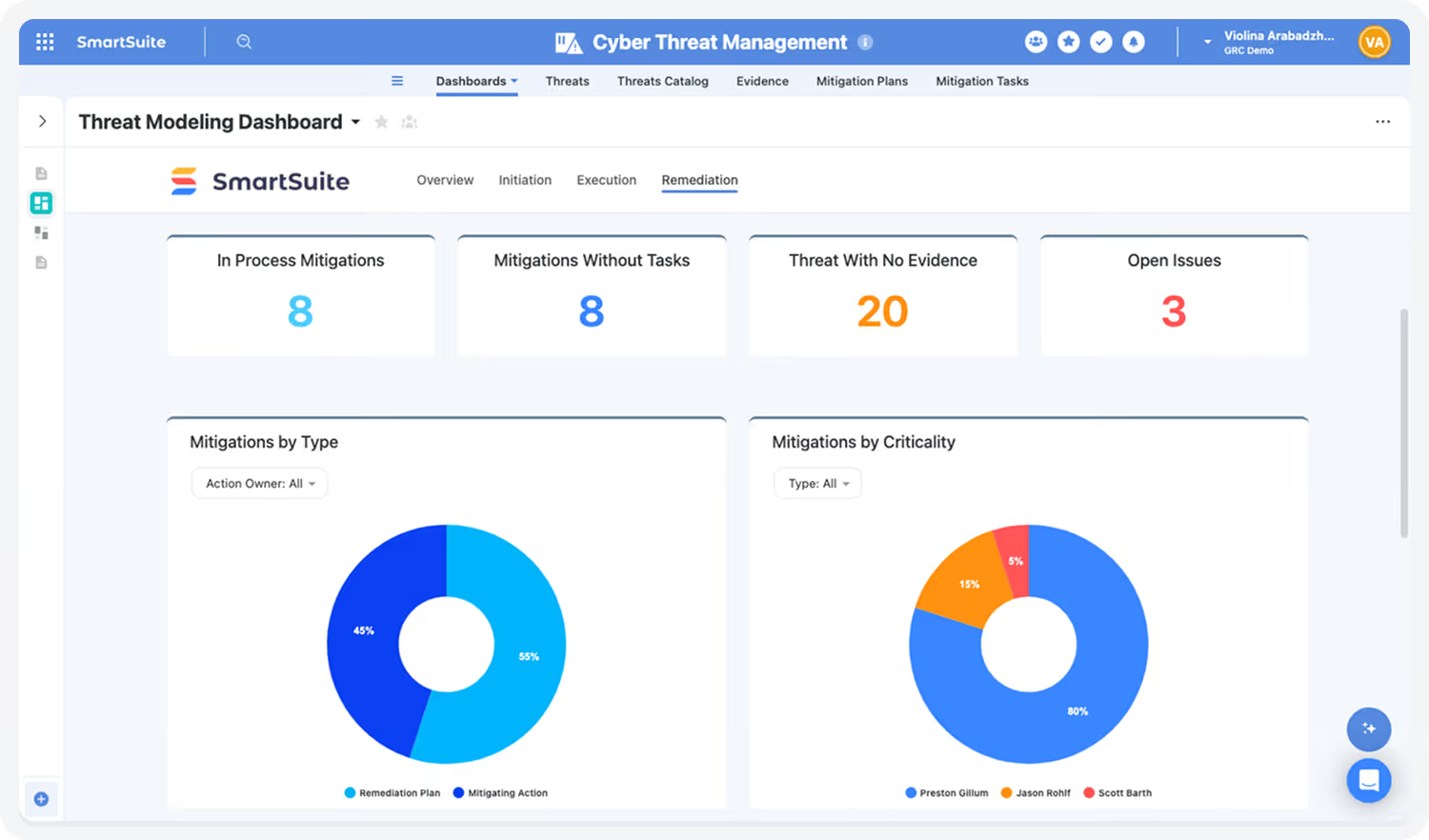
Learn more about how compliance management works in SmartSuite:
Try SmartSuite for free
Regulatory change rarely arrives with much warning, and the cost of catching it late keeps climbing.
The teams that handle it well aren't necessarily the ones with the most staff or the biggest budget.
They're the ones who turned a recurring scramble into a routine: catch the change, trace it to the controls it touches, assign the work, and keep a trail they can hand an auditor without flinching.
Tooling won't do that thinking for you, but the right setup takes the manual chasing off your plate so your team can spend its attention on the judgment calls that actually need a human.
If you want to see what regulatory change management looks like when it's connected to the rest of your operation, you can try SmartSuite for free and build a change register, map it to your controls, and run a real workflow, or book a demo.
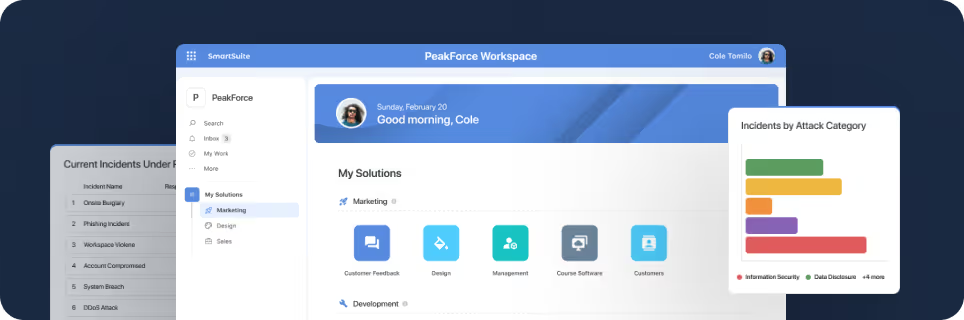
SmartSuite provides work platform for standardizing workflows in the following areas:
- Governance, Risk & Compliance
- IT & Service Ops
- Project / Portfolio Management
- Business Operations