Thoropass pricing isn't publicly listed, which makes it harder to estimate what compliance automation will actually cost your team in 2026.
This is why in this guide, I'll break down how Thoropass structures its pricing, what influences the final quote, and what real-world buyers should expect to pay.
Then I'll help you assess whether the value justifies the investment, or if your budget should be allocated elsewhere.
➡️ I'll also introduce you to a Thoropass alternative that has a more affordable pricing structure, is quick to set up, and comes with premium customer support without paying 6 figures a year.
TL;DR
- Thoropass uses a bundled pricing model that combines compliance software with in-house audit services, with the final quote depending on the number of frameworks, company size, and modules selected.
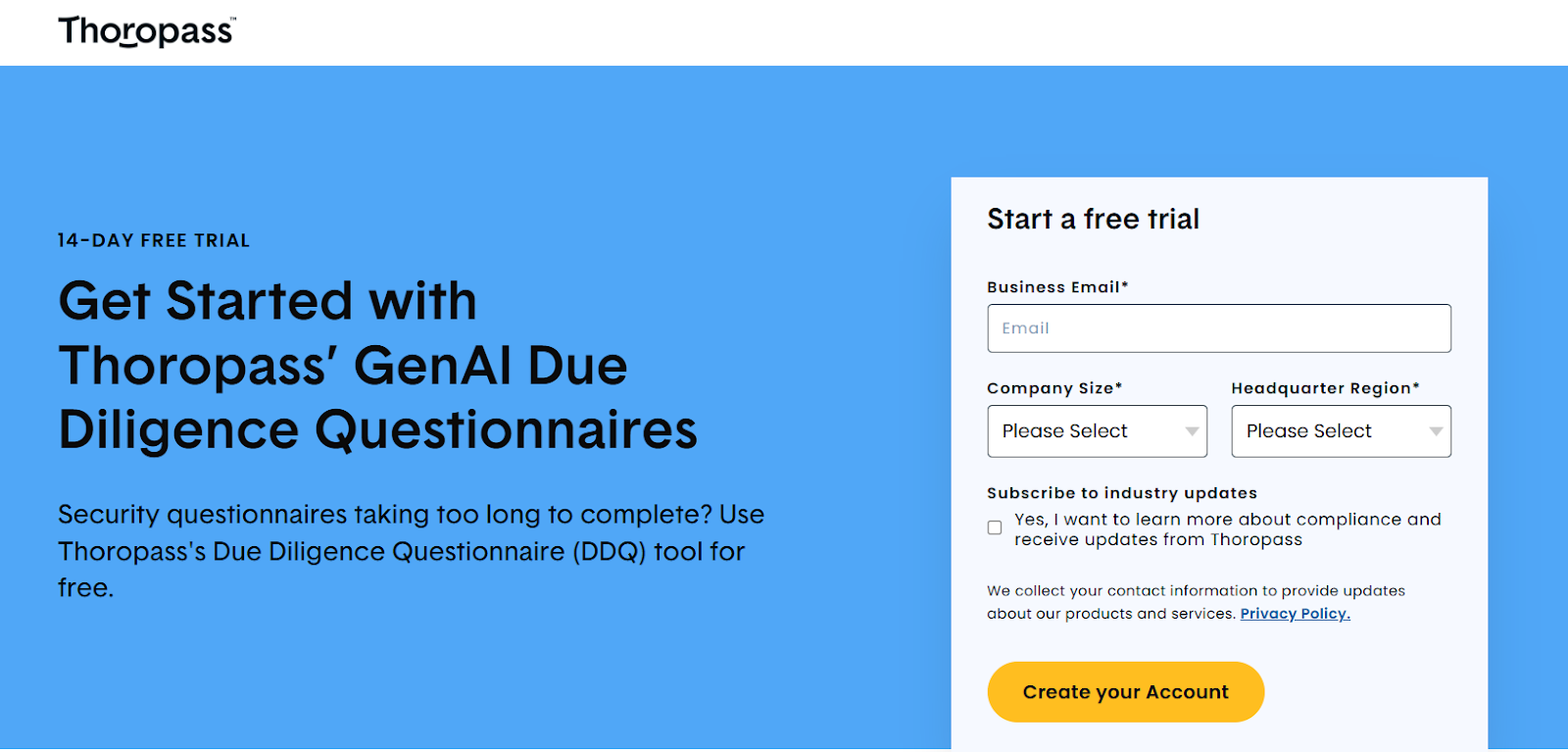
- The platform does not offer a free plan, and the only free trials available are a 14-day trial of its DDQ (Due Diligence Questionnaire) automation feature, and a free trial on AWS that I found.
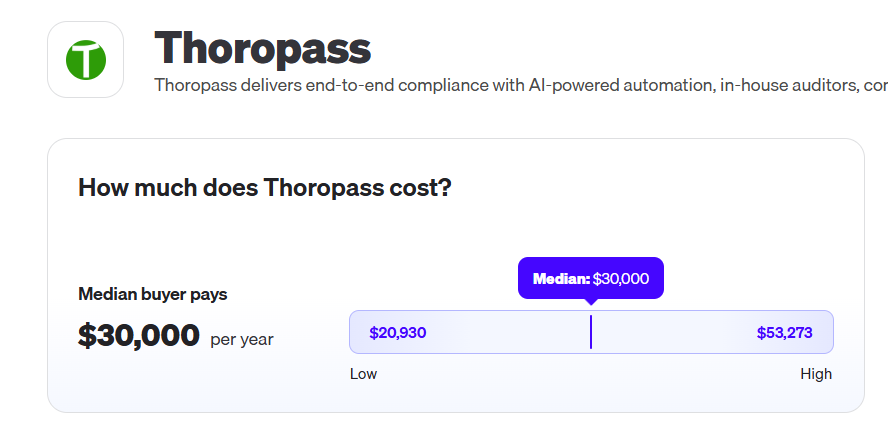
- According to Vendr, the median Thoropass contract sits at $30,000/year, with reported ranges from $20,930 to $53,273/year.
- If you're looking for a Thoropass alternative, SmartSuite offers transparent per-user pricing, deep no-code customization for GRC teams, and connected risk, audit, and compliance workflows in one platform.
How Does Thoropass Calculate Its Pricing?
Thoropass doesn't publicly list fixed pricing tiers or set plans on its website.
There's no clear grid you can browse and buy on the spot.
Instead, pricing is customized based on a few key variables.
The biggest one is the number of compliance frameworks you need. Each additional framework (SOC 2, ISO 27001, HIPAA, PCI DSS, HITRUST, etc.) adds incremental cost to your contract.
Company size and environment complexity also play a role. More employees, more integrations, and a larger infrastructure footprint all increase the scope of the audit, which drives the price up.
The type of audit matters too. A SOC 2 Type I engagement costs less than a Type II. And HITRUST validated assessments carry a higher fee than a standard SOC 2 attestation.
What makes Thoropass different from most compliance automation tools is that the price bundles both the software and the audit.
Competitors like Vanta or Drata charge for the platform separately, and you still need to hire an external audit firm on top.
Thoropass has its own in-house CPA firm (Thoropass Assurance), so the platform prep and the actual audit happen under one roof.
To get a detailed quote, you'll need to book a demo or speak with Thoropass's sales team.
Does Thoropass Have a Free Plan or Free Trial?
Thoropass does not offer a free plan of its core compliance platform, or at least one that I could find.
There’s a 14-day trial of its DDQ (Due Diligence Questionnaire) automation feature, and also a published free trial of AWS.

How Much Does Thoropass Really Cost?
According to Vendr, the median Thoropass contract is $30,000/year. The range sits between $20,930 and $53,273/year based on reported buyer data.
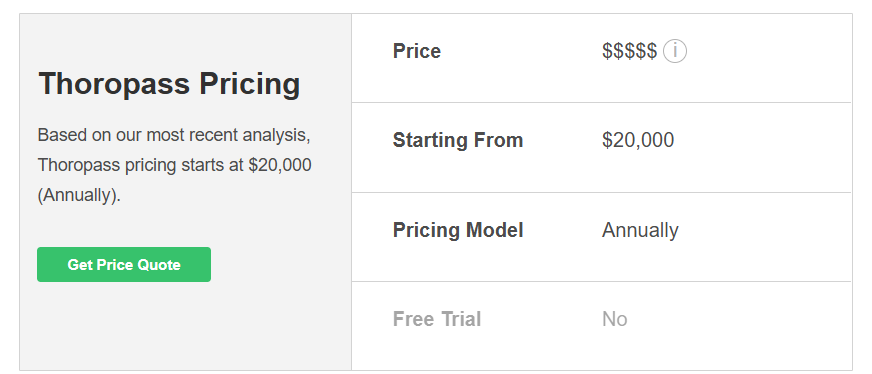
SelectHub independently lists a starting price of approximately $20,000/year for the platform.
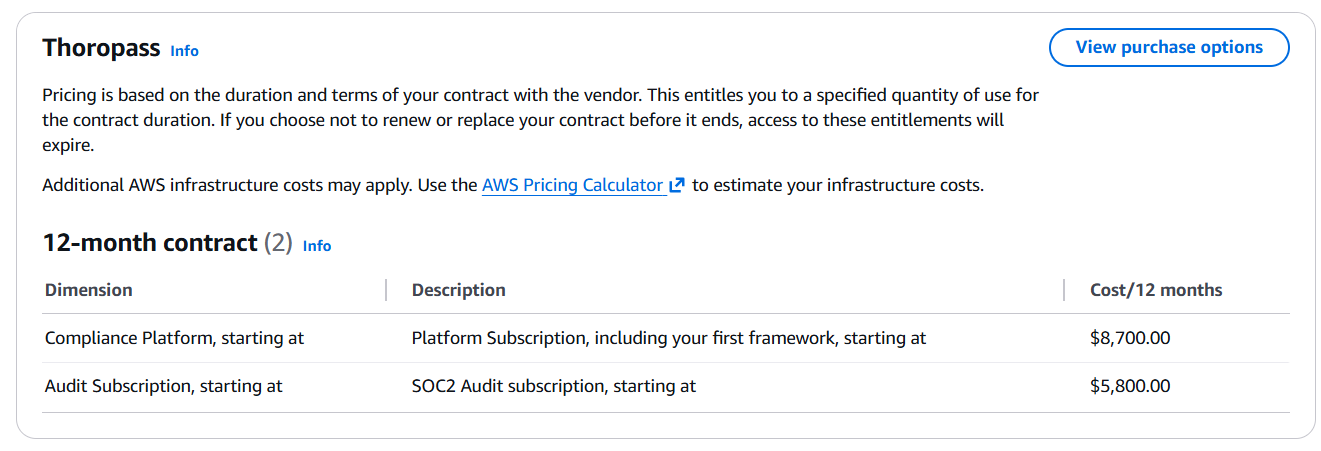
Thoropass is also listed on AWS Marketplace, and there it starts from $5,800/year for its audit subscription and $8,700/year for its compliance platform.
Does Thoropass Provide Good Value for Money?
Let's start with the positives, because Thoropass does a lot of things well.
The platform holds a 4.7 out of 5 rating on G2 from over 570 reviews, which is strong.
Users frequently praise the hands-on audit experience and the dedicated Customer Success Managers who guide teams through their first certification.

"We negotiated a longer team deal covering more than 1 year and are very satisfied given what friends at other companies have paid." - G2 Review
However, there are real concerns worth flagging.
- The platform was oversold on automation and AI, according to one detailed review.
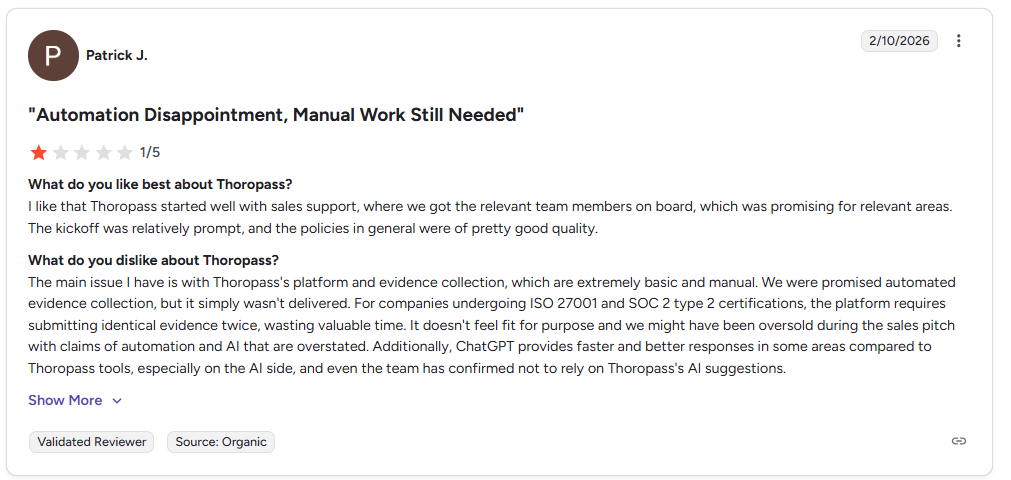
"The main issue I have is with Thoropass's platform and evidence collection, which are extremely basic and manual. We were promised automated evidence collection, but it simply wasn't delivered. For companies undergoing ISO 27001 and SOC 2 type 2 certifications, the platform requires submitting identical evidence twice, wasting valuable time. It doesn't feel fit for purpose, and we might have been oversold during the sales pitch with claims of automation and AI that are overstated. ChatGPT provides faster and better responses in some areas compared to Thoropass tools, especially on the AI side, and even the team has confirmed not to rely on Thoropass's AI suggestions." - G2 Review
- The UI could be more focused on the audit experience. Several reviewers noted that navigating between tasks and evidence requests takes more clicks than it should.
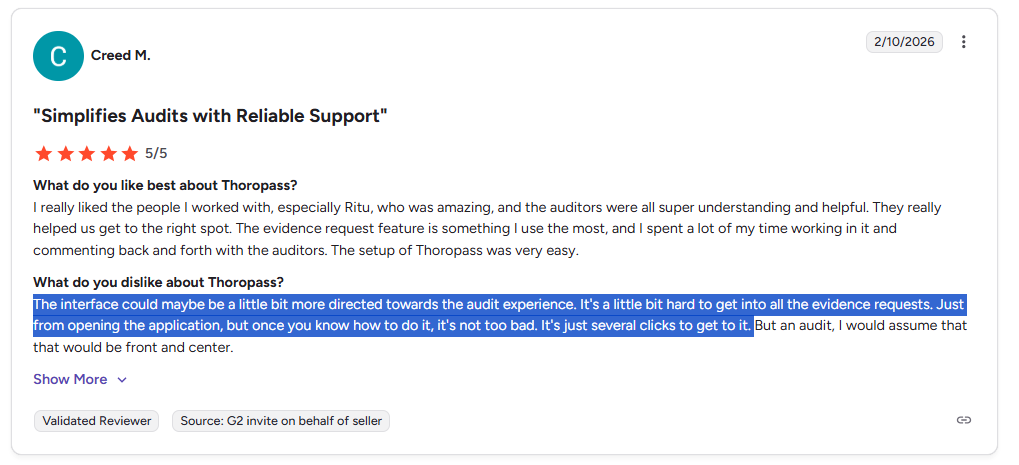
"The interface could maybe be a little bit more directed towards the audit experience. It's a little bit hard to get into all the evidence requests. Just from opening the application, but once you know how to do it, it's not too bad. It's just several clicks to get to it." - G2 Review
- Pricing sits at the premium end of the market. Even users who gave Thoropass 5 stars noted in their dislikes that it's "not the most inexpensive solution in the marketplace."
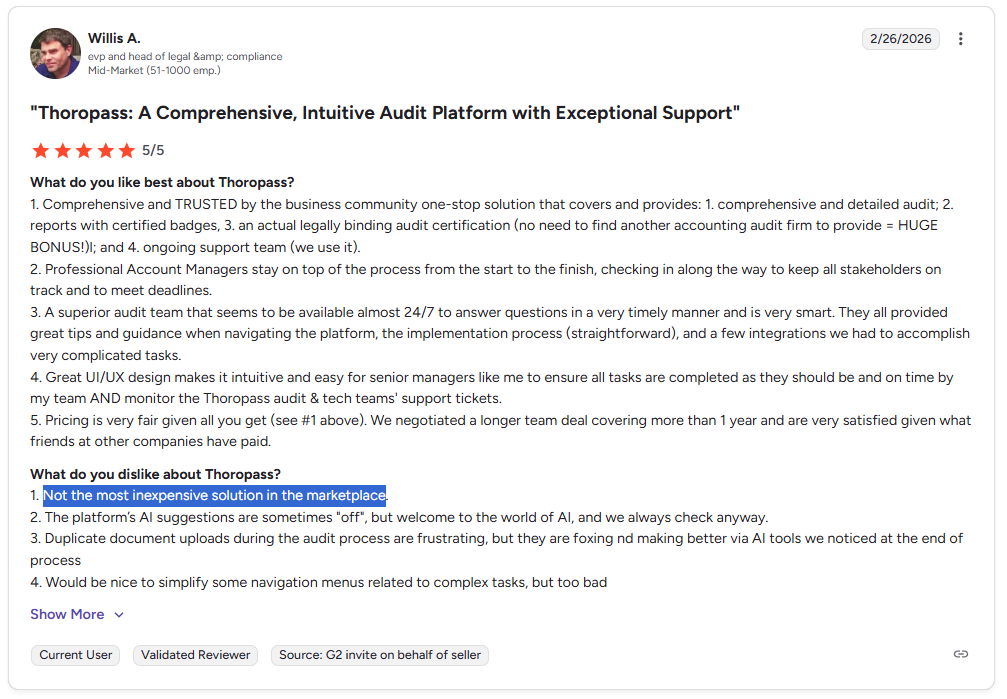
‘’Not the most inexpensive solution in the marketplace.’’ – G2 Review.
So, is Thoropass worth it?
For mid-market companies pursuing their first SOC 2 or managing multiple frameworks, Thoropass often delivers strong value through its bundled audit model and expert guidance.
But for smaller teams, organizations with complex tech stacks, or buyers who need deep AI automation and flexible integrations, the combination of premium pricing and product gaps may raise questions about long-term cost-effectiveness in 2026.
Looking for a Thoropass Alternative?
If Thoropass's pricing opacity or UI friction gives you pause, it may be worth exploring platforms that approach governance, risk, and compliance from a broader operational angle.
SmartSuite (that’s us!) is a no-code work management platform that can be configured into a full-scale GRC solution.
Our platform covers everything from risk registers and audit programs to vendor assessments and incident response in one connected workspace.
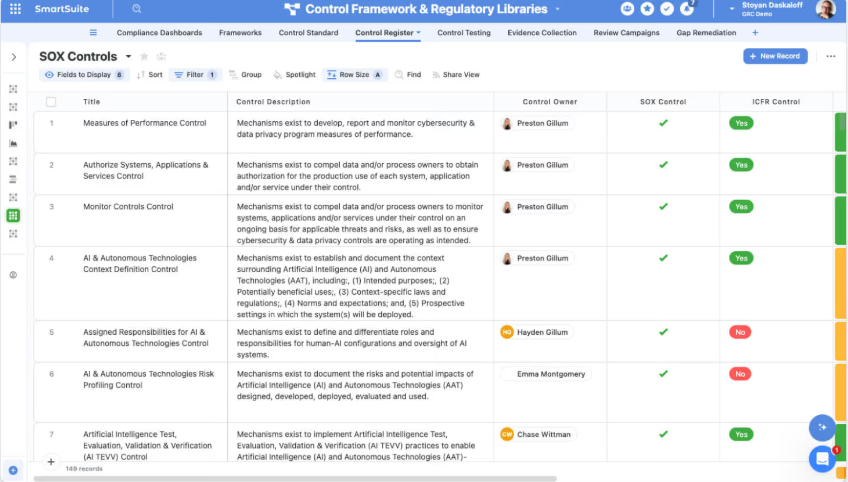
SmartSuite gives your team the flexibility to design and adapt compliance workflows to match how your organization actually operates.
Let's look at some of its standout features. 👇
1. A connected GRC workspace that keeps compliance tied to real work
Most compliance tools treat governance as a separate silo. You prep evidence in one system, track risks in a spreadsheet, manage audits in email threads, and hope nothing falls through the cracks.
SmartSuite takes a different approach.
It brings risks, controls, audits, policies, incidents, vendor assessments, and remediation tasks into a single connected environment.
Your compliance program stays linked to the day-to-day operations that actually generate risk.
That means your risk register isn't just a static document. It's a living workspace where risk owners can see their assigned controls, track related audit findings, and follow remediation progress without switching tools.
Here’s what makes our GRC solution stand out:
- AI governance: Manage AI-related risks, policies, controls, and regulatory obligations in a structured environment that supports responsible AI oversight and documentation.
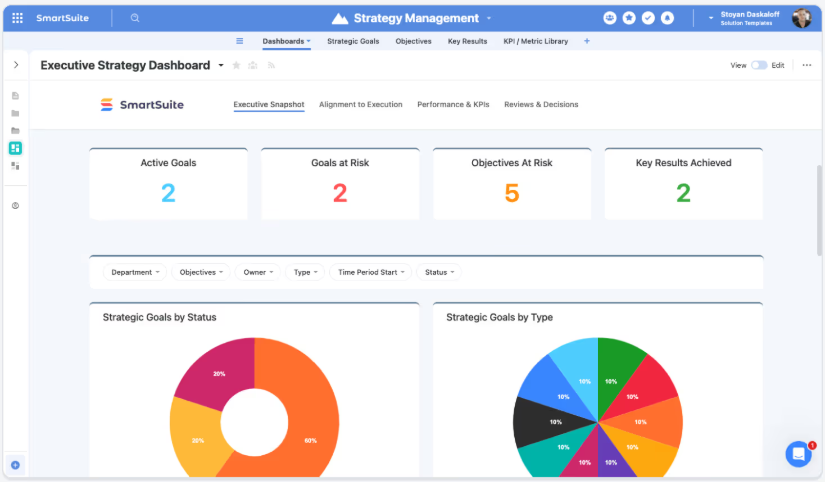
- Audit management: Plan, execute, and track internal or external audits with standardized workflows for evidence collection, testing, findings, and remediation.
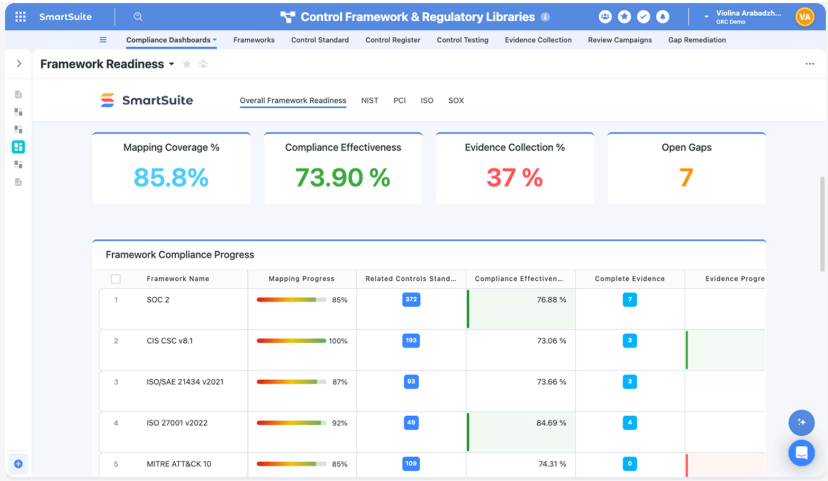
- Compliance management: Monitor regulatory requirements, map controls to frameworks, track obligations, and maintain continuous compliance readiness across standards.
- Cyber & IT risk: Identify, assess, and mitigate cybersecurity and IT risks while linking them directly to controls, incidents, and remediation plans.
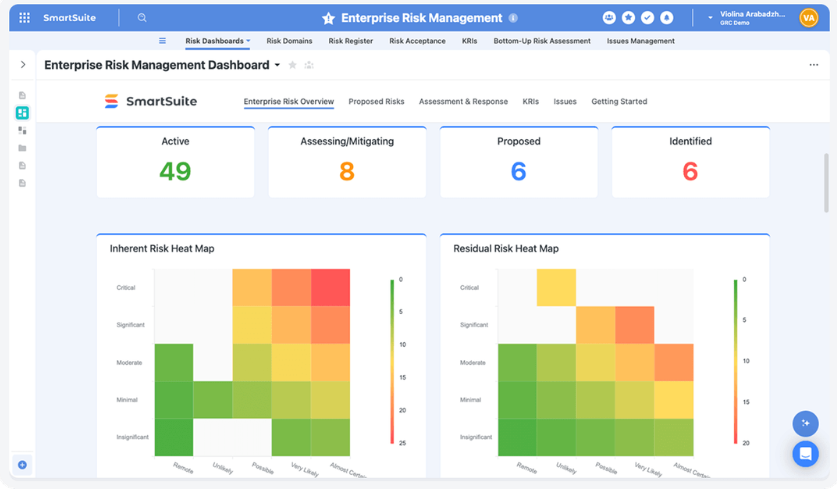
- Enterprise risk management (ERM): Centralize strategic, operational, financial, and reputational risks into a unified risk register with scoring, ownership, and monitoring.
- ESG management: Track environmental, social, and governance metrics, initiatives, and reporting requirements in one governed workspace.
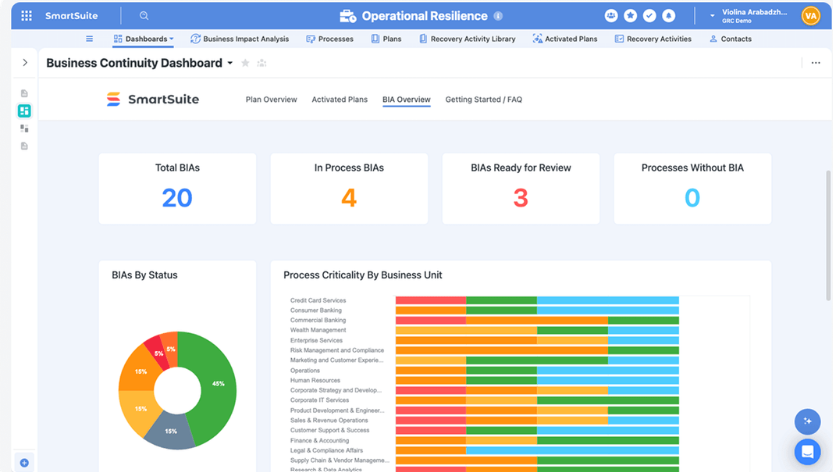
- Operational resilience: Build and maintain business continuity plans, scenario testing, and response coordination to ensure readiness during disruptions.
- Privacy management: Manage data protection obligations, privacy impact assessments, and regulatory requirements such as GDPR in a structured workflow.
- SOX management: Standardize financial controls, testing procedures, documentation, and reporting needed for Sarbanes-Oxley compliance.
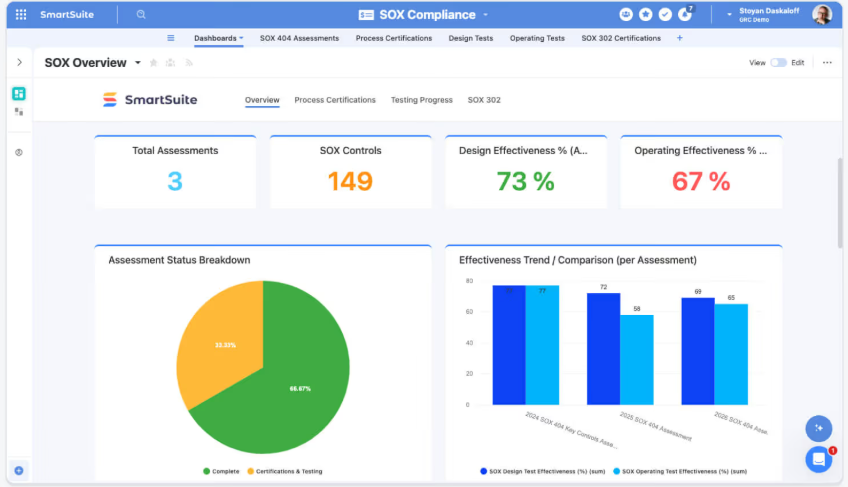
- Third-party risk management: Assess, monitor, and manage vendor and partner risk through structured due diligence, ongoing reviews, and remediation tracking.
2. No-code workflow design for compliance teams
SmartSuite offers a visual workflow builder (SmartSuite Studio) that lets compliance teams model their data, design custom interfaces, and build role-specific views, all without writing a single line of code.
Key no-code customization capabilities include:
- Visual builder: Create tables, fields, linked records, layouts, and conditional logic using a drag-and-drop interface in SmartSuite Studio.

- Role-specific interfaces: Build tailored dashboards, pages, and record layouts so each team sees only what they need to act on.
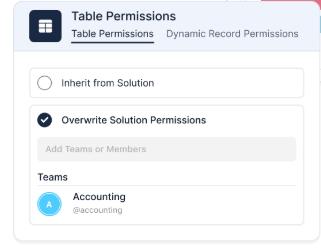
- Reusable workflow patterns: Start from templates or existing solutions, then customize them to match your organization’s processes.
- Multiple work views: Switch between Grid, Kanban, Calendar, Timeline, Chart, or Map views to visualize workflows in the way that fits the task.
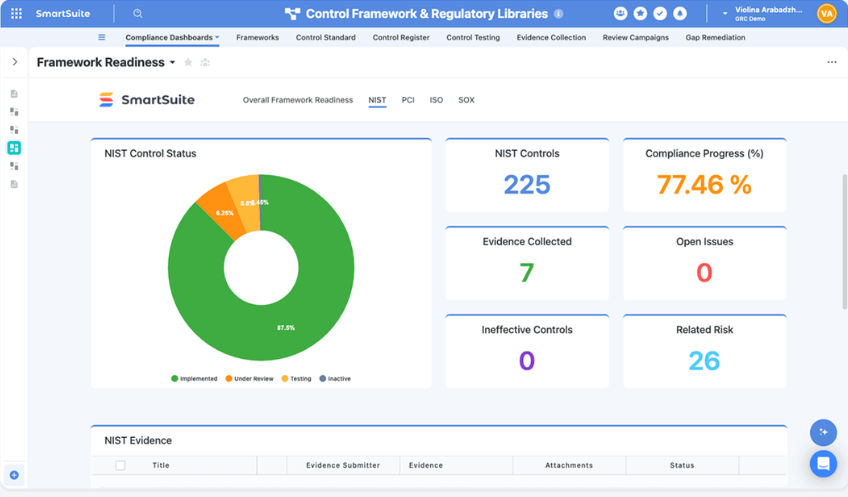
- Connected workflows across teams: Link multiple processes and solutions together while maintaining permissions and structure.
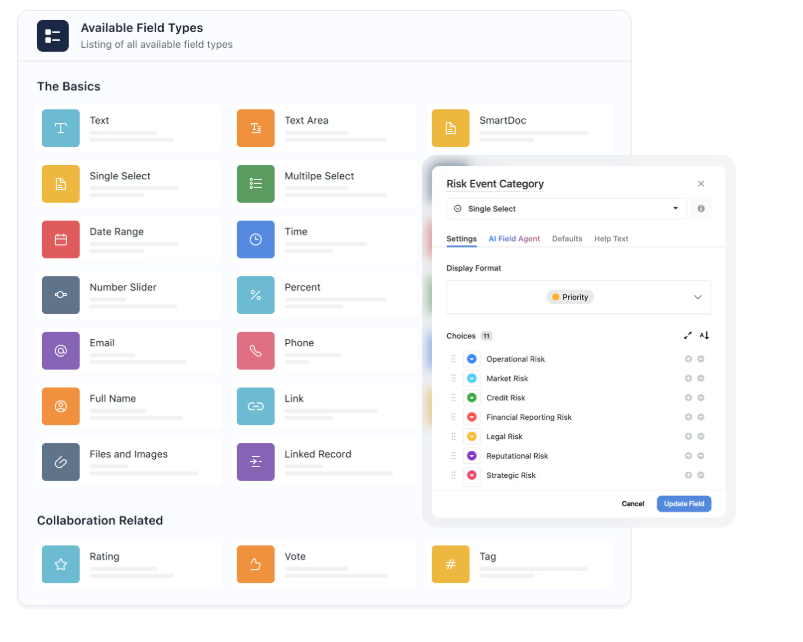
- Flexible data architecture: Model workflows with relational tables, linked records, and over 40 field types to support complex risk, audit, or compliance programs.
3. AI that works inside your GRC workflows
SmartSuite embeds AI directly into workflows, records, and automations. It actively contributes to how work gets done rather than just running a surface-level check.
Here's what that looks like in practice:
- AI Assist inside automations: Add AI-powered steps that enrich data, generate summaries, or structure incoming information as records move through workflows.
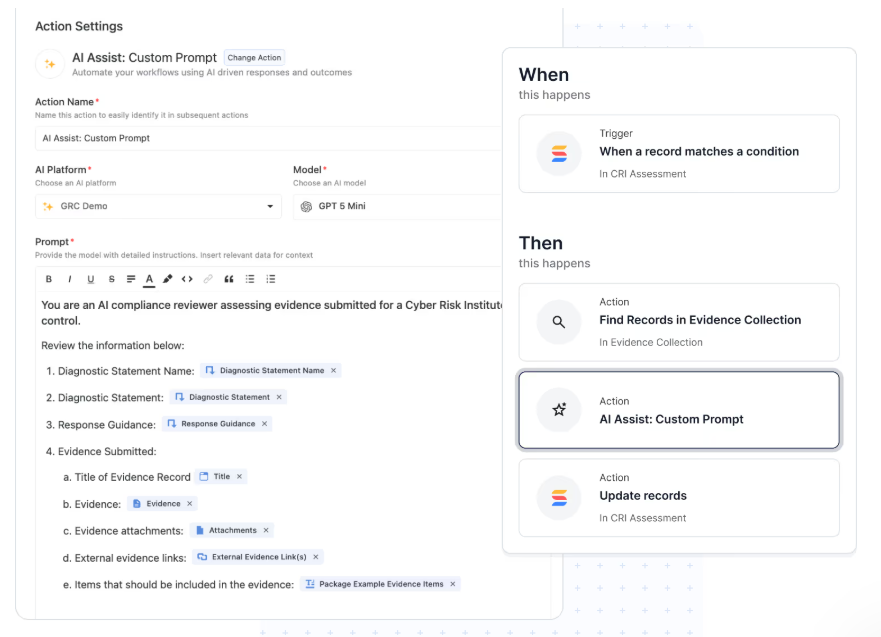
- SmartDoc AI content generation: Create, rewrite, translate, or summarize policies, audit notes, vendor assessments, and incident reports directly inside records.
- AI Field Agent for data intelligence: Monitor records for patterns, missing context, or anomalies, and recommend updates like risk scores, priorities, or classifications.
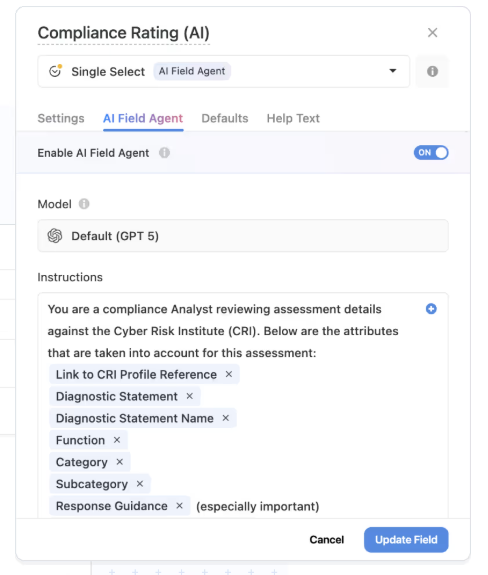
- Third-party risk intelligence: Summarize vendor questionnaires, highlight potential risks in responses, and map findings to required controls and frameworks.
- Operational resilience & continuity insights: Summarize incidents, recovery actions, and lessons learned while surfacing gaps between plans and real-world responses.
- Human-in-the-loop governance: AI prepares suggestions, but teams review and approve decisions, maintaining accountability and auditability.
- Bring-your-own-LLM flexibility: Connect models like OpenAI, Anthropic, Gemini, Bedrock, Azure, Perplexity, or IBM WatsonX while maintaining enterprise governance.
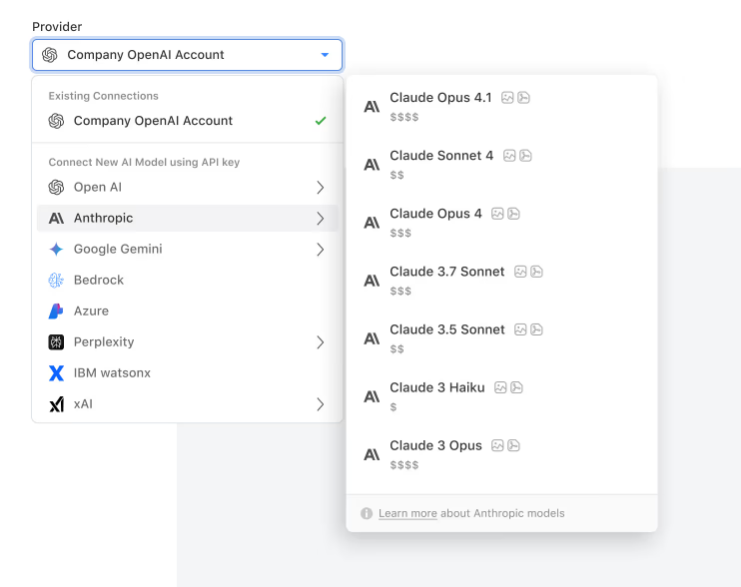
- Permission-aware AI actions: Every AI-generated change respects role-based permissions and is logged for full transparency.
4. A workflow automation engine built for governance
Instead of relying on manual follow-ups and email reminders, SmartSuite lets teams automate the repetitive parts of compliance work using a visual, no-code builder.
You set triggers (record created, status changed, date reached), define conditions (only if priority is high, only if assigned to this team), and specify actions (send a notification, update a field, create a record in another workflow, send an email).
Here’s how it looks in practice:
- No-code workflow automation: Build simple or multi-step workflows with a visual builder to handle notifications, record updates, approvals, and task creation automatically.
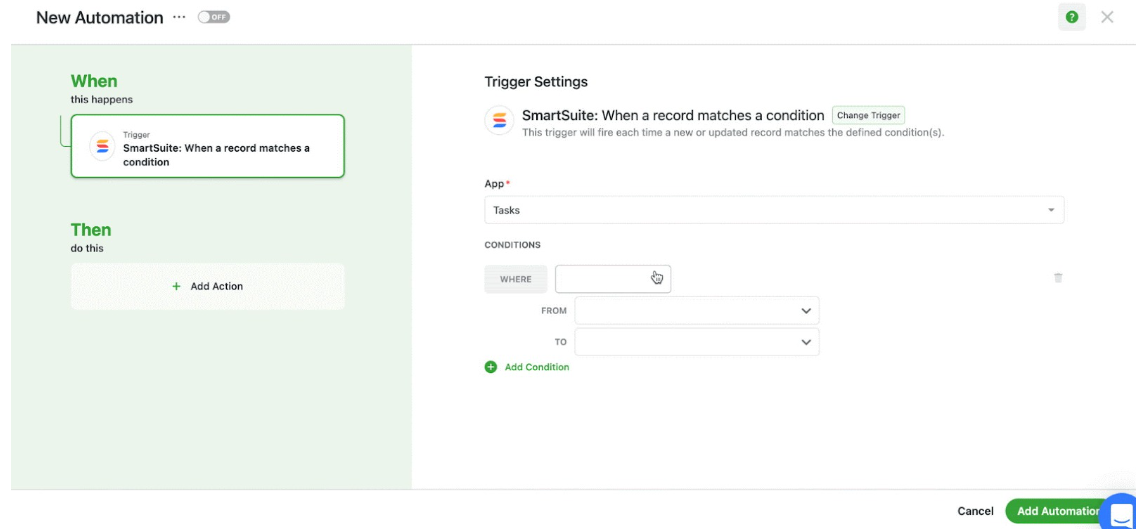
- Real-time triggers & smart filters: Launch automations based on record changes, dates, webhook events, or workflow conditions like failed control tests or high-risk ratings.
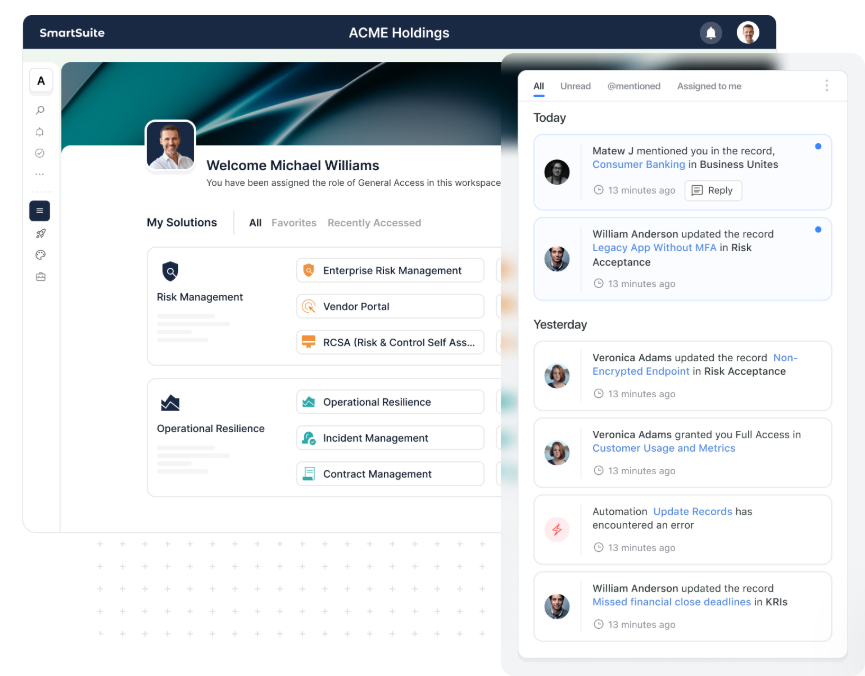
- Notifications on autopilot: Send alerts in tools like Slack, Microsoft Teams, and more to keep teams aligned.
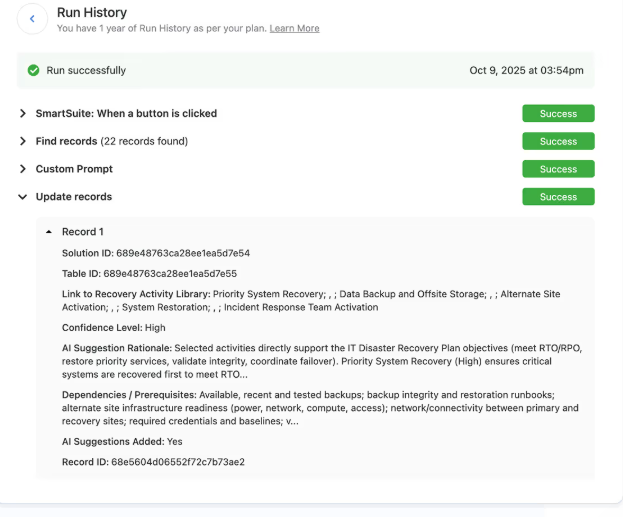
- Looping actions for large programs: Update multiple linked records at once, such as applying risk score changes across controls or closing remediation tasks automatically.
- Webhook integrations: Trigger or receive actions from external GRC, ITSM, security, or business continuity systems for end-to-end process automation.
- Audit-ready automation history: Every automation run is logged with timestamps, triggers, and results to maintain full traceability and governance.
SmartSuite's Pricing
SmartSuite offers a 14-day free trial (no credit card required), making it easy to test real workflows before subscribing.
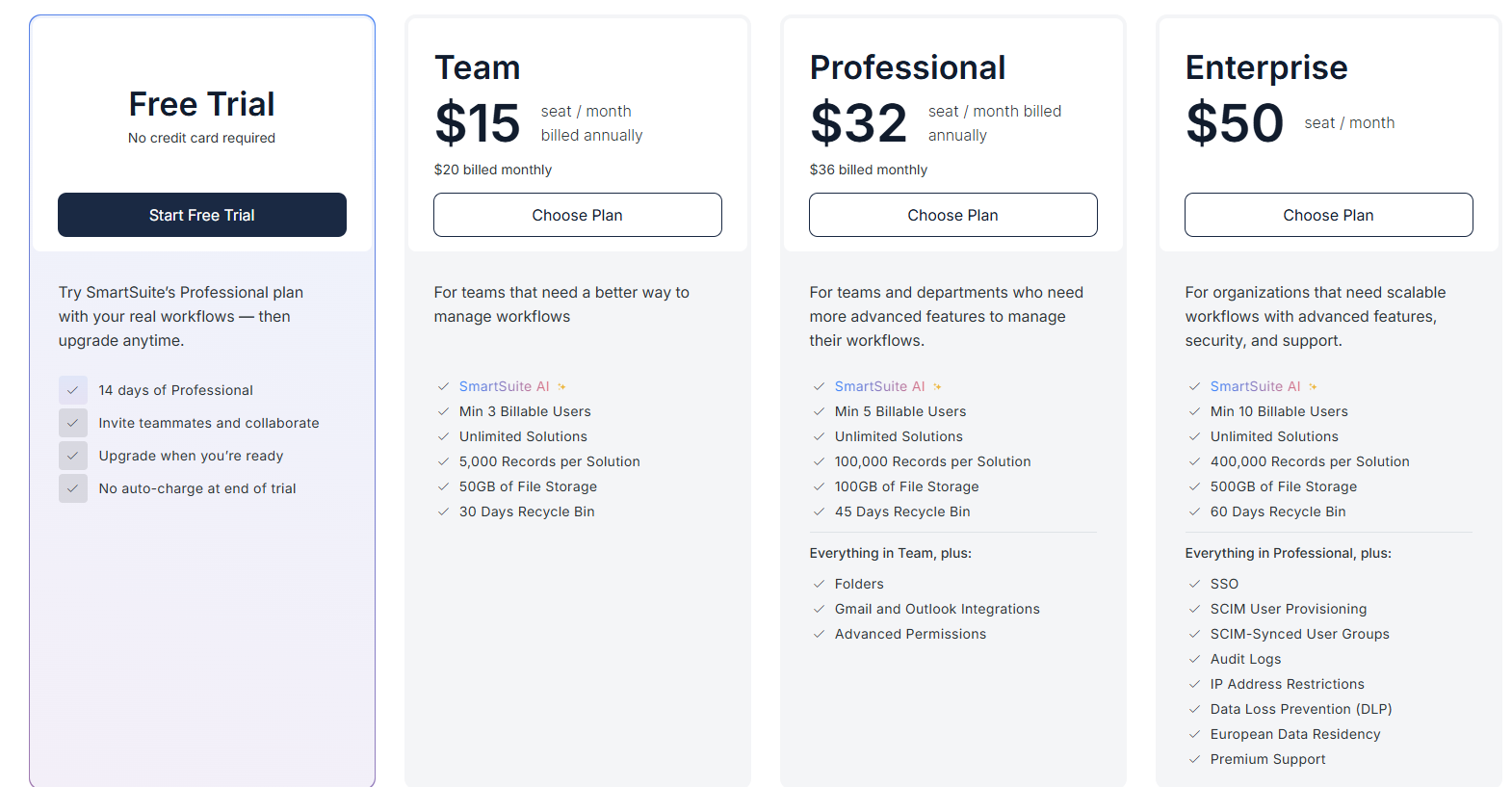
From there, SmartSuite offers two pricing models, depending on organizational size and complexity:
- User-based pricing, designed for small to mid-sized organizations that want full access to the entire platform under one license:
- Team: $15/user/month (minimum 3 users) includes unlimited solutions, 5,000 records per solution, and 50GB storage, and access to all core features, such as SmartSuite AI, reporting and dashboards, pre-built templates, advanced customization options, real-time collaboration, etc.
- Professional: $32/user/month (minimum 5 users), includes everything in Team and adds 100,000 records per solution, 100GB of storage, Gmail & Outlook integrations, folders, and advanced access controls.
- Enterprise: $50/user/month (minimum 10 users), includes everything in Professional and adds 400,000 records per solution, 500GB of storage, SSO, SCIM provisioning, audit logs, DLP, IP restrictions, and premium support.
Each licensed user can access all SmartSuite solutions (ITSM, ITAM, GRC, projects, operations, etc.) without paying separately for service management, asset management, or reporting modules.
- Solution-based custom-tailored pricing, built for regulated industries and large enterprises where per-user licensing across the entire platform isn’t practical. With it you can:
- License only the specific solutions you need (e.g. ITSM, GRC).
- Structure access by department, region, or regulatory requirement.
- Easily scale for thousands of users without compromising security.

How Is SmartSuite Different From Thoropass?
Thoropass does a lot right for teams that want guided, hands-on compliance support with the audit built in.
Its customer success team is excellent, the framework coverage is broad, and the bundled audit model removes the hassle of coordinating external firms.
But when you look at how both platforms support growing organizations in 2026, the differences become clearer.
- Pricing transparency
Thoropass does not publish pricing publicly and requires a sales conversation to get a quote, with median contracts around $30,000/year.
SmartSuite offers transparent, published per-user pricing starting at $12/user/month, with a 14-day free trial and no credit card required.
- Customization and flexibility
Thoropass users have noted that the interface can feel cluttered and rigid, with limited ability to adapt workflows to unique organizational processes.
SmartSuite provides full no-code customization through its visual builder, from relational data models and custom fields to role-specific layouts, automations, and cross-workflow relationships.
- Operational breadth
Thoropass centers around certification automation (SOC 2, ISO 27001, HIPAA, etc.) with bundled audit services.
SmartSuite lets organizations run compliance alongside risk management, IT operations, project management, and vendor oversight inside one unified workspace, so GRC doesn't live in isolation from the rest of the business.
- AI maturity
Thoropass's AI Monitoring capability scores 5.9 out of 10 on G2, with users flagging reliability concerns.
SmartSuite embeds AI across workflows, automations, and records with human-in-the-loop governance, bring-your-own-LLM flexibility, and permission-aware actions logged for full auditability.
So, in short:
- Thoropass is a strong fit for teams that want their compliance software and auditor under one roof, with expert-led guidance through certifications.
- SmartSuite is built for organizations that want a broader, more flexible GRC platform with transparent pricing, deep customization, and the ability to connect compliance work to the rest of the business.
Ready to try a different approach to GRC?
If you're researching compliance platforms and want something that goes beyond certification checklists, you can give SmartSuite a try with our free trial and ready-to-use GRC templates.
Here's what's in it for your team when you try SmartSuite:
- Access to a 14-day free trial with all features unlocked.
- No-code workflow builder to design GRC processes in minutes.
- Built-in AI capabilities for risk analysis, policy drafting, vendor assessment summaries, and compliance automation.
- Real-time dashboards and reporting with no additional modules.
- Pre-built GRC solution templates for risk management, audit, compliance, vendor risk, and incident response.
- Full customization with over 40 field types, relational data models, and role-specific interfaces.
Start a free SmartSuite trial or book a demo to see how your team can replace rigid compliance checklists with a flexible, audit-ready GRC workspace.
⚠️ Disclaimer: This article was last updated on 12/03/2026, and if there's any misinterpretation of the information, please contact us, and we will fact-check it.
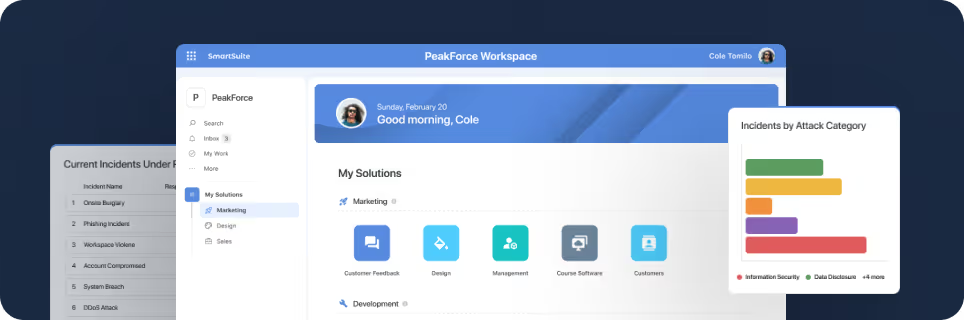
SmartSuite provides work platform for standardizing workflows in the following areas:
- Governance, Risk & Compliance
- IT & Service Ops
- Project / Portfolio Management
- Business Operations