
Across cyber, risk, compliance, audit, and resilience functions, one underlying challenge quietly consumes more time, more effort, and more operating cost than almost any other:
Evidence.
Collecting it. Validating it. Storing it. Retesting it. Reattaching it. Interpreting it. Presenting it.
And, increasingly, connecting it.
Evidence, not frameworks, not tools, not policies, has become the single biggest operational drag on modern governance.
But here’s the paradox:
Evidence is also the backbone of trust.
It is the reason regulators believe.
It is the mechanism by which boards gain confidence.
It is the proof behind every maturity score, audit opinion, cyber assertion, and resilience claim.
The challenge is not that institutions lack evidence.
It’s that evidence is isolated, manual, static, and incomplete relative to how risk actually evolves.
This mismatch between dynamic risk and static evidence is unsustainable.
And it’s why the future of GRC will be defined by a radical shift: a move toward continuous, automated, connected evidence that updates as the environment updates, and flows wherever the risk flows.
This is the most important evolution in governance that few institutions see coming.
Evidence Today: Manual, Siloed, and Out of Sync with Reality
Across every institution I’ve worked with, large banks, credit unions, fintechs, and FS technology vendors, the same patterns appear:
Evidence lives in dozens of systems
Audit folders. SOC tools. Ticketing systems. Email threads. Vendor portals. SharePoint sites.
Evidence is recreated again and again
Cyber collects the same file audit needs.
Continuity re-asks for the same proof cyber already had.
Compliance stores what resilience has already validated.
Evidence becomes stale immediately
A perfect screenshot from yesterday means nothing if the system changed this morning.
Evidence is disconnected from workflows
It sits around the work, not inside it.
Evidence is interpreted differently across teams
Audit wants one format.
Cyber another.
Resilience another.
Regulators another.
Evidence is heavily manual
Which means inconsistent, slow, and error-prone.
Institutions have spent years trying to modernize tooling, but few have modernized evidence itself.
The result? A fragile, expensive, inconsistent evidence model running on top of increasingly dynamic risk.
This will not survive the next decade.
Why Evidence Must Become Continuous
The world that created snapshot evidence is gone.
Cloud environments drift hourly.
Access changes dynamically.
Vendors shift configurations daily.
Resilience dependencies evolve constantly.
Threats update in real time.
AI-driven attacks adapt instantly.
A quarterly evidence sample cannot reflect this.
A yearly audit sample is obsolete by definition.
True governance requires evidence that updates as reality updates, not in periodic bursts, but continuously.
Continuous evidence is the only way to create continuous assurance.
And continuous assurance is where regulators, boards, and institutions are all heading.
Why Evidence Must Become Automated
Continuous evidence is impossible without automation.
No team can manually collect, attach, validate, or reconcile evidence every time a system shifts or a control updates.
Automation must become the engine that powers evidence.
Automated evidence is:
- Timestamped.
- Contextual.
- Consistent.
- Complete.
- Tamper-resistant.
- Directly tied to diagnostics.
- Instantly reusable.
- Always aligned to controls.
Imagine:
- System configuration evidence attached automatically.
- Vendor assurance reports parsed and linked to diagnostics.
- User access logs streamed into evidence records.
- Resilience test results auto-attached to continuity diagnostics.
- Cloud drift evidence automatically updating posture.
Automation replaces screenshots with telemetry. Evidence becomes behavior, not artifacts.
Why Evidence Must Become Connected
Evidence does not live in a vacuum.
It lives inside relationships:
- Between controls and diagnostics.
- Between issues and remediation.
- Between risks and dependencies.
- Between vendors and resilience.
- Between cyber signals and operational impacts.
The future requires evidence that is connected across domains, not captured inside them.
Connected evidence means:
One artifact supports multiple frameworks
A single log proves compliance across cyber, audit, and resilience.
One piece of evidence updates multiple risk states
Cloud drift evidence updates cyber, vendor, and resilience diagnostics simultaneously.
Evidence flows through workflows
It is not attached at the end, it appears at every step.
Evidence has traceability
You can see when it was created, why it changed, how it was validated, what diagnostic it affects.
Evidence supports AI reasoning
AI needs structured, connected evidence to reason effectively.
This is the deep shift: Evidence becomes a network, not a library.
CRI Is the Model That Makes Connected Evidence Possible
The CRI Profile’s true power is not maturity scoring, it is diagnostic structure.
CRI diagnostics:
- Define the outcome.
- Specify what evidence must demonstrate.
- Unify expectations across teams.
- Map to resilience and cyber outcomes.
- Structure the relationships between controls, issues, and readiness.
- Create a schema AI can interpret.
- Give automation a stable anchor.
CRI turns evidence from a chaotic mess into a standardized data model.
Connected evidence requires connected diagnostics. CRI provides them.
This is why CRI is becoming the backbone of continuous assurance, AI reasoning, and connected workflows across FS.
SmartSuite: Where Evidence Becomes Continuous, Automated & Connected
CRI creates the structure.
AI creates the intelligence.
SmartSuite creates the motion.
Because SmartSuite is workflow-native, it can do what legacy GRC systems cannot:
Evidence attaches automatically to workflows
Not as files, but as structured records.
Evidence updates automatically
When signals change, evidence changes.
Evidence connects across domains
Cyber → risk → resilience → audit → vendor → board reporting.
Evidence powers dynamic risk states
It influences posture continuously.
Evidence becomes reusable
One artifact supports cyber, audit, resilience, and supervisory exams.
Evidence anchors every diagnostic
CRI diagnostics become evidence templates, triggers, expectations, and scoring logic.
SmartSuite doesn’t store evidence. SmartSuite operationalizes it.
This is the architecture the next decade requires.
What the Future of Evidence Will Look Like (2030 Vision)
Here’s the world I believe we will be operating in by 2030:
1. Evidence will be generated by systems, not humans.
Automation replaces screenshots.
2. Evidence will be connected across cyber, risk, resilience, and vendors.
Not just stored, interwoven.
3. AI will validate evidence continuously.
Not periodically.
4. Evidence will update maturity states in real time.
Ending periodic scoring forever.
5. Evidence will be diagnostic-driven.
CRI’s structure will guide context.
6. Evidence will follow workflows automatically.
It will live inside processes, not beside them.
7. Boards will see evidence-backed narratives instantly.
Not after reconciliation cycles.
8. Regulators will expect continuous evidence.
Periodic samples will become insufficient.
9. Evidence will become predictive.
AI will detect patterns suggesting future failures.
10. Evidence will become the connective tissue of trust.
Within institutions. Between institutions and regulators. Between institutions and customers.
This is the most important shift ahead for GRC: evidence becomes living.
Conclusion: Evidence Is the Engine of Modern Governance
Evidence used to be an afterthought, the material you assembled after the real work was done.
By 2030, evidence is the real work. It is the heartbeat of continuous assurance, AI reasoning, diagnostic governance, vendor alignment, and resilience.
The future of evidence is:
Continuous. Automated. Connected. And it will define the institutions that lead the next decade of GRC.
CRI gives evidence clarity.
AI gives evidence intelligence.
SmartSuite gives evidence movement.
Together, they create a new form of governance the industry has been needing for years.
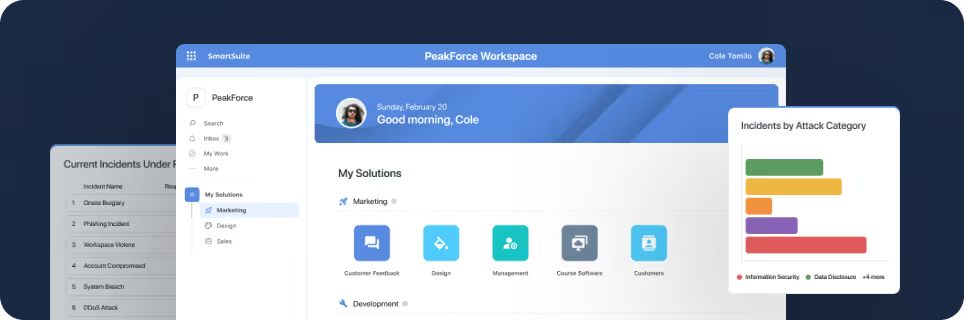
SmartSuite provides work platform for standardizing workflows in the following areas:
- Governance, Risk & Compliance
- IT & Service Ops
- Project / Portfolio Management
- Business Operations