
Governance, Risk, and Compliance systems weren’t built for humans.
They were built for:
- Auditors.
- Regulators.
- Spreadsheets, signatures and static reports.
And for years, that was enough. Until the world changed.
Today, risk moves faster, collaboration happens in real time, and the people responsible for managing it are no longer confined to a back-office department.
Everyone, from operations to cybersecurity to HR, plays a role in resilience.
Yet the tools most organizations rely on still feel like relics of another era.
They’re functional, but not intuitive. Comprehensive, but not connected. Powerful, but painful to use.
It’s time for a reset. It’s time for design thinking in GRC.
From Compliance to Experience
The traditional GRC model focused almost entirely on functionality: the ability to track controls, log incidents, and generate reports.
What it never focused on was experience: how people actually interact with those systems, how information flows between teams, and how the product itself encourages engagement rather than resistance.
Design thinking reverses that equation.
It starts with empathy: understanding the user’s day, their goals, their frustrations, and the context in which they operate.
When you apply that mindset to GRC, everything changes.
Because risk management isn’t just a data problem, it’s a human one.
The Usability Gap in Legacy GRC
Ask almost any risk or compliance professional what frustrates them most, and you’ll hear the same thing:
“Our system does everything we need, but no one wants to use it.”
Legacy GRC tools were built on complex forms, rigid hierarchies, and IT-centric workflows. They required specialized training, consultants, and endless configuration.
As a result:
- Adoption was limited to a small group of administrators.
- Collaboration happened outside the system: in email, chat, and spreadsheets.
- The data inside the platform became stale, fragmented, or inaccurate.
When usability suffers, governance suffers. And when governance suffers, risk increases.
It’s a vicious cycle that no amount of feature development can fix, because the problem isn’t functionality. It’s design.
Design Thinking: A Different Mindset
Design thinking is a problem-solving approach centered on empathy, experimentation, and iteration.
It asks three simple questions:
- Who are we designing for?
- What do they really need?
- How can we make it intuitive and valuable from the first interaction?
In GRC, that means shifting focus from process owners to participants. From compliance enforcement to collaborative engagement. From data entry to decision-making.
When people actually enjoy using the system, adoption skyrockets, and suddenly, governance isn’t something you have to enforce; it’s something that happens naturally.
Why GRC Needs a Human Interface
Risk management touches nearly every employee, yet most platforms treat users like data entry clerks.
Design thinking flips that by designing interfaces that work the way people think.
A human-centered GRC platform should:
- Show what matters: clear dashboards tailored to role and priority.
- Guide, not overwhelm: contextual instructions that reduce error.
- Simplify complexity: progressive disclosure instead of endless forms.
- Encourage action: seamless task assignment and feedback loops.
- Foster collaboration: shared workspaces and real-time updates.
These principles sound basic, but they’re revolutionary in a field that has long prioritized compliance over clarity.
When design gets it right, users stop thinking about “using the system,” and start thinking about solving the problem.
SmartSuite: Design Thinking in Action
At SmartSuite, design thinking isn’t a layer we added later: it’s the foundation we started with.
We asked ourselves early on:
‘’What would risk management look like if it were designed for the people actually doing the work?’’
That question shaped every decision we’ve made:
1. Visual Simplicity with Depth
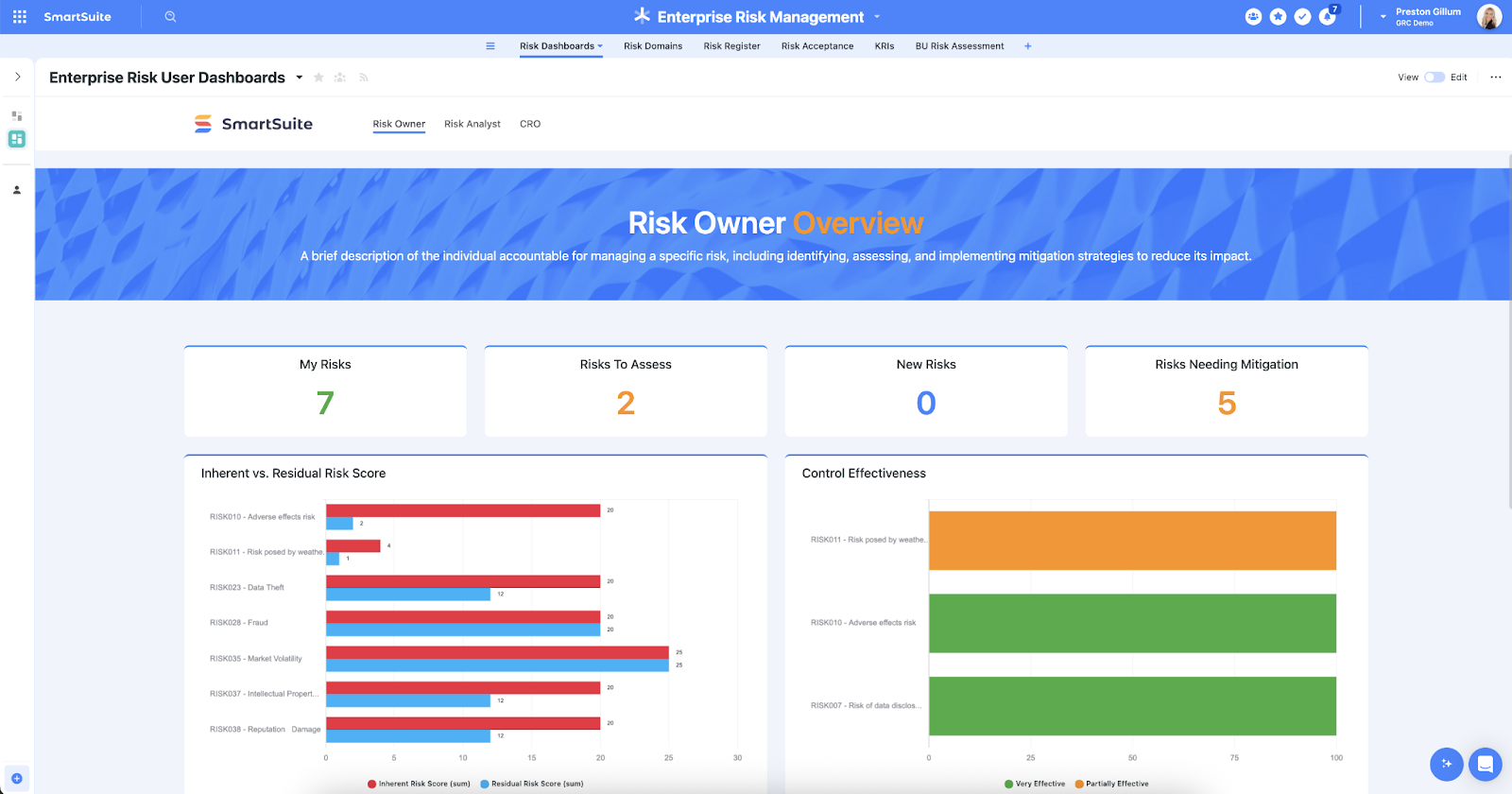
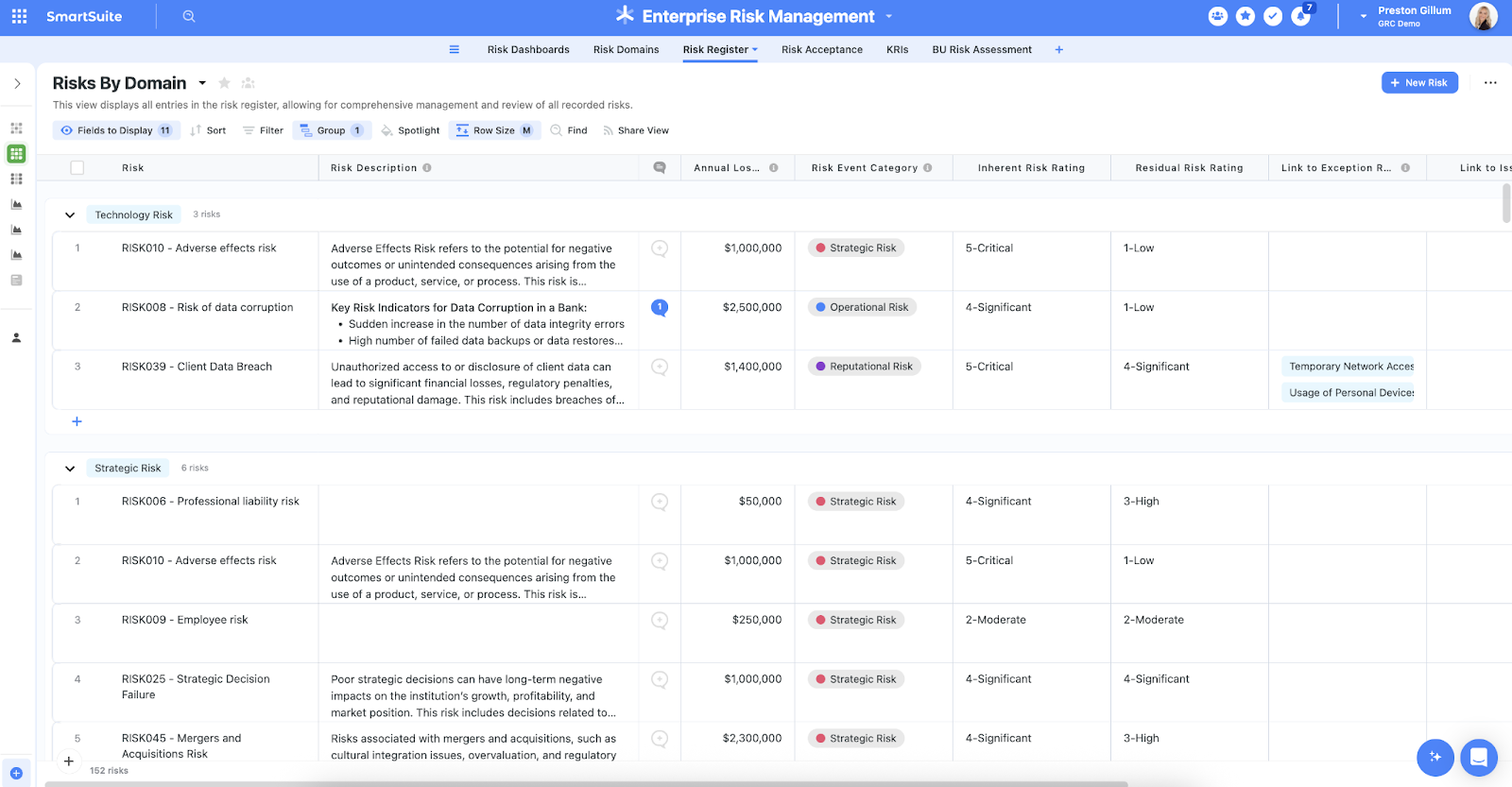
SmartSuite’s interface is clean, modern, and adaptable. Users can surface what’s important without losing access to depth.
It feels as natural to an analyst as it does to an executive.

2. Contextual Workflows
Rather than forcing users into rigid templates, SmartSuite adjusts dynamically, showing relevant fields, linked records, and instructions based on role, process stage, and framework.
3. Collaborative by Design
Every record, whether it’s a control, incident, or risk assessment, is a living workspace. Teams can comment, attach evidence, assign actions, and close loops without leaving the platform.
4. Built for the Next Generation
We designed SmartSuite for how Millennials and Gen Z work: visually, collaboratively, and intuitively.
Real-time updates, mobile access, dark mode, and personalized dashboards feel as fluid as modern productivity tools.
5. Beauty as a Business Case
Design isn’t decoration. A well-designed system reduces training cost, boosts adoption, and improves data quality. Form is a function when it comes to engagement.
Bridging Design and Governance
At first glance, “design thinking” and “governance” might seem like opposites: one focused on creativity, the other on control. But in practice, they’re complementary:
- Governance defines the boundaries.
- Design determines how people navigate them.
When done right, design doesn’t weaken governance: it strengthens it by making compliance effortless and intuitive.
A system that guides users through policy adherence, evidence collection, and remediation with clarity will always outperform one that relies on training and enforcement.
Good design turns governance into muscle memory.
Data Integrity Through Usability
Here’s a simple truth most GRC vendors ignore: Bad user experience leads to bad data.
- When entering information feels like a chore, people take shortcuts.
- When it’s confusing, they guess.
- When it’s unintuitive, they give up.
The result is incomplete or inconsistent data, which undermines every report, metric, and audit downstream.
SmartSuite’s user-first design solves that. By making workflows natural and rewarding, it improves accuracy at the source.
Clean design produces clean data, and clean data produces better decisions.
How Design Thinking Drives Adoption
When we talk about “user adoption,” we’re not talking about compliance; we’re talking about trust.
People adopt tools they trust, and they trust tools that make them feel competent, informed, and in control.
Design thinking fosters that trust by aligning system behavior with user expectation.
Each click feels purposeful. Each interaction delivers feedback. Each workflow ends with resolution, not frustration.
This sense of flow turns governance into collaboration.
When teams actually like the tool, they use it more, and that’s when GRC finally becomes enterprise-wide.
The ROI of Design
The return on good design is measurable:
- Faster onboarding: New users ramp up in hours, not weeks.
- Higher engagement: More users, more often, entering better data.
- Reduced support cost: Fewer help tickets and configuration requests.
- Better analytics: Cleaner, timelier information for leadership.
- Cultural impact: Risk awareness becomes a shared behavior, not a compliance mandate.
In other words: Design thinking doesn’t just look good, it pays off.
The Next Frontier: Emotional Design in Risk Management
The best enterprise systems do more than function, they feel good to use.
They build confidence, reduce anxiety, and create a sense of progress. In GRC, that emotional connection matters.
When risk professionals feel supported, not burdened, by their tools, they perform better, make smarter decisions, and elevate the perception of the function across the organization.
Design thinking introduces humanity into a discipline that desperately needs it.
Why It Matters Now
As GRC expands into areas like ESG, privacy, AI governance, and resilience, user engagement will determine success.
Complexity is inevitable, while confusion is optional.
The winners will be those who design for clarity, inclusivity, and experience at scale.
Frameworks like CRI have given us the shared language for risk. Design thinking gives us the shared experience for managing it.
Together, they represent the future of connected governance: systems that people actually want to use, built for how they think and work.
The Future of GRC Is Human
Technology evolves. Frameworks evolve. Regulations evolve.
But the people managing risk will always be the constant. The future belongs to tools that understand them, not the other way around.
Design thinking ensures that the systems guiding governance and resilience aren’t just technically capable, but emotionally intelligent.
Because at the end of the day, the best GRC system isn’t the one with the most features, it’s the one that people actually use.
And that’s exactly what we built SmartSuite to be.
Jon Darbyshire is CEO and Founder of SmartSuite and previously founded Archer IRM, one of the first enterprise GRC platforms. He continues to work closely with financial institutions, regulators, and technology partners to advance the future of integrated risk management.
SmartSuite provides work platform for standardizing workflows in the following areas:
- Governance, Risk & Compliance
- IT & Service Ops
- Project / Portfolio Management
- Business Operations