
For decades, financial institutions treated cybersecurity, enterprise risk management, and business continuity planning as three distinct disciplines.
Each evolved from different historical moments:
- Cybersecurity grew out of information security.
- Enterprise risk matured from regulatory pressure, operational governance, and Basel expectations.
- Business continuity emerged from disaster recovery, operational planning, and crisis management.
Each discipline developed its own teams, tools, frameworks, certifications, and vocabulary. Each had its own dashboards, testing rituals, and reporting cadence. And each maintained its own model for describing preparedness.
Yet in every large institution I’ve worked with, from global banks to mid-sized credit unions to fintech organizations, the truth has been clear for years:
These disciplines don’t just overlap, they are deeply interdependent. Treating them separately has become one of the biggest inefficiencies in modern governance.
A cyber event is almost always a business continuity event.
A resilience failure is usually a risk management failure.
A continuity dependency reveals technology and vendor risks.
An operational outage exposes both cyber and continuity gaps.
A third-party incident creates downstream impacts everywhere.
The work is interconnected.
The systems are not.
The Cyber Risk Institute’s CRI Profile is the first framework that meaningfully bridges these worlds, not accidentally, but by design.
CRI is becoming the connective tissue between cyber, risk, and business continuity teams by giving them something they have never had before: a shared diagnostic language that describes maturity consistently across domains and connects technical controls to operational outcomes.
The Root Problem: Three Disciplines, Three Languages, One Reality
Across institutions, cyber, risk, and continuity teams often present three different versions of the same story.
- Cyber talks in vulnerabilities, configuration drift, threat vectors.
- Risk talks in inherent, residual, control effectiveness, KRIs.
- Continuity talks in RTO, RPO, impact tolerances, disruption scenarios.
These are different expressions of the same underlying concern: Can the institution operate reliably under stress, disruption, or attack?
But because each discipline speaks its own language, institutions face three chronic problems:
1. Fragmented maturity assessments
Cyber rates controls one way; risk scores them another; continuity evaluates readiness differently.
2. Duplicate and conflicting evidence
Evidence collected for continuity exercises rarely maps directly to cyber governance or risk assurance, and vice versa.
3. Governance blind spots
Boards must interpret three different narratives about organizational readiness.
This fragmentation creates inconsistency in oversight, inefficiency in operations, and friction in remediation.
The work isn’t broken, the language is.
CRI Solves This Through Diagnostic Alignment
One of CRI’s greatest contributions is that it describes expectations in a way that naturally bridges cyber, risk, and continuity functions.
CRI is diagnostic, not prescriptive.
It evaluates outcomes, governance, processes, capabilities, and maturity, in language that is accessible to both technical and operational teams.
CRI is harmonized across regulatory expectations.
It aligns cybersecurity, operational resilience, and technology governance frameworks into one model.
CRI focuses on operational impact.
Its diagnostic statements highlight how cyber weaknesses influence operational continuity and resilience.
CRI creates a shared maturity model.
All teams evaluate readiness the same way, using the same lenses.
This structure changes how institutions work, because teams that previously operated in parallel can now operate in alignment.
How CRI Bridges Cyber and Risk
Cybersecurity teams benefit from CRI because diagnostics translate technical controls into governance expectations.
Risk teams benefit because the same diagnostics map naturally into:
- Control libraries
- Issue management
- Risk statements
- Key indicators
- Continuous monitoring signals
- Board reporting
Cyber learns to speak governance. Risk gains visibility into technical realities. Both teams evaluate maturity through one shared structure.
How CRI Bridges Risk and Business Continuity
Risk outlines potential impacts. Business continuity plans for them.
Yet historically, their frameworks were only loosely connected.
CRI closes this gap through diagnostics that address:
- Governance.
- Critical service dependencies.
- Technology integration.
- Incident response.
- Recovery capabilities.
- Disruption scenarios.
- Business-impact alignment.
Risk can finally map continuity gaps into the same diagnostic structure. Continuity teams can align their readiness to control maturity. Both contribute to a unified story of “institutional resilience.”
How CRI Bridges Cyber and Business Continuity
This might be CRI’s most important bridge.
Cyber incidents are now among the most common sources of operational disruption. Ransomware, identity compromise, cloud misconfiguration, vendor outages, all cyber triggers, all continuity consequences.
CRI enables these teams to speak through the same diagnostic expectations:
- Incident planning → cyber + continuity.
- Recovery capabilities → continuity + cyber governance.
- Resilience indicators → cyber + operations.
- Control dependencies → both functions.
- Vendor resilience → both functions.
- Critical process mapping → cyber + risk + continuity.
Cyber teams begin viewing security not only as prevention, but as resilience.
Continuity teams begin viewing resilience not only as recovery, but as cyber alignment.
This is the bridge the industry has been missing.
The Combined Effect: Integrated Institutional Readiness
Once cyber, risk, and continuity teams adopt CRI diagnostics as their shared structure, institutions experience a transformation across governance, operations, and culture.
1. Unified maturity scoring
Teams no longer fight inconsistent interpretations, they evaluate maturity through diagnostic expectations that reflect all three domains.
2. Unified evidence
Evidence collected for continuity tests becomes usable for cyber governance. Cyber evidence becomes informative for continuity planning. Risk evidence becomes universal.
3. Unified remediation
An issue triggered in one domain flows into a single remediation workflow, not three.
4. Unified reporting
Boards no longer interpret three stories, they see one integrated view of readiness.
5. Unified culture
Instead of cyber, risk, and continuity operating in silos, they operate as one integrated resilience function.
And this is exactly what regulators, from the OCC and FFIEC to UK PRA/BoE and DORA, have been signaling through their guidance: Resilience is the outcome of aligned functions.
CRI builds the alignment.
Why SmartSuite Operationalizes the CRI Bridge
CRI provides the LANGUAGE. SmartSuite provides the SYSTEM. Together they create the bridge.
Because SmartSuite is workflow-native, CRI’s diagnostic statements become:
- Workflow triggers.
- Evidence anchors.
- Continuous assurance indicators.
- Remediation categories.
- Risk scoring inputs.
- Resilience dependencies.
- Board-level narrative drivers.
This allows cyber, risk, and continuity teams to work inside:
- One platform.
- One workflow lifecycle.
- One maturity model.
- One evidence library.
- One remediation path.
- One executive dashboard.
SmartSuite doesn’t replace discipline expertise; it connects it.
CRI gives teams a shared interpretation. SmartSuite gives them shared motion.
This is what true cross-functional resilience requires.
Why This Matters Now More Than Ever
Financial institutions face unprecedented operational stressors:
- Hybrid cloud architectures.
- Global vendor ecosystems.
- Geopolitical instability.
- Regulatory convergence.
- Sector-wide resilience expectations.
- Cyber threats with continuity impact.
- Reliance on critical business services.
Legacy governance structures are not built for this level of interdependence.
But CRI’s diagnostic structure, paired with workflow-native platforms, is.
The institutions that adopt a unified model for cyber, risk, and continuity will:
- Detect risks earlier.
- Respond faster.
- Reduce audit friction.
- Strengthen resilience.
- Improve regulatory posture.
- Build board confidence.
- Align teams naturally.
- Reduce operational inefficiency.
- Produce clearer maturity stories.
The ones that don’t will continue to operate in a fractured model that is increasingly mismatched to the external world.
Risk doesn’t move in silos. And institutional readiness must not either.
CRI provides the bridge. SmartSuite makes it walkable.
Conclusion
For the first time, the financial-services industry has a framework capable of unifying cyber, risk, and business continuity into a coherent model.
CRI does not collapse disciplines, it connects them. It does not replace frameworks, it harmonizes them. It does not reduce complexity, it gives complexity structure.
Cyber, risk, and continuity are no longer three domains. They are one story: the story of whether an institution can operate reliably under stress.
CRI gives that story a shared language. SmartSuite turns that language into connected workflows.
This is the future of institutional resilience.
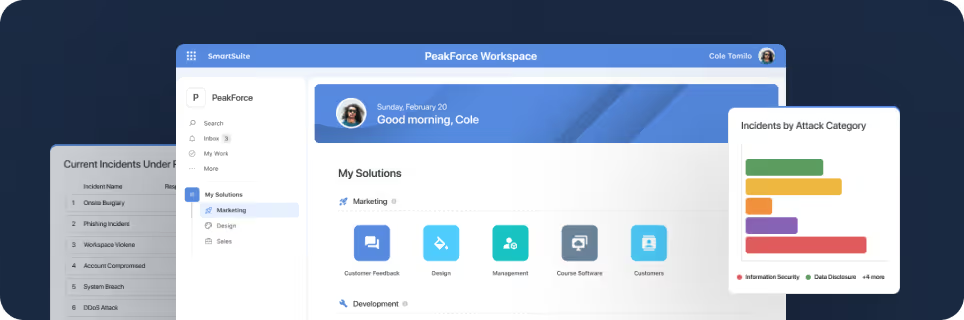
SmartSuite provides work platform for standardizing workflows in the following areas:
- Governance, Risk & Compliance
- IT & Service Ops
- Project / Portfolio Management
- Business Operations