For decades, financial institutions have been guided by regulatory frameworks that grew independently, evolved in isolation, and often overlapped in ways that made operational consistency difficult.
Each regulation reflected legitimate concerns, cybersecurity readiness, vendor oversight, business continuity, governance expectations, but the sheer number of frameworks created a landscape that was increasingly hard to navigate, interpret, and operationalize.
As digital complexity increased, so did the fragmentation.
The largest financial institutions were left to harmonize hundreds of regulatory expectations through internal spreadsheets, crosswalk tables, custom mappings, and annual translation exercises that consumed extraordinary time and talent.
Smaller institutions struggled even more, often lacking the staff or infrastructure to keep up with fast-shifting regulatory demands.
For years, leaders across cyber, risk, audit, and resilience have been asking for something that seemed almost unattainable: a single, coherent structure that unifies these expectations into one language. A framework that regulators could accept, that institutions could understand, and that boards could trust.
The Cyber Risk Institute’s CRI Profile is the first framework that finally delivers on this vision.
A Framework Born From the Right Ingredients
The CRI Profile didn’t emerge from a single regulator or private initiative. It was created through collaboration, by financial institutions, trade associations, cybersecurity experts, and regulatory stakeholders all working together to bridge the gaps between major standards.
What makes CRI unique is not simply its content, but its design philosophy. CRI is:
- Harmonized across dozens of regulations
- Portable across cyber, risk, compliance, and resilience functions
- Diagnostic rather than prescriptive
- Outcome-oriented instead of control-listing
- Structured to support governance and executive reporting
- Adaptable to emerging threats and regulatory evolution
Before CRI, institutions were left to interpret frameworks independently. NIST CSF, ISO 27001, FFIEC guidelines, MRA observations, OCC expectations, EBA interpretations, and local supervisory requirements all needed cross-mapping to ensure consistent coverage.
The result was predictable: every institution produced its own version of harmonization.
CRI changes that.
It is the first unified diagnostic model that the industry has broadly accepted, and one that is increasingly shaping regulatory conversations.
Why Financial Services Needed CRI
After two decades working across banks of every size, I’ve seen how damaging framework fragmentation can be. It causes more than administrative overhead; it creates strategic blind spots.
Across institutions, fragmentation produced four persistent challenges:
1. Different teams used different structures to describe the same risk.
- Cyber spoke NIST.
- Resilience spoke FFIEC.
- Compliance spoke OCC.
- Audit spoke ISO and internal frameworks.
Boards were left to synthesize competing viewpoints.
2. Evidence was inconsistent.
Teams gathered proof differently, evaluated it differently, and stored it in disconnected systems.
3. Maturity meant different things to different people.
Some defined maturity by the number of controls.
Others by compliance percentages. Others by audit findings. Few could put all of it together.
4. Regulators evaluated through differing lenses.
One exam cycle focused heavily on governance.
Another on cyber hygiene. Another on resilience readiness.
Institutions were left translating dozens of expectations into a single operational understanding.
CRI is the first framework to solve these challenges systemically, not tactically.
Why CRI Works When Previous Attempts Didn’t
The industry has tried harmonization before.
Typically, these efforts suffered from one of three failures:
- Too prescriptive: forcing institutions into rigid control sets
- Too abstract: lacking operational clarity
- Too narrow: unable to cover the full spectrum of cyber and resilience requirements
CRI avoids all three.
Its structure is what differentiates it: diagnostic statements.
Diagnostic statements:
- Articulate maturity
- Describe intended outcomes
- Unify expectations
- Bridge frameworks
- Connect operational controls
- Support defensible assurance
- Align with real-world workflows
They provide clarity without prescribing how each institution must implement controls, a balance that previous frameworks struggled to achieve.
That balance is why CRI works.
A Shared Diagnostic Model Is a Shared Language
One of the most consequential benefits of CRI is that it gives institutions a common vocabulary.
When diagnostic statements become the foundation of cyber, risk, and resilience discussions:
- CISOs speak in governance-aligned terms
- Risk teams map controls and indicators consistently
- Audit evaluates maturity through a shared lens
- Resilience leaders connect cyber posture to continuity expectations
- Boards receive a coherent narrative rather than disparate reports
The conversation changes. The alignment deepens. Decision-making accelerates.
For the first time, different teams are no longer describing risk from incompatible frameworks; they are speaking from the same diagnostic structure.
This is the heart of harmonization.
How CRI Changes Operations Inside Institutions
When CRI is adopted fully, institutions begin to experience several tangible shifts.
1. Maturity becomes measurable
No more patchwork scoring or subjective evaluations.
2. Evidence becomes reusable
One artifact can serve multiple regulatory expectations.
3. Controls map naturally across teams
Cyber, GRC, and resilience all evaluate controls through the same lens.
4. Remediation becomes unified
Issues don’t disappear into departmental silos, they follow one lifecycle.
5. Reporting becomes honest
Boards finally receive a clear picture of readiness and gaps.
These improvements aren’t theoretical. They’re the result of moving from a fragmented world to a harmonized one.
What CRI Means for Regulators
Regulators have long struggled with evaluating cybersecurity and resilience consistently across institutions. CRI helps by:
- Reducing interpretation variance
- Improving maturity comparability
- Aligning risk expectations
- Reducing examination friction
- Promoting clarity across exams
Regulators aren’t adopting CRI because it is simpler; they’re adopting it because it is clearer.
And clarity is the currency of modern supervision.
Where CRI Goes Next
Based on conversations across the industry, I believe CRI will increasingly serve as:
- The baseline diagnostic model for FS institutions
- The translation layer between cyber, risk, and resilience
- The governance backbone for board reporting
- The maturity benchmark across institutions
- The foundation for technology integrations and vendor alignment
What NIST did for cybersecurity standards, CRI will do for enterprise risk interpretation in financial services.
Conclusion
For the first time in decades, the financial services industry has a unified, harmonized framework capable of aligning cyber, risk, and resilience activities under a single diagnostic structure.
The CRI Profile solves a problem institutions have faced for years, not by simplifying the work, but by standardizing the language behind it.
This is more than a framework. It is the infrastructure for modern cyber governance.
Institutions that adopt it early will operate with more clarity, consistency, and confidence than those that continue stitching together competing expectations.
Those who integrate CRI into workflows, not just documents, will move faster, see clearer, and perform better.
CRI is the first unified foundation for the next era of financial services resilience.
And that makes it the most important framework evolution our industry has seen in years.
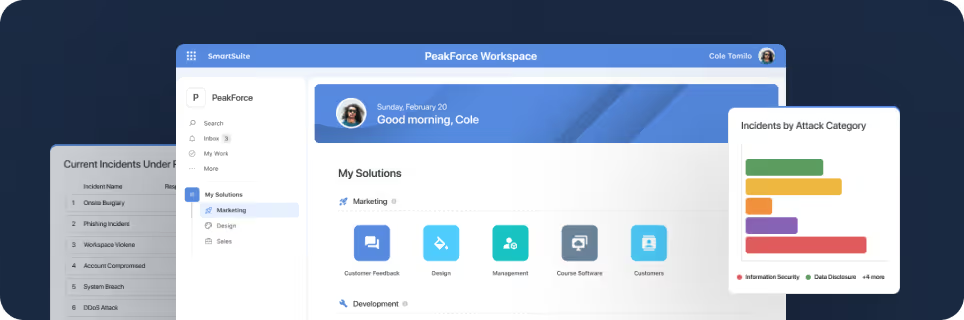
SmartSuite provides work platform for standardizing workflows in the following areas:
- Governance, Risk & Compliance
- IT & Service Ops
- Project / Portfolio Management
- Business Operations