
This guide walks through what ESG management actually is in 2026, the frameworks shaping it, and how to build a program that holds up under regulatory pressure and investor scrutiny.
TL;DR
- ESG management is a discipline, not a reporting exercise: it's the ongoing work of identifying material environmental, social, and governance issues, embedding them into decisions, tracking performance, and disclosing results to your stakeholders.
- Frameworks aren't interchangeable: GRI speaks to stakeholders, ISSB and SASB speak to investors, ESRS speaks to EU regulators, TCFD and TNFD give you the climate and nature lens, and mature programs combine them.
- The assessment that matters is materiality, not a generic checklist: double materiality (financial plus impact) has become the operating standard for any serious program, even outside the EU.
- The right platform connects ESG to the rest of the business: spreadsheets break at scale, point tools fragment your data, and the teams pulling ahead in 2026 run ESG alongside risk, compliance, and operations in a single governed workspace.
What is ESG management?
ESG management is the work of running environmental, social, and governance issues as a real business function.
That means deciding what's material, setting goals, collecting data across operations and the value chain, embedding ESG criteria into how decisions get made, tracking outcomes, and reporting to your stakeholders (e.g., investors, regulators, customers, employees, and communities).
However, it's not the same as sustainability reporting.
Reporting is the output. Management is everything that has to happen for that output to be credible: governance, controls, evidence, owners, methodologies, and a feedback loop that turns disclosures into changes in how the business runs.
Think of it the way you'd think of financial management: it exists so the company can run its money well, not just publish statements at year-end.
ESG management exists for the same reason on a different set of issues.
What are the different types of ESG management?
Here are the different types of ESG management based on what's actually driving the program inside your organization, as that determines scope, owners, frameworks, and tooling:
- Compliance-led ESG: The dominant driver is regulatory pressure, including CSRD, California climate laws, sector rules, and exchange listing requirements.
Sustainability sits inside legal, finance, or GRC, and the output is reports that have to pass assurance.
- Investor-led ESG: Capital markets are the primary audience, and programs are built around what rating agencies, debt providers, and institutional investors ask for.
The work is owned by IR or finance, and the metrics skew toward financially material climate, governance, and human capital data.
- Risk-led ESG. ESG issues are treated as a category of enterprise risk: physical climate exposure, transition risk, supply chain disruption, governance failures, and social license to operate.
This approach lives inside ERM or GRC and uses the same risk register, control library, and reporting cadence as other risk types.
- Operationally-integrated ESG. The program is woven into how the business runs day to day: procurement decisions, facility management, product design, R&D, and HR.
Sustainability owns coordination, but the work happens inside operating teams. This is the model many large industrials and consumer brands are moving toward.
A regulated bank, for example, can run compliance-led ESG on disclosure, risk-led ESG on climate stress testing, and investor-led ESG on sustainable finance products.
Why is ESG management important?
ESG management is important because the cost of getting ESG wrong has moved beyond reputational damage and into financial, legal, operational, and competitive territory.
Here are a few specifics from the past 18 months:
- The European Central Bank has folded climate risk into its bank supervisory process, and Pillar 2 capital add-ons have already been influenced by climate-related findings.
- Asset managers have paid greenwashing settlements in the tens of millions (Invesco settled with the SEC for $17.5 million in late 2024), and the UK's CMA gained powers in April 2025 to fine companies up to 10% of global turnover for misleading environmental claims.
EU companies that failed to scope CSRD obligations in time most likely spent 2024 and 2025 in a scramble that cost far more than a phased build would have.
And procurement teams at large enterprises now routinely send ESG questionnaires that gate access to multi-year contracts.
The upside is real, too.
Companies with credible climate transition plans access cheaper debt through sustainability-linked loans and green bonds, and companies that can produce auditable ESG data on demand are pulling ahead in supplier selection processes that used to be price-only.
The takeaway isn't that every company needs the same program.
It's that ESG management has become a discipline you have to do well enough to avoid the downside and capture the upside, even if your industry isn't directly regulated yet.
What are the benefits of ESG management?
A working ESG program pays off in ways that compound:
- Cleaner decisions: When material ESG factors sit alongside financial data, leadership can weigh tradeoffs honestly instead of pretending they don't exist.
- Lower cost of capital: Investors, lenders, insurers, and rating agencies all price ESG risk into their terms, and a credible program with good data narrows that spread.
- Audit-ready disclosures: When the underlying data has clear owners, controls, evidence, and methodologies, sustainability reports stop being a separate annual fire drill and start looking like every other piece of financial reporting.
- Procurement and customer wins: Enterprise buyers increasingly require ESG data as part of supplier qualification, and a program that can answer those questions quickly converts to revenue.
- Operational efficiency: Mapping emissions often surfaces process inefficiencies nobody had bothered to find, with energy, waste, water, and travel work typically paying back in cost savings before it pays back in disclosure.
- Regulatory readiness: A program built around material data, owners, evidence, and assurance absorbs new rules with marginal effort, while deadline-driven programs get rebuilt every time the rules change.
How can you approach ESG management?
There are 4 main ways that you can approach ESG management:
The compliance-first approach
You start with the rules you have to meet: CSRD if you have EU exposure, California SB 253 if you have California revenue, sector rules if you're regulated, and exchange listing rules if you're public.
The way it works is that you map obligations to owners, build the data collection and control infrastructure to meet them, then expand from there.
The risk here is treating ESG as a checklist that ends when the report is filed.
The materiality-first approach
Start with a double materiality assessment that identifies what's significant to your business and to your stakeholders, then build the program around those topics, even if some aren't required disclosures yet.
This produces more durable programs because the work isn't driven by the next deadline, though it takes longer to show visible output.
The risk integration approach
The risk integration approach means treating ESG topics as risk categories inside your existing ERM or GRC program, using the same risk register, control library, assessment cadence, and reporting line to the audit committee or board risk committee.
It works well in regulated industries and for companies with a mature risk function, but can struggle where ESG issues are also strategic opportunities, since risk functions aren't usually set up to manage upside.
The strategy-led approach
The strategy-led approach is anchoring ESG to the company's long-term strategy, including net-zero commitments, circular economy goals, and social impact missions.
The strongest model is when leadership owns the agenda, and the weakest is when they don't.
In practice, mid-market companies often start compliance-first and evolve toward materiality-first as the program matures; regulated enterprises lean risk integrated, while large industrials and consumer brands more often run strategy-led programs with compliance as a layer underneath.
What are the different ESG management frameworks?
There's no single framework that covers everything, and there is probably not going to be in the near future.
Here's the practical map for 2026:
ESRS (European Sustainability Reporting Standards).
ESRS is the mandatory standards under the EU's Corporate Sustainability Reporting Directive (CSRD).
After the Omnibus I package, the scope narrowed: CSRD now applies primarily to companies with over 1,000 employees and €450 million or more in net annual turnover.
ISSB (IFRS S1 and S2)
The global investor-focused baseline, issued by the International Sustainability Standards Board.
IFRS S1 covers general sustainability disclosures, and IFRS S2 covers climate-specific disclosures.
As of January 2026, more than 30 jurisdictions had adopted or were in the process of adopting ISSB standards, including Australia, Hong Kong, Brazil, Chile, Mexico, Singapore, and Canada.
GRI (Global Reporting Initiative)
The GRI is the most widely used standard for stakeholder-focused sustainability reporting.
GRI is impact-oriented: it asks how the company affects the environment and society, not just how those issues affect the company. It complements ISSB, and most large companies use both.
SASB Standards
SASB Standards are industry-specific disclosure standards that cover 77 industries.
SASB is now part of the IFRS Foundation and integrated into ISSB's industry-based guidance.
TCFD and TNFD
The TCFD and TNFD are international corporate reporting frameworks that were designed to help organizations disclose their environmental and financial risks.
What kinds of tools can you use for ESG management?
Tools fall into a handful of categories, and the right one depends on program maturity, scope, internal capacity, and how integrated you want ESG to be with the rest of operations:
- Spreadsheets and shared documents: Where almost every program starts.
They tend to be fine for a small program with one or two people managing data manually.
However, its limitations show up fast: version control issues, no audit trail, no real validation, no easy way to handle Scope 3 calculations or multi-framework mapping.
- Carbon accounting platforms: Persefoni, Watershed, Sweep, and Plan A focus specifically on greenhouse gas measurement, emissions factor application, and Scope 1, 2, and 3 calculations.
They're strong on the carbon problem and improving on broader ESG capability.
If emissions are the dominant issue and you need a rigorous methodology, this category is worth a look.
- Dedicated ESG reporting platforms: Workiva, Diligent ESG, Novisto, and Sphera are built for end-to-end sustainability reporting: data collection, framework mapping, disclosure preparation, and assurance support.
They handle complex multi-framework reporting well and are commonly chosen by large enterprises with mature programs.
- GRC platforms with ESG modules: MetricStream, IBM OpenPages, ServiceNow GRC, and OneTrust have added ESG capabilities on top of their risk and compliance functionality.
These work well when ESG is being run as part of an integrated risk program.
- Connected work platforms: A newer category where ESG, GRC, and operations all live in one no-code system.
This model suits mid-market and growing enterprise teams that want ESG data and workflows connected to procurement, HR, operations, and risk, not isolated in a specialty tool.
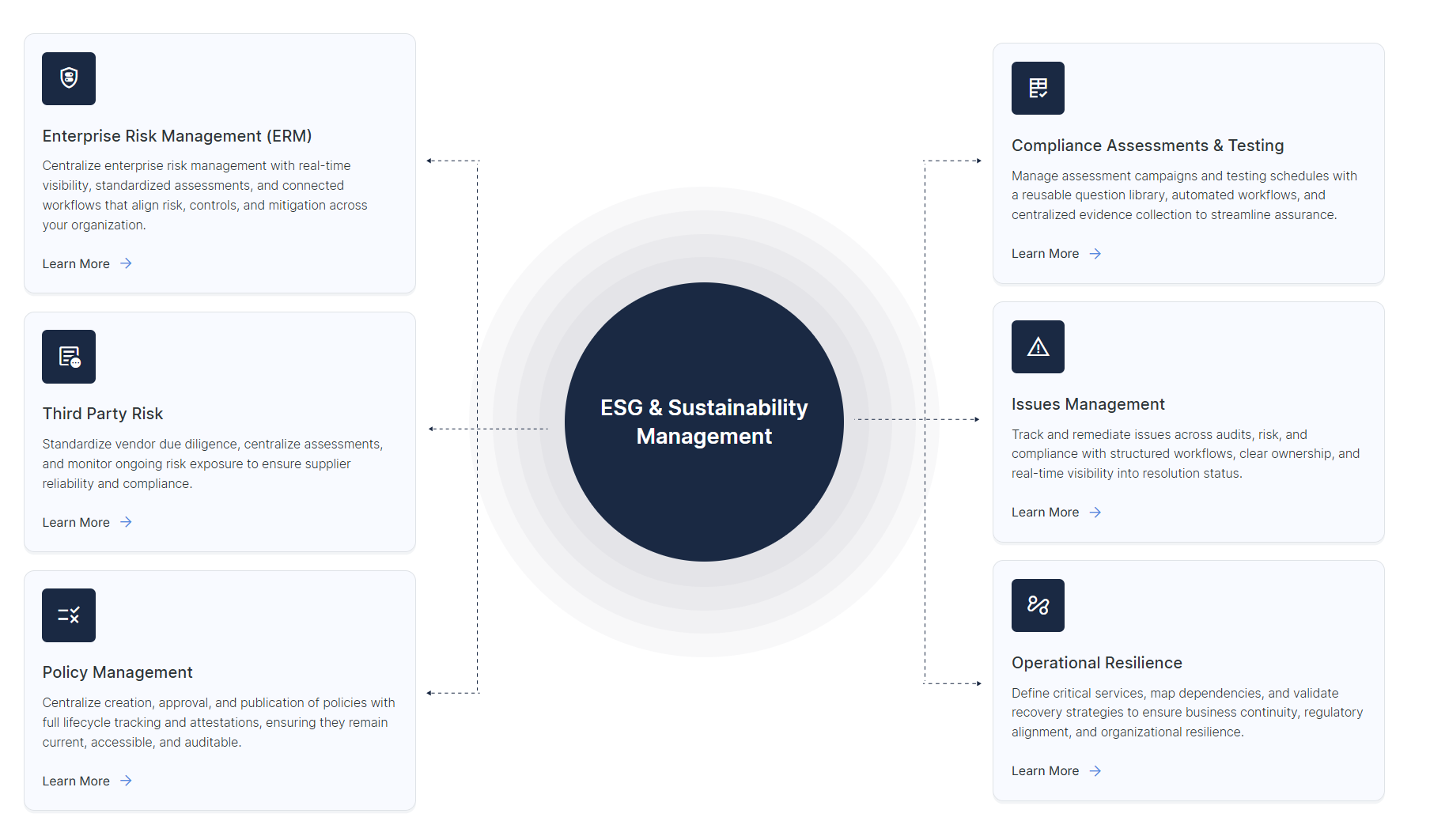
➡️ If your ESG program is outgrowing spreadsheets but you're not ready for a six-figure enterprise reporting platform, SmartSuite (that’s us) is worth a look.
Our AI-native work management platform that handles ESG data management, sustainability reporting, carbon and emissions tracking, social impact programs, and governance and ethics workflows in one connected workspace, with every data point linked to owners, KPIs, controls, and audit trails.
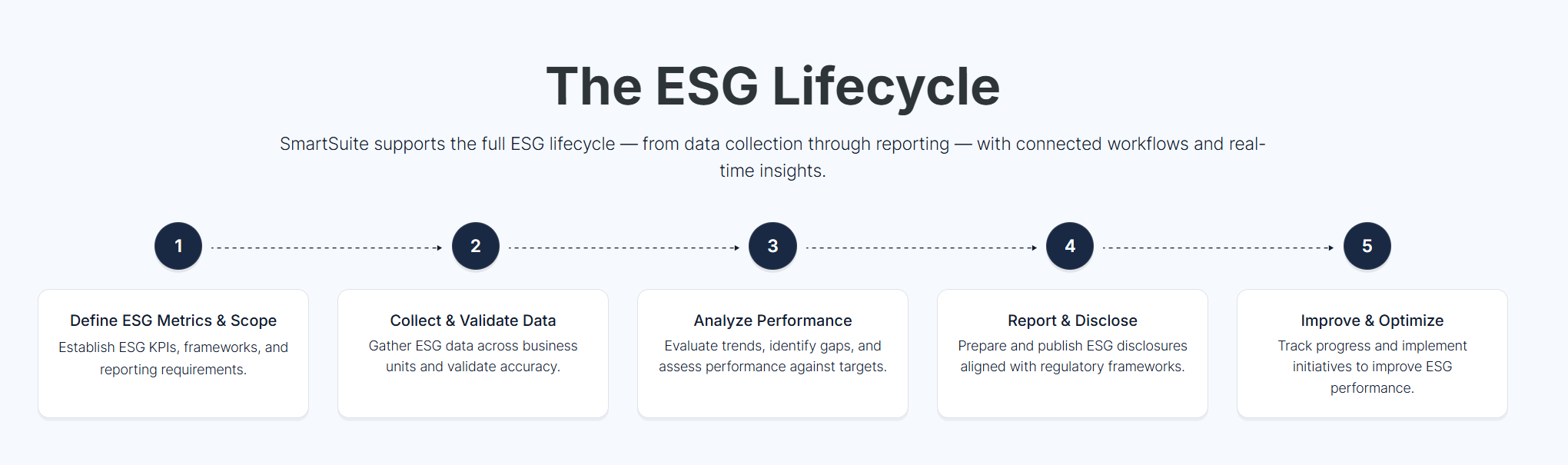
As the platform is no-code and built on a flexible data model, your sustainability team can structure the program around your actual material topics and map activities to frameworks like GRI, SASB, and TCFD using pre-configured templates and gap analysis.
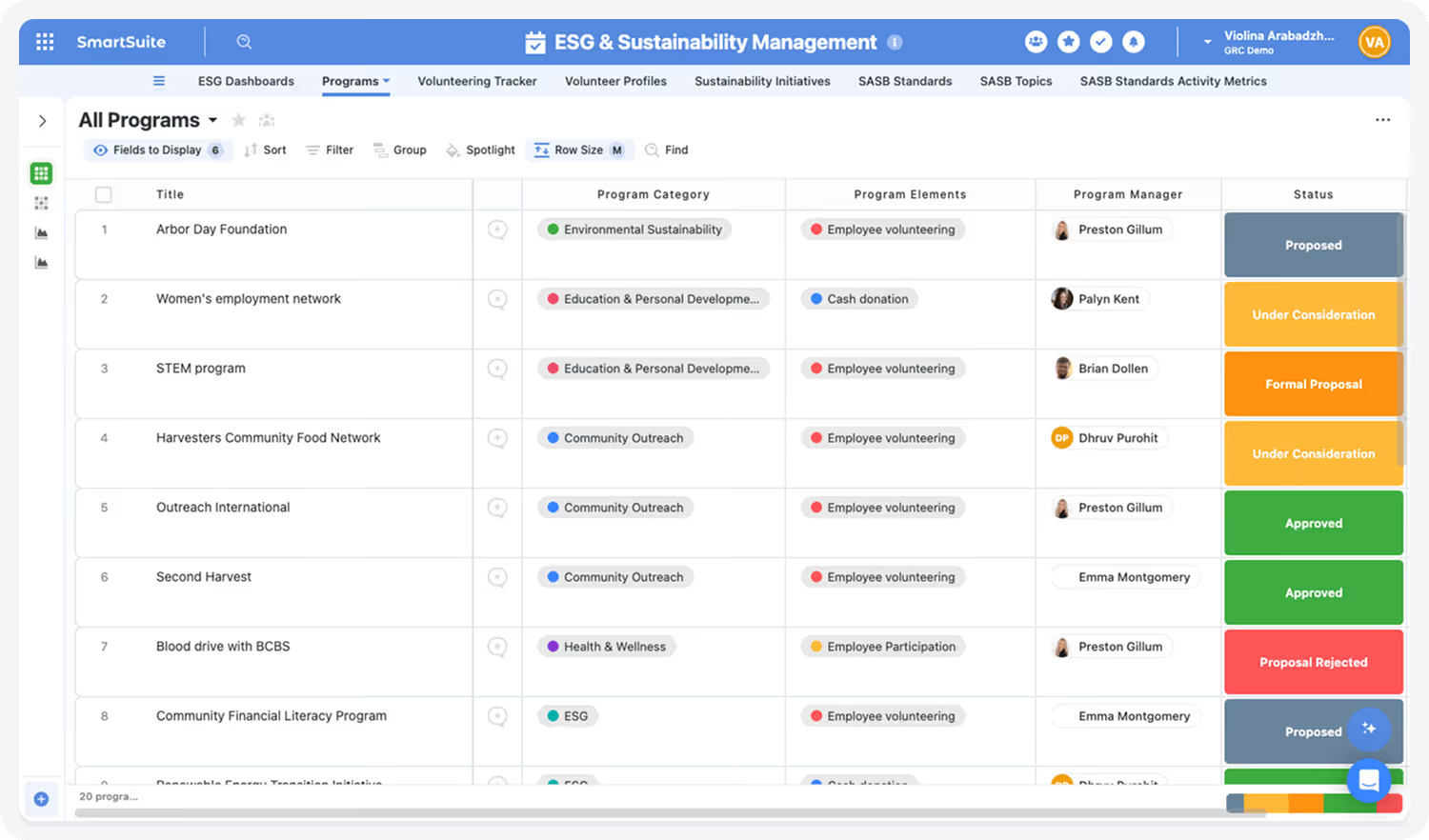
ESG data sits next to your risk register, compliance controls, vendor records, and operational work, so the same records feed disclosure, audit, board reporting, and management decisions without duplicate entry.
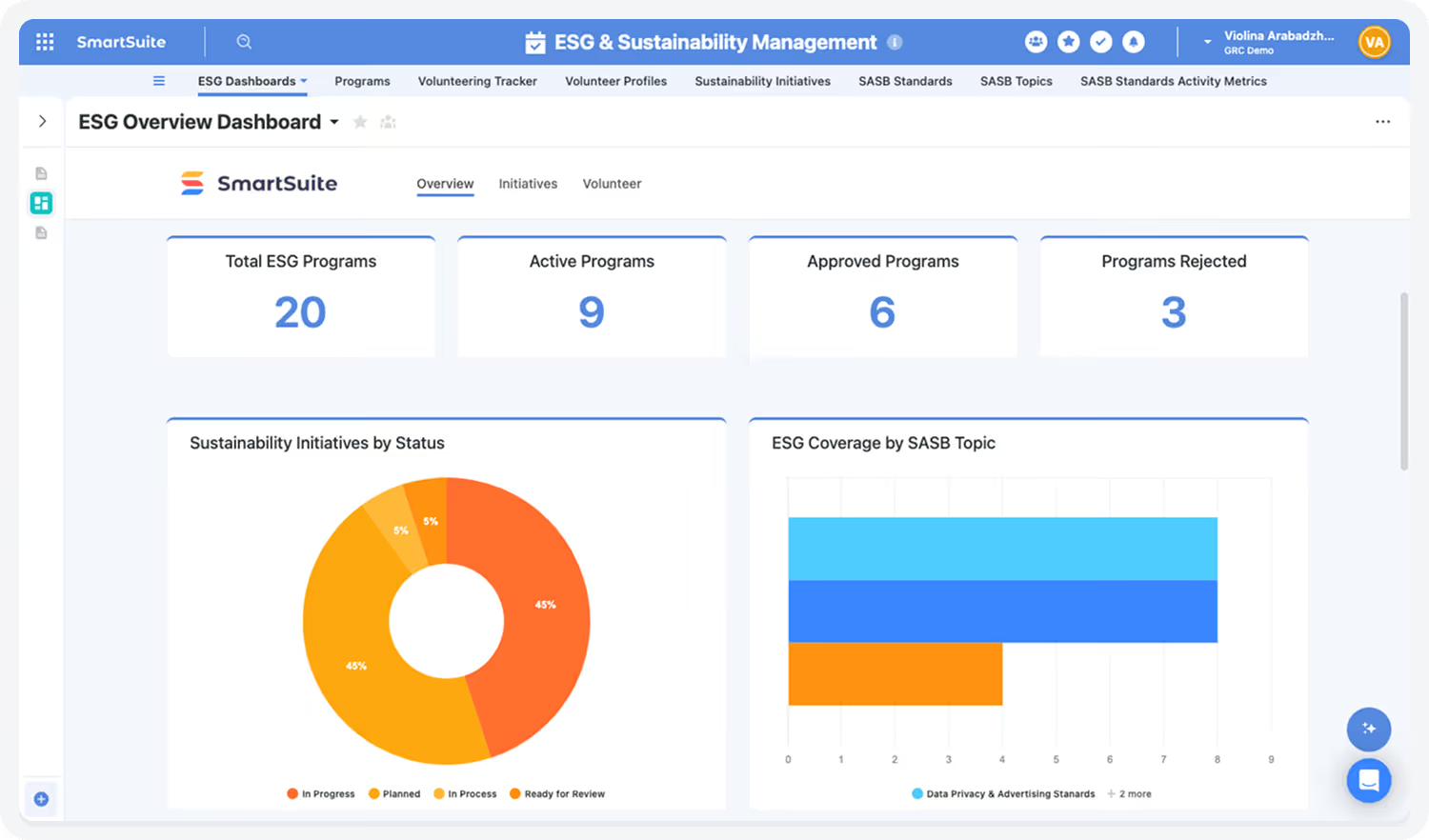
Real-time dashboards give leadership a live view of progress against ESG goals, and configurable stakeholder summaries support transparent reporting backed by audit trails and document version control.
Built-in automation handles data collection reminders, framework-mapped KPI tracking, and approval routing, while SmartSuite AI handles the slow parts (summarizing supplier questionnaires, drafting policy language, flagging data gaps) under role-based permissions, with every AI-driven change written to the audit log.
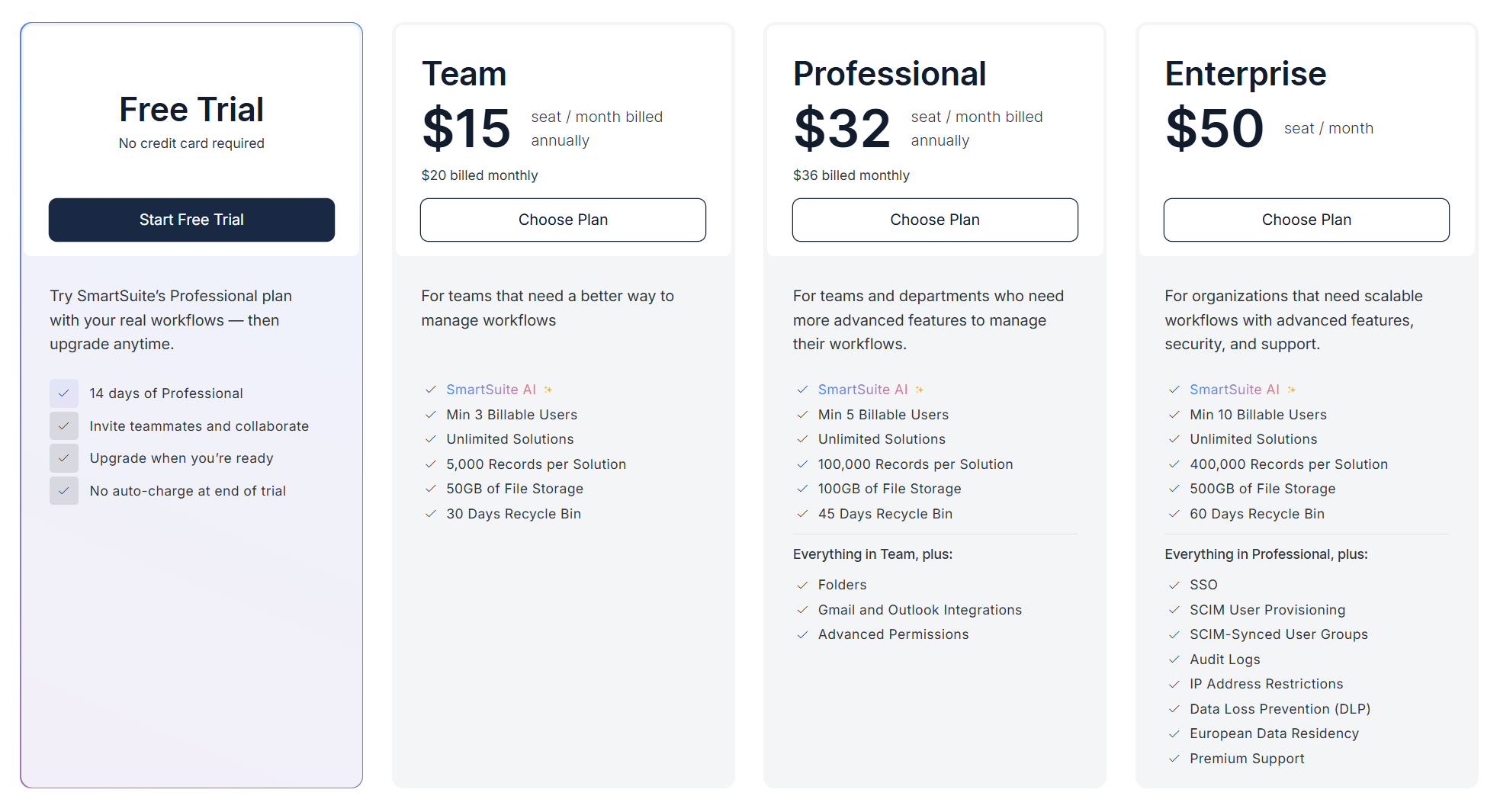
Pricing starts at $15/user/month for the Team plan, with solution-based pricing available for regulated enterprises that need to license access by department or regulatory scope.
Get started with SmartSuite for free
SmartSuite gives you flexibility and governance at the same time:
A no-code environment where the sustainability team can model the program around real material topics, backed by enterprise-grade permissions, audit logs, AI governance, and framework-aligned templates.
ESG initiatives, metrics, disclosures, carbon tracking, and governance workflows live in one governed workspace, alongside risk, compliance, and the rest of the business.
➡️ Start a free SmartSuite trial or book a demo to see how your team can run ESG management connected to the work that drives it.
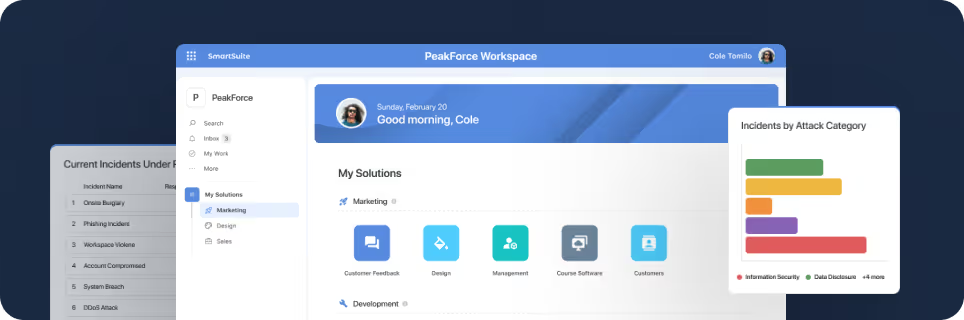
SmartSuite provides work platform for standardizing workflows in the following areas:
- Governance, Risk & Compliance
- IT & Service Ops
- Project / Portfolio Management
- Business Operations