This guide covers what SOC 2 compliance is, the report types and criteria behind it, how to run an assessment, and which tools actually help you manage the whole thing in 2026.
TL;DR
- SOC 2 isn't a pass-or-fail certification: It's an attestation report an independent CPA firm issues describing how well your controls protect customer data against the AICPA Trust Services Criteria.
- Two report types exist: A Type I report checks how controls are designed at a single moment; a Type II report checks whether those controls held up across a monitoring window.
- Five Trust Services Criteria set the scope: Security is mandatory, while availability, processing integrity, confidentiality, and privacy get added based on what you've promised customers.
- An assessment is continuous work, not a project with a finish line: scope, gap analysis, remediation, the observation window, the audit, then around again next year.
- Tooling spans spreadsheets, compliance automation, and connected GRC platforms like SmartSuite, and the right choice depends on whether SOC 2 lives on its own or beside your wider risk and audit program.
What is SOC 2 Compliance?
SOC 2 is a reporting standard that shows how well a service organization protects the data it handles for its customers.
The American Institute of Certified Public Accountants (AICPA) built it, and it belongs to the broader System and Organization Controls family.
People get one thing wrong about it constantly. It's not a certification you pass or fail.
A licensed CPA firm examines your controls and issues an attestation report describing what they found.
That report becomes the document you hand a prospect's security team when they ask how you keep their data safe.
The standard measures your controls against the AICPA Trust Services Criteria, which span security, availability, processing integrity, confidentiality, and privacy.
Most companies that pursue it are in cloud and SaaS, or any business that stores or processes sensitive information for clients.
It traces back to 2010 to provide a modern compliance framework focused on cloud-based services and data security.
What are the different types of SOC 2 Compliance?
There are two types of SOC 2 compliance, and the difference matters more than you’d expect:
- A Type I report looks at your controls at a single point in time.
It confirms whether the right controls were designed and in place on a given date.
You can earn one fairly quickly, which makes it handy when a customer needs proof now, and you don't yet have a track record.
- A Type II report is the heavier lift, and the one enterprise buyers actually want.
It examines whether your controls operated effectively across a stretch of time, usually somewhere between three months and a full year.
So Type I is a photograph, and Type II is the footage.
Plenty of teams start with Type I to unblock a deal, then move to Type II for the credibility that comes with a sustained record.
Why is SOC 2 Compliance important?
The reason why SOC 2 compliance is important is because a lot of deals don't move without it.
Enterprise security questionnaires increasingly treat a SOC 2 Type II report as a baseline, not a bonus.
When you can hand one over, you skip weeks of back-and-forth and let the buyer's risk team close out a requirement they were going to insist on anyway.
But the value runs deeper than sales velocity.
Building toward SOC 2 forces you to document how security actually works at your company, then give every control a named owner who can prove it runs on schedule.
That discipline tends to surface real problems before an incident, or an auditor does.
It also maps cleanly onto standards like ISO 27001 and the NIST Cybersecurity Framework, so the work you do for SOC 2 rarely stays locked to SOC 2.
For regulated buyers in banking, healthcare, insurance, and fintech, that overlap is a real draw, since one set of controls can answer several assurance needs at once.
What are the five Trust Services Criteria?
Every SOC 2 report is built on the Trust Services Criteria, and getting your head around them is the fastest way to understand what your audit will actually cover.
Security is the only one that's mandatory.
It's often called the common criteria, and it covers the controls protecting systems against unauthorized access, both physical and logical.
The other four are optional.
You add them based on the promises you've made to customers.
- Availability: whether your systems stay up and reachable in line with the commitments in your SLAs.
- Processing integrity: whether your systems process data accurately and on time, without dropping or corrupting records along the way. It matters most for platforms running transactions or calculations.
- Confidentiality: whether information labeled confidential, like contracts or internal financials, stays protected.
- Privacy: how you collect, use, retain, and dispose of personal information, aligned to the privacy notice you've published.
A SaaS analytics tool might scope in security and availability and leave privacy out completely. A health-tech platform handling patient records will almost certainly pull privacy in.
I've watched teams scope all five criteria out of pure caution, then burn months gathering evidence for promises no customer ever asked them to make.
Get the criteria right at the start, and you keep the audit narrow and the evidence pile sane.
How long does SOC 2 take, and what trips teams up?
The honest answer is that it depends on where you're starting, but the shape of the timeline is predictable.
For Type II, the observation window dominates the clock.
That's the period the auditor watches your controls operate, and it can't be faked or compressed.
- A short window runs around three months.
- A thorough one stretches closer to a full year.
Before the window even opens, there's readiness work: scoping, writing policies, fixing gaps, and standing up the systems that will collect your evidence.
For a company starting from zero, the readiness phase alone often eats two to four months.
Then audit fieldwork and report drafting add a few more weeks on the back end.
So a realistic first Type II, soup to nuts, tends to land somewhere in the six-to-twelve-month range.
A handful of things reliably blow that timeline up.
- Scoping too broadly: pulling in every criterion and every system multiplies the evidence you produce and the controls you defend.
- Treating evidence as a last-minute task: auditors want proof a control ran throughout the window, so screenshots gathered the night before don't hold up.
- No clear owners: a control with no name attached to it quietly stops running, and the gap surfaces during fieldwork at the worst possible moment.
- Policy-reality drift: your written policy says one thing, your team does another, and an auditor spots the mismatch fast.
How to conduct a SOC 2 compliance assessment
A SOC 2 assessment is the structured work of figuring out where your controls stand against the criteria you've scoped, then closing the distance before an auditor shows up.
It moves through stages, and while they look tidy on a slide, in practice the later stages keep feeding the earlier ones.
- Stage one is scoping.
You settle on the criteria that apply and draw a clear boundary around the systems and teams in scope, along with the report type you're after.
Get this wrong, and everything downstream inherits the mistake.
- Next comes the gap assessment.
You hold what the criteria require up against what you actually do today, control by control, and write down every place reality falls short.
A readiness review from an advisor or an internal team earns its keep here, because it tells you the size of the problem before the auditor delivers the same news for a fee.
- Then you remediate.
Every gap gets an owner, a fix, a due date, and a status you can track to closed.
Some fixes are technical, like turning on encryption or enforcing MFA.
Others are procedural, like documenting an access-review cadence someone will actually follow.
- The fourth stretch is evidence and observation.
For Type II, this is the long phase when controls run, and you capture proof that they did: logs, tickets, approvals, and review records, all timestamped and tied back to the control they support.
Auditors sample at this point too, testing a portion of activity, not every single event.
- Finally, the examination.
The CPA firm tests your controls and issues the report, noting any exceptions it finds along the way.
Then you start preparing for the next cycle, because SOC 2 runs on an annual rhythm.
The teams that handle this calmly are the ones who treat the evidence trail as something that builds continuously, so audit season turns into a review of work already done.
What kinds of tools can you use for SOC 2 Compliance?
Which tool you need comes down to how mature your program is, and whether SOC 2 is your whole compliance story or one chapter of a bigger risk and audit effort.
- Most teams begin in a spreadsheet.
A control matrix in Excel or Google Sheets does the job while the program is small and one person keeps the whole picture in their head.
That arrangement breaks the first time you need version history, a second contributor, or evidence an auditor won't laugh at six months later.
- Compliance automation tools are the category most people picture when they hear SOC 2.
Vanta, Drata, Sprinto, Secureframe, Scytale, and Thoropass wire into your cloud and SaaS accounts, then gather evidence and watch your controls more or less on autopilot.
They get a young company audit-ready impressively fast, which is why so many startups grab one before their first report.
- Enterprise GRC suites cover the most ground.
Archer IRM, MetricStream, IBM OpenPages, and ServiceNow give large, regulated institutions deep control modeling and the board-grade reporting and risk quantification those environments demand.
- Then there are connected work platforms, where compliance shares a home with the rest of how a company operates.
SmartSuite facilitates SOC 2 compliance by providing modules for risk tracking, control management, and evidence collection.
Our platform enables automated audit readiness, supports remediation workflows, and delivers reporting tools to help organizations monitor controls and demonstrate compliance with the Trust Services Criteria.
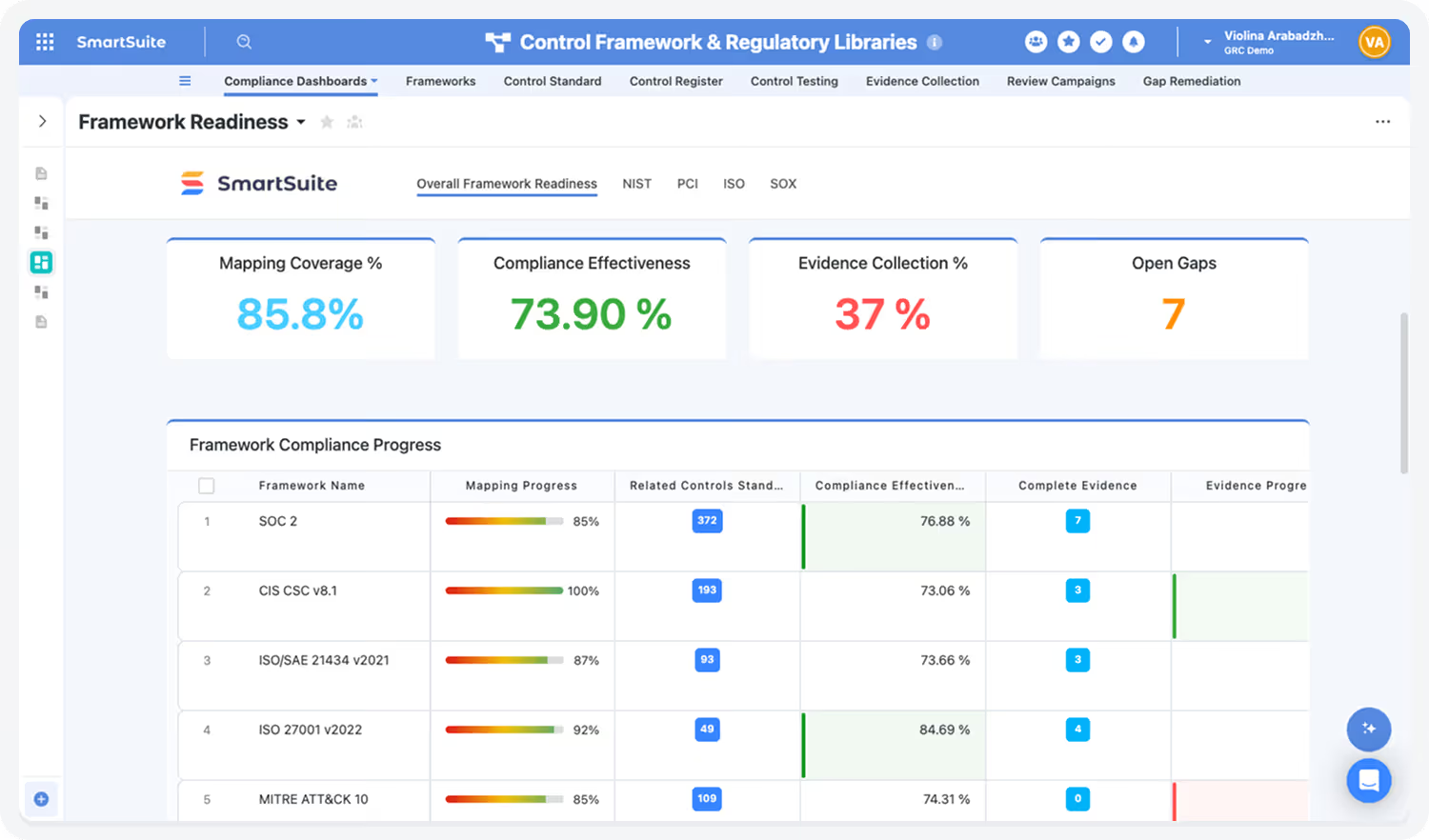
For SOC 2, that gives you a control library organized around the Trust Services Criteria, with an owner and a review cadence on every control.
Evidence gets captured under a timestamp and a named reviewer, each record tied back to the control it proves.
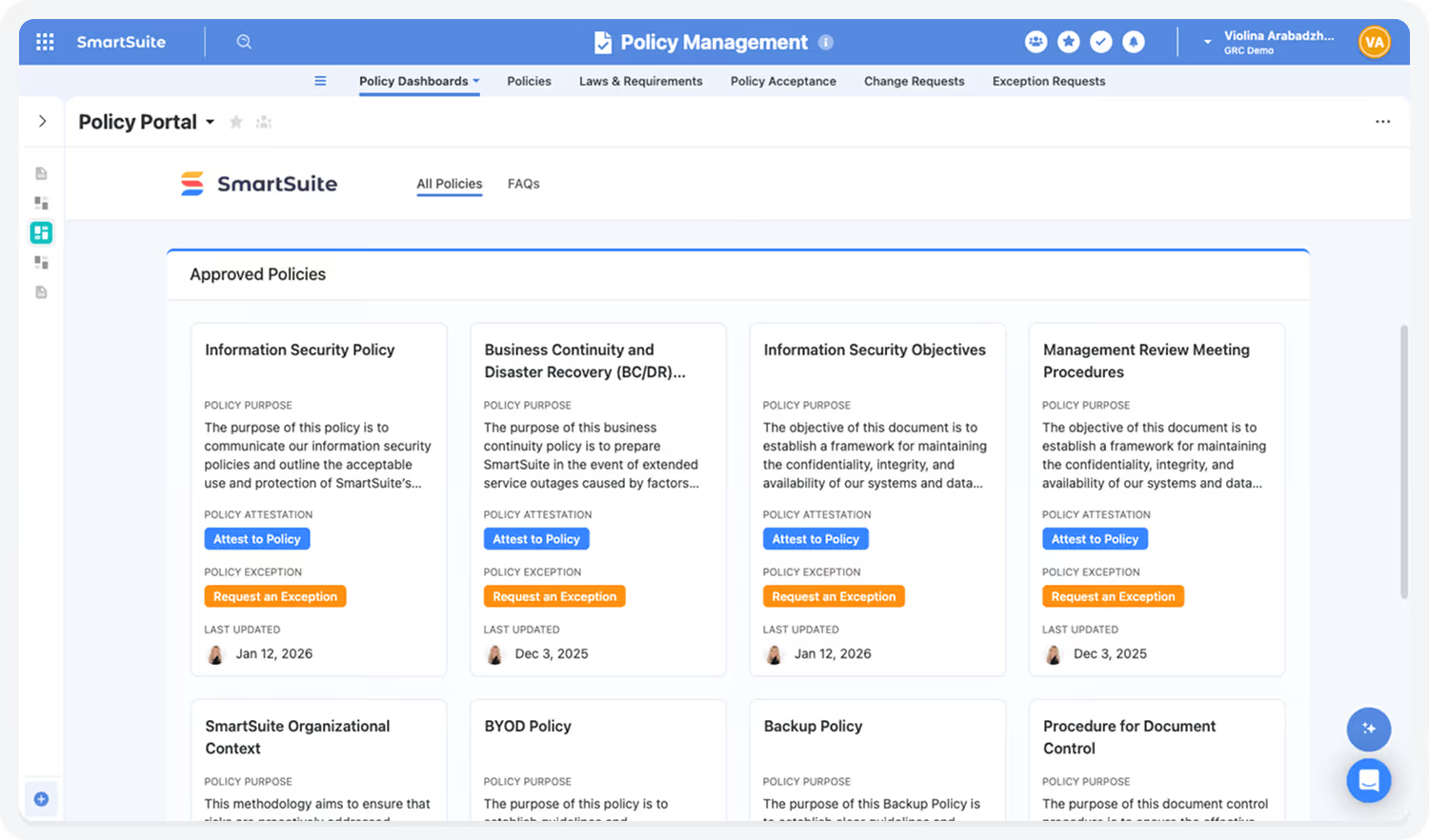
Testing results and remediation tasks stay attached to those same records, with any exceptions logged right beside them, so nothing drifts off into a forgotten tab.
Since your risks and vendors connect to the same data, scoping an audit and proving coverage no longer means exporting half a dozen spreadsheets and reconciling them by hand.
Because the dashboards read live data, leadership can check control status and audit readiness any day of the week, not just at quarter close.
The built-in AI takes the grind off the work too, whether that's compressing a sprawling vendor questionnaire into something readable or catching the spot where an incident report trails off without a resolution, and a person always signs off before any of it counts as a decision.
Here’s how SmartSuite’s compliance management solution works:
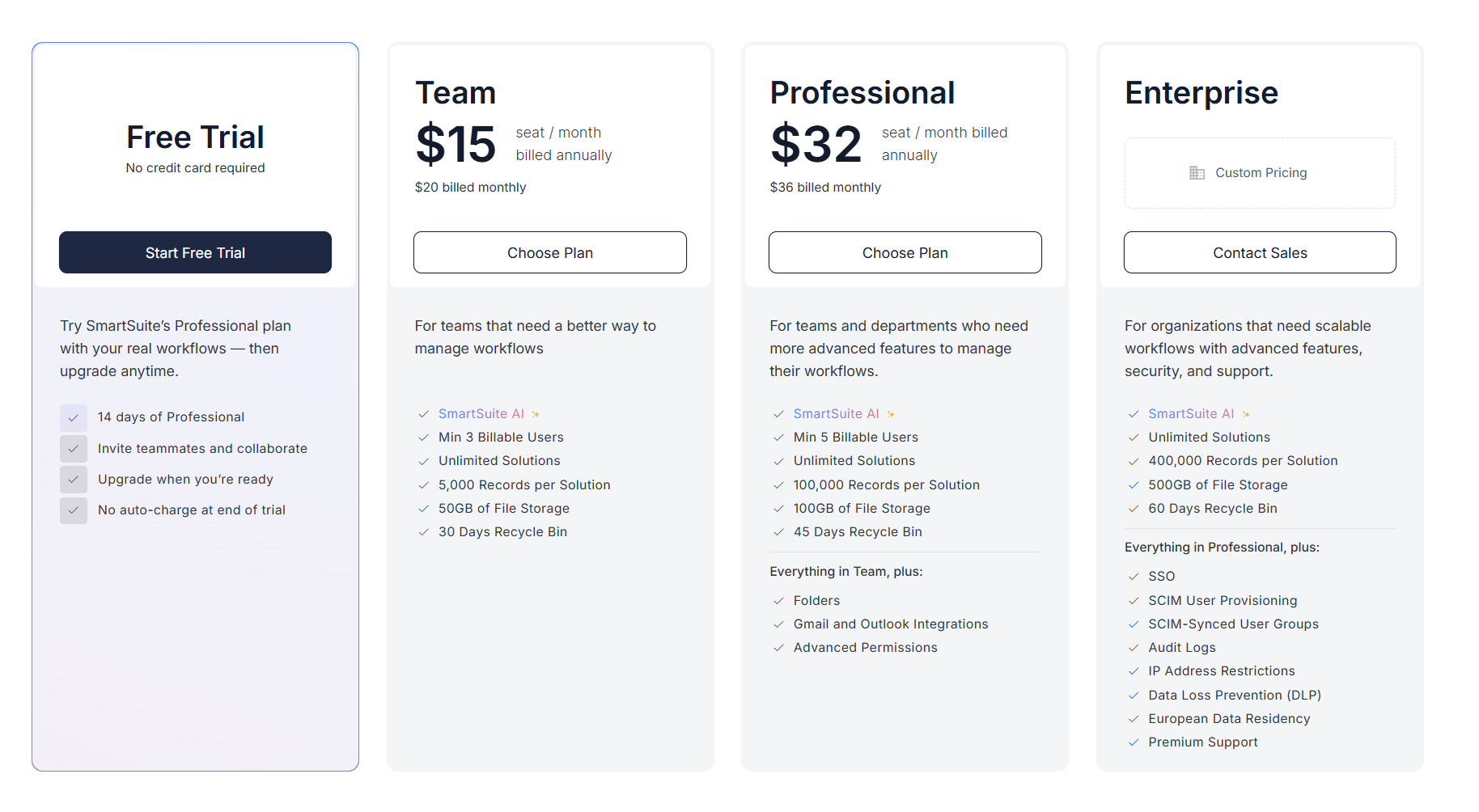
Pricing opens at $15/user/month on the Team plan, and there's a 14-day free trial with no card required.
Regulated enterprises can move to solution-based pricing, licensing only the modules they need and dividing access by department or regulatory scope.
Pick the SOC 2 tool that fits how your team actually works
Every tool here solves a slice of SOC 2, and the right pick depends on what you need the program to become:
- Vanta and Drata will get a first report across the line at impressive speed.
- Archer and MetricStream give big institutions enormous GRC capabilities, but can get expensive at scale.
- And a spreadsheet works right up until the morning it doesn't.
Most mid-market and regulated teams (banking, healthcare, insurance, fintech) land in the awkward middle, too big for a spreadsheet but unwilling to commit to a six-figure GRC project just to clear one audit.
SmartSuite was built for that exact middle.
It hands compliance leads a no-code workspace that keeps controls, evidence, risks, vendors, and audits in one connected place, wrapped in enterprise-grade permissions and audit logs, with AI that drafts and flags but never decides.
So your SOC 2 work stops being an island and starts trading data with the risk and operational programs it was always tied to.
If your current setup is starting to creak, spin up a free SmartSuite trial or book a demo and watch how it carries SOC 2 next to the rest of your GRC work.
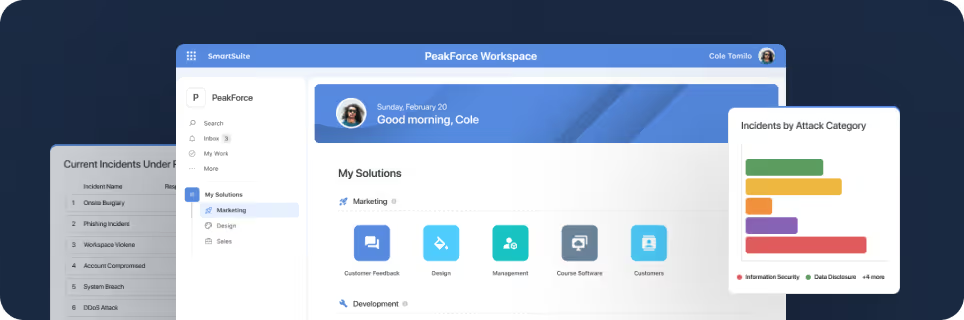
SmartSuite provides work platform for standardizing workflows in the following areas:
- Governance, Risk & Compliance
- IT & Service Ops
- Project / Portfolio Management
- Business Operations