
This guide breaks down what cyber risk management is and how to run a cyber risk assessment, plus the tools security and GRC teams use to keep it under control in 2026.
TL;DR
- Cyber risk management is the ongoing work of finding, scoring, treating, and monitoring threats to your information systems, and it's become a core piece of enterprise risk management.
- The process repeats: It isn't a one-time project. NIST frames it as a continuous cycle, because your IT systems and the threats against them both keep shifting.
- Compliance is a driver, not the destination: Frameworks like ISO 27001 and the NIST Cybersecurity Framework give you structure, and the evidence you generate doubles as proof for auditors and regulators.
- A risk assessment inventories your assets, surfaces threats and vulnerabilities, scores likelihood against impact, then sorts the results into a prioritized risk register you can act on.
- Tooling spans a wide range, from spreadsheets and vulnerability scanners to dedicated GRC platforms. SmartSuite takes the connected work platform approach, keeping cyber risk wired to its controls and the incidents around them.
What is cyber risk management?
Cyber risk management, sometimes called cybersecurity risk management, is how an organization sizes up the threats to its information systems and decides what to do about each one.
It's part of the wider governance, risk, and compliance (GRC) discipline, and one of the fastest-growing branches of enterprise risk management (ERM).
Almost every company now runs on technology, which means almost every company carries cyber risk.
That exposure comes from ransomware crews and phishing campaigns, sure.
But it also shows up as a misconfigured cloud bucket, a vendor breach two suppliers down the chain, an employee reusing a password, or a laptop left in the back of a cab.
You can't erase cyber risk. Nobody can.
What a program does is pull the likelihood and the damage down to a level your business is willing to live with, guided by frameworks like the NIST Cybersecurity Framework (NIST CSF) and ISO 27001.
The work never really stops.
What are the different types of cyber risk?
It helps to think about cyber risk in a few buckets, because each one calls for a slightly different response.
- Technical and infrastructure risk covers the systems themselves: unpatched servers, weak network segmentation, exposed APIs, and the vulnerabilities scanners flag every week.
- Third-party and supply-chain risk is everything you inherit from the vendors and outside software your business depends on. A breach at a SaaS provider quietly becomes your breach.
- Human and insider risk spans honest mistakes and deliberate misuse, from a clicked phishing link to an employee walking out the door with customer data.
- Compliance and regulatory risk is the exposure that comes from missing obligations like GDPR, HIPAA, PCI DSS, where the bill arrives as fines and lost trust on top of the breach itself.
There's also a split in how teams measure all of this.
Qualitative programs score risk on a simple scale, low to high, using expert judgment and a heat map.
Quantitative programs put a dollar figure on exposure, often with a model like FAIR (Factor Analysis of Information Risk), so leadership can weigh a control against the loss it prevents.
Most mid-market teams start qualitative and layer in quantitative scoring as the program matures.
What frameworks guide cyber risk management?
You don't have to invent a method from scratch.
A handful of frameworks already define the steps, and most teams blend two or three of them.
- NIST Cybersecurity Framework (CSF) organizes the work into core functions, govern, identify, protect, detect, respond, and recover, and it's become the common language for cyber programs across industries.
- NIST Risk Management Framework (RMF) is the more prescriptive cousin, built for federal systems, with formal steps for categorizing systems and authorizing them to operate.
- ISO 27001 is the international standard for an information security management system, and certification signals to customers and auditors that your controls are real.
- FAIR is less a control checklist and more a way to quantify risk in financial terms, handy when leadership wants dollars on the page, not colors on a heat map.
Pick the one your regulators or customers expect, then borrow from the others wherever they fill a gap.
Who is responsible for cyber risk management?
Ownership derails more cyber risk programs than any tool gap ever will.
I've watched teams buy a slick platform and still flounder, simply because nobody could say who owned a given risk when it mattered.
The short answer is that responsibility is shared, but it shouldn't be vague. Most mature programs map roles onto the three lines of defense model:
- The first line is your business and IT teams, the people who own the systems and carry the everyday risk.
- Behind them, the risk and compliance function sets policy and challenges what the first line decides.
- Internal audit forms the third line, checking independently that the whole thing holds up.
Above all of it, the chief information security officer (CISO) usually steers the program, while the board and senior executives set the risk appetite and answer for it to regulators.
The point I’m trying to make here isn't to pile on layers. It's to make sure that when a risk is accepted, a named person accepted it, and there's a record of why.
How to conduct a cyber risk management assessment?
A cyber risk assessment is the engine the whole program runs on.
Run it well, and everything downstream gets easier, from the control choices to the board report:
- Set the scope and inventory your assets: Decide which systems and data are in play, then list them and flag the ones you can't afford to lose. You can't protect what you've never written down.
- Identify threats and vulnerabilities: For each asset, work out what could go wrong and where the soft spots are.
A threat is whatever could cause harm, a ransomware operator or a careless click.
The vulnerability is the opening that lets it through, say an unpatched server or an access rule nobody's reviewed in a year.
- Estimate likelihood and impact: Judge how probable each scenario is and how badly it would hurt if it landed.
Pull from internal signals like your SIEM, then add outside threat intelligence and whatever's already burned comparable companies.
- Build and prioritize the risk register: Combine likelihood and impact into a score, then rank everything so the riskiest items float to the top.
This catalog, the risk register, is the deliverable the rest of the program runs on.
- Decide how to treat each risk: For every prioritized item, choose a response.
You can avoid the risk by retiring whatever creates it, reduce it with a control, transfer it through cyber insurance, or accept it when the fix costs more than the risk.
Whatever you pick, record the decision and the name behind it.
How often should you run a cyber risk assessment?
Once a year is the floor, not the answer. A full assessment on an annual cadence keeps you honest and satisfies most auditors.
But your systems and the threats against them shift far faster than that, so the sharper teams run lighter checks continuously and save the deep assessment for set triggers.
You want to re-assess when something material changes: a new system goes live, you acquire a company, a key vendor gets breached, or a regulator updates its rules.
Continuous monitoring covers the gaps between formal reviews, flagging fresh vulnerabilities and failed controls as they surface.
Treat the assessment as a living record. Last March's assessment is already out of date, however polished it looked at the time.
What kind of tools can you use for cyber risk management?
The tooling question usually comes down to a single decision: how connected you need everything to be.
The options run from point tools that each do one job well, up to platforms built to hold the whole program together:
Spreadsheets
Plenty of teams still run their cyber risk register in a spreadsheet.
It's cheap and familiar, and it turns quietly dangerous once the program outgrows a handful of entries, with no audit trail and nothing tying a risk to the control meant to cover it.
Vulnerability scanners
These find the technical weaknesses, the unpatched software and misconfigurations attackers go looking for.
They're essential. But a scanner only tells you what's broken, not which broken thing matters most to the business.
SIEM platforms
Security information and event management tools collect and correlate logs so suspicious activity surfaces fast.
Great for detection, but can be less useful for the risk scoring and treatment work, which happens elsewhere.
Cyber risk quantification tools
These translate exposure into money, usually with a model like FAIR.
When leadership wants the cost of a risk in dollars before signing off on a control, this is the kind of tool that gets you there.
GRC and integrated risk management platforms
Dedicated GRC and IRM platforms pull the threads together, mapping risks to controls and the frameworks behind them in one place.
Most large security teams shop in this category, and the established names handle deep, single-purpose compliance and risk work very well.
Connected work platforms like SmartSuite
Tools like SmartSuite (that’s us) come at cyber risk from a different angle: a connected work management platform, where your security program and the rest of your operations share one system.
Underneath, it's all one relational database, which is the part that matters for cyber risk.
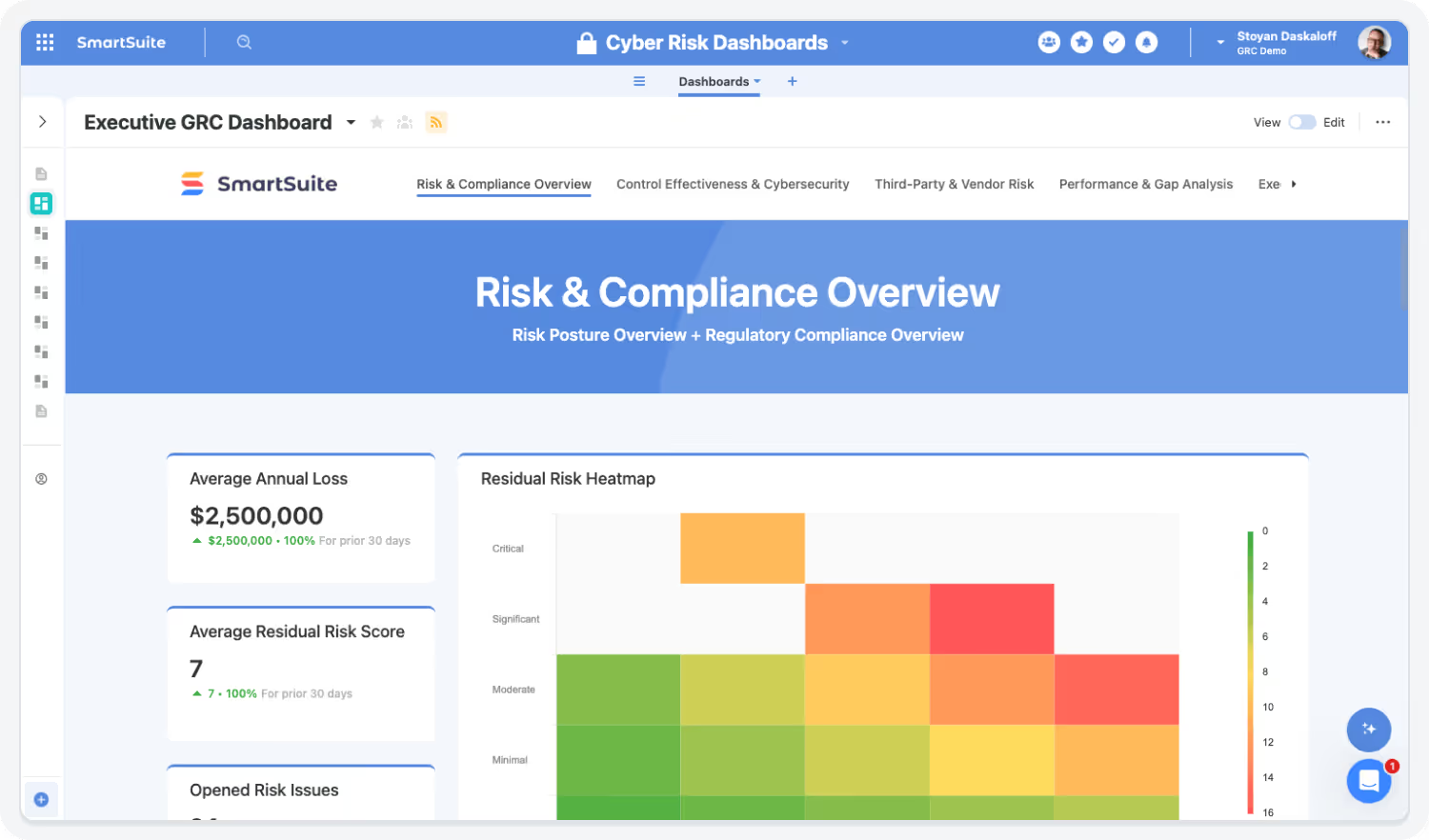
A single risk record connects to its controls, its open vulnerabilities, the incident that exposed it, and the remediation tasks assigned to close it out.
Pull up any risk, and you see the whole chain, not a static row in a sheet.
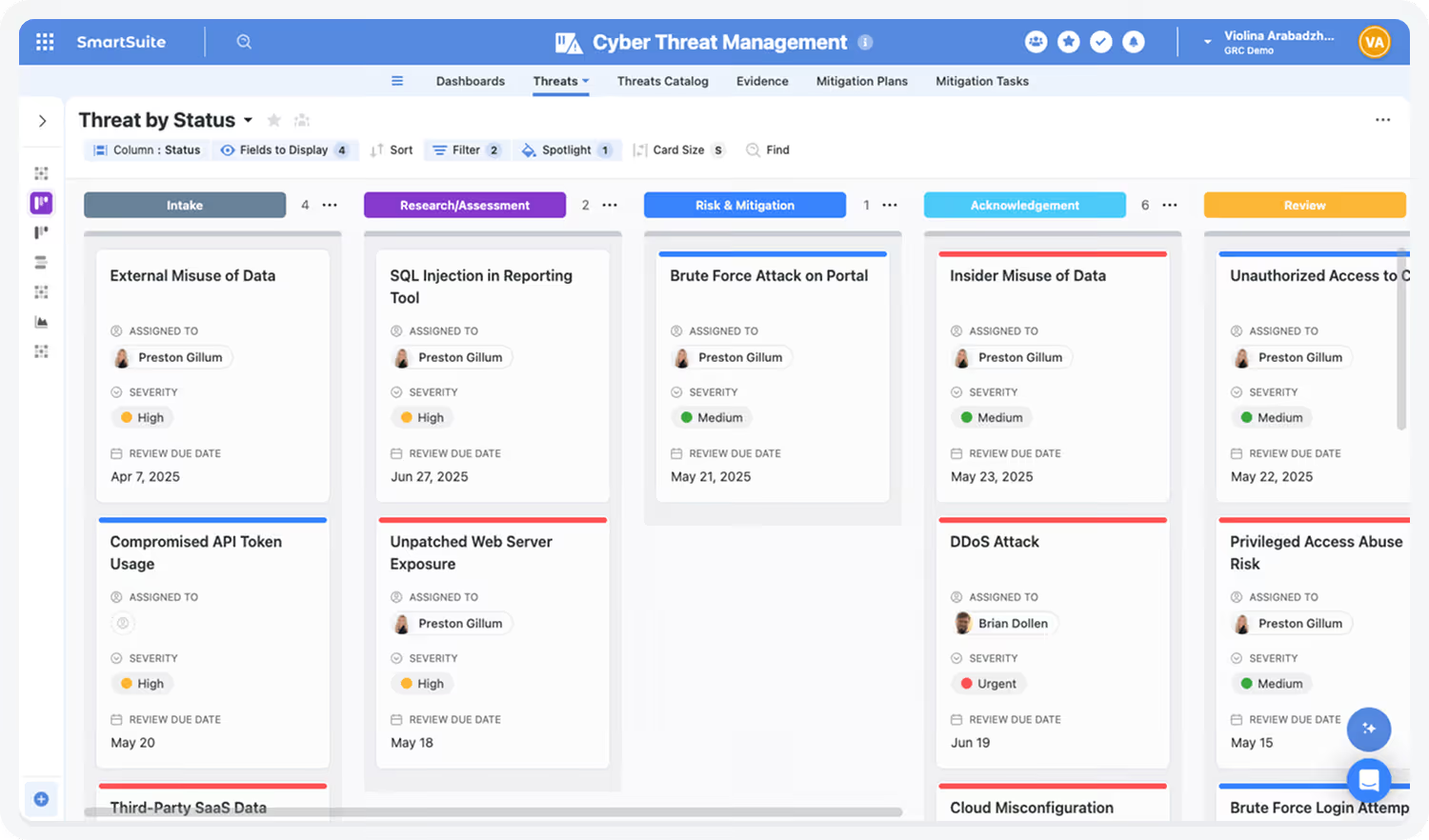
On the cyber and IT risk side, SmartSuite covers the pieces a real program needs:
- Cyber risk management gives you a centralized risk register where you score likelihood and impact, map controls, track mitigation plans, and report residual risk over time.
- Vulnerability management pulls findings in from your scanners, ranks them by business risk, assigns an owner, and tracks each fix through to verification.
- Incident response management runs the full playbook, from intake and severity through containment, notifications, evidence, and the after-action review.
- Policy and control management keeps policies and controls in one place, with ownership, testing schedules, exceptions, and the evidence auditors ask for.
- Asset and configuration management tracks what you own and how each asset connects to the services it supports and the risks attached to it.
- Compliance and framework mapping comes pre-mapped to standards like ISO 27001 and the NIST CSF, so controls and evidence link straight to the requirements they satisfy.
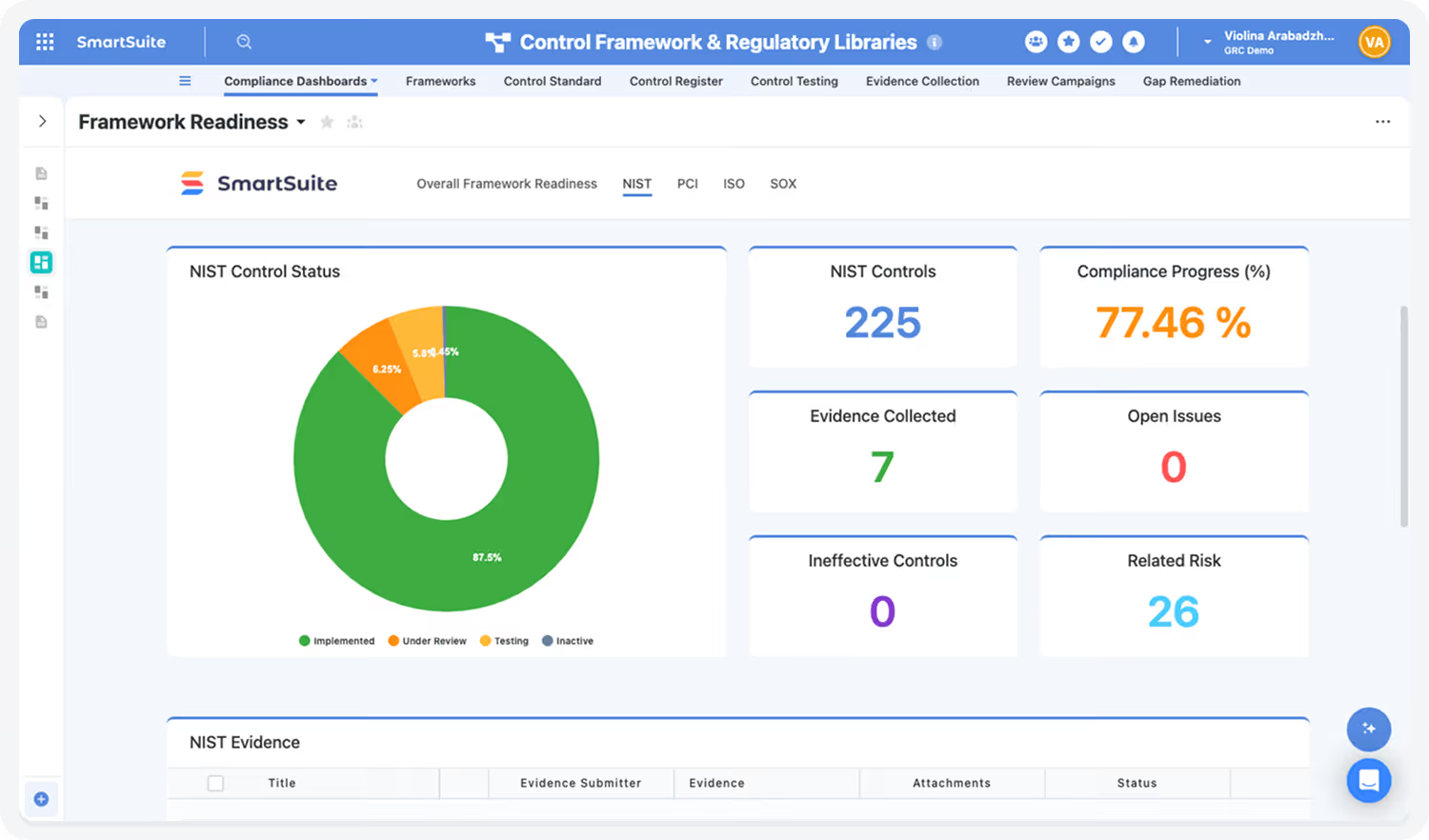
Real-time dashboards give security leaders a live read on threat posture, control coverage, open incidents, and remediation progress, with board-ready reporting on top.
Automation ties it together.
Triggers and multi-step rules can escalate an incident the moment it lands, or roll a single risk-score change across every linked control without anyone touching it by hand.
There's an AI layer too: SmartDoc AI drafts and summarizes incident reports and policies, and an AI Field Agent watches records for gaps and suggests updates like a revised risk score.
Here’s more about how SmartSuite works:
SmartSuite also carries the certifications a security buyer checks for: SOC 2 Type II, ISO 27001, HIPAA, and GDPR, and in 2025, we partnered with the Cyber Risk Institute and integrated X-Analytics for financial cyber risk quantification.
Putting cyber risk management to work
Cyber risk management isn't a tool you buy once and forget.
It's a habit. You re-run the assessment as the threats shift, and you keep the register and the controls honest in between.
The frameworks hand you the method. The tooling decides how much friction you fight along the way.
If you'd sooner keep your cyber risk program connected to your real work than buried in a spreadsheet nobody trusts, SmartSuite is worth a look.
You can start free or book a demo to see the cyber risk register and dashboards in action.
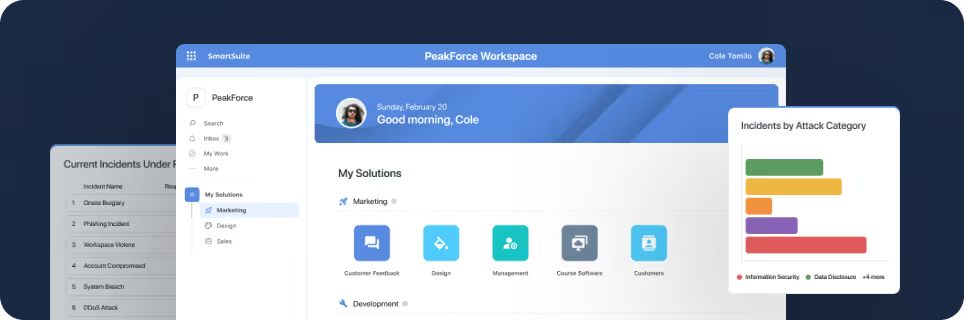
SmartSuite provides work platform for standardizing workflows in the following areas:
- Governance, Risk & Compliance
- IT & Service Ops
- Project / Portfolio Management
- Business Operations