
In this guide, I'll cover what ERM actually is, why it matters more in 2026 than it did a few years ago, the frameworks worth knowing, and the kinds of tools real ERM programs run on.
TL;DR
- Enterprise risk management is enterprise-wide. It's the connective tissue between strategic, operational, financial, cyber, and compliance risk, not a parallel program to any one of them.
- In terms of ERM frameworks, serious programs blend COSO ERM, ISO 31000, NIST RMF, and FAIR, as each of them serves a different purpose.
- As for enterprise risk management software: spreadsheets work at a small scale, and enterprise GRC suites carry six-figure price tags, but connected work management platforms like SmartSuite can fill the gap for teams growing past a register.
What is enterprise risk management?
Enterprise risk management (ERM) is the discipline of identifying, assessing, responding to, and continuously monitoring risks at an organization-wide level, with every risk in the register tied to a strategic objective.
Plain risk management can mean one team handling one type of risk: cyber risk in the security team, credit risk in finance, vendor risk in procurement.
ERM goes a layer higher.
It pulls those domain-specific views into a single risk register, applies consistent scoring across them, and gives leadership one place to see where the business is exposed and where it isn't.
A working ERM program covers a few moving parts:
- Risk register: a live source of truth for every material risk the company has identified, scored, and assigned.
- Risk appetite and tolerance: an explicit statement of how much risk the business is willing to carry by category, set by leadership and signed off by the board.
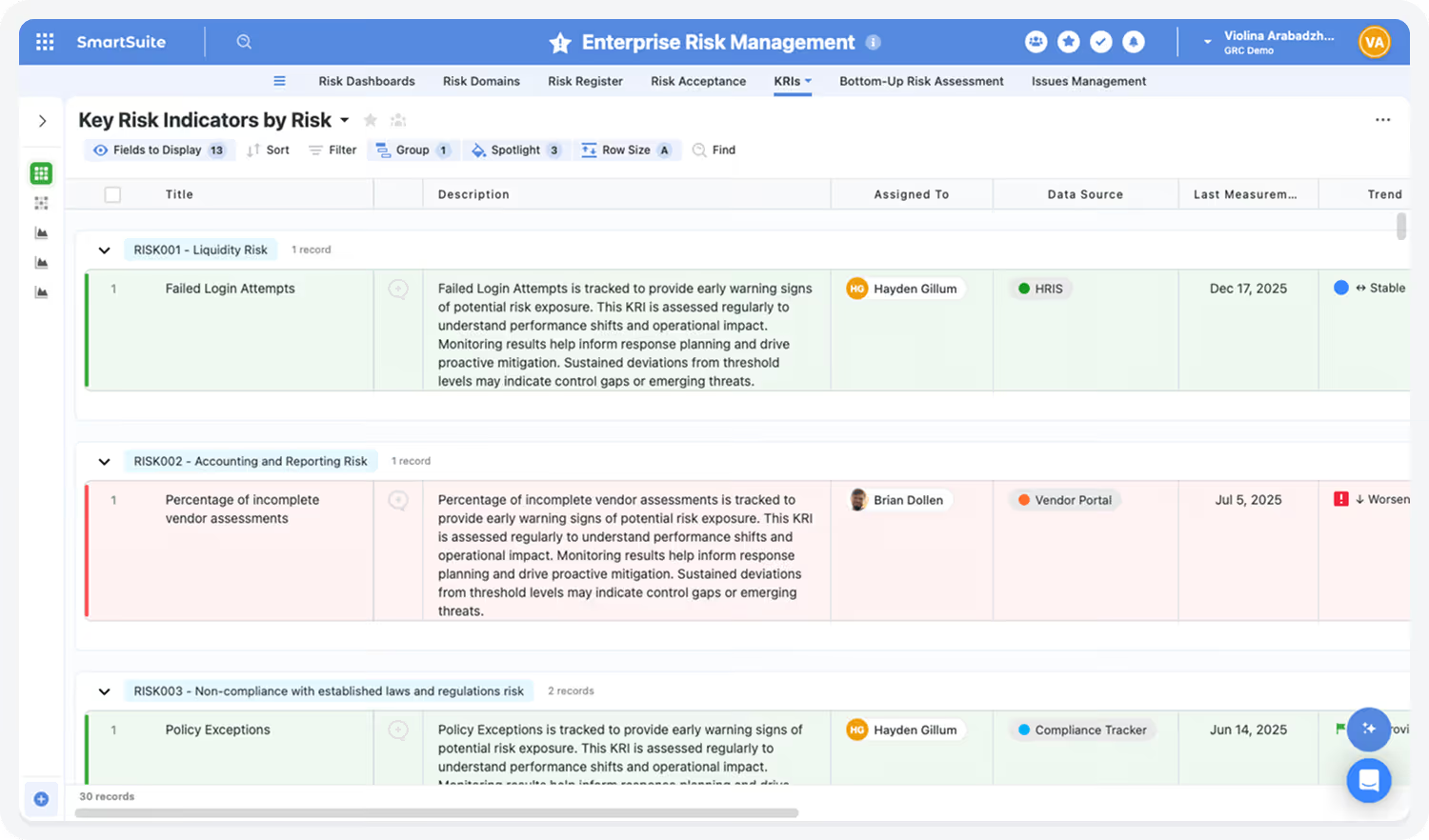
- Key risk indicators (KRIs): metrics with thresholds that flag when a risk is heading the wrong direction.
- Risk treatments and controls: what the company is doing about each risk, who owns it, and what evidence proves it's working.
Without all four working together, what you've got isn't really enterprise risk management. It's a more organized list of things to worry about.
Why is enterprise risk management important?
ERM matters more in 2026 than it did even two years ago, and the reasons are less theoretical than they used to be.
A few specific shifts have made the case for everyone:
The Digital Operational Resilience Act (DORA) became enforceable for EU financial entities in January 2025, and it explicitly requires risk frameworks that connect ICT risk to business resilience.
The EU AI Act phased in obligations through 2025 and 2026, adding a category of risk that didn't exist in most registers three years ago.
And boards have started asking for explicit risk appetite statements before approving strategy, not after the fact.
ERM stopped being a back-office function.
It became a board-level conversation with documentation requirements attached.
➡️ Companies whose ERM programs were already mature when these rules landed spent 2025 making small adjustments. The ones who weren't spent it rebuilding under deadline pressure, which is a much worse place to be writing a risk appetite statement.
What are the benefits of enterprise risk management?
A working ERM program pays back in ways that don't show up on a single line item.
The clear benefits include:
- Sharper decisions at the top: the board and executive team weigh strategic moves against a real picture of exposure, not gut feel.
- Fewer expensive surprises: KRIs catch slow-burning problems (a vendor's deteriorating financials, a control quietly failing month over month) before they become incidents.
- Audit and regulator readiness: When a regulator or auditor asks for evidence of how the company manages enterprise risk, the answer takes hours, not weeks.
- Lower cost of capital: Insurers, lenders, rating agencies, and, increasingly, enterprise customers look at ERM maturity when pricing you. Mature programs can get better terms.
- Strategic agility: Teams that know which risks they'll tolerate can move faster on opportunities that fall inside that envelope.
How can you approach Enterprise Risk Management?
There's no single right way to run an ERM program, but the ones that actually work share a few habits.
Start with risk appetite, not the register
Most teams jump straight into listing risks, and that's understandable: it feels like progress, and listing things is satisfying.
But until leadership has decided how much risk the business is willing to accept by category, every risk in the register is floating without context.
A risk scored "high" doesn't mean much when nobody's said whether "high" is tolerable in that category.
Get the appetite statements written first, signed by the board, and revisited every year.
Push ownership into the business
The risk team doesn't own risks. It owns the framework, the methodology, and the reporting cadence.
Risks themselves get owned by the executive whose function the risk comes from.
If your CFO doesn't own credit risk and your CISO doesn't own cyber risk, you don't have ERM. You have a centralized worry list with the risk team's name on it.
Use the Three Lines Model properly
- First line: business units that own the risks they create.
- Second line: risk and compliance functions that set policy, oversee, and challenge.
- Third line: internal audit, providing independent assurance.
The programs that struggle have usually collapsed the lines (risk team doing audit work) or skipped one entirely (business units treating risk as someone else's job).
It's the one ERM concept that's older than most current GRC software and still completely valid.
Pick a scoring philosophy early
Qualitative scoring (high, medium, low with narrative) is faster to set up and easier for non-quants to engage with.
Quantitative methods like FAIR for cyber and Monte Carlo simulation for operational risk give sharper answers and pair better with board reporting
Most mature programs end up doing both: qualitative for the long tail, quantitative for the top 10 to 20 risks the board actually wants numbers on.
What are the common Enterprise Risk Management pitfalls?
Most ERM programs don't fail outright. They underperform quietly, and the same handful of patterns show up across industries:
The register-driven program
A team builds a perfectly formatted risk register, refreshes it on a calendar, and otherwise lets it sit.
The register exists. Nothing in the business changes because of it.
If you can't point to three or four decisions in the past year that shifted because of what was in the risk register, the register isn't doing work for you.
Risk owned by the risk team
When the second line (risk and compliance) gets pushed into the role of risk owner because the first line (business units) won't take it, the program develops a structural problem.
The risk team becomes a bottleneck and an easy scapegoat.
Business units stop engaging with risk thinking because it's been outsourced.
This is one of the most-documented failure modes in COSO and IIA literature, and the fix is structural, not procedural.
Risk appetite that exists on paper only
A lot of organizations have a risk appetite statement somewhere in a SharePoint folder.
Far fewer have one that gets cited in actual investment committee meetings, M&A pipelines, or product launch reviews.
An appetite statement that doesn't shape decisions is a compliance artifact, not a governance tool.
The annual refresh trap
ERM done once a year can't keep up with operational reality.
Threats shift, vendors fail, regulations land, controls degrade.
A program that only looks at itself in October to prepare for a December board meeting is a snapshot, not a system.
Disconnect between risk and strategy
In a lot of programs, the risk function reports through internal audit and almost never connects with strategic planning.
When risk and strategy don't share a meeting, the strategic plan gets built without a clear view of what the business is willing to absorb, and the risk register gets built without a clear view of what the strategy needs to protect.
Most of these are fixable with operating model changes, and not really with new tools.
The right tooling makes the fixes easier to sustain, but it can't substitute for the underlying structural work.
What are the different enterprise risk management frameworks?
No serious ERM program runs on one framework.
The mature teams I've watched pick a primary, then borrow from two or three others where the primary is thin.
It helps to think about frameworks in three buckets: the strategy-tied ones, the cyber-leaning ones, and the quantification ones, plus one integration model that doesn't fit neatly into any of them.
The strategy-tied frameworks: COSO ERM and ISO 31000
COSO ERM is what most US public companies anchor to. Its 2017 update repositioned ERM as a strategic discipline tied directly to performance, which is the version most boards now expect.
If your audit committee already speaks COSO, build the program around it.
ISO 31000 takes the opposite approach. It gives you principles you adapt, not a checklist you follow.
The 2018 revision kept it light on prescription and heavy on adaptability, which works well for international operations, private companies, and any team that needs to map onto multiple regional standards at once. European and Asian programs lean on it more than US ones do.
You don't have to pick one. Plenty of teams use ISO 31000 as their operating spine and produce COSO-aligned outputs for board reporting.
The cyber-leaning frameworks: NIST RMF and the CRI Profile
There are two NIST frameworks worth knowing here, and they get conflated all the time.
NIST RMF (the Risk Management Framework, SP 800-37) is the structured authorization process most US federal contractors run on. If your environment touches FISMA, CMMC, or FedRAMP, you'll need RMF in the mix.
NIST CSF (the Cybersecurity Framework) is a voluntary one, used widely outside federal work.
Its 2024 update, CSF 2.0, added a "Govern" function that pulled it closer to enterprise-wide use and made it the more common reference point for private-sector cyber risk programs.
The CRI Profile is worth knowing in financial services specifically.
It maps cyber obligations across NIST CSF, FFIEC, DORA, and MAS TRM into one unified control set, which saves a meaningful amount of duplicated work for banks operating across more than one regulatory regime.
Learn more about how SmartSuite works for CRI compliance:
The quantification framework: FAIR
FAIR doesn't replace COSO or ISO. It plugs into them when leadership wants cyber exposure stated in actual dollars.
As boards push harder on financialized risk reporting, FAIR has moved from niche to mainstream, and the FAIR-CAM control assessment model made it easier to connect specific controls to dollar-loss reductions.
The integration model: OCEG GRC Capability Model (Red Book)
OCEG treats governance, risk, and compliance as one connected operating model where the three functions share data, workflows, and reporting infrastructure.
It's less a framework and more a blueprint for integration, useful when the goal is breaking down silos between the three.
What kind of tools can you use for Enterprise Risk Management?
ERM tooling falls into five categories, and which one fits depends on program maturity, scope, and budget.
- Spreadsheets and shared docs: Excel, Google Sheets, Confluence, and Notion.
These can be fine for small programs run by one person, but they are most likely going to break the moment you need cross-team visibility, audit trails, or live data feeding KRIs.
- Enterprise GRC suites: Tools here include Archer, MetricStream, IBM OpenPages, and SAP GRC.
They were built for large, deeply regulated organizations with the budgets and timelines to absorb long implementations.
- Integrated risk management (IRM) platforms, such as LogicGate, Riskonnect, Protecht, and Optro (formerly AuditBoard).
It’s a newer category that focuses on configurability, no-code workflows, real-time dashboards, and built-in risk quantification
- Connected work management platforms: SmartSuite and a handful of similar no-code systems that bring ERM workflows into the same workspace as the rest of operations.
The category attracts risk teams in mid-market companies and growing enterprises that have realized the artificial separation between "GRC tooling" and "operations tooling" is the main reason their risk data feels dead between board meetings.
➡️ SmartSuite approaches ERM from a different angle than the categories above.
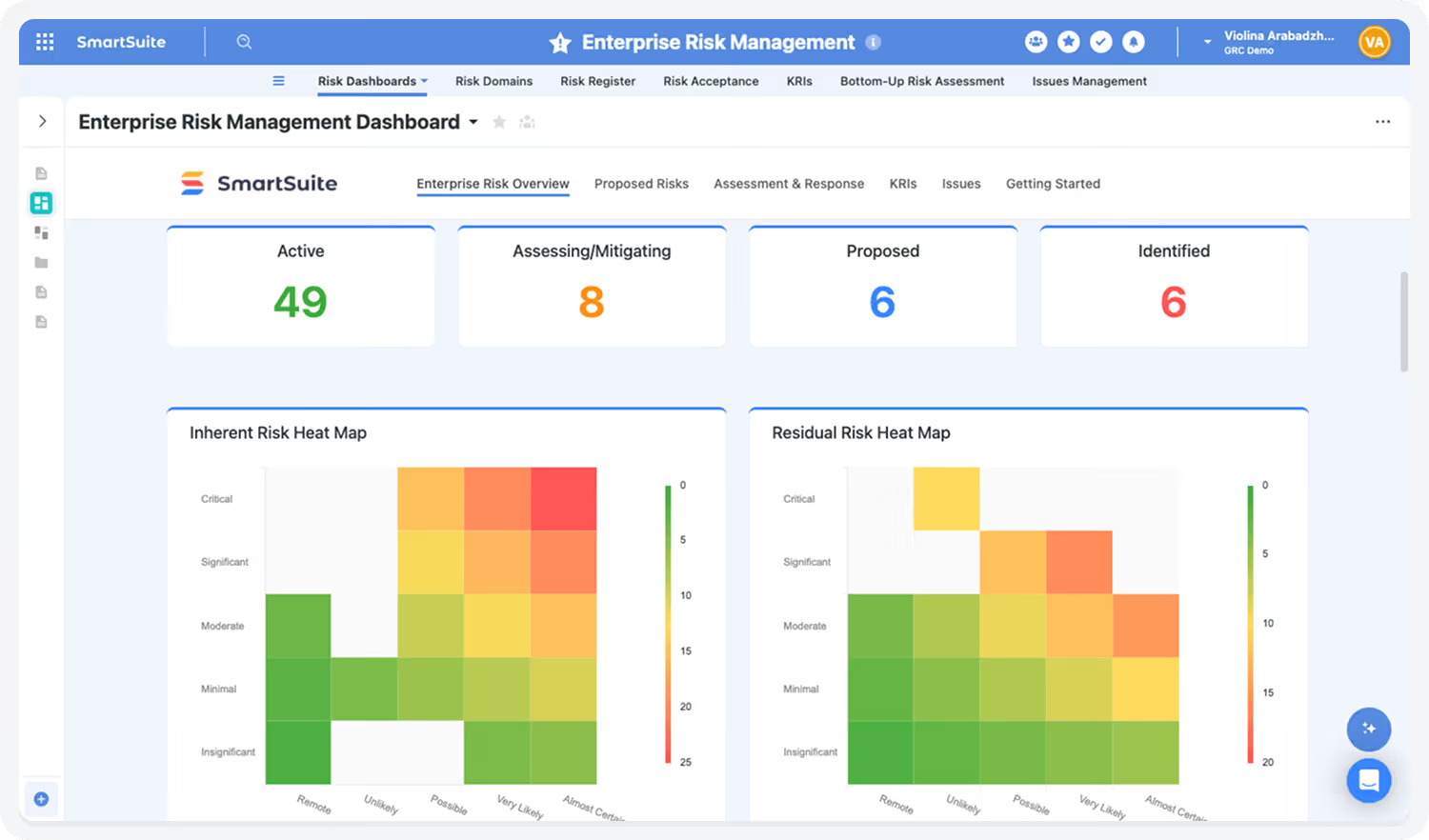
ERM operations share a workspace with the rest of the business: your risk register, KRIs, RCSA workflows, mitigation plans, and audit work run side-by-side with project management, vendor operations, and incident response in the same system.
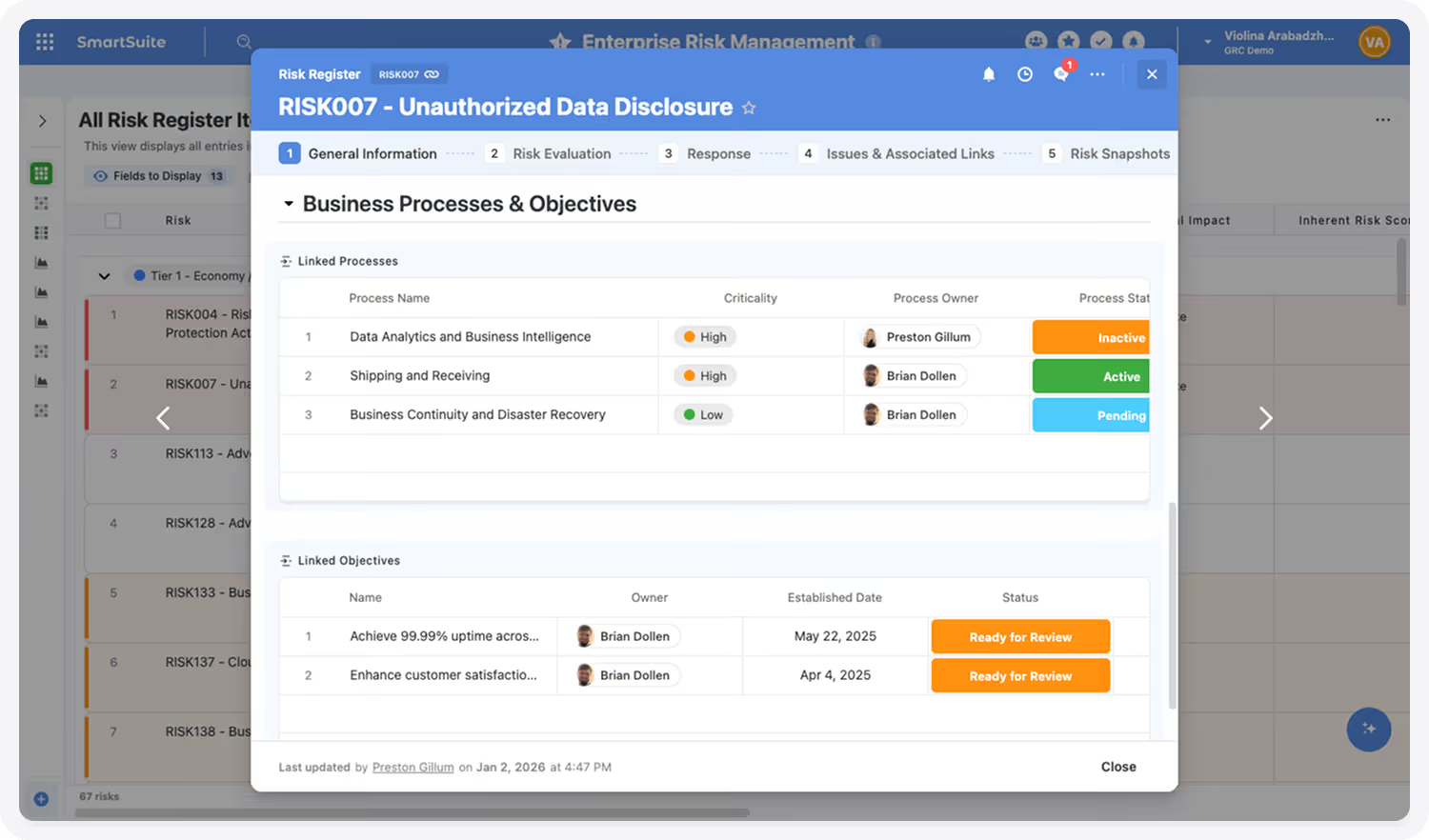
A control issue raised in an audit can link directly to the risk it relates to, the owner who needs to act, and the policy that governs it, with no copying between systems.
See SmartSuite in action:
The risk taxonomy and scoring models come pre-configured for COSO ERM, ISO 31000, NIST RMF, and the CRI Profile, and because the architecture is no-code, your team can adjust scoring, add categories, or build new workflows without engineering tickets.
A dedicated RCSA module lets business unit owners run their own assessments using the same taxonomies as the central register, which keeps decentralized work from fragmenting the scoring model.
Automation covers the operational drag (KRI breach alerts, control test reminders, appetite escalations, vendor reassessments), and SmartSuite AI handles the slow human work: summarizing third-party questionnaires, drafting policy revisions, and pattern-matching across incident reports.
SmartSuite’s pricing starts at $15/user/month on the Team plan, with solution-based licensing for regulated enterprises that need access controlled by department, region, or regulatory regime.
Picking the right ERM platform for your program
The right tool comes down to three things: how mature your ERM program is, how much budget you've got, and how connected risk needs to be to the rest of the business.
A few honest guidelines:
- If your program is one analyst with a spreadsheet that gets you to the next board meeting, don't overbuy. Excel or Google Sheets will do the job. The pain shows up later, and that's when you can upgrade.
- If you're a publicly-traded financial services firm with hundreds of controls and a multi-quarter implementation budget, Archer, MetricStream, and IBM OpenPages were built for that scale.
- If you're somewhere in the middle (an ERM program that's outgrown spreadsheets, an IT and compliance team that needs to share data with operations, regulatory exposure growing faster than the team can hire for it), SmartSuite is the option worth evaluating closely.
It gives you a connected workspace where ERM, third-party risk, internal audit, incidents, policies, and operational resilience operate as a single system, configured by your team and priced so a 25-person GRC function can adopt it without months of procurement back-and-forth.
➡️ Try SmartSuite for free, or book a demo to see how it handles your specific risk and compliance stack.
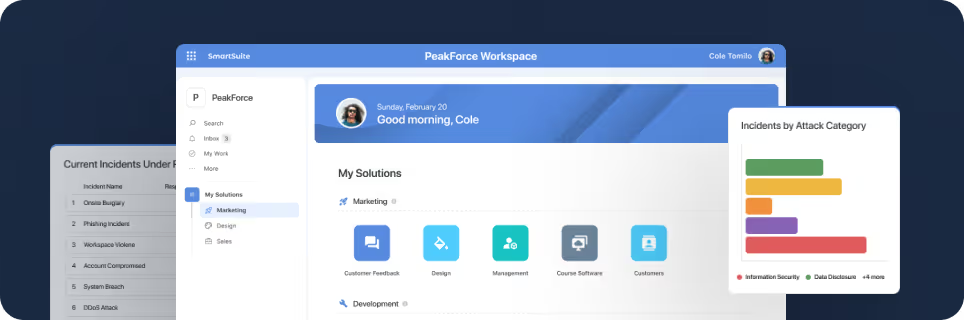
SmartSuite provides work platform for standardizing workflows in the following areas:
- Governance, Risk & Compliance
- IT & Service Ops
- Project / Portfolio Management
- Business Operations