



Operationalizing AI governance: what KPMG and SmartSuite showed
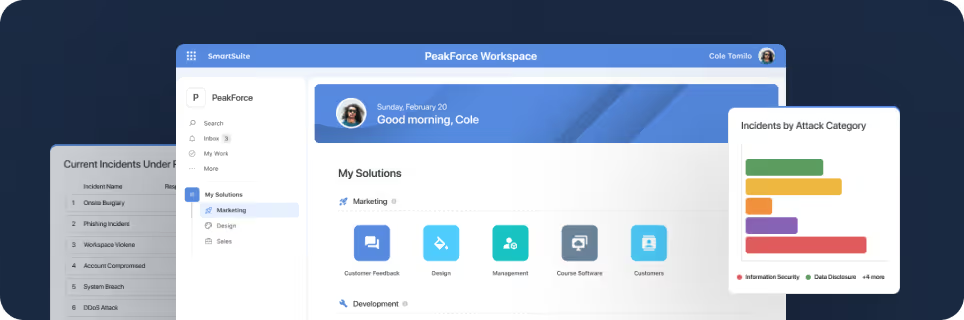
SmartSuite provides work platform for standardizing workflows in the following areas:
- Governance, Risk & Compliance
- IT & Service Ops
- Project / Portfolio Management
- Business Operations

KPMG and SmartSuite showed AI governance as a working workflow: intake, assessment aligned to NIST AI RMF, ISO/IEC 42001 and CRI, risk-based review, approval and runtime monitoring.
- A governance framework on paper and governance in technology are different things; AI's pace of change makes the gap costly.
- Start by giving the business a channel to apply for AI use. Intake creates the inventory and makes business owners share the risk.
- Assessment questions can be derived from KPMG Trusted AI, NIST AI RMF, ISO/IEC 42001 and CRI, then tuned to your own risk appetite.
- Governance should not stifle innovation: automated assessment and risk-based routing move the process, in KPMG's words, from months to potentially days.
- Governance does not end at approval: runtime alerts from AI security tools can fail controls, open incidents and notify owners automatically.
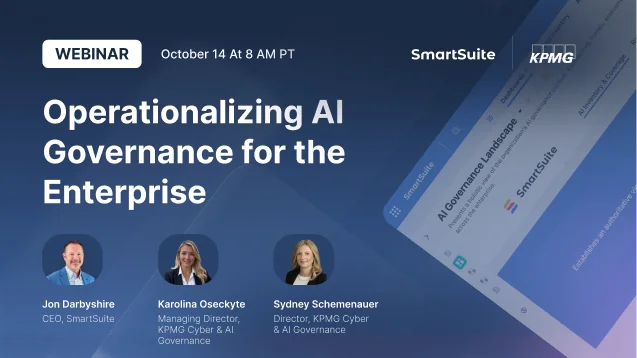
On 14 Oct 2026, KPMG's cyber and AI governance team joined SmartSuite to show KPMG's Trusted AI methodology running as a live workflow, from the moment a business team asks to use AI through assessment, review, approval and runtime monitoring. Here is what was shown, what is worth borrowing and what the audience asked.
Why does AI governance on paper fail?
Karolina Oseckyte, Managing Director at KPMG, opened with the line that framed the hour: "having a governance framework on paper and governing in technology are two different things." Her argument was about pace. Models change daily, agents gain new capabilities, and the risk landscape moves faster than the periodic assessments and static policies that traditional governance was designed around.
Sydney Schemenauer, Director at KPMG, made the same point from the business side. The question she hears most from clients is how to make sure governance does not stifle innovation: "If we have governance right now taking a month to get through, there's probably a new model at the end of that month that we'd rather be using than when we started this governance process." The other question she hears first is simpler and harder: governance teams do not know where AI is already in use.
Tara Darbyshire, SmartSuite co-founder and EVP of Strategic Accounts, described the fit plainly: KPMG has the methodology and SmartSuite has the platform.
What does the workflow look like end to end?
Preston Gillum, GRC Product Manager at SmartSuite, demonstrated the Trusted AI Governance solution the two teams built together. The sequence, in the order it was shown:
- Intake. A business user submits an AI use case through a form (or by email or the API), with the attributes KPMG recommends capturing: review type, intake source, ROI and value category. The submission creates a record on a triage dashboard.
- Case to system. The new case is linked to AI systems and models already in the inventory. Most requests build on an existing platform or model, so the link shows what has already been assessed and what is new, so work is not duplicated.
- Framework-aligned assessment. The questions were derived from KPMG's Trusted AI framework and aligned to NIST AI RMF, ISO/IEC 42001 and the CRI AI Risk Management Framework. Each framework reduces to pillars (accountability, privacy, security, reliability, fairness, explainability, transparency and safety), each pillar produces questions, and each answer carries a weight. Formulas roll the weights up into inherent risk ratings per pillar, and the scoring is tuned to each organization's risk appetite. An AI Field Agent, running on the customer's own model, summarizes the ratings and rewrites the summary when answers change.
- Controls. Automation pulls in the controls mapped to the pillars the assessment triggered. Controls map many-to-many to pillars, risks and the CRI Profile, and a second field agent states whether the controls in place address the risk.
- Risk-based review. Security, privacy, legal and model risk reviewers are notified by email, Slack or Teams and can override ratings and leave notes. Branching logic decides who is needed: a low security rating might take a self-attestation, while a moderate or high one calls security in.
- Approval. The AI committee sees the overall rating, residual ratings compared with inherent ones, and any findings logged along the way. Findings carry their own workflow to remediate or accept.
- Inventory. Each approved case becomes an AI system record: intended and prohibited use, regulatory attributes, assessments, a scorecard, and the incidents, findings and alerts related to it. Dashboards show lifecycle phase, open findings by severity and the highest-tiered systems.
- Runtime monitoring. Sydney showed alerts from a runtime AI security tool (CrowdStrike AIDR in the demo) arriving by API. A detected prompt injection fails the prompt-injection control on the affected system, opens an incident and notifies the control owner. "We need guardrails at runtime," she said.
- Automations. Every step runs on triggers and actions: create the assessment when a case reaches that phase, notify reviewers, ingest alerts. A scheduled AI Workflow Agent reads incidents, findings and alerts and writes up themes, such as data leakage or third-party involvement, as structured records.
Tara's summary of the shift: "This is not a static risk assessment anymore." New incidents or negative news change the rating of the model in the inventory, which is what she means by GRC moving from a system of record to a system of orchestration.
Three ideas worth stealing
Make the business apply to use AI. Tara's observation is that shadow AI persists because people have nowhere to ask. An intake channel turns a compliance exercise into a shared one: the business unit that applies also understands and shares the risk, and the inventory builds itself from the requests.
Route reviews by risk, not by habit. Security, privacy and legal should not review every request. Let the inherent rating decide who is needed and let low-risk cases self-attest. Preston's version: "if you don't need to bug people, then don't bug people." KPMG's estimate is that automated assessment and routing takes the process "from months to potentially days."
Wire runtime alerts to controls. The demo's most concrete moment was an alert failing a control on its own and opening an incident for the owner. Sydney's experience explains why it matters: organizations that approved AI without the data later made the wrong risk decision, pulled the solution offline and left the business unhappy.
What did the audience ask?
Can the rating be quantitative instead of low, moderate, high? Yes. The qualitative rating is an overlay on a numeric score that already exists in the background, and the number can be displayed instead. Karolina added that risk quantification approaches such as FAIR can be connected and folded into the workflow.
Can context drift feed continuous monitoring? Drift is detected by the runtime AI security tool of choice, with the sensitivity set there; the alert arrives the same way as a malicious-entity alert and fails the drift control. Tara added that webhooks can bring alerts in at a threshold for critical systems or in batches for lower tiers, so the risk team sees the picture without waiting on the SOC.
Where do the pre-populated controls come from? They are KPMG's Trusted AI framework controls, built using the CRI framework, NIST AI RMF and ISO/IEC 42001, mapped to pillars and to the assessment questions. Karolina said KPMG is not married to any framework: the set is industry-agnostic, and the Cyber CRI Profile has been added for financial services clients.
What do organizations struggle to sustain after go-live? Sydney named three things: governance kept in PowerPoint and Excel, which does not scale; looping in privacy, security and legal without slow manual hand-offs; and implementing the controls once they have been defined and assigned owners.
Watch the recording
Watch the full session, including the demo and the Q&A, on the Operationalizing AI Governance for the Enterprise webinar page.
To see how AI governance runs alongside risk, compliance and audit in one platform, see AI governance in SmartSuite GRC.
Speakers: Karolina Oseckyte, Managing Director, KPMG; Sydney Schemenauer, Director, KPMG; Tara Darbyshire, Co-founder and EVP of Strategic Accounts, SmartSuite; Preston Gillum, GRC Product Manager, SmartSuite; Jon Darbyshire, CEO, SmartSuite (introductions).




Put these ideas to work
Start a free trial, or book a demo and see how it runs in SmartSuite.

