
This guide breaks down what vulnerability management is, how it connects to your governance, risk, and compliance (GRC) program, and how to run an assessment that survives an audit.
TL;DR
- Vulnerability management is a continuous loop, not a once-a-year scan. You hunt for weaknesses, judge how risky each one is, fix or contain it, then confirm the fix and run the cycle again.
- It's a GRC discipline, not just an IT chore, because agencies like CISA, frameworks like the NIST CSF and ISO 27001, and SOC 2 auditors all expect documented evidence that you find and close gaps on a schedule.
- Prioritization is the hard part, since no team can patch everything, so scoring signals like CVSS severity and the CISA KEV catalog help you fix what attackers actually exploit first.
- The right tooling connects scanner output to risk and accountability, and that's where a connected GRC platform like SmartSuite helps by turning raw CVE findings into owned, tracked remediation work.
What is vulnerability management?
Vulnerability management is the ongoing practice of finding security weaknesses in your systems, ranking them by risk, fixing or mitigating them, and confirming the fix actually worked.
It runs as a loop, not a project with an end date.
Each pass through it looks roughly the same.
You find what's exposed, work out how dangerous each finding really is, fix or contain it, then circle back to confirm the fix held before starting over.
A weakness might be an unpatched server, a misconfigured cloud bucket, an open port that shouldn't be open, or a known flaw in a third-party library your application depends on.
Each one picks up a Common Vulnerabilities and Exposures (CVE) identifier when it's publicly disclosed, plus a Common Vulnerability Scoring System (CVSS) score that rates its technical severity.
I’ve noticed that one thing trips people up constantly: vulnerability management is not the same as a vulnerability assessment.
An assessment is a point-in-time snapshot, a single scan that tells you what's broken right now.
Management is the wider program that decides what to do about those findings, assigns owners, tracks the work, and proves it got done.
You need both, but they're different things, and auditors care a lot about the difference.
What are the different types of Vulnerability Management?
Teams usually split the work by where the weaknesses actually live, because each environment calls for different tools and different expertise.
Here are the main categories you'll deal with:
- Network and infrastructure: Scanning servers, firewalls, routers, and other devices for missing patches, exposed services, weak credentials, and risky configurations. This is the oldest, most familiar form of the practice.
- Application and web: Testing custom software and public-facing web applications for flaws like injection, broken access controls, and the rest of the OWASP Top 10. Both dynamic and static analysis play a part.
- Cloud and container: Checking cloud configurations, identity permissions, and container images for exposures. Misconfiguration causes far more cloud incidents than exotic exploits do.
- Third-party and software supply chain: Using software composition analysis and a software bill of materials (SBOM) to catch known flaws in open-source components you didn't write but still ship to customers.
Plenty of teams add a fifth bucket for endpoints and mobile devices, which matters more now that work happens from everywhere.
The point isn't to memorize the list.
It's that a credible program has to cover all of these, because an attacker will happily find whichever one you decided to ignore.
How does vulnerability management fit into GRC?
Most vulnerability work happens inside security and IT teams, which is exactly why it so often drifts away from the wider GRC program.
That disconnect is the problem worth solving.
A vulnerability is a risk. So treat it like one, with a risk register entry that's scored and owned alongside everything else you track.
When you map it that way, vulnerability data starts feeding the things GRC leads already report on.
Open critical vulnerabilities become a key risk indicator (KRI) you can put in front of leadership.
Remediation SLAs become control objectives you can test.
Scanner coverage becomes evidence that a control is operating, which is precisely what an auditor wants to see under ISO 27001 or the NIST Cybersecurity Framework.
Frameworks reinforce all of this.
ISO 27001 Annex A and the NIST CSF both name it as a control in its own right, and the CIS Controls do the same.
The three lines of defense model makes the gap obvious:
- The first line owns and fixes the vulnerabilities.
- Policy-setting and risk monitoring fall to the second line.
- Internal audit, the third line, checks that the whole thing actually works.
When findings stay trapped in a scanner nobody outside IT ever opens, the second and third lines are flying blind.
Connect that data to your risk and control environment, and a routine scanning chore becomes actual governance.
How to conduct a vulnerability management assessment?
I'll walk through this as a repeatable cycle, because that's how a defensible program actually runs.
It starts with discovery and asset inventory.
You can't assess what you don't know exists, so the program begins by mapping every asset:
- Servers.
- Endpoints.
- Cloud workloads.
- Applications.
- The third-party components buried inside them.
A network map and an asset inventory aren't glamorous, but missing assets are exactly where breaches tend to start.
Next comes scanning and detection
Run authenticated scans wherever you can, since logged-in scans see missing patches and local misconfigurations that surface-level scans completely miss.
Pull in data from tools you already run too, like SIEM alerts and software composition analysis results.
Classification and prioritization
Classification and prioritization is the part that separates a working program from a merely busy one.
You'll always find more vulnerabilities than you can fix at once, so you have to rank them.
CVSS gives you raw technical severity.
Then real-world signals refine it: the CISA KEV catalog flags what's already being exploited, while the Exploit Prediction Scoring System (EPSS) estimates the probability a given flaw gets hit soon.
A smart program weights all of that against asset context, because a medium-severity flaw on a critical, internet-facing system usually outranks a high-severity flaw on some isolated test box.
In my experience, this is the step that quietly kills good programs: teams scan diligently, then try to fix everything at once and finish nothing.
Then you remediate
Sometimes that's a patch, sometimes it's a config change, a firewall rule, network segmentation, or pulling a system offline until it's safe.
Each fix gets an owner and a deadline tied to its risk ranking.
Finally, you verify and report
You rescan to confirm the fix held, close the record, and report the trends leadership cares about, like time to remediate and the recurring issues that hint at a deeper process gap.
Then the cycle starts over. The loop never really stops, and that's the whole point.
How often should you run a vulnerability assessment?
There's no single right answer, but "once a year" is almost always the wrong one.
Cadence comes down to your risk profile and what your regulators actually demand.
Here are a few practical anchors:
- Continuous is becoming the norm: Mature teams run automated scans weekly or even daily, because waiting three months to discover a critical flaw hands attackers a three-month head start.
- Risk tier changes the math: Internet-facing and high-value systems deserve a tighter clock than isolated internal ones. Not every asset needs to be scanned on the same schedule.
- Event-driven scans matter just as much: Scan after any significant change, like a new deployment, a major patch, or a freshly disclosed CVE affecting software you run.
What matters most is the pairing: scan frequency and remediation speed count for far more together than either does alone.
Finding a critical vulnerability fast doesn't help much if it then sits unowned for two months.
The Verizon data backs this up, with organizations taking a median of around a month to patch and just over half of vulnerable systems fully remediated within the year.
What kind of tools can you use for vulnerability management?
The real question with tooling comes down to one decision: how connected you need all of this to be.
At one end are point tools that each do a single job well. At the other are platforms built to hold the whole program together.
Let’s see what the solution range looks like:
Spreadsheets and ticket queues
Most teams start here, logging findings in a sheet or a generic ticketing tool.
It's cheap and familiar, and it quietly falls apart once the volume grows, with nothing linking a vulnerability to the asset or control it threatens.
Vulnerability scanners
These are the engine room, surfacing the unpatched software and misconfigurations attackers go looking for.
You can't run a program without them, but a scanner only tells you what's broken, not which broken thing actually matters to the business.
SIEM and SOAR platforms
Security information and event management tools pull logs together so suspicious activity shows up fast, and SOAR bolts automated response onto that.
They can be strong for catching trouble, but weaker for the scoring and treatment work that decides what you fix first.
Threat intelligence and prioritization tools
This layer blends CVSS severity with exploitation data like the CISA KEV catalog and EPSS, so you can rank findings by real-world danger.
When you've got ten thousand open issues and time for fifty, this is the kind of tool that tells you which fifty.
GRC and integrated risk management platforms
Dedicated GRC and IRM platforms tie the threads together, mapping vulnerabilities to controls and the frameworks behind them.
The larger security teams usually land in this category, and the established names handle deep, single-purpose compliance and risk work very well.
Connected work management platforms like SmartSuite
SmartSuite comes at the problem from a different direction as a connected work management platform, with your security program and the rest of your operations on one system.
Our solution operates in one relational database, where a single vulnerability record links to the asset it affects, the control it weakens, the incident it triggered, and the task assigned to close it out.
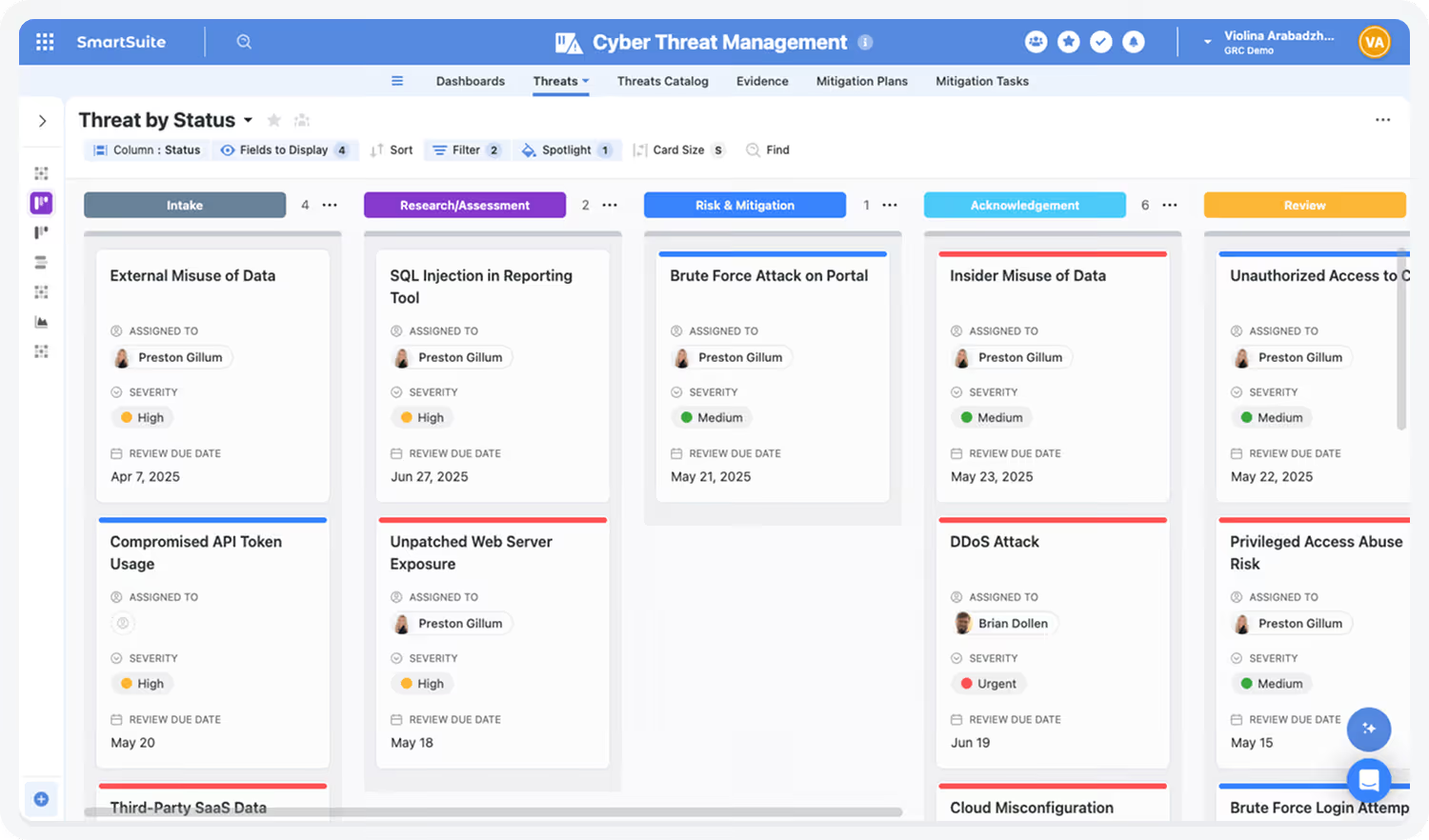
When you open any finding, you’ll see the whole chain, and not a dead row in a sheet.
On the cyber and IT risk side, SmartSuite covers what a working program needs:
- Vulnerability management pulls findings in from your scanners, ranks them by business risk, assigns an owner, and tracks each fix through to verification.
- Asset and configuration management keeps a live picture of what you own and how each asset connects to the services and risks attached to it.
- Compliance and framework mapping comes pre-mapped to standards like ISO 27001 and the NIST CSF, so controls and evidence link straight to the requirements they answer.
- Incident response management runs the full playbook when a vulnerability gets exploited, from intake and severity through containment, notifications, evidence, and the after-action review.
- Real-time dashboards give security leaders and the board a live read on threat posture and remediation progress.
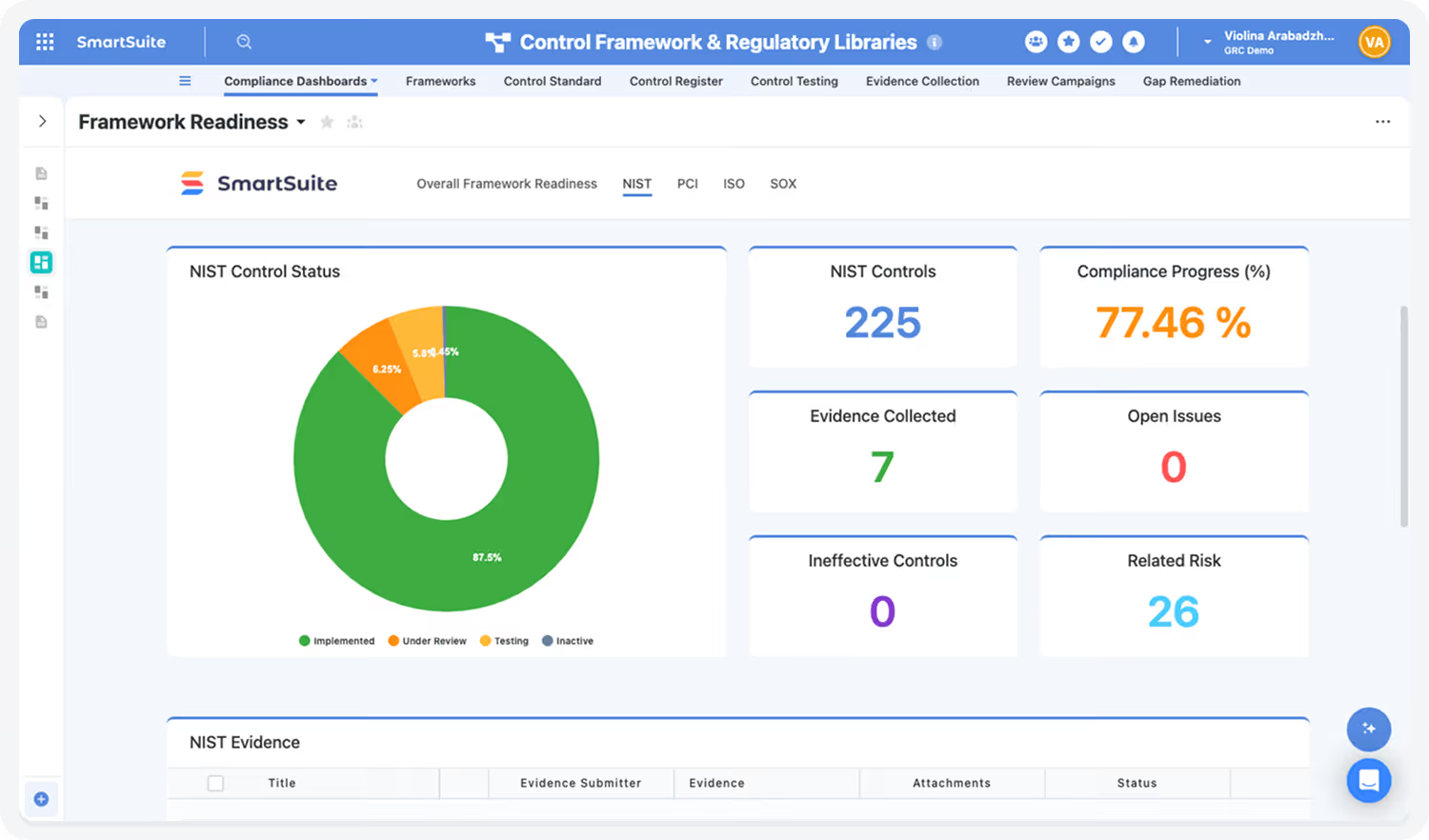
And automation holds all of this together.
Triggers and multi-step rules can escalate a critical finding the moment a scanner reports it, or roll a single risk-score change across every linked control without anyone touching it by hand.
There's an AI layer too, with SmartDoc AI drafting and summarizing reports and policies, and an AI Field Agent watching records for gaps and suggesting updates like a revised risk score.
Here’s more about how SmartSuite works:
On the trust side, our platform carries the certifications a security buyer checks for: SOC 2 Type II, ISO 27001, HIPAA, and GDPR, and last year we partnered with the Cyber Risk Institute to help US banks move off the retired FFIEC CAT framework.

Putting vulnerability management to work
Vulnerability management, similar to cyber risk management, isn't a tool you buy once and forget about. It's a habit that your organization needs to develop.
You re-run the scan and the triage as the threats shift, and you keep the register and the fixes honest in the gaps between.
The frameworks hand you the method. The tooling decides how much friction you fight getting there.
If you'd sooner keep your vulnerability program connected to your real audit and risk work than buried in a spreadsheet nobody trusts, SmartSuite is worth a look.
You can start free with our free trial or book a demo to see the vulnerability register and dashboards in action.
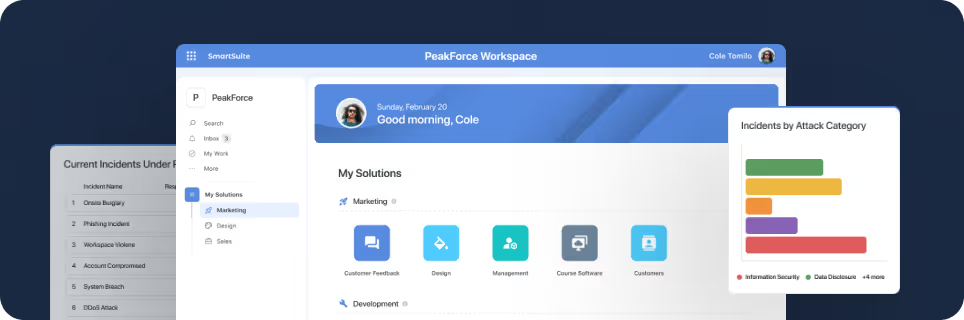
SmartSuite provides work platform for standardizing workflows in the following areas:
- Governance, Risk & Compliance
- IT & Service Ops
- Project / Portfolio Management
- Business Operations