



Calendar View — See Every Deadline Before It Arrives
Display Records on an interactive calendar driven by their date Fields—consolidating schedules from multiple Tables into one color-coded view, and rescheduling work with a drag instead of a form.
What Is Calendar View?
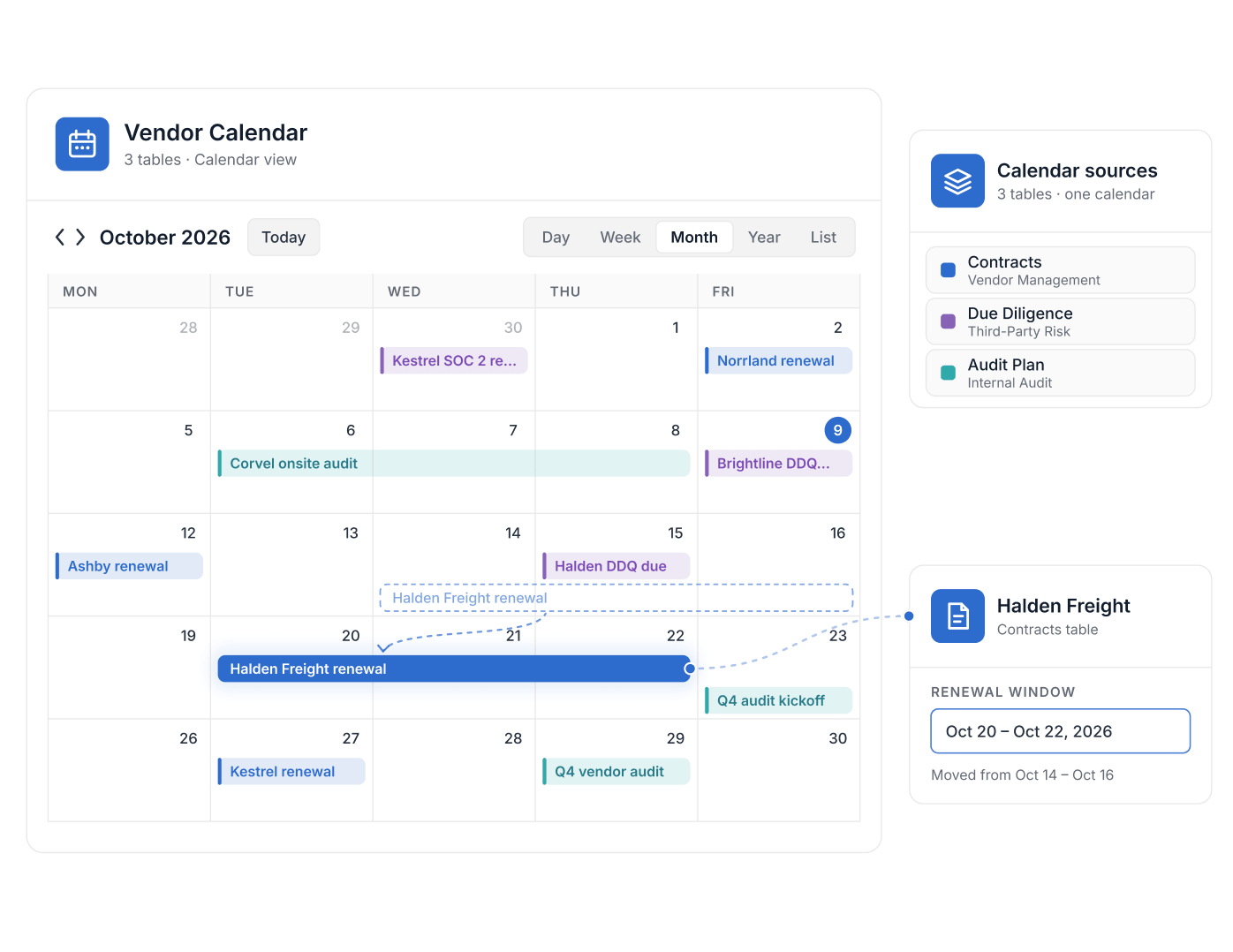
Calendar View is a SmartSuite View type that displays Records in a calendar layout based on their date Fields, from a single Table or from multiple Tables and Solutions combined into one unified calendar. It helps GRC, IT, project, and business operations teams see deadlines and scheduled work at a glance—and reschedule by dragging Records to new dates. Calendar View is available on every current SmartSuite plan as part of the Views system.
Date-Driven Display
Plot Records by Any Date Field, in Any Time Frame
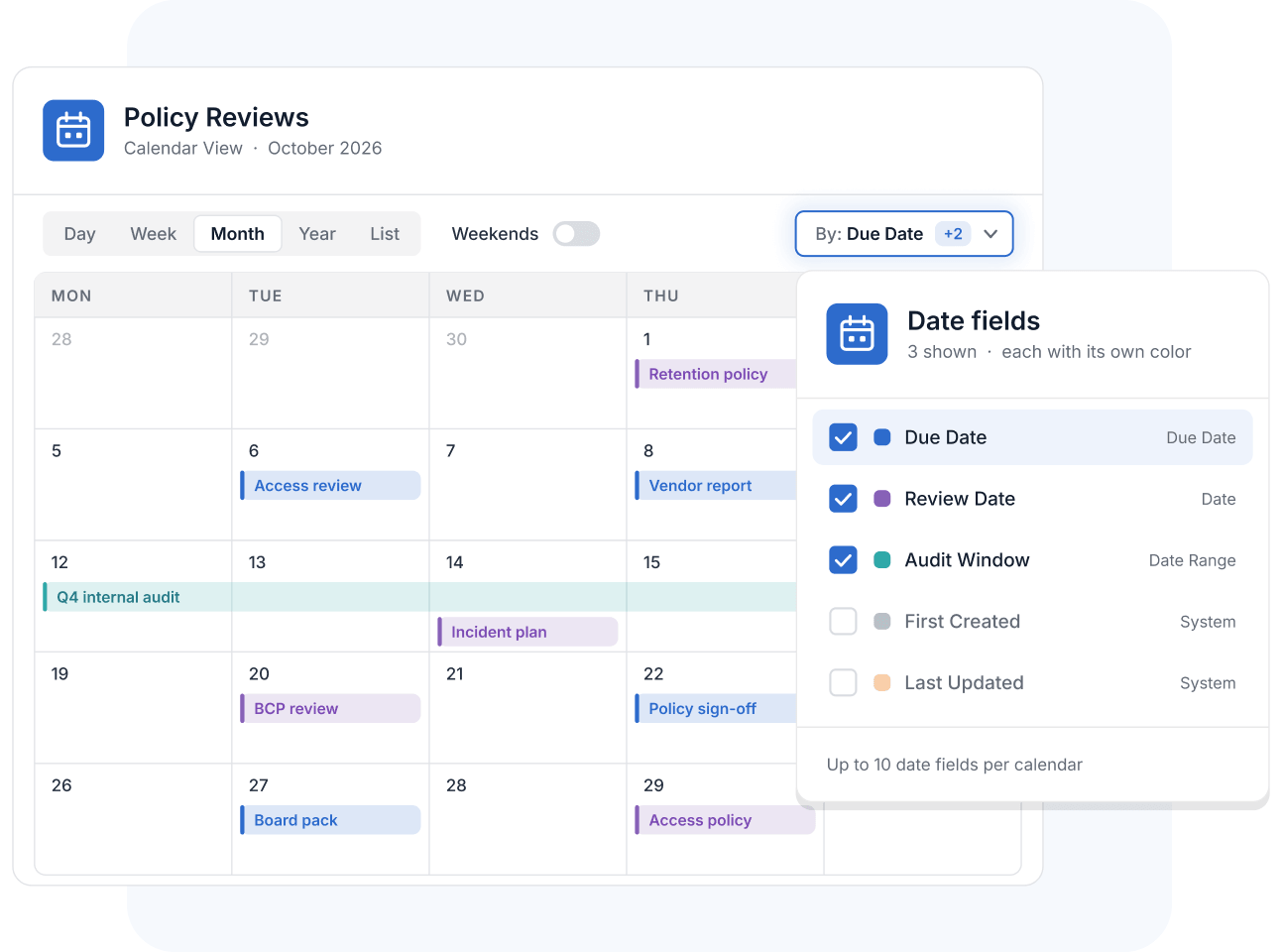
Calendar View recognizes Date, Due Date, and Date Range Fields, plus system Fields like First Created and Last Updated—a single calendar can reference up to 10 date Fields, each with its own color. Switch between Day, Week, Month, Year, and List modes, and toggle weekends on or off to match how your team plans.
The "By: [Date]" control in the toolbar sets which Field drives placement, so the same Table can power a due-date calendar and a review-date calendar side by side.
Multi-Source Calendars
Combine Calendars from Multiple Tables into One Schedule
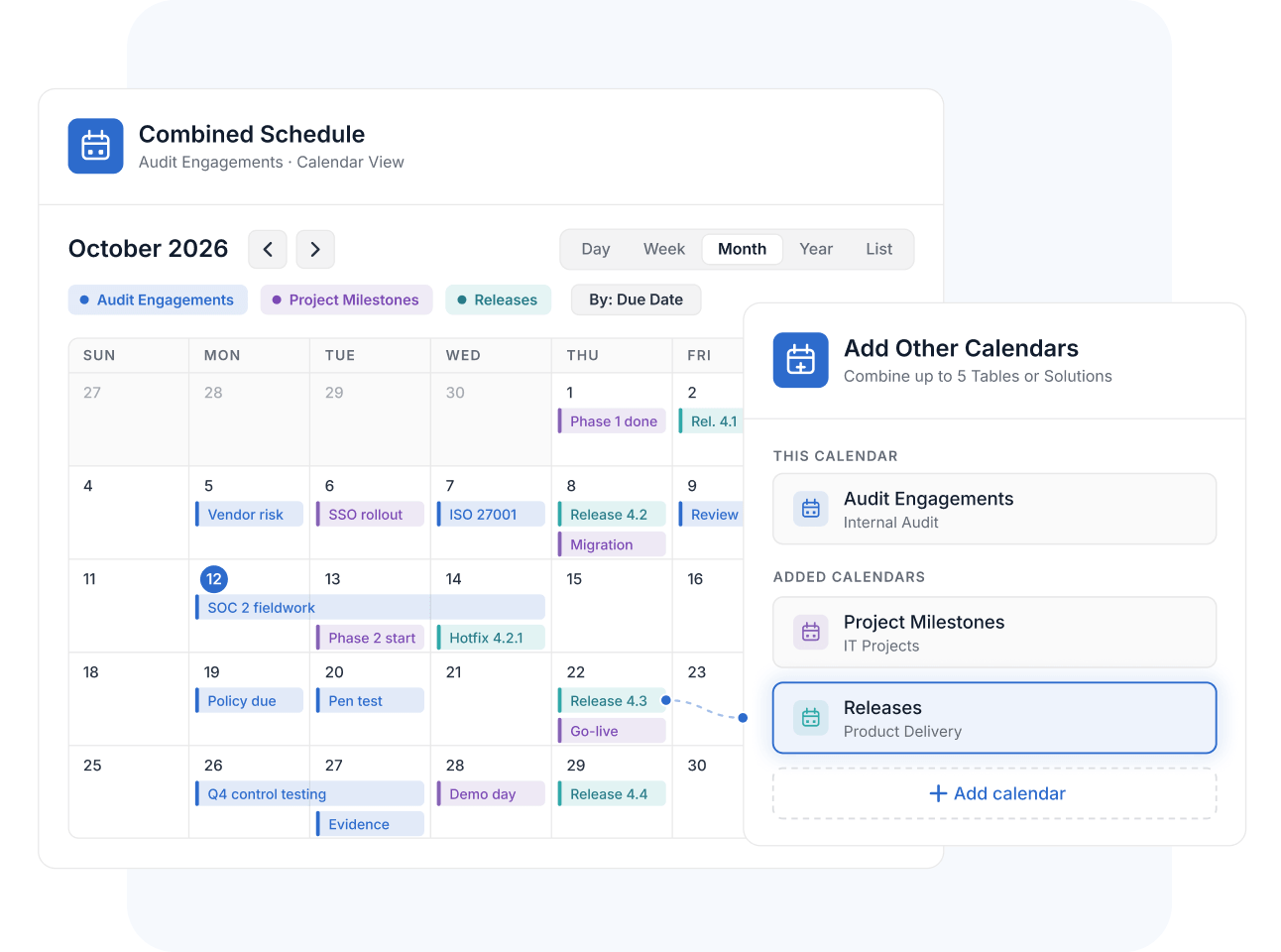
Pull in up to 5 additional Tables or Solutions through "Add Other Calendars," each source rendered in its own color—project milestones, audit deadlines, and release dates on one screen instead of three tabs. Source Tables expose a public calendar view, and the combined calendar stays live as each source changes.
One consolidated schedule replaces the ritual of cross-checking calendars before every planning meeting.
Drag to Reschedule
Reschedule Work by Dragging—Create Records by Clicking
Drag a Record to a new date and its date Field updates instantly—including stretching or shrinking a Date Range directly on the calendar grid. Click an open date cell and a new Record is created pre-populated with that date, so scheduling and capturing work happen in the same motion.
Records without dates never disappear: they stay available in the Record Listing panel, which supports sort, filter, group, and search alongside the calendar.

Focus & Reporting
Spotlight What Matters and Export the Schedule
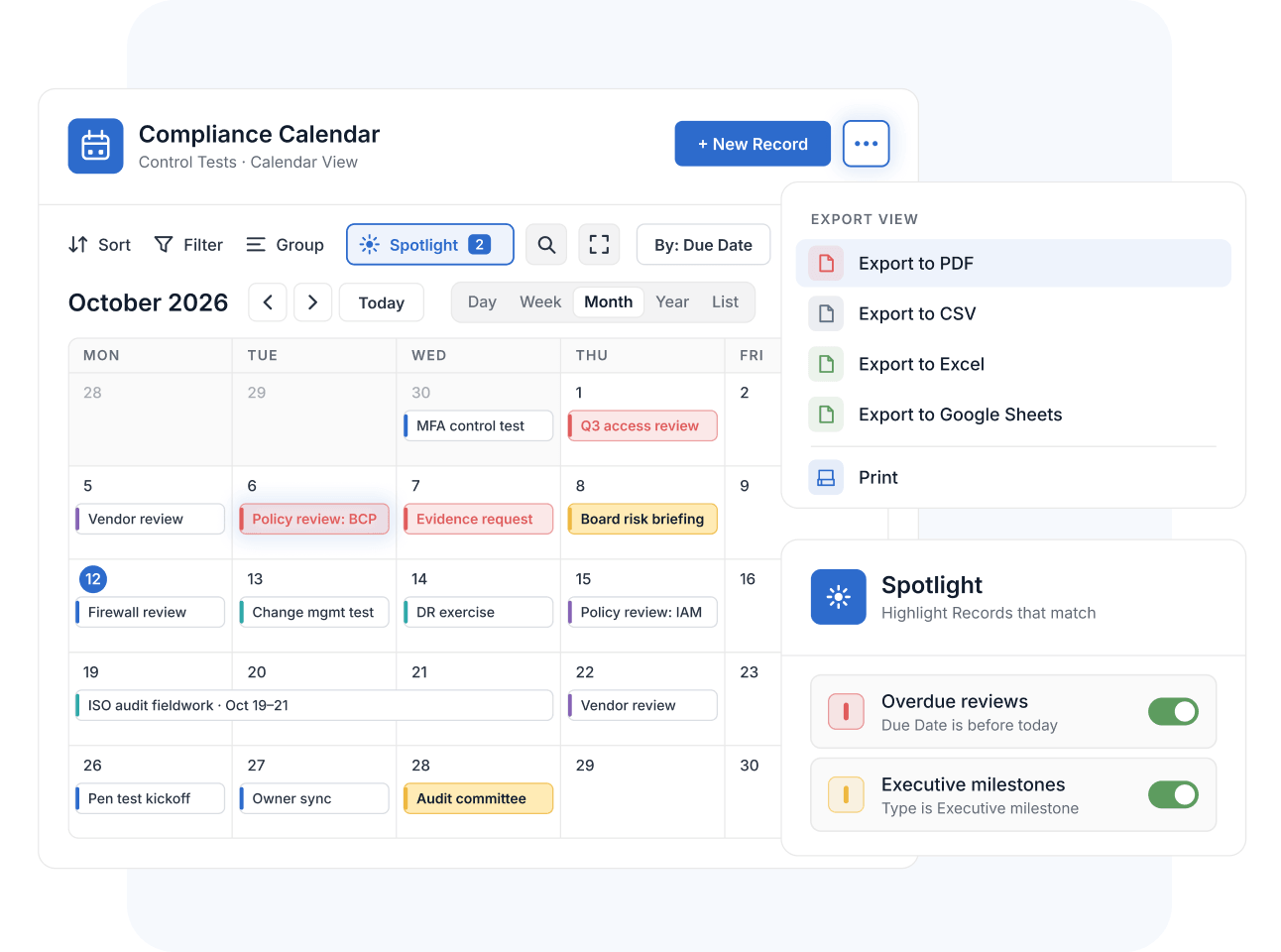
Spotlight color-coding highlights Records matching conditions you set—overdue reviews in red, executive milestones in gold—so a crowded month still reads at a glance. The full Report Toolbar applies: sort, filter, group, and find, plus full-screen mode for planning sessions.
Export or print the schedule to PDF, CSV, Excel, or Google Sheets when stakeholders need a copy outside the workspace.
Calendar View
Deadlines drive governed work—control tests, attestation windows, policy reviews, audit fieldwork. Calendar View puts them on one schedule that updates itself as the underlying Records change.
Plot control test due dates, attestation windows, and audit fieldwork on one calendar. Spotlight overdue items so the compliance team sees slippage the day it happens, not at month end.
Track policy review and renewal dates across departments with a multi-source calendar—each owning Table in its own color, one consolidated review schedule for the risk office.
Consolidate filing and reporting deadlines across jurisdictions into one governed calendar in Month or Week mode. When a submission date changes, drag the Record and every stakeholder sees the new date instantly.
Schedule business continuity and disaster recovery exercises across sites on a shared calendar, with the Record Listing panel keeping unscheduled tests visible until each one gets a date.
Pair Calendar View with Automations—when a plotted control test or attestation due date approaches, trigger reminders and escalation workflows so the calendar drives action, not just awareness.
Calendar View is a SmartSuite View type that displays Records on an interactive calendar based on their date Fields. It supports Day, Week, Month, Year, and List modes, drag-and-drop rescheduling, and consolidated calendars combining multiple Tables.
Calendar View recognizes Date, Due Date, and Date Range Fields, plus system Fields like First Created and Last Updated. A single calendar can reference up to 10 date Fields, each displayed in its own color.
Yes. Through "Add Other Calendars" you can combine up to 5 additional Tables or Solutions into one calendar, each source color-coded. Source Tables need a public calendar view to be added this way.
Yes. Drag a Record to a new date—or adjust the start or end of a Date Range on the grid—and the underlying date Fields update automatically. Clicking an open date creates a new Record pre-populated with that date.
Calendar View itself displays SmartSuite Record data; it is not a two-way sync with external calendars. SmartSuite's documented Google Calendar integration lives in Automations, where workflow actions can create and manage external calendar events.
They don't appear on the calendar grid, but they remain accessible in the Record Listing panel alongside the calendar, where you can sort, filter, group, and search them—and schedule them when ready.
Yes. Calendar View is included on every current SmartSuite plan, with export and print to PDF, CSV, Excel, and Google Sheets built in.
Put Every Deadline on One Calendar
Consolidate dates from across your workspace and reschedule with a drag—before the deadline reschedules you.