



Data Import — Bring Every Spreadsheet Into One Governed Platform
Upload CSV, Excel, calendar, or contact files and map them to structured, relational Tables—eliminating manual re-entry, catching errors before they land, and keeping Records current with every re-import.
What Is Data Import?
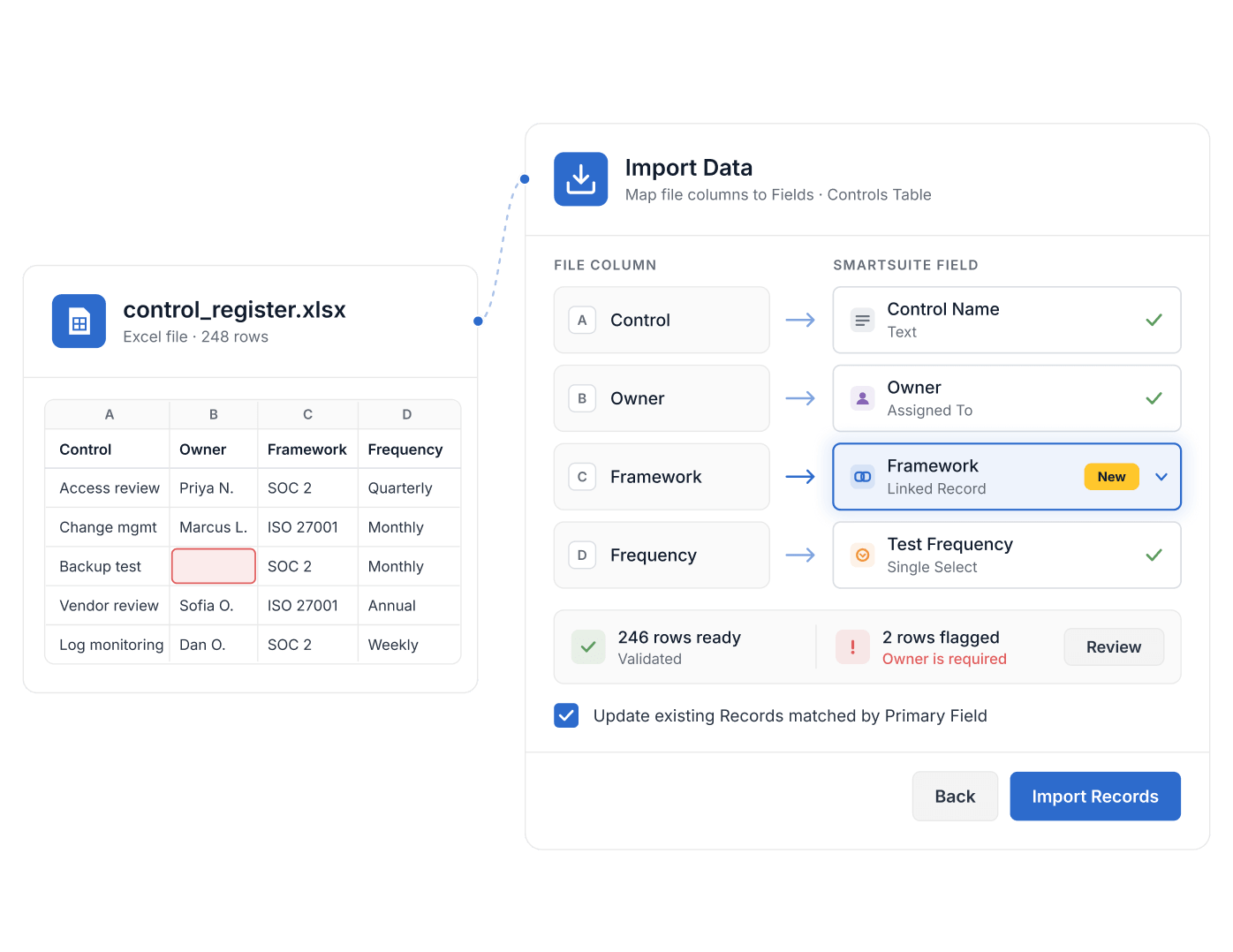
Data Import is a SmartSuite capability that brings external data into a Solution by uploading a CSV, Excel, ICS, or vCard file, mapping its columns to Fields, and creating or updating Records in bulk. It helps GRC, IT, project, and business operations teams move spreadsheets, contact lists, and calendars into governed, relational Tables—validated before a single Record is created. Data Import is included on every SmartSuite plan as part of the platform's data architecture.
File Formats
Import CSV, Excel, Calendar, and Contact Files
Drag and drop a file—or pick one from your computer—and SmartSuite reads it on the spot. Data Import supports CSV and Excel spreadsheets alongside ICS calendar files and vCard contact exports, so project plans, control registers, event schedules, and vendor lists all follow the same guided path.
Each import creates or updates up to 20,000 Records in a single pass, and every one lands in a structured, permission-aware Table.
Column Mapping
Map Columns to Fields—Including Ones You Create on the Fly
A guided mapping step pairs every column in your file with the right SmartSuite Field. Need a Field that doesn't exist yet? Create it during mapping—any Field type, including Linked Records that connect incoming data to Records in other Tables.
Your data lands structured on day one, not dumped into text columns you re-model later.
Validation
Validate Every Row Before It Becomes a Record
Real-time validation flags formatting problems, type mismatches, and empty required values while you map—not after the import posts. Fix flagged rows in the built-in editor, or download an error-highlighted Excel file, correct it at your desk, and re-upload.
Nothing lands in your Tables until the data is clean.
Update via Import
Update Existing Records with Every Data Import
Re-importing a refreshed file doesn't create duplicates. Match incoming rows on Primary Field values or Record IDs and Data Import updates the existing Records in place—turning a weekly pricing sheet, headcount export, or asset extract into a repeatable refresh.
Imports also respect record-level assignment permissions, so bulk updates stay inside the same guardrails as everyday edits.
Data Import
Governed teams rarely start from a blank slate—controls, risks, policies, and vendor lists already live in spreadsheets and legacy exports. Data Import brings them into SmartSuite through a guided, no-code flow.
Export controls from spreadsheets or a legacy GRC suite and import them into a governed control register. Map framework, owner, and test-frequency columns to structured Fields so testing workflows start immediately.
Merge departmental risk spreadsheets into a single register. Re-import updated files matched on Record ID to refresh scores and treatment status without creating duplicates.
Import the policy inventory from spreadsheets into a governed policy register. Validation catches missing owners and malformed review dates before a single policy Record is created.
Bring closed findings and remediation history from prior audit cycles into SmartSuite, so trend reporting and recurring-issue analysis keep their history from day one.
Import vendor contact lists—including vCard exports—into a third-party register that risk assessments, contracts, and due-diligence tasks link back to.
Pair Data Import with Linked Records to create relationship Fields during mapping—imported risks arrive linked to their controls, and findings to the audits that raised them.
Governed teams rarely start from a blank slate—controls, risks, policies, and vendor lists already live in spreadsheets and legacy exports. Data Import brings them into SmartSuite through a guided, no-code flow.
Data Import is SmartSuite's built-in tool for bringing external data into a Solution. You upload a CSV, Excel, ICS, or vCard file, map its columns to Fields, review flagged rows, and create or update Records in bulk—no code required.
Data Import accepts CSV, Excel, ICS (calendar), and vCard (contact) files up to 5 MB, and each import can create or update up to 20,000 Records. Larger datasets can be split across multiple imports or loaded through the REST API.
Yes. Match incoming rows on Primary Field values or Record IDs and Data Import updates the matched Records in place, so re-importing a refreshed file acts as a data refresh rather than a duplicate load.
No. Data Import is a guided, no-code flow—upload, map, review, import. For automated or recurring data flows, SmartSuite also offers a REST API and integrations with tools like Zapier and Make.
Real-time validation highlights problem rows during mapping. You can correct them in the built-in editor, or download an error-highlighted Excel file, fix it, and re-upload before completing the import.
No. Imports create and update Records without firing Automations or generating notifications, so a bulk load never sets off unintended workflows or floods your team's inboxes.
Data Import respects record-level assignment permissions—a Member with Assignee-only access cannot import changes to Records assigned to someone else. Validation before import keeps source data clean, which helps GRC and ITSM teams stay audit-ready.
Migrate Your Data in Days, Not Months
Upload your first file, map it to Fields, and see your work in SmartSuite—structured, validated, and ready to govern.