



Grid View — Spreadsheet Speed on a Governed Database
Work with Records in an interactive data grid that behaves like the spreadsheet your team already knows—editing inline, grouping and totaling on the fly, and keeping every change inside your permission model.
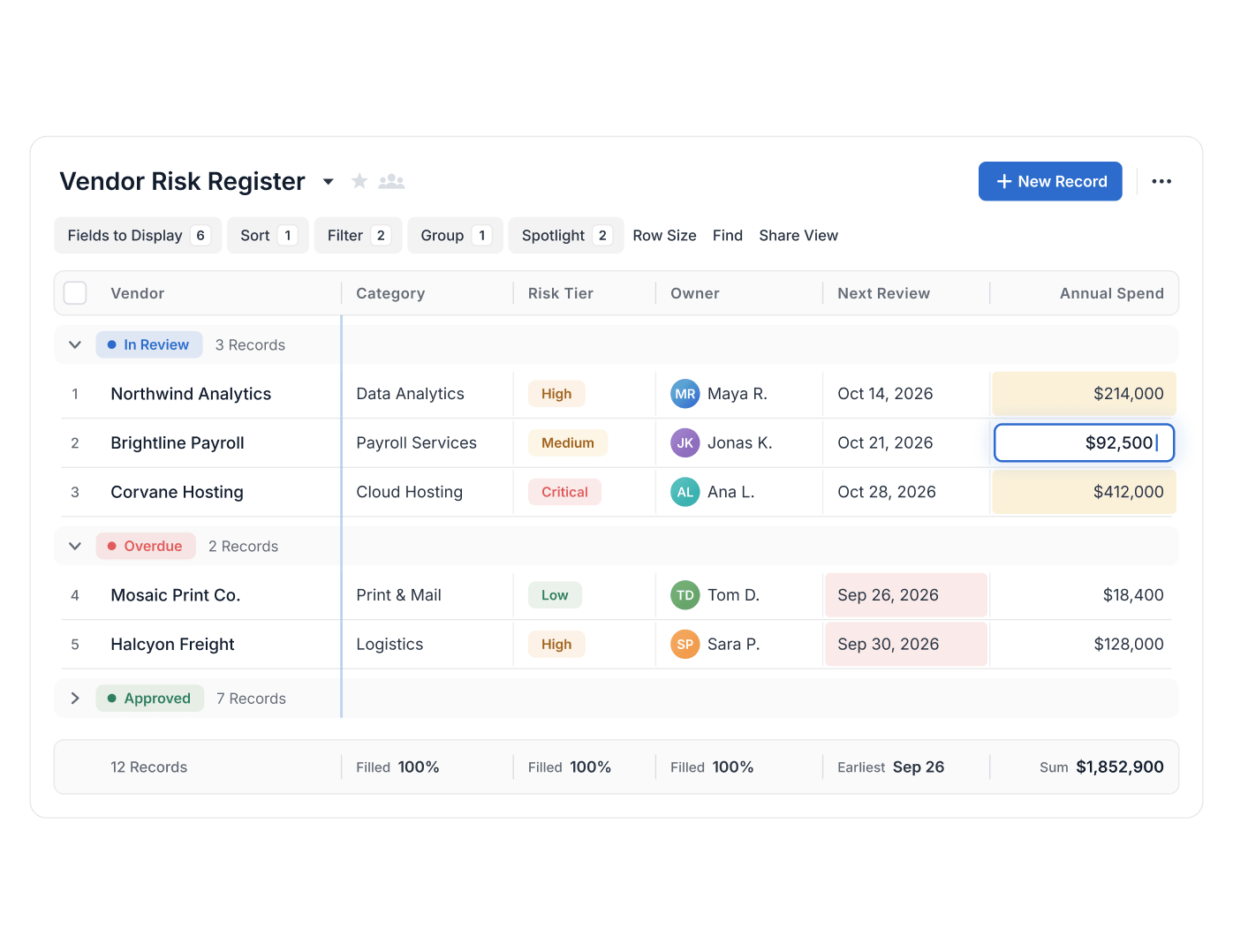
- Grid View is the default view and is available on every plan.
- Inline editing, copy and paste, undo and redo, keyboard navigation and batch updates of selected records are built in.
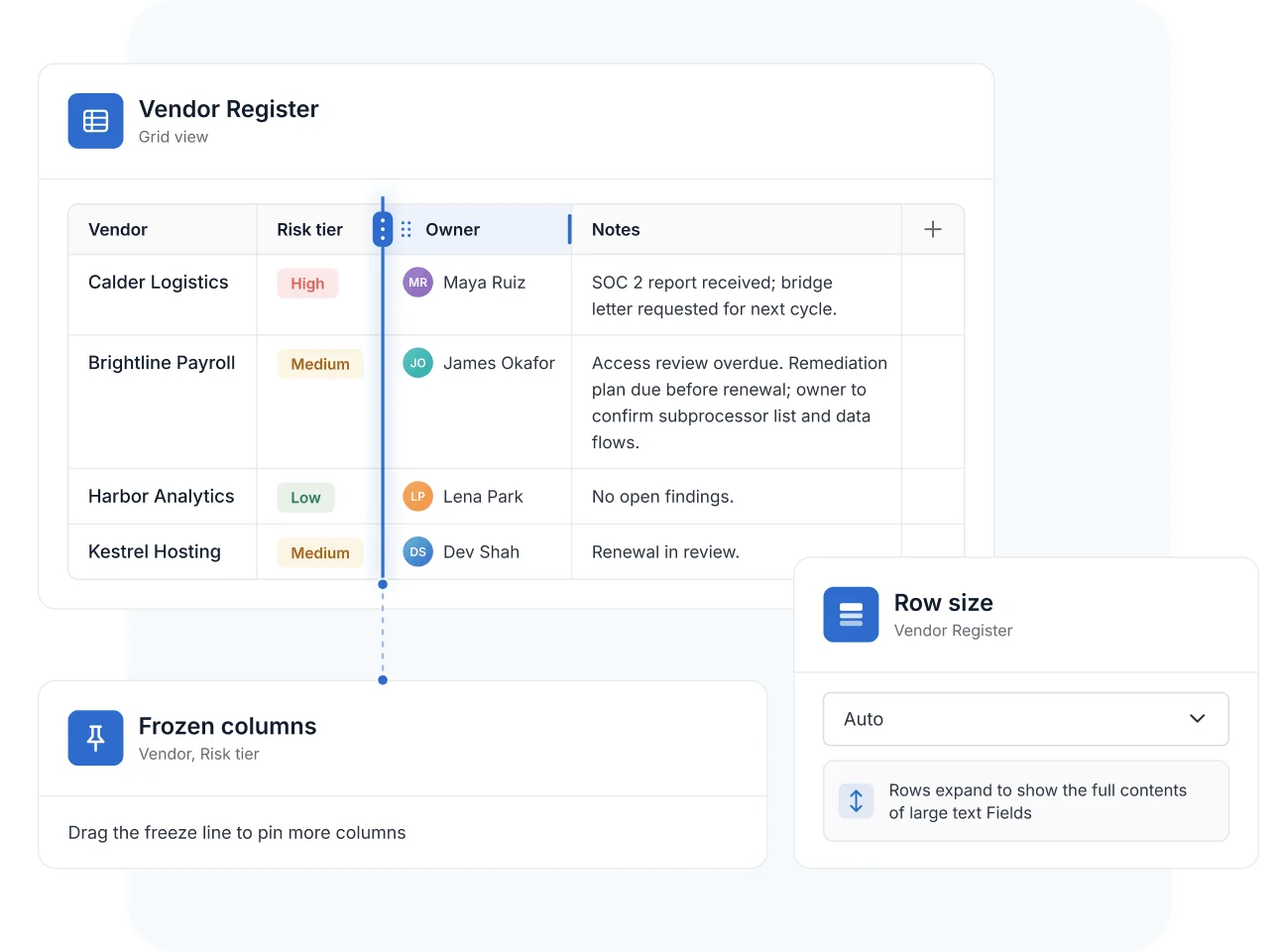
- Columns can be frozen up to 60 percent of the screen width, collapsed, reordered and resized.
- Bulk paste from Excel, Sheets or Numbers fills rows and columns, and the fill handle extends values and numeric patterns.
- Column totals show sum, average, median, standard deviation and date ranges; bulk actions update, print, export, copy, duplicate or delete records.
What Is Grid View?
Grid View is SmartSuite's default View type, combining spreadsheet and database functionality into an interactive data grid for viewing, editing, and analyzing Records in real time. It helps GRC, IT, project, and business operations teams update structured data at spreadsheet speed—with sorting, filtering, grouping, column totals, and export built in. Grid View is available on every current SmartSuite plan as part of the platform's Views system.
In-Cell Editing
Edit Records Inline at Spreadsheet Speed
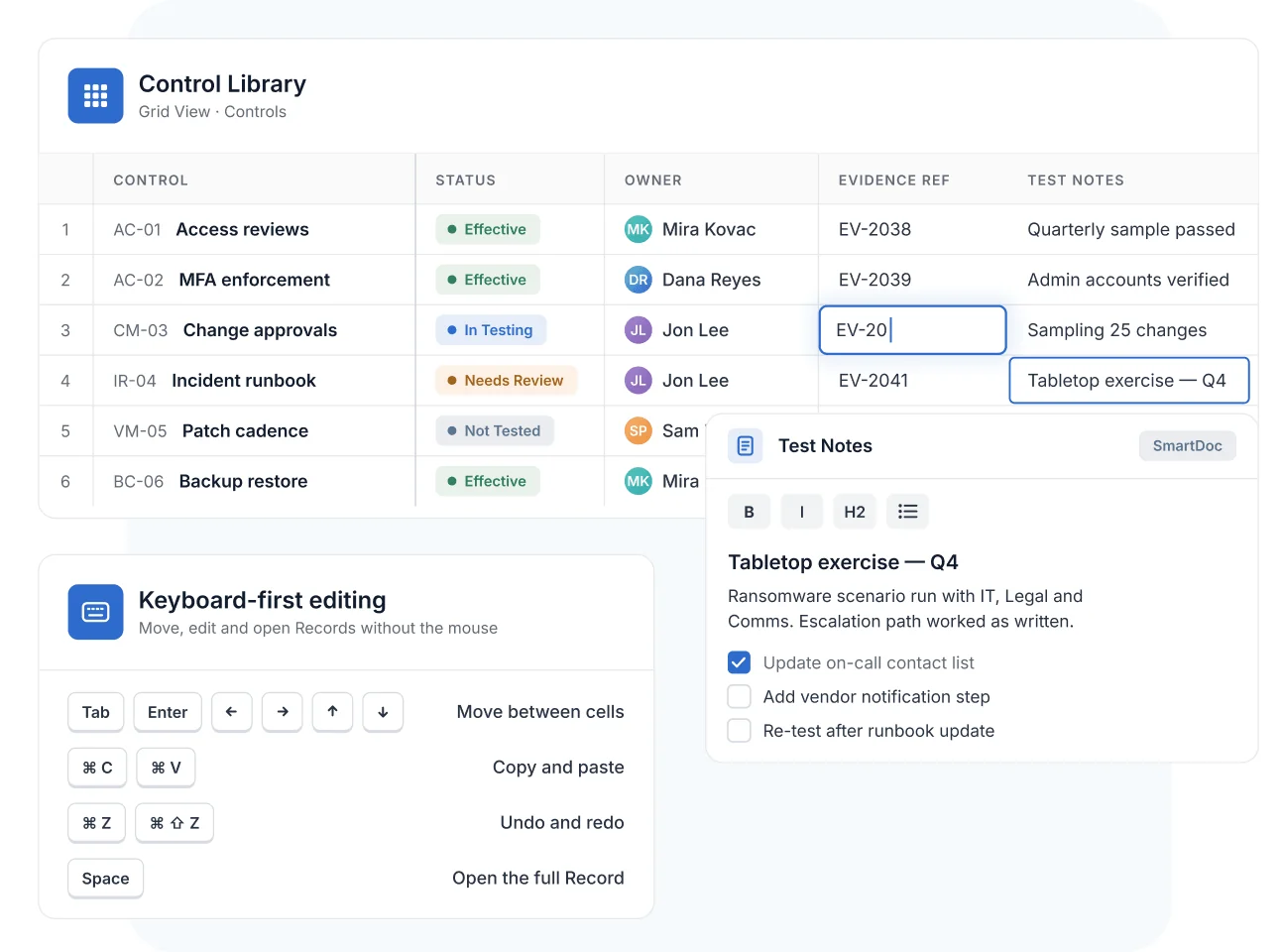
Change a value without opening the Record—click a cell and type. Grid View supports keyboard navigation with Tab, Enter, and arrow keys, copy and paste with familiar shortcuts, and undo and redo, so bulk cleanup feels like working in a spreadsheet. Pressing the spacebar opens the full Record panel focused on the active Field when you need more context.
Expandable cells give long-form content room to breathe—SmartDoc, Checklist, Linked Record, Tag, and file Fields all open in place. When a View should stay read-only, inline editing can be disabled for the entire Grid View.
Data Shaping
Sort, Filter, and Group Records Without Formulas
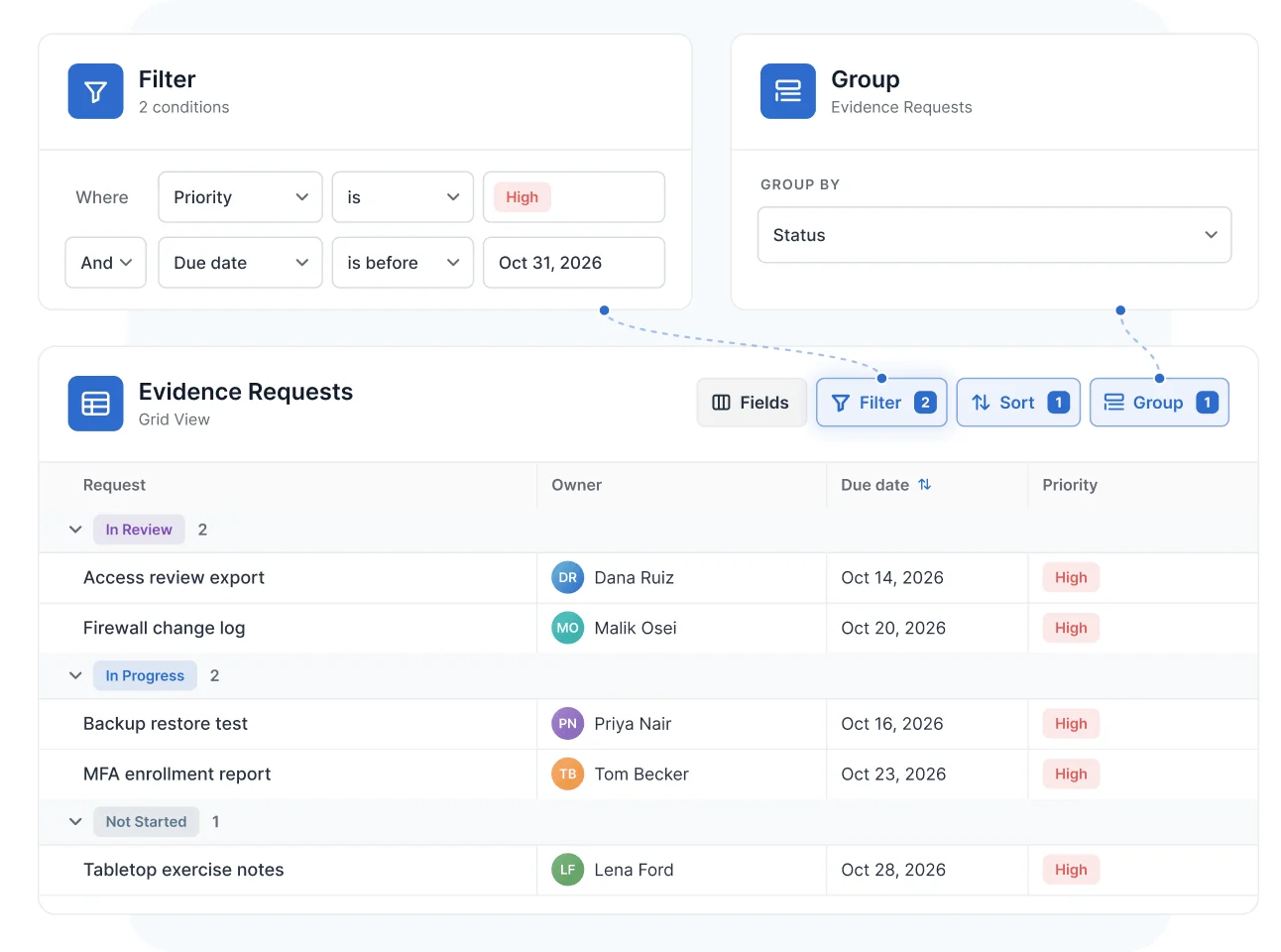
Shape large datasets directly from the toolbar: sort ascending or descending on any Field, filter on single or multiple conditions, and group Records by status, owner, date, or any value list. Grouping turns a flat Table into a triage board—open items by priority, controls by framework, assets by location.
Every arrangement saves with the View, so the team opens the same shaped dataset tomorrow that you built today.
Column Totals
Summarize Columns with Built-In Grid View Totals
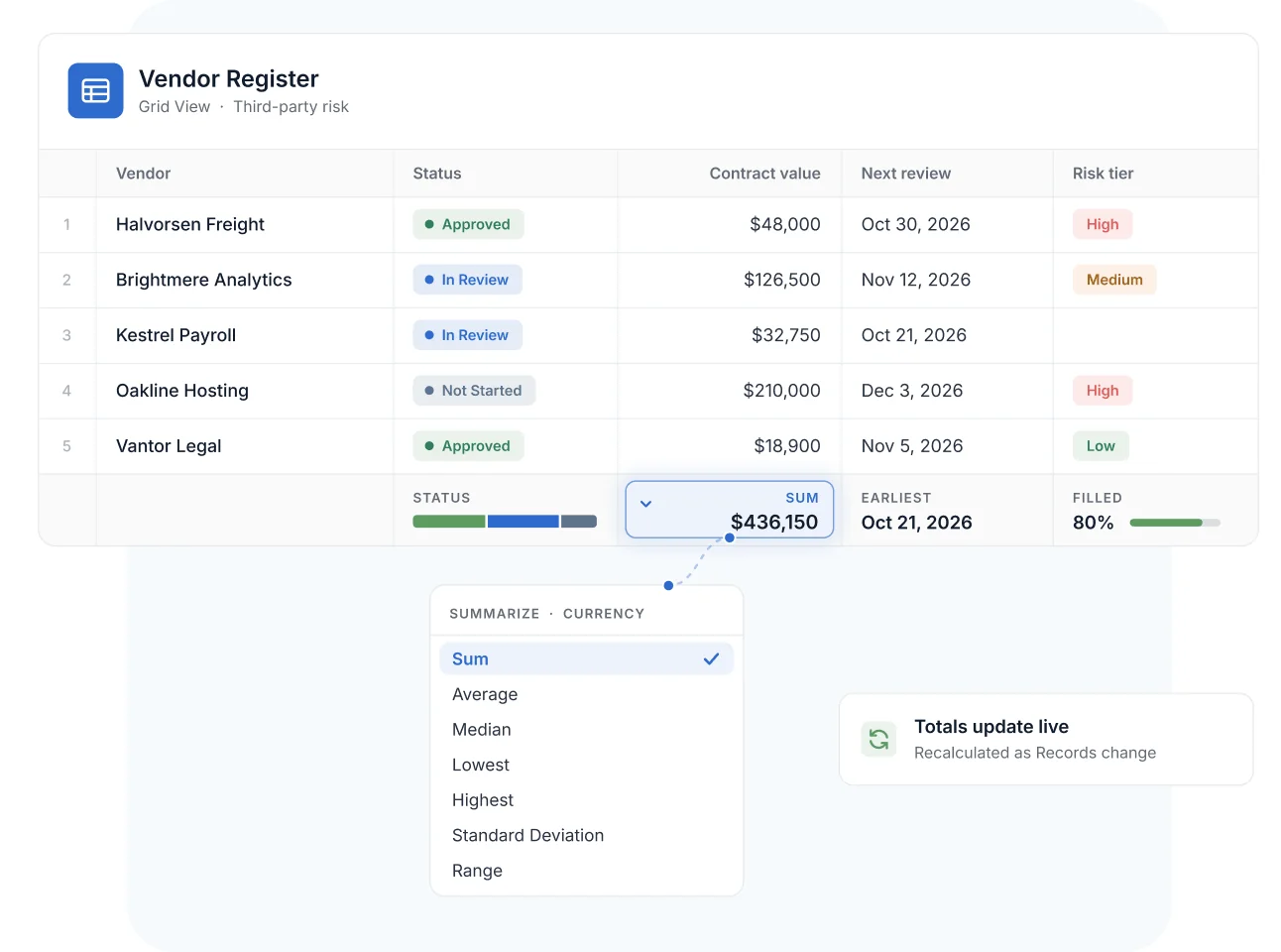
Click any column footer to add a live summary matched to the Field's data type. Numeric Fields calculate Sum, Average, Median, Lowest, Highest, Standard Deviation, and Range; date Fields report Earliest Date, Latest Date, and Date Range; text and select Fields count Empty, Filled, and percentage completion. Status Fields show a real-time visual breakdown of where work stands.
Totals recalculate as Records change—no exported spreadsheet, no stale numbers.
Layout Control
Control Columns—Freeze, Resize, Reorder, and Collapse
Arrange the grid around the work. Create Fields from the "+" at the end of the header row, drag columns into a new order, resize by dragging column edges, and collapse or remove Fields you don't need in this View. The primary Field stays frozen by default, and you can drag the freeze line to pin additional columns—up to 60% of the screen.
Row heights adjust from Small to Extra Large, with an Auto option that expands rows to show the full contents of large text Fields.
Reporting & Sharing
Export Grid View Data to Excel, Google Sheets, CSV, and PDF
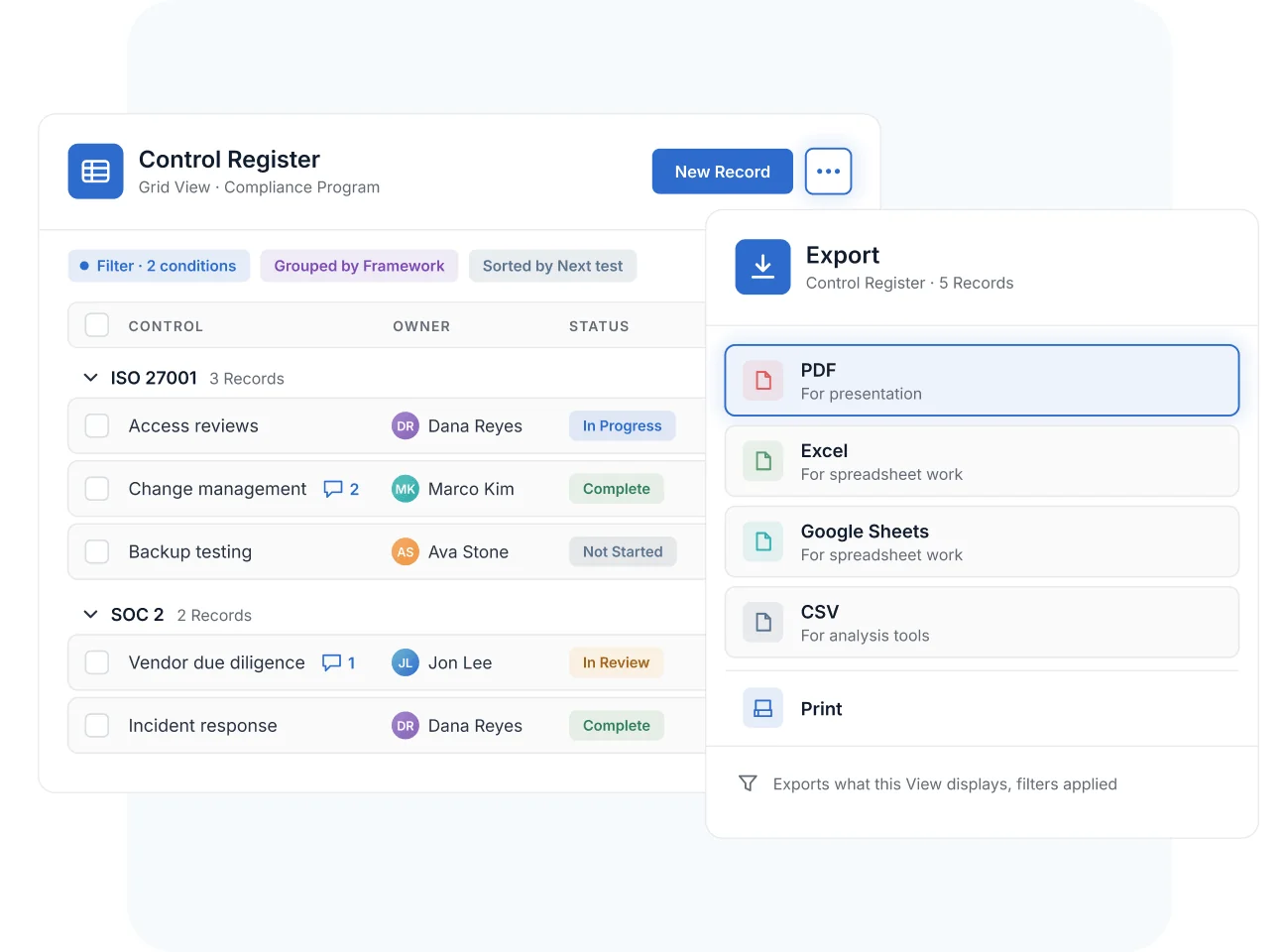
When results need to travel, export the shaped dataset to Excel, Google Sheets, CSV, or PDF—or print it directly. Shareable links respect user permissions, including a read-only mode for audiences who should see the data but never touch it.
Grid View reports across more than 40 Field types, with open-comment indicators on Records and a full-screen mode for review sessions.
Grid View
Grid View is where GRC teams do the day-to-day work—updating registers, reviewing evidence, and cleaning structured data without leaving the permission model.
Group a third-party register by assessment status and filter to overdue reviews. Analysts update scores and owners inline while column totals show completion percentages across the vendor portfolio.
Sort controls by next test date and group by framework. Compliance managers scan open-comment indicators, update test results in place, and export an audit-ready snapshot to PDF.
Group the attestation Table by department with column summaries counting complete and outstanding responses—policy owners monitor the cycle without building a separate report.
Filter the evidence Table to unassigned or overdue requests, bulk-select, and batch-update owners and due dates. Keyboard navigation and copy-paste make high-volume register hygiene fast.
Pair Grid View with Data Import—load a legacy risk register spreadsheet into a governed Table, then use inline editing, grouping, and column totals to validate and clean the imported Records in place.
Grid View is SmartSuite's default View type—an interactive data grid that combines spreadsheet usability with database structure. Records display as rows and Fields as columns, with inline editing, sorting, filtering, grouping, and column totals built in.
Yes. Inline editing lets you change values in the cell without opening the Record, with keyboard navigation, copy and paste, and undo and redo. You can also disable inline editing to make a Grid View read-only for its audience.
Totals match the Field type: numeric Fields offer Sum, Average, Median, Lowest, Highest, Standard Deviation, and Range; date Fields offer Earliest Date, Latest Date, and Date Range; text and select Fields count Empty, Filled, and percentages; Status Fields show a visual breakdown.
Grid View looks and edits like a spreadsheet, but every cell is a structured Field on a governed Record—typed data, Linked Records, permissions, and Activity History included. You get spreadsheet speed without spreadsheet sprawl.
Yes. Export the current View to Excel, Google Sheets, CSV, or PDF, or print it directly. Shareable links respect user permissions and support a read-only mode.
Yes. Grid View is included on every current SmartSuite plan, and all roles can configure and manage Grid Views within their permissions.
Every edit in Grid View happens on a governed Record—permission-checked, tracked in Activity History, and visible to the team in real time. Read-only sharing and view-level export give auditors the data without giving them edit access.
Work at Spreadsheet Speed—Without Spreadsheet Sprawl
Open your data in Grid View and edit, group, and total governed Records as fast as you think.