



Gantt Charts — Dependencies, Milestones, and Schedules That Adjust Themselves
Track tasks, dependencies, and milestones on a combined grid-plus-timeline chart—auto-scheduling downstream work when one task moves, and highlighting the critical path that decides your delivery date.

- Gantt View is listed on every plan (Team, Professional and Enterprise) on the pricing page.
- A Gantt chart shows task dependencies, start and end dates, durations and assigned members; a Table can hold one Dependency field.
- The Dependency field tracks predecessors and successors, with auto-scheduling and a start-forward or end-backward scheduling direction.
- Gantt views can be shared as read-only links or embeds.
- Grouping and Spotlight are available in Gantt View.
What Are Gantt Charts?
Gantt Charts in SmartSuite (Gantt View) are a project-management View type for organizing and tracking tasks, dependencies, and milestones over time, built on the Dependency Field and rendered as a combined grid-plus-timeline chart. They help project, IT, and operations teams sequence work, auto-schedule around changes, and keep delivery dates visible. Gantt Charts are available on all paid SmartSuite plans as part of the Views system.
Dependency Modeling
Model Task Dependencies with Predecessors and Successors
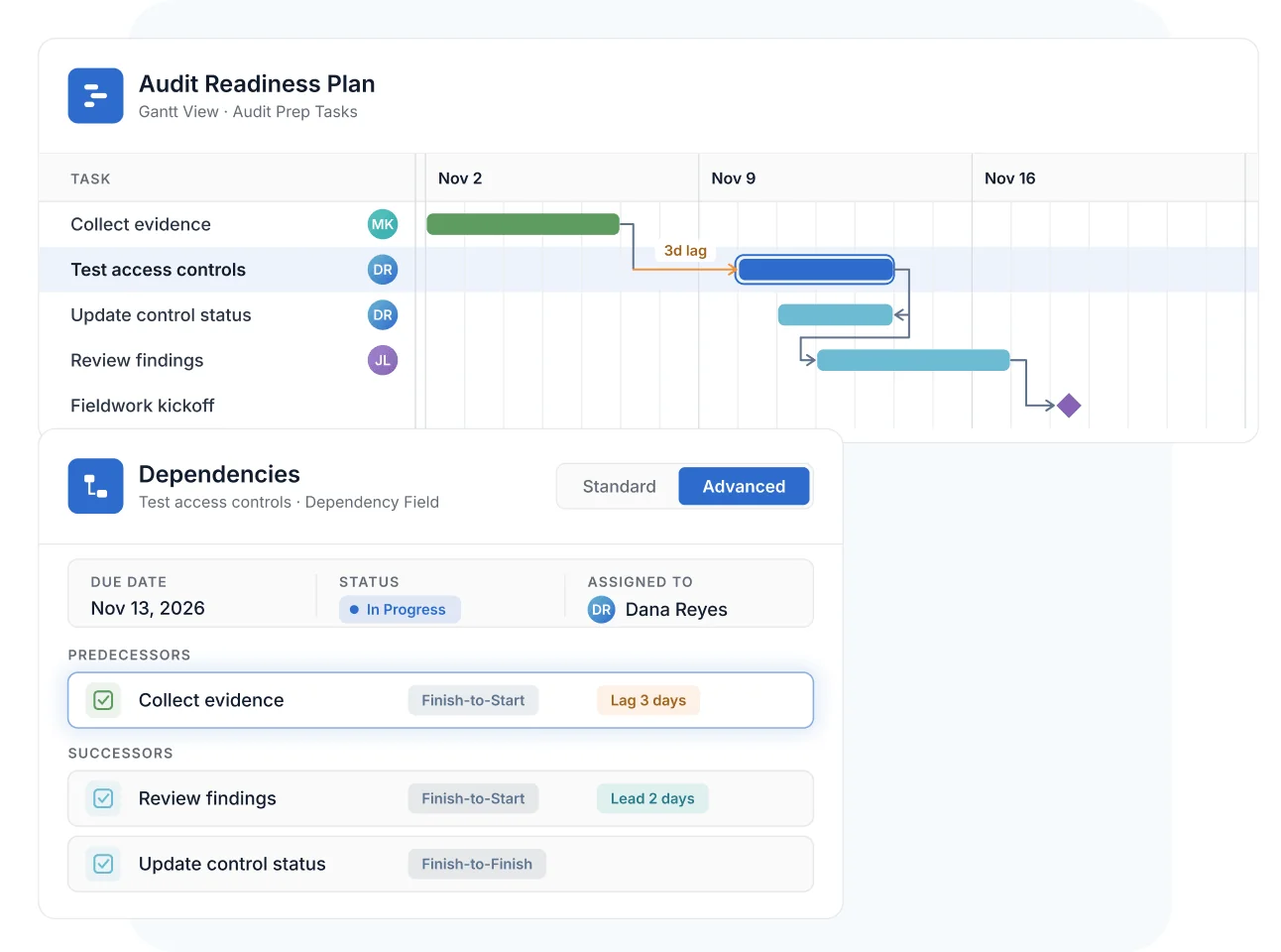
Gantt Charts are built on the Dependency Field, which tracks each task's predecessors—work that must finish or start first—and successors blocked until the current task completes. Standard mode covers Finish-to-Start sequencing; Advanced mode adds Start-to-Start, Finish-to-Finish, and Start-to-Finish relationships plus lead and lag offsets, so a successor can start two days early or wait three days after its predecessor.
The Dependency Field links to Due Date, Status, and Assigned To Fields, and also displays in Grid and Kanban Views of the same Table.
Auto-Scheduling
Move One Task and Auto-Schedule Everything Downstream
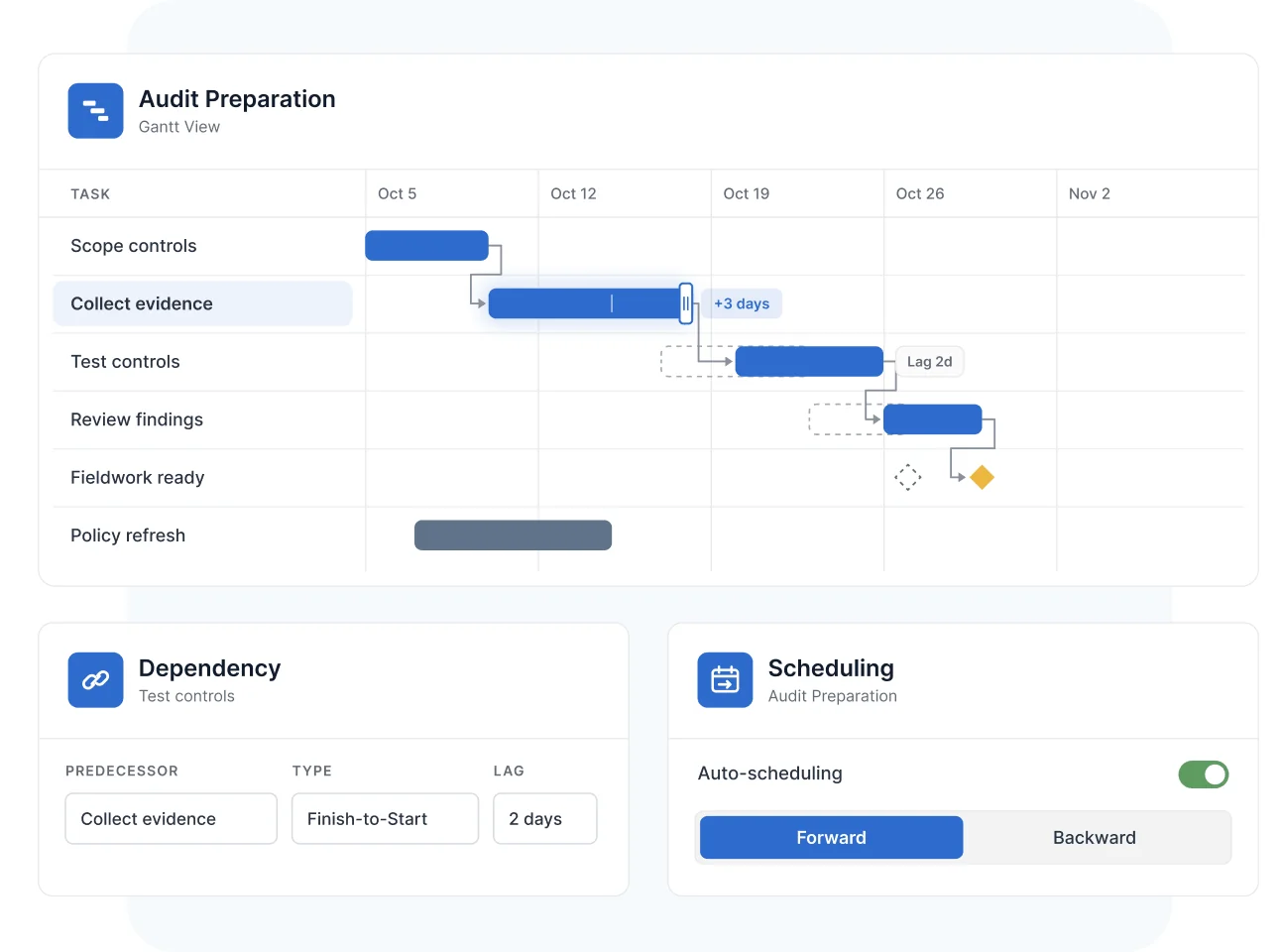
With auto-scheduling on, moving or resizing one task shifts its dependents automatically according to the dependency type and any lead or lag values. Forward scheduling places tasks as early as possible; backward scheduling works from the deadline and schedules as late as dependencies allow. Prefer manual control for a specific task? Toggle auto-scheduling off and set its dates independently.
Critical Path
Highlight the Critical Path and Mark Milestones
Critical-path highlighting shades the tasks that determine your project's finish date, so trade-off conversations start with the work that actually moves the deadline. Milestones render as diamond icons for zero-duration events, blocked tasks show in red, and active tasks are highlighted—status you read at a glance, not in a report.
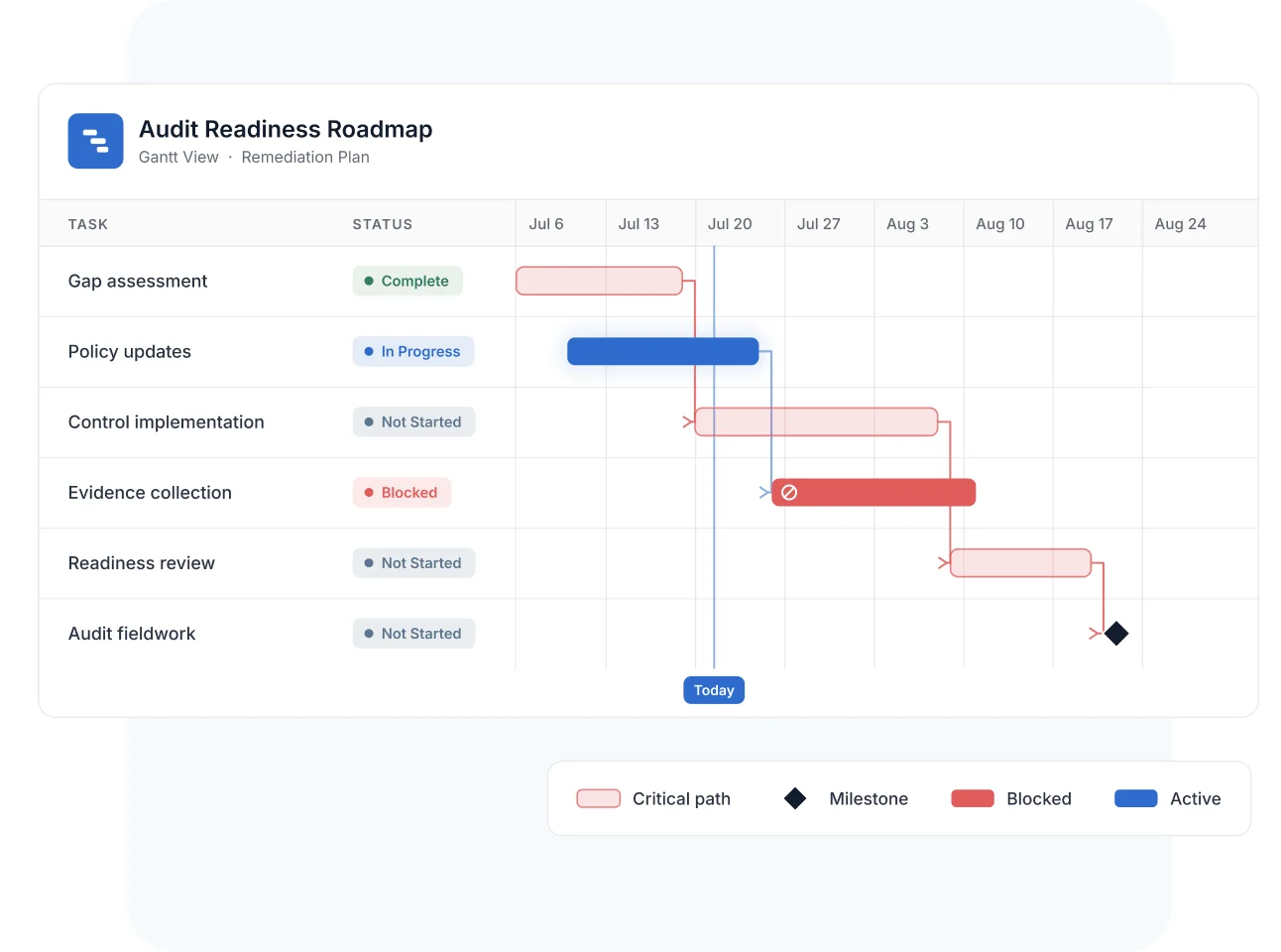
Chart Presentation
Tune the Chart with Visual Toggles and Spotlight Rules
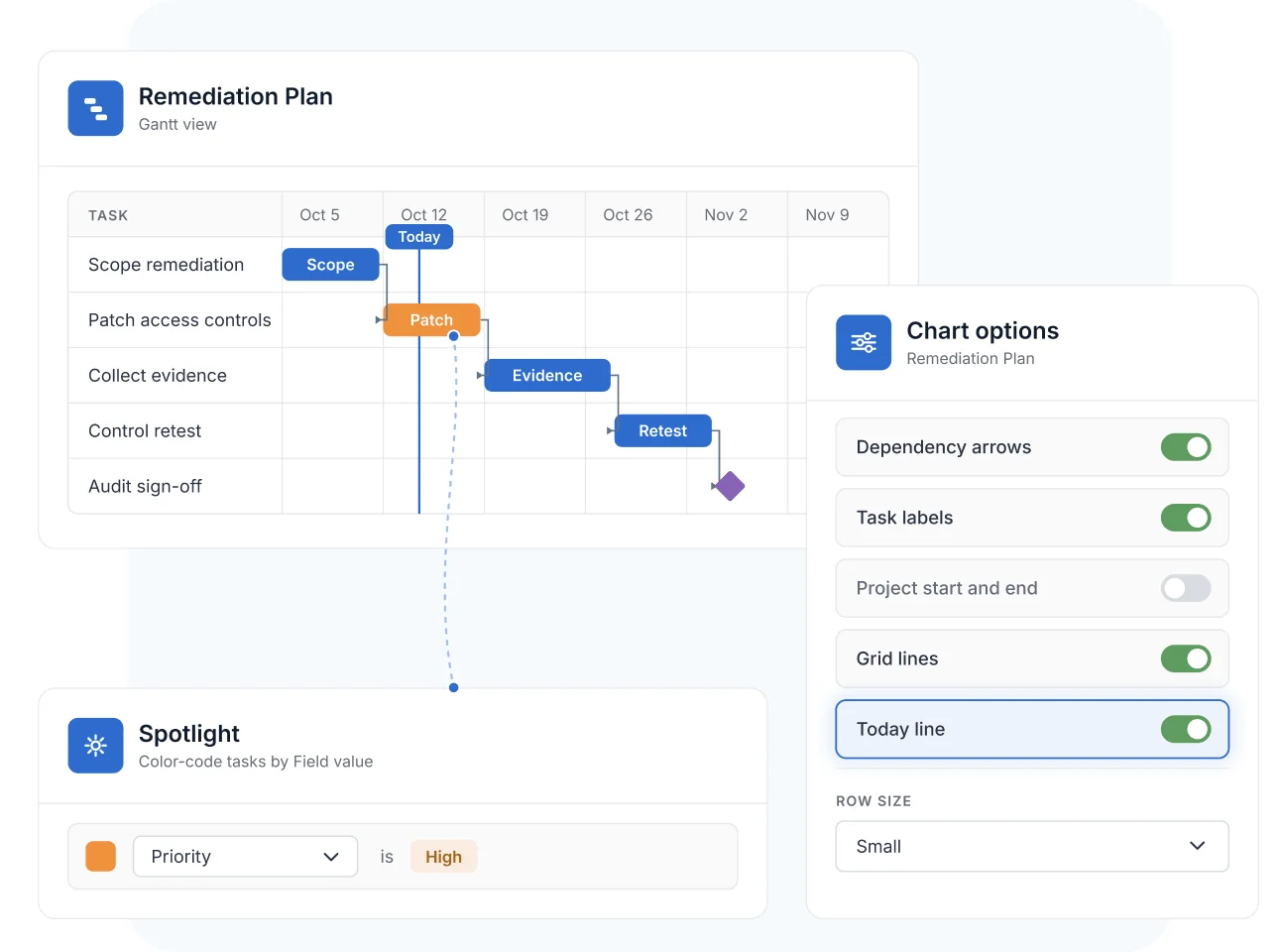
Show or hide dependency arrows, task labels, project start and end markers, grid lines, and a Today line to match the audience—full detail for the delivery team, clean lines for the steering committee. Spotlight color-codes tasks by Field value or condition, and rows size from Small to Extra Large.
Shared Gantt charts support access controls, including passcode protection, for stakeholders outside the workspace.
Gantt Charts
When governed work has to happen in order—and slipping one task moves ten more—Gantt Charts keep the sequence, the dates, and the accountability in one governed chart.
Sequence remediation tasks where fixes depend on completed prerequisites; blocked tasks show in red and active work stays highlighted, so finding owners see exactly what's holding closure.
Model a business continuity exercise where recovery steps depend on completed prerequisites. Auto-scheduling recalculates the plan when the exercise window moves.
Work backward from the audit date with backward scheduling—evidence collection, control testing, and review tasks land as late as dependencies allow while still hitting fieldwork day.
Plan an ISO 27001 or SOC 2 readiness program as dependent phases with milestone diamonds at certification checkpoints, and critical-path shading showing which workstream drives the timeline.
Pair Gantt Charts with Task Management—each bar is a governed task Record with owners, checklists, and comments, so the chart and the work never drift apart.
Gantt Charts (Gantt View) are SmartSuite's project-management View type—a combined grid-plus-timeline chart that tracks tasks, dependencies, and milestones, with auto-scheduling and critical-path highlighting built on the Dependency Field.
A Gantt View needs a Dependency Field on the Table, paired with a date Field such as Due Date. The Dependency Field stores each task's predecessor and successor links, which drive the chart's arrows and auto-scheduling.
Standard mode supports Finish-to-Start dependencies. Advanced mode adds Start-to-Start, Finish-to-Finish, and Start-to-Finish relationships plus lead and lag offsets—Advanced mode is available on Professional and Enterprise plans.
When a task moves or resizes, dependent tasks shift automatically according to their dependency type and lead or lag values. Forward scheduling places tasks as early as possible; backward scheduling works back from the deadline. Auto-scheduling can be toggled off per task for manual dates.
Yes. Gantt Charts render the same Records as Grid, Card, and Kanban Views of the Table—switching Views changes the lens, not the data. The Dependency Field also displays in Grid and Kanban Views.
Yes. Gantt charts can be shared with access controls, including passcode protection, so external stakeholders see a live chart without joining the workspace.
Gantt Charts are available on all paid SmartSuite plans—Team, Professional, Enterprise, and Signature. Advanced dependency mode (all four relationship types plus lead/lag) requires Professional or Enterprise.
Ship on the Date the Chart Says
Model the dependencies once—then let auto-scheduling and critical-path highlighting keep the plan honest.