



Formulas — Calculations That Keep Themselves Current
Compute values from other fields with functions and operators that recalculate in real time—risk scores, days to deadline, and contract totals that are never stale.
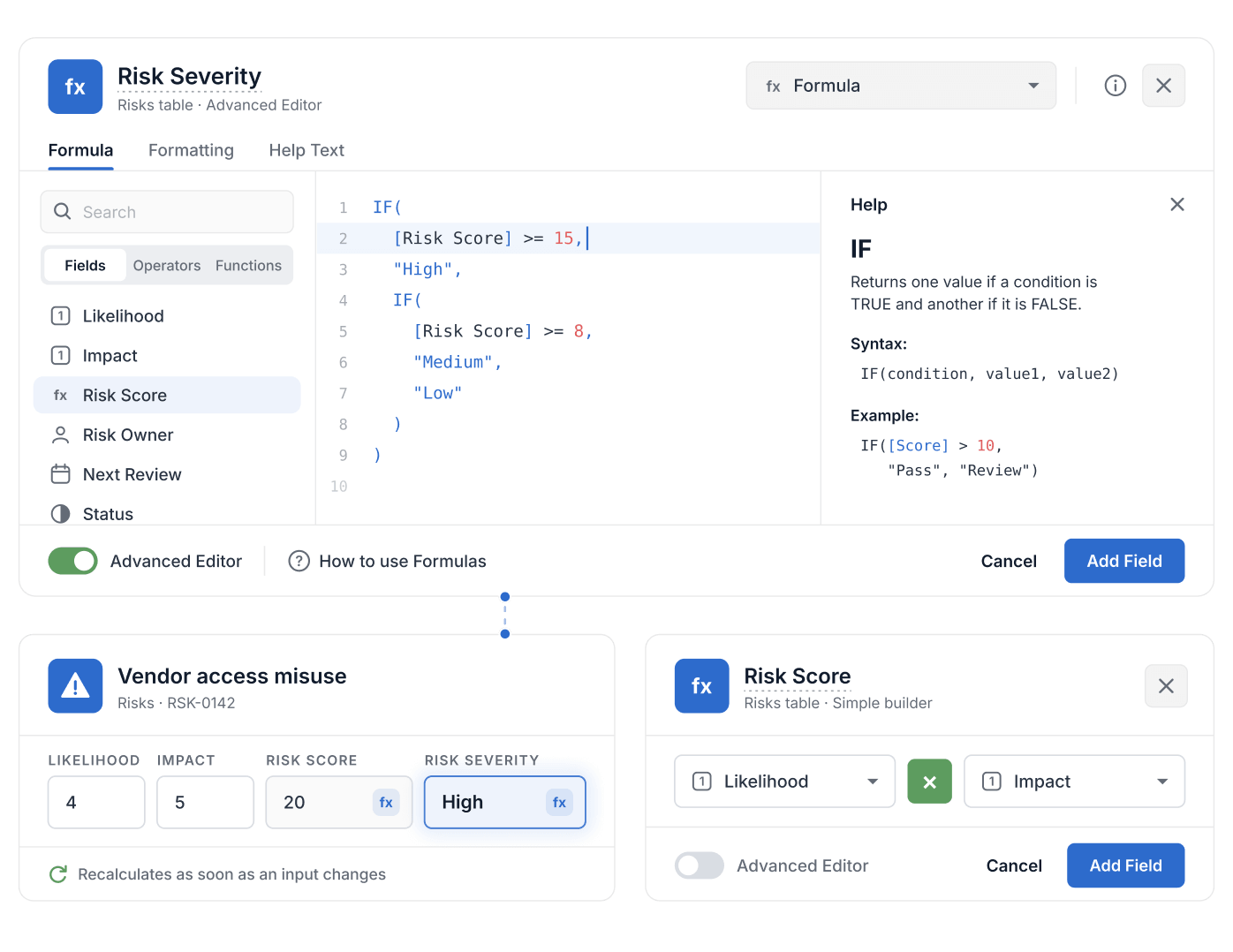
- Formula fields are available on every plan and are created by Solution Managers.
- Formulas calculate numbers, apply conditions and build text from other fields, and results update as data changes.
- Per Table, Formula, Rollup and Count fields share a combined limit of 30 on Team, 50 on Professional and 100 on Enterprise.
- Linked record references use dot notation up to 3 levels deep, and conditional functions must return one data type.
- Results format as number, currency or date with precision, separators and abbreviations.
What Are Formulas?
Formulas is a SmartSuite field type that calculates a value automatically from other fields in a Record, using functions and operators, and updates in real time as the underlying data changes. It helps GRC, IT, project, and business operations teams compute scores, dates, totals, and labels without spreadsheets on the side—outputs that feed directly into saved Views, charts, and reports. Formula fields are available on every SmartSuite plan and can reference data across Linked Records.
Real-Time Results
Compute Values That Update the Moment Data Changes
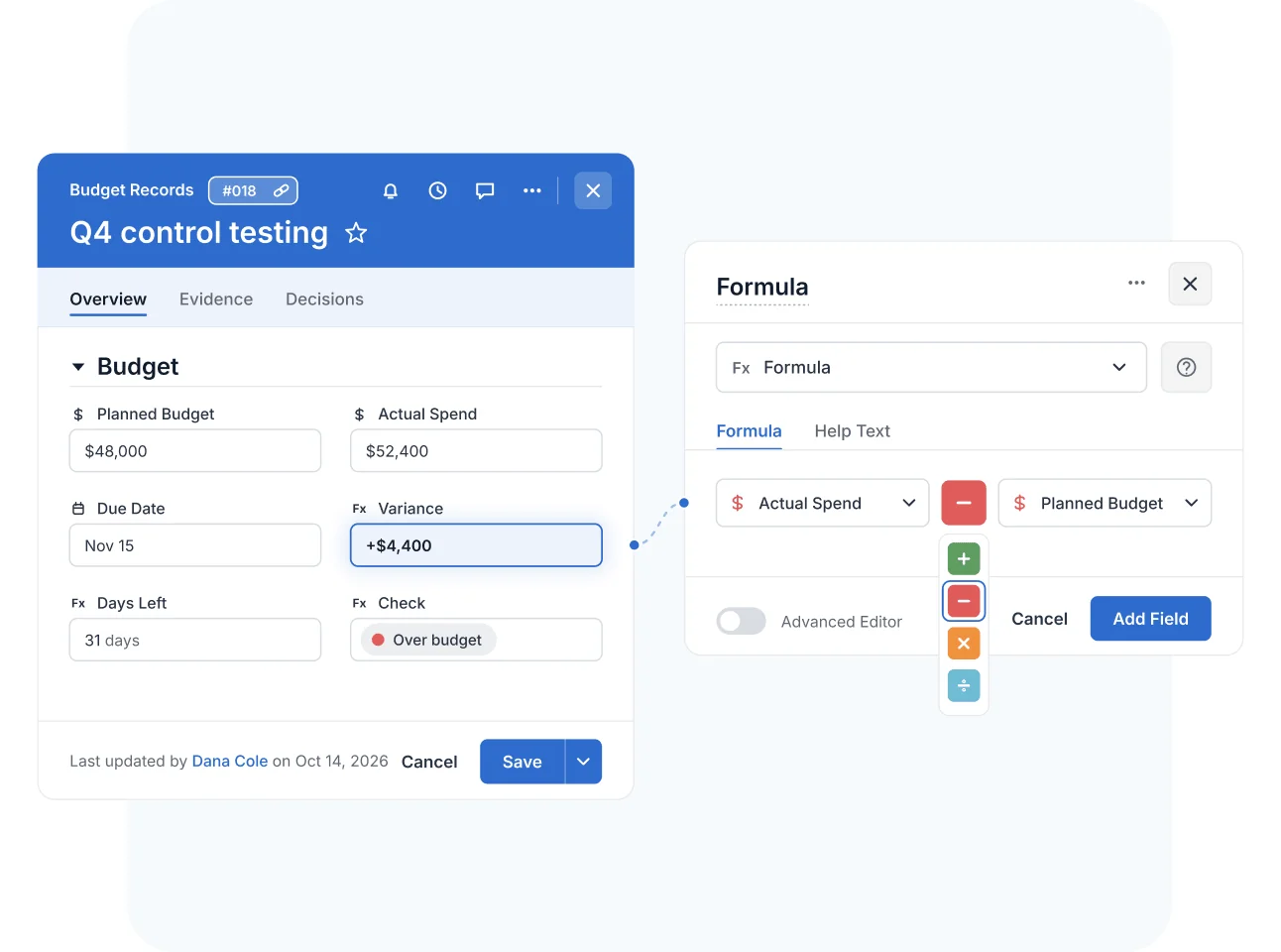
A Formula field combines arithmetic and comparison operators with the Record's own fields—budget variance from actuals and plan, days remaining from a due date, a pass/fail flag from a threshold. When an input changes, the result recalculates instantly.
No refresh, no re-run, no stale copy of the truth.
Function Library
Build Logic With Math, Text, Date, and Conditional Functions
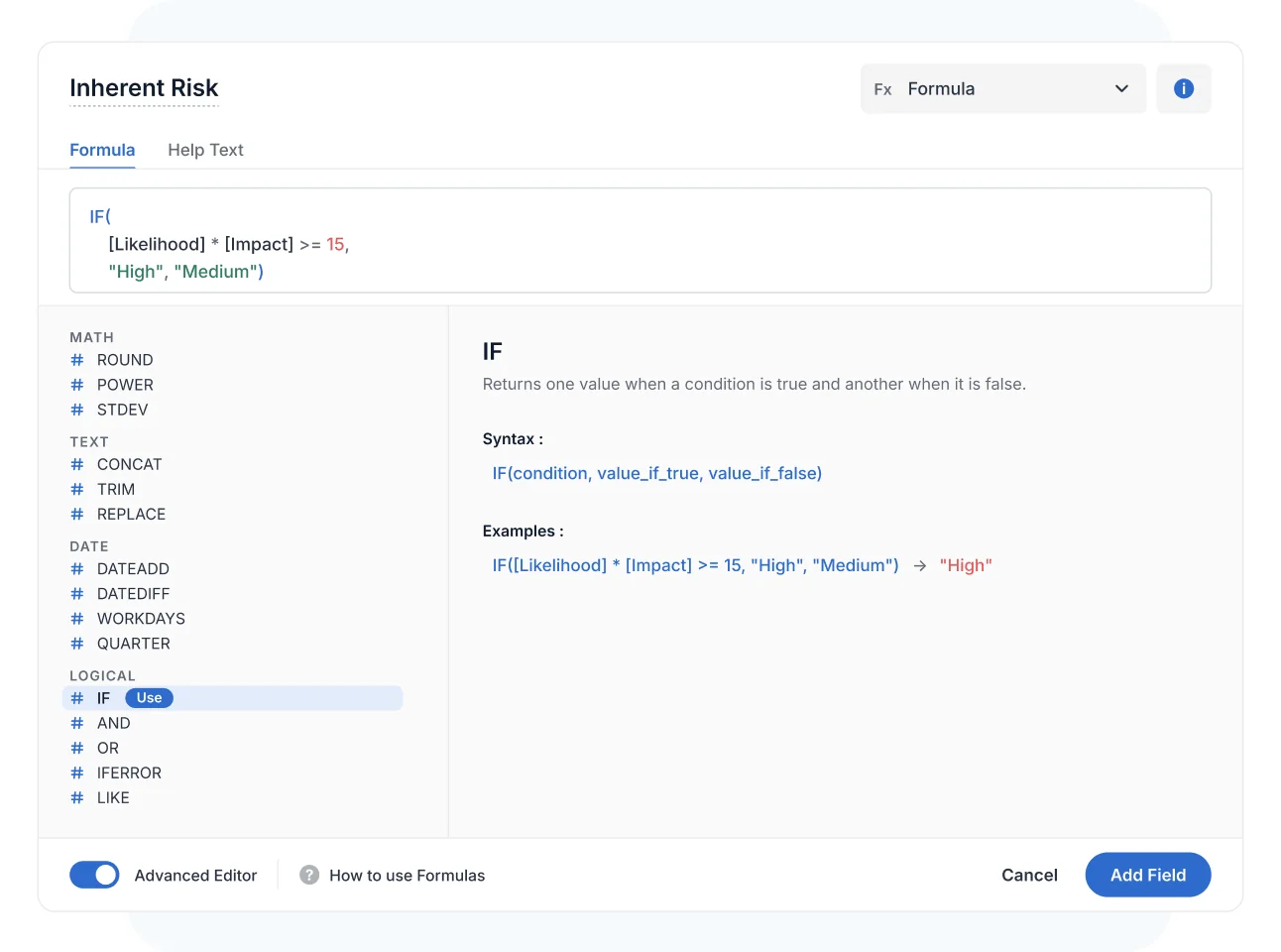
The function library covers mathematical functions like ROUND, POWER, and STDEV; text functions like CONCAT, TRIM, and REPLACE; date functions like DATEADD, DATEDIFF, WORKDAYS, and QUARTER; and logical functions—IF, AND, OR, IFERROR, and LIKE for wildcard matching. Conversion and array functions handle formatting and multi-value fields.
Outputs can be text, numbers, or dates, formatted the way the audience needs them.
Across Relationships
Aggregate Linked Records Inside a Formula
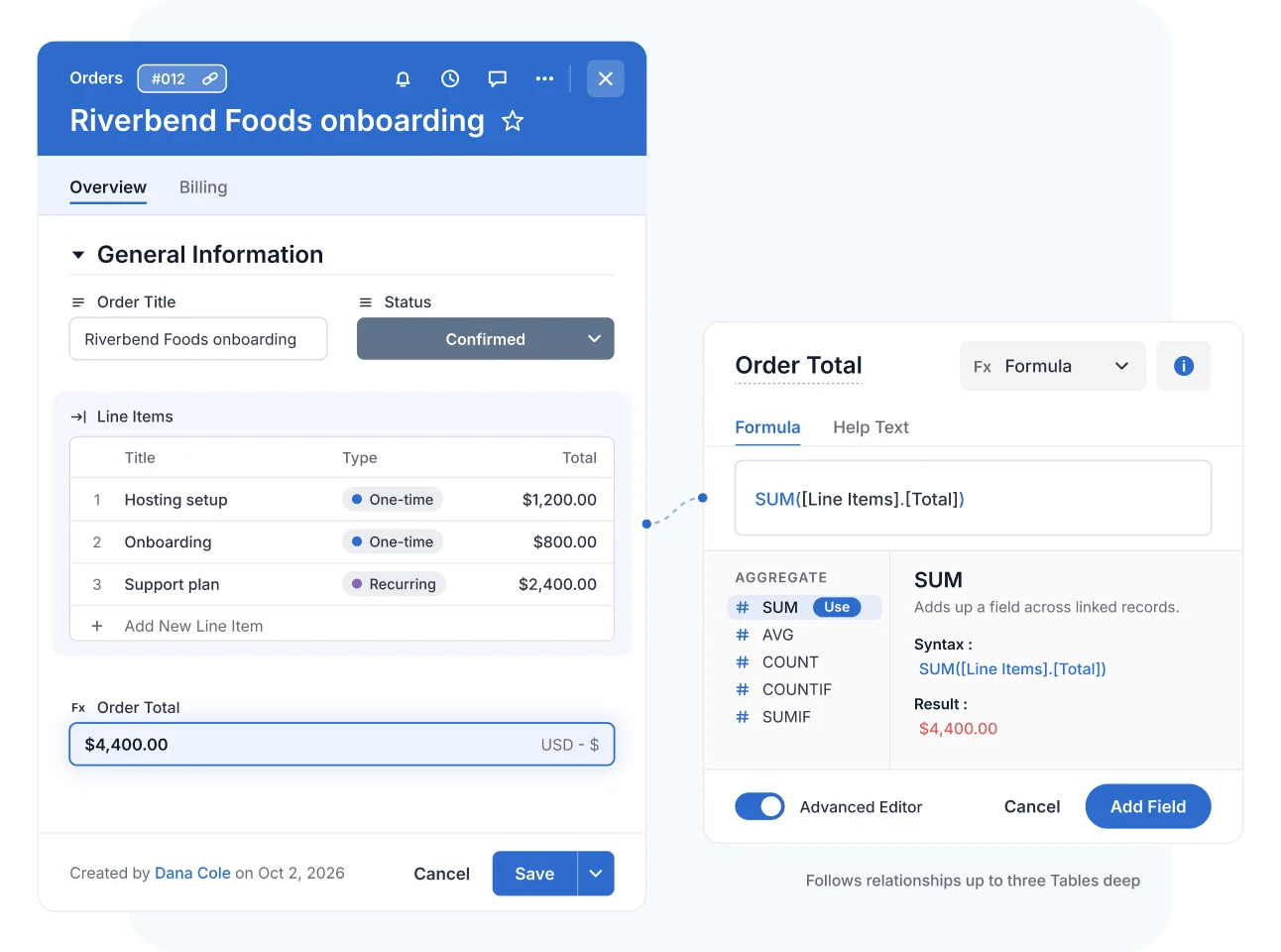
Formulas reach across Linked Records with aggregate functions—SUM, AVG, COUNT, COUNTIF, SUMIF, and more—so an order can compute SUM([Line Items].[Total]), or a project can average completion across its tasks. Reference chains follow relationships up to three Tables deep.
Cross-table math lives in the data model, not in an export someone rebuilds every month.
From Field to Report
Feed Computed Values Into Views, Charts, and Automations
Formula outputs behave like any other field value: filter and group saved Views by a computed score, chart a calculated metric, or use a formula-driven value in reporting. Calculated-field counts scale by plan—30 per Table on Team, 50 on Professional, and 100 on Enterprise and Signature.
The logic is defined once by a Solution Manager and consistent for everyone who reads it.
Formulas
Governed metrics should be computed by the platform, not maintained by hand—Formulas make scores, ages, and totals part of the Record itself.
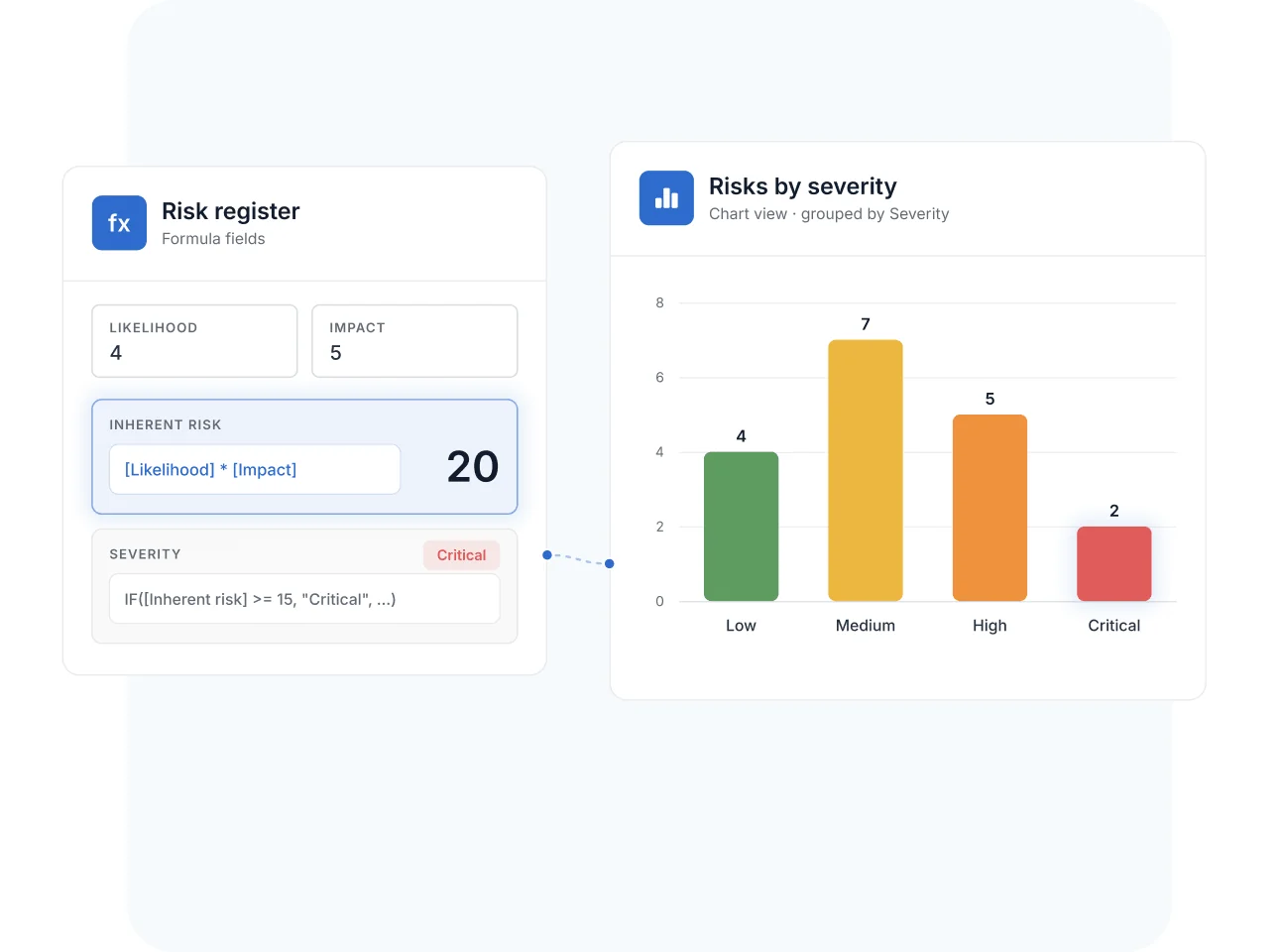
Multiply likelihood by impact in a Formula field to compute inherent risk, then apply IF logic to band results into severity tiers—scored consistently across the whole register.
Use DATEDIFF and TODAY to compute days since the last test and days until the next one, then filter Views to the controls drifting toward overdue.
Calculate days remaining against each finding's remediation target with date functions, and flag at-risk items with conditional logic before the deadline passes—not after.
CONCAT severity, framework, and business-unit fields into one formatted reference label so registers, reports, and escalation emails all describe the finding the same way.
Pair Formulas with Linked Records to compute across relationships—total remediation cost per audit, or summed contract value per vendor.
It is a computed field that calculates a value automatically from other fields in a Record using functions and operators, and updates in real time as the underlying data changes. Outputs can be text, numbers, or dates.
The library spans mathematical functions (ROUND, POWER, STDEV, SUM), text functions (CONCAT, TRIM, REPLACE), date functions (DATEADD, DATEDIFF, WORKDAYS, QUARTER), logical functions (IF, AND, OR, IFERROR, LIKE), plus aggregate, array, and conversion functions.
No. Formulas are written in a spreadsheet-style expression language with named functions and field references—familiar to anyone who has written an Excel formula, with no scripting involved.
Yes. Formulas reference linked-record data with aggregate functions like SUM([Line Items].[Total]), following relationship chains up to three Tables deep (A to B to C).
Calculated-field counts scale by plan: 30 per Table on Team, 50 on Professional, and 100 on Enterprise and Signature. Formula fields are available on all SmartSuite plan types and managed by Solution Managers.
Yes. Formula outputs feed saved Views, charts, and reports like any other field—group a View by computed severity, or chart a calculated metric that recalculates as source data changes.
The calculation is defined once on the field and applied identically to every Record—no per-spreadsheet variants of the risk formula. Combined with Activity History on source fields, teams can show how a score is derived and when inputs changed.
Retire the Side Spreadsheet for Good
Define the calculation once and let every Record keep its own score, age, and total—current the moment data changes.