

In every financial institution I’ve worked with, global banks, mid-sized institutions, credit unions, and fintechs, one theme has grown louder with each passing year: most modern financial-services risks now originate outside the institution.
Processes depend on vendors.
Infrastructure depends on cloud providers.
Data flows through external systems.
Operational continuity relies on partners.
The third-party ecosystem is no longer “supporting infrastructure.” It is the infrastructure.
Yet despite this new reality, third-party risk management (TPRM) practices have not kept pace with the scale, speed, or interconnectedness of today’s vendor landscape. Institutions still rely on questionnaires, point-in-time reviews, SOC reports, control attestations, and manual re-assessments that produce an overwhelming amount of information, but not enough insight.
Vendor risk has always been complex. Now it is systemic. And systemic risk requires a systemic approach.
This is where the Cyber Risk Institute’s CRI Profile is beginning to transform third-party oversight in financial services, by giving institutions something they’ve never had before: a shared diagnostic structure that connects vendor controls to internal controls in a meaningful, consistent, interpretable way.
The Third-Party Risk Problem No One Has Solved
Financial institutions depend on hundreds, often thousands, of vendors. But vendor risk programs typically suffer from four structural weaknesses:
1. Vendor assessments are not aligned to internal control expectations.
Banks often evaluate vendors using questionnaires that do not map back to their own cyber or resilience frameworks.
2. Every vendor speaks a different control language.
Some follow NIST.
Some follow ISO.
Some use SOC 2 criteria.
Others follow internal or proprietary models.
3. Vendor maturity cannot be compared consistently.
Without a shared diagnostic standard, “high maturity” from one vendor may mean something entirely different from another.
4. Vendor issues do not naturally map into the institution’s risk workflows.
Teams often need to translate vendor findings into their own control taxonomy, a manual and error-prone exercise.
These problems produce what I call TPRM fog, an overwhelming quantity of assessments, reports, and artifacts that do not translate cleanly into internal frameworks, operational workflows, or board-level narratives.
Financial institutions don’t need more vendor data. They need aligned vendor insight.
Why CRI Is Becoming the Anchor Framework for Vendor Alignment
The CRI Profile provides something the industry has never had before:
a harmonized, diagnostic structure that internal teams and vendors can align to.
Its diagnostic statements describe:
- Cybersecurity expectations.
- Technology governance.
- Operational resilience.
- Incident readiness.
- Access and identity assurance.
- Third-party oversight.
- Continuity and recovery expectations.
Because diagnostics focus on outcomes, not prescriptive controls, they serve as a bridge between:
- Internal controls.
- External vendor controls.
- Regulatory expectations.
- Audit structures.
- Resilience models.
- Cyber maturity scales.
This is the core shift:
CRI gives institutions and vendors a shared maturity baseline.
And that shared baseline collapses years of fragmentation, translation, and misalignment.
How CRI Aligns Vendor Risk with FS Controls
1. Vendors can now assess themselves using the same diagnostic statements.
Instead of mapping to dozens of frameworks, vendors anchor their security posture to CRI’s diagnostic backbone.
2. Internal teams evaluate vendors using the same lens they evaluate themselves.
No more crosswalks. No more translating vendor reports into internal taxonomies.
3. Vendor evidence becomes interoperable.
Artifacts from vendors map naturally into CRI diagnostic expectations, making evidence reusable across cyber, risk, audit, and resilience.
4. Vendor risk scoring becomes consistent.
Instead of custom scoring models, vendor maturity aligns to CRI’s diagnostic grading, comparable, explainable, defensible.
5. Vendor issues map directly into internal remediation workflows.
CRI-aligned gaps feed into the same issue management lifecycle used internally.
6. Vendor monitoring aligns to continuous assurance.
Signals from vendor tools now map into CRI outcomes, supporting continuous oversight.
The result is a unified ecosystem where internal controls and external controls speak the same language.
Why This Matters Now
Third-party risk is no longer a “compliance function.” It is deeply intertwined with:
- Cyber posture.
- Resilience capability.
- Operational continuity.
- Regulatory compliance.
- Business model viability.
Financial institutions outsource critical functions at a scale unimaginable a decade ago. Cloud, payments, analytics, fraud, customer service, infrastructure, all increasingly externalized.
The financial-services supply chain is now digital, and digital supply chains require unified governance structures.
CRI is the first model that makes it possible.
Where SmartSuite Brings CRI + TPRM to Life
CRI provides the shared language. SmartSuite provides the workflow engine.
Inside SmartSuite:
- CRI diagnostic statements become the structure of vendor assessments.
- Vendor controls map directly into internal controls.
- Vendor gaps map into internal remediation workflows.
- Vendor evidence anchors to internal evidence repositories.
- Vendor events update internal metrics.
- Vendor maturity updates real-time dashboards.
- Third-party risk aligns with cyber, compliance, audit, and resilience workflows.
This turns third-party risk into part of the same narrative that governs internal risk, not a bolt-on function.
Instead of treating vendors as external entities with external models, SmartSuite and CRI bring them into the same diagnostic ecosystem that governs the institution.
This is the future of TPRM, not parallel, but integrated.
The Promise of a Truly Connected Vendor Ecosystem
When institutions and vendors share a diagnostic language, several things become possible:
1. Vendor ecosystems can finally be compared and benchmarked.
Institutions can assess hundreds of vendors using the same maturity scale.
2. Vendor evidence becomes reusable across domains.
Audit, cyber, resilience, and compliance can draw from the same artifacts.
3. Vendor oversight moves from static to continuous.
Monitoring signals map directly to diagnostic expectations.
4. Vendor issues flow seamlessly into internal issue management.
One gap → one workflow → one narrative → one closure path.
5. Vendor risk becomes operationally connected to internal controls.
The distinction between “inside risk” and “vendor risk” begins to dissolve.
This is a paradigm shift, not in vendor quantity, but vendor alignment.
Conclusion: CRI Is the Future of Third-Party Alignment
The financial-services vendor ecosystem is too complex, too interconnected, and too critical to manage through fragmented frameworks and inconsistent maturity models.
Institutions need a unified way to evaluate, compare, remediate, and govern third-party risk.
CRI provides the shared structure.
SmartSuite provides the workflow.
Combined, they create something the industry has long needed: a unified model for aligning vendor maturity with financial-services controls.
The future of TPRM is not more assessments; it is more alignment.
Not more evidence, more meaning.
Not more tools, more connection.
CRI + SmartSuite is how the industry gets there.
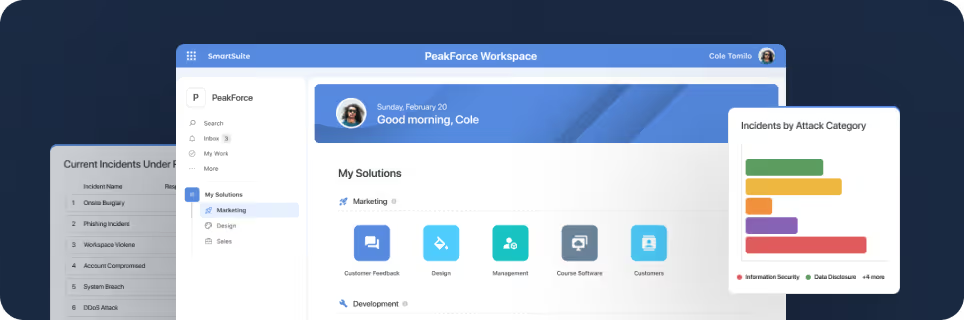
SmartSuite provides work platform for standardizing workflows in the following areas:
- Governance, Risk & Compliance
- IT & Service Ops
- Project / Portfolio Management
- Business Operations