
I'll map risk management tools against 5 levels of program maturity, show which tools fit each level, walk through how the main platforms handle the risk domains that matter, and close with a self-assessment you can run in about 15 minutes.
What are the different types of risk management software?
I’d argue that the clearest way to sort the market isn't by vendor category. It's by the kind of risk program the software was built to support.
Five maturity levels show up in practice, and most tools land cleanly inside one of them:
Level 1: Certification-anchored risk programs
At this level, risk exists mostly to support a security certification. The risk register is a requirement of SOC 2 or ISO 27001, not a standalone program.
Scoring is light, usually likelihood times impact on a three-by-three or five-by-five grid.
Treatment plans map directly to controls, because the real work is evidence collection.
Tools that fit here include Vanta, Drata, Secureframe, Sprinto, Scytale, Scrut Automation, and Thoropass.
They were built around the certification, and their risk modules are optimized for that reality, which means that they can be highly effective for organizations looking to get certified as quickly as possible, regardless of the cost.
Level 2: Structured operational risk
Once a team outgrows certification-only thinking, risk starts covering operational domains.
Incident management, business continuity, third-party vendors, SOX controls, and internal audit begin sitting alongside compliance.
The methodology gets more structured, too:
- Inherent versus residual scoring.
- Control effectiveness testing.
- KRI tracking against thresholds.
Tools that fit here include Hyperproof, VComply, OneTrust, ZenGRC, StandardFusion, and SureCloud.
Level 3: Connected enterprise risk
This is where risk stops being a siloed program and starts connecting to the rest of the business.
- Risks are linked to operations, projects, and vendors directly.
- Controls tie to incidents and remediation tasks.
- The risk team stops being the bottleneck because business unit owners can participate without leaving their daily tools.
Tools that fit here include SmartSuite, LogicGate, Onspring, Resolver, and Protecht.

Each takes a no-code or configurable approach, with SmartSuite going deepest on the connected-operations angle.
Level 4: Quantified enterprise risk
Some programs quantify:
- FAIR models.
- Monte Carlo simulations.
- Scenario stress testing.
The risk team translates exposure into dollars and gives the board a defensible number.
At this level, methodology depth becomes a hard requirement. A tool without real quantification support will find it difficult to serve the program.
Tools that fit here include Archer IRM, MetricStream, IBM OpenPages, LogicGate (through Risk Cloud Quantify), Axio, Safe Security, Kovrr, and SAI360.
Level 5: Regulated enterprise risk
At the top of the maturity curve sit the programs running inside banking, insurance, energy, pharma, and the public sector.
Regulatory reporting obligations, multi-entity consolidation, and decades-long audit trails drive the tool requirements.
These platforms ship with pre-mapped regulatory content, horizon scanning feeds, and board governance capabilities.
Tools that fit here include ServiceNow GRC, NAVEX, SAP GRC, IBM OpenPages, Riskonnect, Diligent, Optro (formerly AuditBoard), Workiva, and Archer IRM.
Product heritage matters at this level:
- Riskonnect's insurance roots show up in how it handles loss scenarios.
- SAP GRC is designed for SAP-native enterprises.
- Diligent leads on board governance reporting.
Most buyers end up at Level 2 or Level 3.
The common mistake is shopping at Level 1 because it's cheapest and easiest to deploy, then outgrowing the tool inside 18 months when the program matures.
What factors to evaluate when selecting risk management platforms?
The risk domains a platform needs to handle in 2026 go well past the SOC 2 checklist most vendors grew up supporting.
Here's how the main tools stack up across the domains that actually matter right now.
Cyber and IT risk
Every tool in this guide claims to handle cyber risk.
The real question is whether the platform models cyber risk as its own discipline, with vulnerability data, threat intelligence feeds, and control testing tied to a recognized framework (NIST CSF, CIS, ISO 27005).
Compliance-led tools like Vanta and Drata pull cyber signals from cloud telemetry and map them to controls, which covers hygiene well but leaves threat modeling thin.
Archer IRM, IBM OpenPages, and MetricStream bring dedicated cyber risk modules with pre-built threat libraries.
SmartSuite's approach links cyber risks directly to the assets, services, and incident workflows they affect, which fits how IT ops teams actually triage risk.
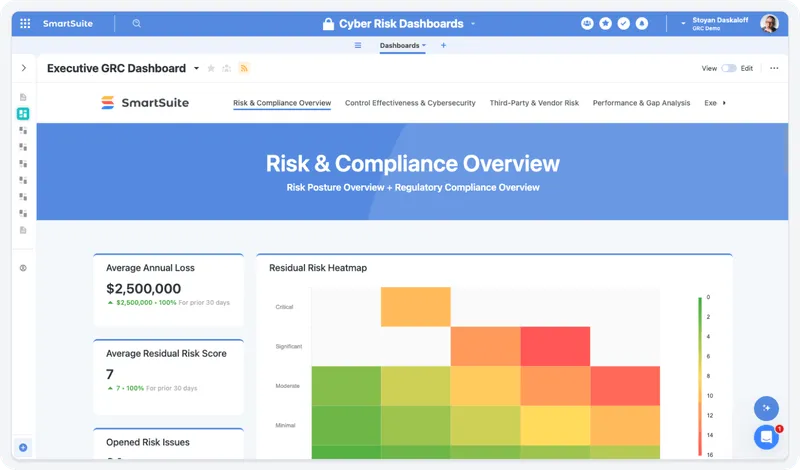
Interested in seeing SmartSuite’s cybersecurity in action?
You can see how SmartSuite helps organizations protect assets, manage risks, and respond to threats in one connected cybersecurity platform below:
Third-party and vendor risk
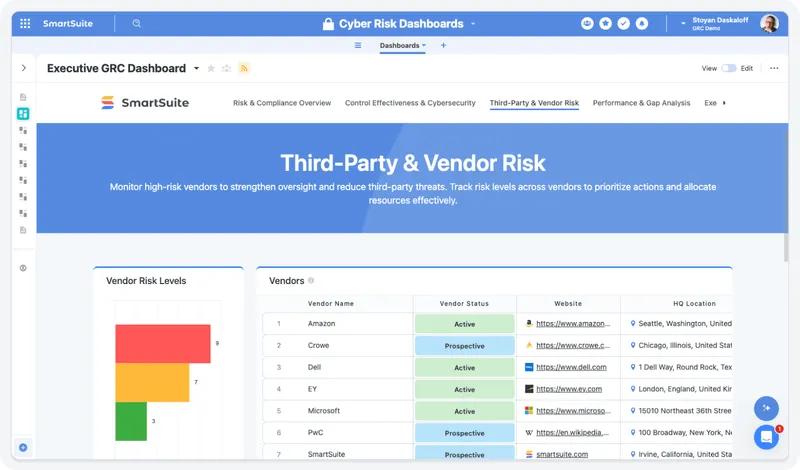
Third-party risk has become its own category of buying decision.
OneTrust, Prevalent, and Riskonnect run deep here, with questionnaire engines, continuous monitoring, and portfolio aggregation.
Compliance-led tools treat vendor risk as a lightweight add-on, usually a basic questionnaire and a risk rating.
The gap shows up fast once a team needs to manage hundreds of vendors with staggered reassessment cycles.
Connected platforms like SmartSuite and LogicGate let you model vendor risk the way your program needs it, including inherent vendor tiering, continuous control validation, and onboarding workflows that tie into procurement.
AI governance
The EU AI Act's first enforcement phase kicked in during 2025, and NIST's AI Risk Management Framework is now the reference most US regulators cite.
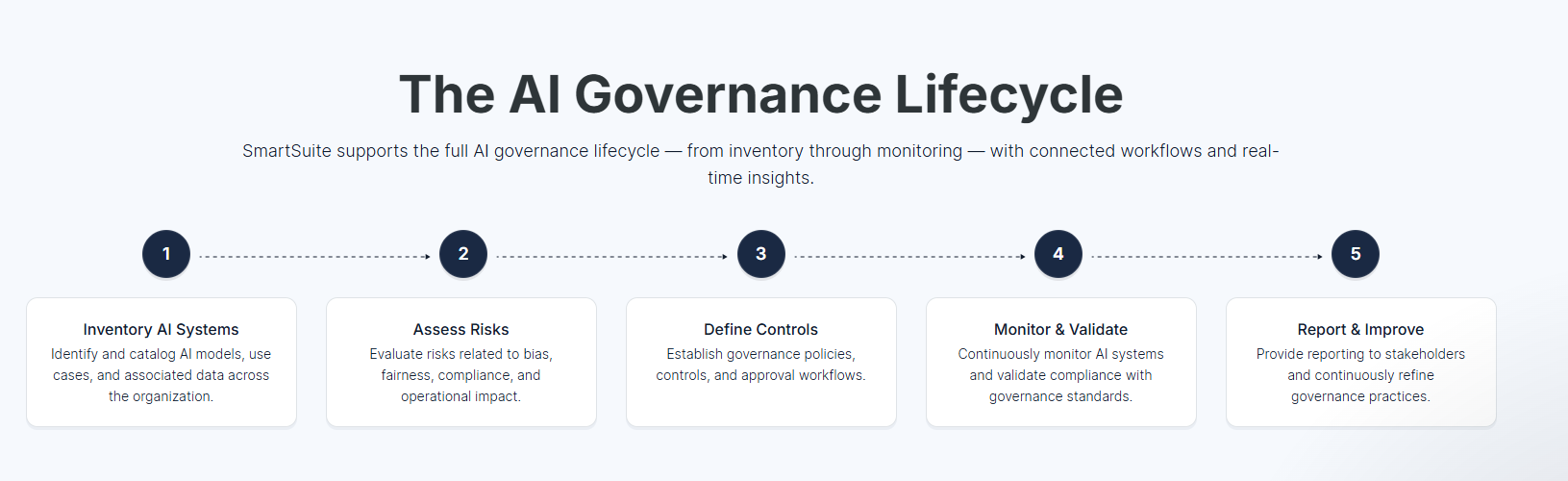
Risk teams need to maintain AI model inventories, classify use cases by risk tier, run impact assessments, and document human oversight.
Few tools ship with purpose-built AI governance yet. OneTrust and IBM OpenPages have moved fastest on native AI modules.
SmartSuite handles AI model inventories, risk assessments, and lifecycle monitoring inside the same workspace as the rest of the risk program, which matters because AI risk touches operational, third-party, and regulatory domains at once.
Operational resilience
DORA hit full enforcement in January 2025 for EU financial services, NIS2 widened scope across critical sectors, and the UK’s operational resilience rules remain active.
For buyers affected by any of these, the platform needs to handle impact tolerance mapping, important business service identification, scenario testing, and third-party service chain analysis.
Archer IRM, Riskonnect, Protecht, and MetricStream have mature resilience modules.
SmartSuite handles resilience inside connected workflows, linking business services to the risks, vendors, and controls that support them.
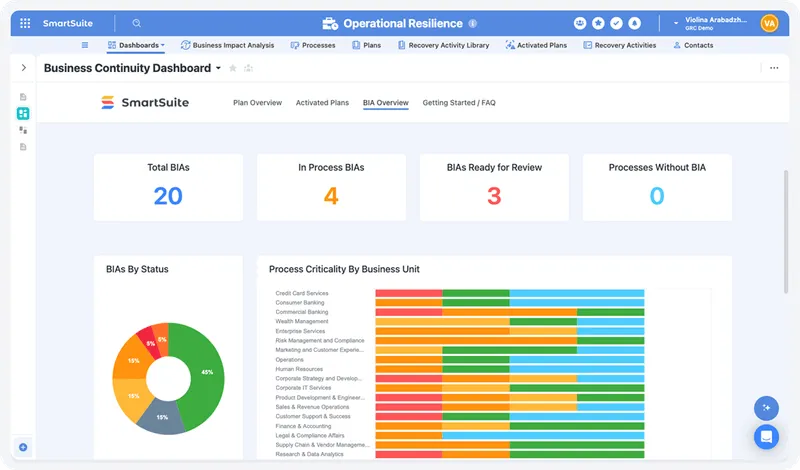
You can see our operational resilience in action here:
Climate and ESG risk
CSRD reporting obligations came online for the largest EU entities in 2025 for FY2024 data.
The 2025 EU Omnibus simplification package significantly narrowed the scope: now only companies with 1,000+ employees and €450M+ turnover are in scope, and Wave 2 reporting was postponed to FY2027.
Workiva leads on narrative ESG reporting, and Diligent and SAI360 have added climate risk modules.
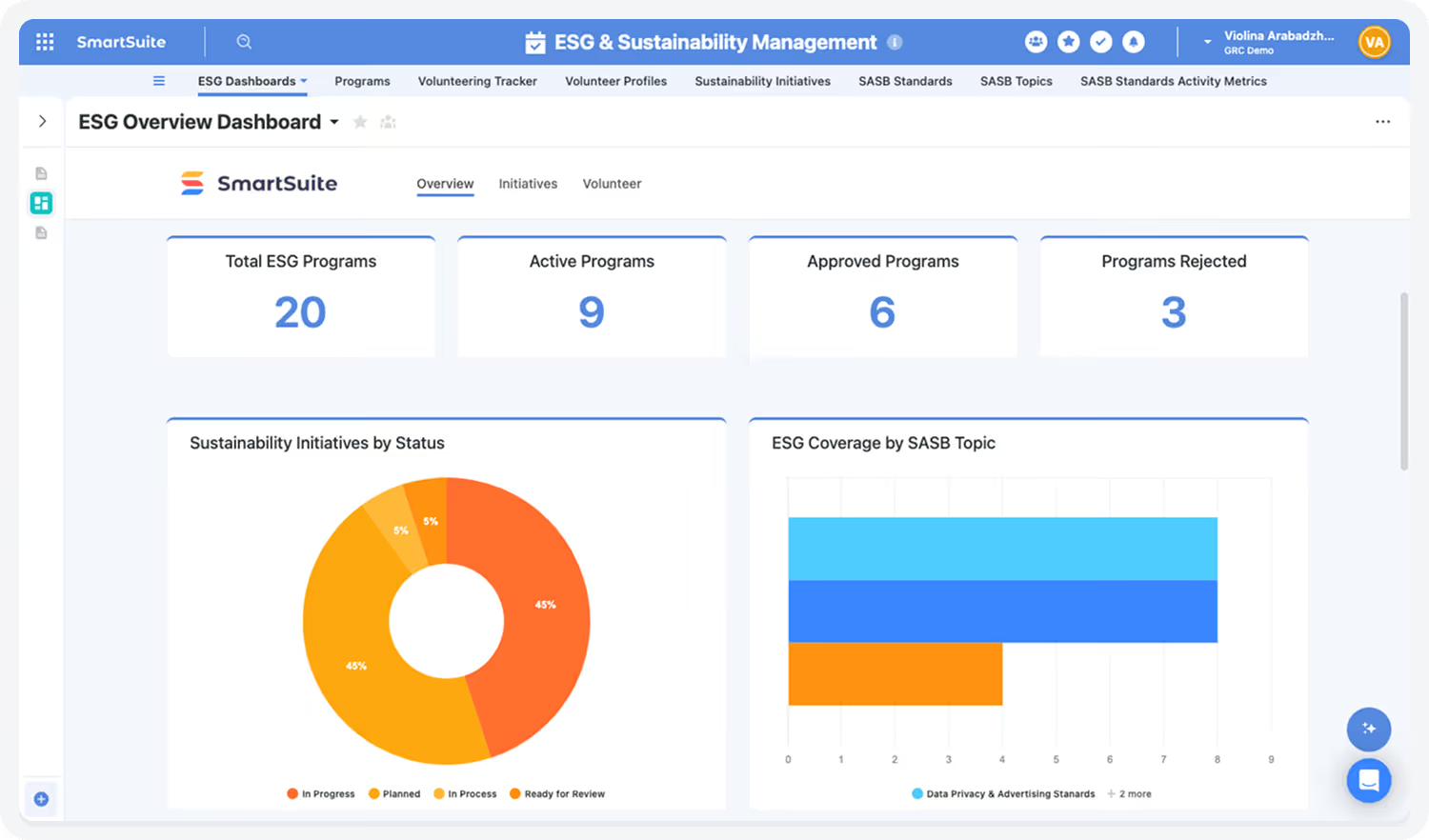
SmartSuite covers ESG tracking alongside the rest of the risk program, which keeps climate risk connected to the operational and financial domains it intersects with.
Enterprise risk aggregation
At higher maturity levels, the program depends on aggregation:
- Rolling up business unit risks to the enterprise view.
- Tracking KRIs against board-approved appetite statements.
- Producing residual risk trends over time.
This is where tools diverge most visibly.
ServiceNow GRC, IBM OpenPages, MetricStream, and Archer IRM have decades of aggregation engineering behind them.
SmartSuite's relational data architecture supports multi-level aggregation with role-aware views, which lets the CRO and business unit owners see the same data shaped for their decisions.
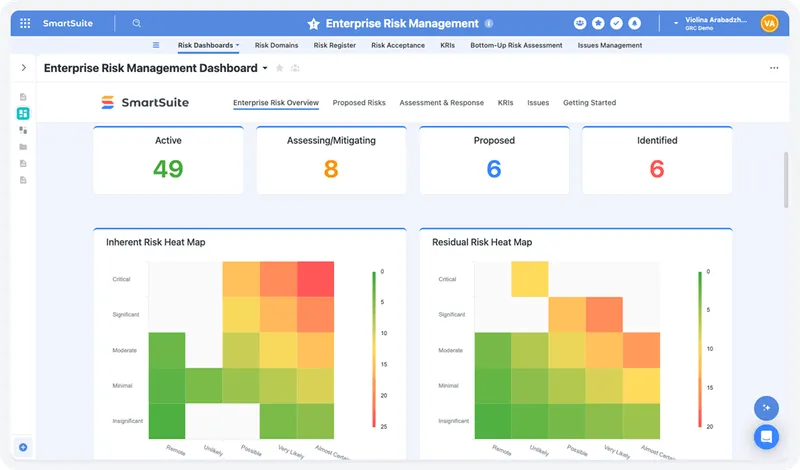
See our enterprise risk management in action:
The connected-operations question
I’ve seen many buyers miss this one evaluation angle: how well does the risk tool connect to the operational work it's supposed to govern?
- A risk flagged on a vendor onboarding should link to the procurement record.
- An incident should be tied to the service it affected.
- A control failure should open a remediation task in the team that owns the control.
Most risk tools treat this as an integration problem: a webhook into Jira or ServiceNow, a scheduled sync, a CSV export.
SmartSuite treats it as a native one.
Risks, controls, incidents, vendors, projects, and remediation tasks live in the same connected workspace, which means the risk program sees what's happening in operations without relying on integrations to stay synchronized.
For teams working across GRC, ITSM, and project delivery, that eliminates the silo problem most risk programs fight constantly.
💡 We have recently partnered with the Cyber Risk Institute to deliver a CRI profile for U.S. Banks' compliance needs.
A 15-minute self-assessment
Before you open any vendor website, you can sit down and answer these eight questions honestly:
- What frameworks or methodologies does your risk program align with today?
- How many risk domains do you actively manage (cyber, operational, third-party, compliance, AI, climate, other)?
- How do you quantify risk, and does your board expect dollar-based exposure reporting?
- How many business unit owners need to participate in risk workflows, and what tools do they already live in?
- What's your current admin bandwidth to maintain a risk platform?
- Which regulations drive your reporting obligations, and which are on your 36-month roadmap?
- How does your risk program connect to operations, IT service management, and project delivery today?
- What's your honest three-year budget for tooling, services, and internal time?
The answers point to a maturity level, and the maturity level points to a short list of vendors worth evaluating.
Build your risk program on a platform that grows with it: try SmartSuite for free
Most risk management tools force a compromise.
- Certification-first tools get you audit-ready fast but leave you rebuilding when the program matures past a single framework.
- Enterprise suites bring the depth regulated programs need, with the implementation timelines, service bills, and admin overhead that come with enterprise software.
SmartSuite sits in the middle ground, and it's where most risk programs find room to grow.
It's a connected no-code platform where risk lives next to the operations, projects, and teams it governs.
The same workspace handles enterprise risk, cyber and IT risk, third-party risk, internal audit, compliance, incident management, operational resilience, AI governance, and ESG tracking, without separate modules or silos.
Here’s what that buys you in practice:
- A data model your team owns. Build risk taxonomies, assessment templates, KRI dashboards, and workflows with a no-code builder, more than 40 field types, and relational links between every object in your program.
- Risk is connected to the rest of the business. Controls link to services. Vendors link to contracts. Incidents link to remediation tasks. Nothing sits in a walled-off risk module your business partners can't reach.
- AI inside the work, not bolted on. You’ll be able to classify incoming risk events, summarize vendor assessments, draft audit findings, and flag control anomalies inside the records your team already uses, with full permission logging and bring-your-own-LLM support.
- Live dashboards for every role. The CRO, CISO, business unit risk owners, and internal audit each see the data shaped for their decisions, refreshed the moment it changes.
- Pricing you can plan around. Our pricing starts at $15/user/month, and every licensed user gets every SmartSuite solution (risk, GRC, ITSM, project management, operations).
It doesn’t matter if you're building your first enterprise risk register or running a multi-domain program.
Our platform can adapt to your methodology instead of forcing you to adapt to its template.
Start a free SmartSuite trial or book a demo to see how your team can manage governance, risk, and compliance in one place.
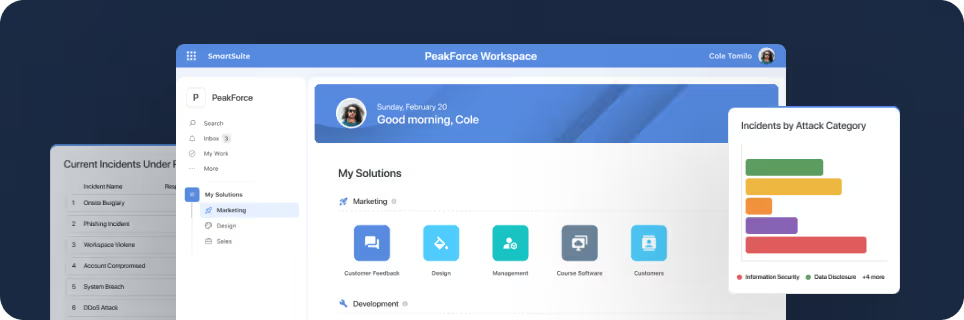
SmartSuite provides work platform for standardizing workflows in the following areas:
- Governance, Risk & Compliance
- IT & Service Ops
- Project / Portfolio Management
- Business Operations