

StandardFusion is often shortlisted by teams that take governance, risk, and compliance seriously because it promises a centralized place to manage frameworks, controls, risks, and audits without drowning in spreadsheets or ad hoc tools.
But when you move from “this looks powerful” to “what will this actually cost us every year?”, things get blurry.
Pricing isn’t published, packaging varies by module, and the total investment often goes beyond the subscription itself.
So, if you’re wondering how StandardFusion is priced, what drives costs up, and whether it still delivers solid value for growing GRC teams, this breakdown will help you get clarity before talking to sales.
In this guide, I’ll unpack what’s known about StandardFusion’s pricing model, where teams typically feel the trade-offs, and how it compares to other, more transparent no-code GRC software.
Let’s dive in.
Does StandardFusion offer a free plan or trial?
Most simply put - no.
StandardFusion keeps access to its platform closed off.
The website offers only two paths forward, and neither option gives you immediate hands-on experience with the product:
- You can request pricing by filling out a form.

- Or, you can book a demo with its team to see the platform in action first.
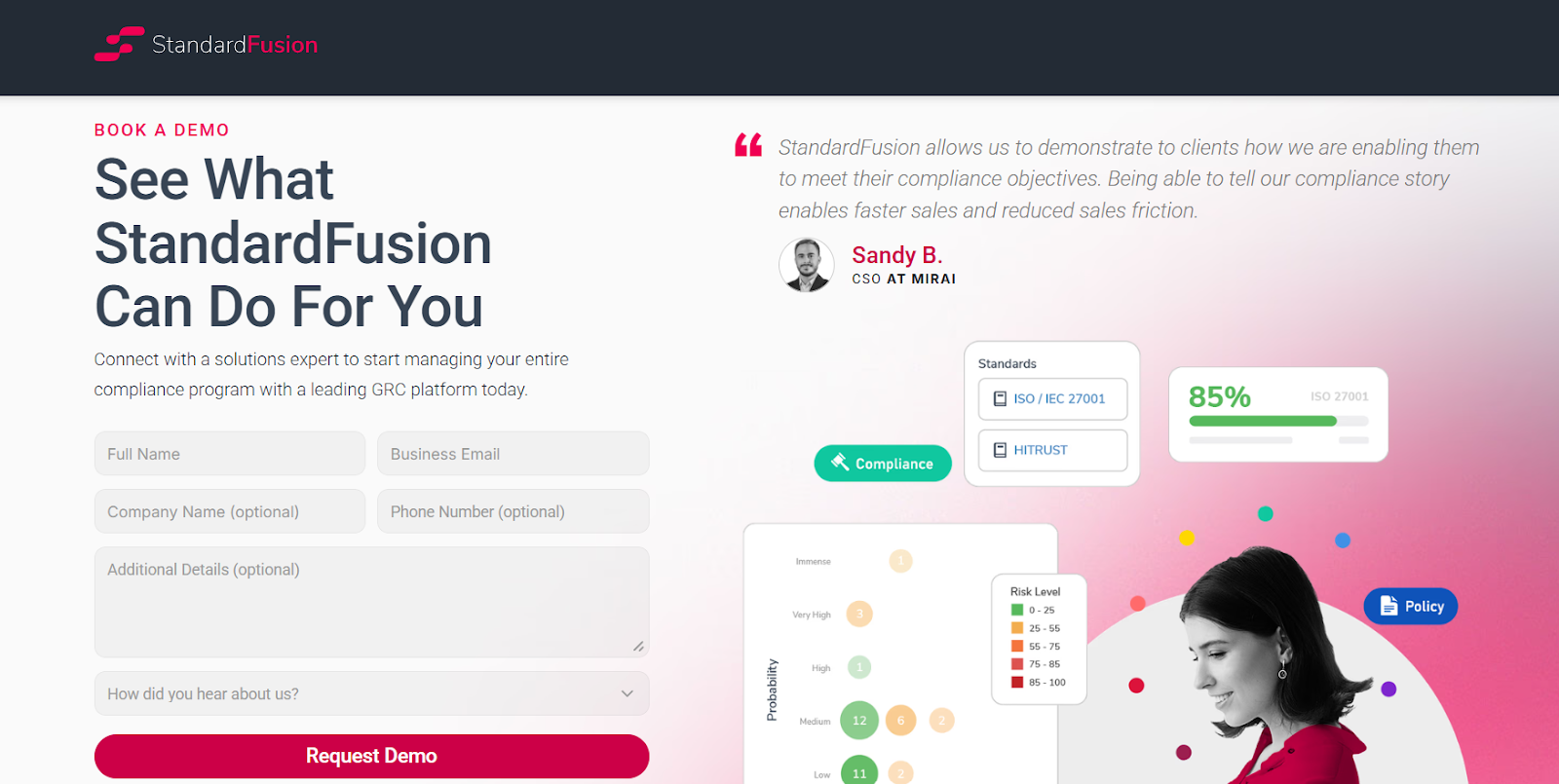
There’s no option to try it yourself, meaning that new users can’t experiment with core features without first engaging with the sales team.
So, if you want to see the platform, you’ll need to schedule a demo and wait for access, which may slow down early comparison and validation for buyers who prefer a quicker, self-guided trial process.
StandardFusion pricing plans
StandardFusion doesn’t publish a classic SaaS pricing table with named tiers, user limits, or feature bundles.
On its official pricing page, you’ll only see the form for requesting a custom quote, alongside messaging explaining you can tailor the platform to your GRC program across compliance, policy, audit, risk, vendor, incident, privacy, and business continuity.
In practice, this means StandardFusion runs on a quote-based subscription model, so pricing is probably dependent on factors such as:
- Number of users and stakeholders in your GRC program.
- Scope of modules you plan to use (e.g., risk, vendor, incident, privacy).
- Implementation and onboarding support.
- Any integration or configuration requirements.
Because StandardFusion doesn’t disclose list prices or plan names, the only way to get an accurate quote is to speak with the vendor.
Realistically, you should expect pricing to move based on how broad your GRC rollout is and how much help you need with setup and ongoing support.
How much does StandardFusion actually cost in 2026?
Because StandardFusion doesn’t publish pricing, the most reliable way to understand its real-world cost is to look at third-party purchasing data.
The strongest source available is Vendr, which aggregates actual contract values from verified buyers.
According to Vendr’s 2026 data:
- The median StandardFusion contract is $72,000 per year.
- Reported purchases range from $21,040/year on the low end to $72,000/year on the high end.
- These figures are based on 5 verified transactions, giving us a meaningful - though still limited - snapshot of where typical buyers land.
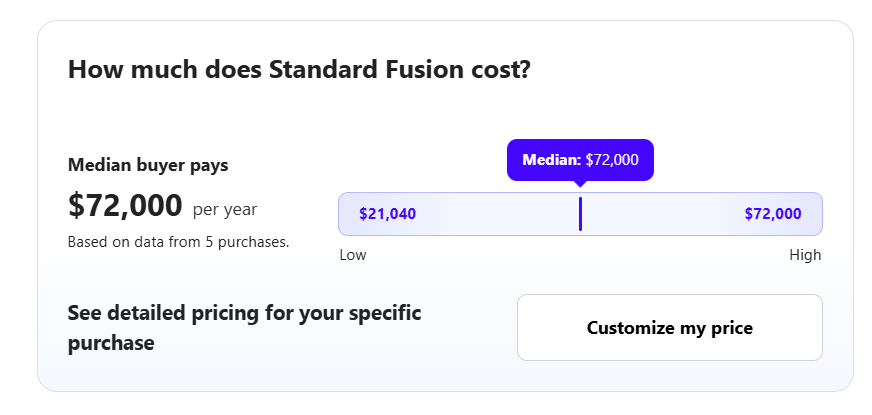
There’s a few things this data tells us:
- StandardFusion is priced as an enterprise-grade GRC tool: Even at the low end, annual costs are well into five figures, which aligns with platforms targeting mature compliance programs, mid-sized security teams, or organizations with multi-framework requirements.
- Pricing likely scales sharply with scope: The difference between the lowest and highest recorded price suggests factors like user count, modules, and implementation support significantly affect total cost.
- Budgeting is difficult without a quote: With no public tiers and a high variance in contract values, it’s nearly impossible to estimate StandardFusion’s cost until you go through its sales process.
This means you can expect StandardFusion to be a premium investment, generally suited to teams with established GRC operations and budgets that can accommodate a five-figure annual contract.
Does StandardFusion provide good value for money in 2026?
StandardFusion delivers strong core GRC capabilities, and users consistently highlight its ease of use, clean interface, and broad framework support as major advantages.
For many teams, it succeeds in what matters most: simplifying audits, centralizing documentation, and reducing the manual effort that usually surrounds compliance work.
But at a median contract value of $72,000/year, the question isn’t just “Is it good?”.
It’s “Is it good for the price?”
Namely, even satisfied users experience a range of limitations, which can be pretty off-putting, especially considering its price point:
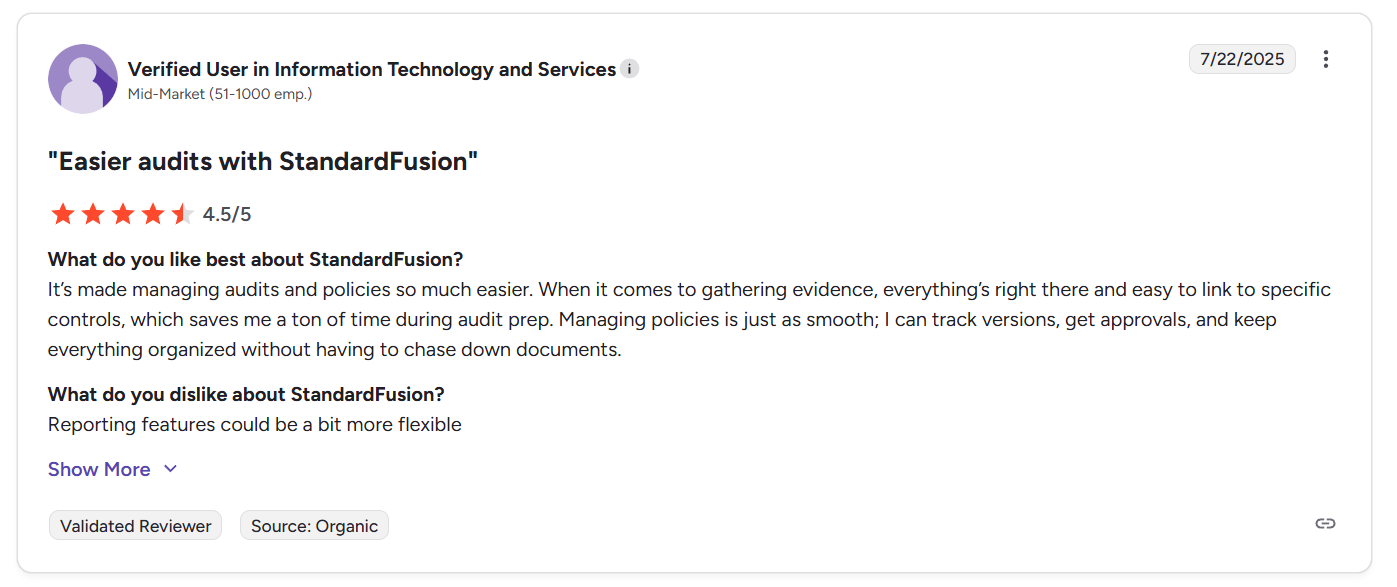
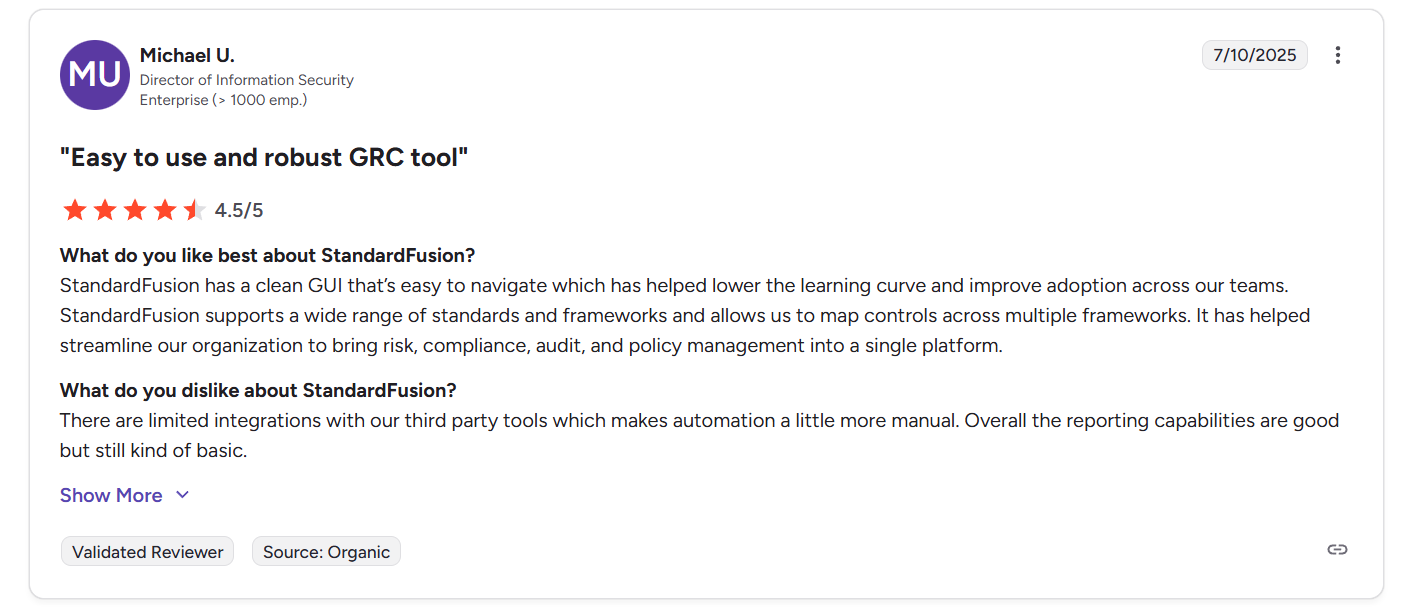
- Reporting is functional but basic: Several reviews mention that dashboards and reports are useful, but not as advanced as what you’d expect from a mid–five-figure GRC platform.
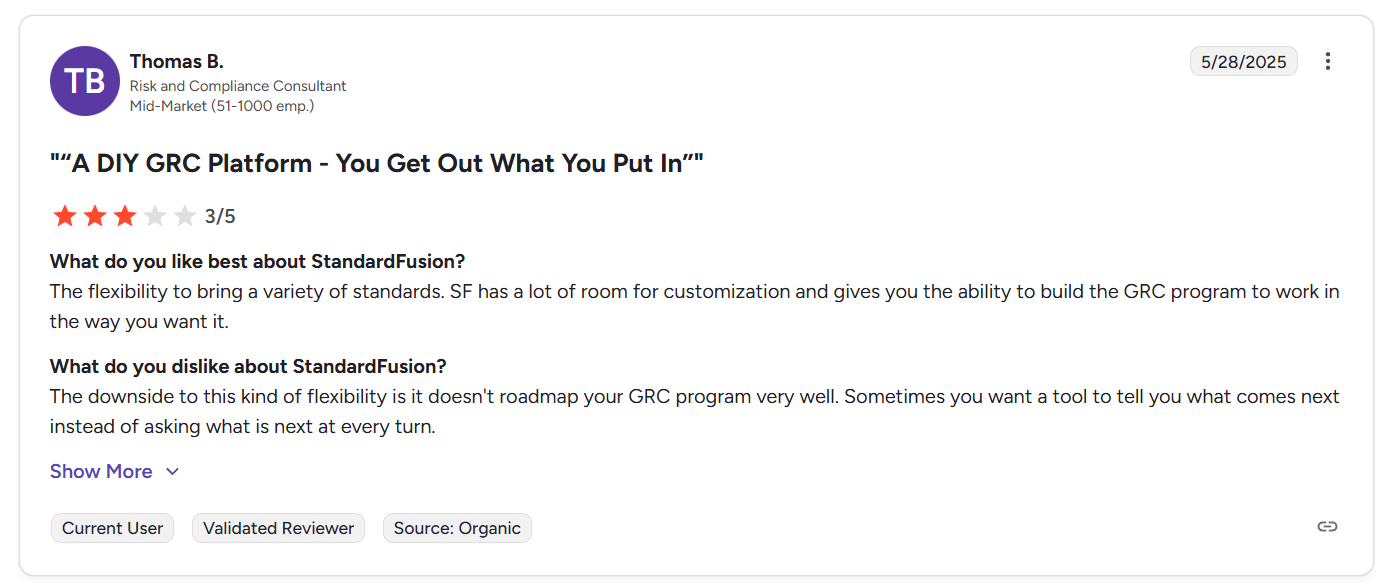
- High flexibility, but with lots of complexity: Some users note that the “build-it-yourself” approach can be overwhelming, especially when your GRC program is undergoing changes or quick scales.
- Integrations that are more limited than expected at this price point: This means that some automation requires too much manual effort, which can reduce the ROI for organizations expecting a highly connected GRC ecosystem.
Finally, it’s fair to say that StandardFusion offers meaningful value for organizations with mature GRC processes and the resources to customize the platform.
But at a mid five-figure annual cost, teams expecting deeper automation, more flexibility, or more advanced reporting may find the ROI harder to justify compared to more modern, no-code GRC platforms with transparent pricing.
Looking for a StandardFusion alternative?
There’s no question StandardFusion is capable, but it isn’t a plug-and-play tool.
To get the most out of it, you need enough budget and internal bandwidth to manage its customization, navigate its modules, and keep the system evolving.
If your team wants a more modern, easier-to-adapt solution with transparent pricing, SmartSuite offers a very different path.

SmartSuite brings together risk, compliance, audit, policy, and vendor management in one intuitive workspace, but without the heavy configuration, opaque contracts, or steep annual costs that often come with traditional GRC platforms.
It’s designed for organizations that want to move fast, collaborate easily, and scale their program without relying on technical admins or complex setups.
In the next section, I’ll break down the key GRC features that make SmartSuite a strong StandardFusion alternative in 2026.
1. A single, connected hub for all your GRC workflows
One of the clearest differences between SmartSuite and traditional GRC platforms is how unified the experience is.
Instead of navigating separate modules for risks, audits, vendors, and policies, SmartSuite brings every core GRC process into one clean, consistent workspace.
That means your team can:
- Track risks, controls, audits, and incidents in one place: Everything lives inside a single workspace, so teams don’t have to switch between modules or different tools to follow an issue from identification to remediation.
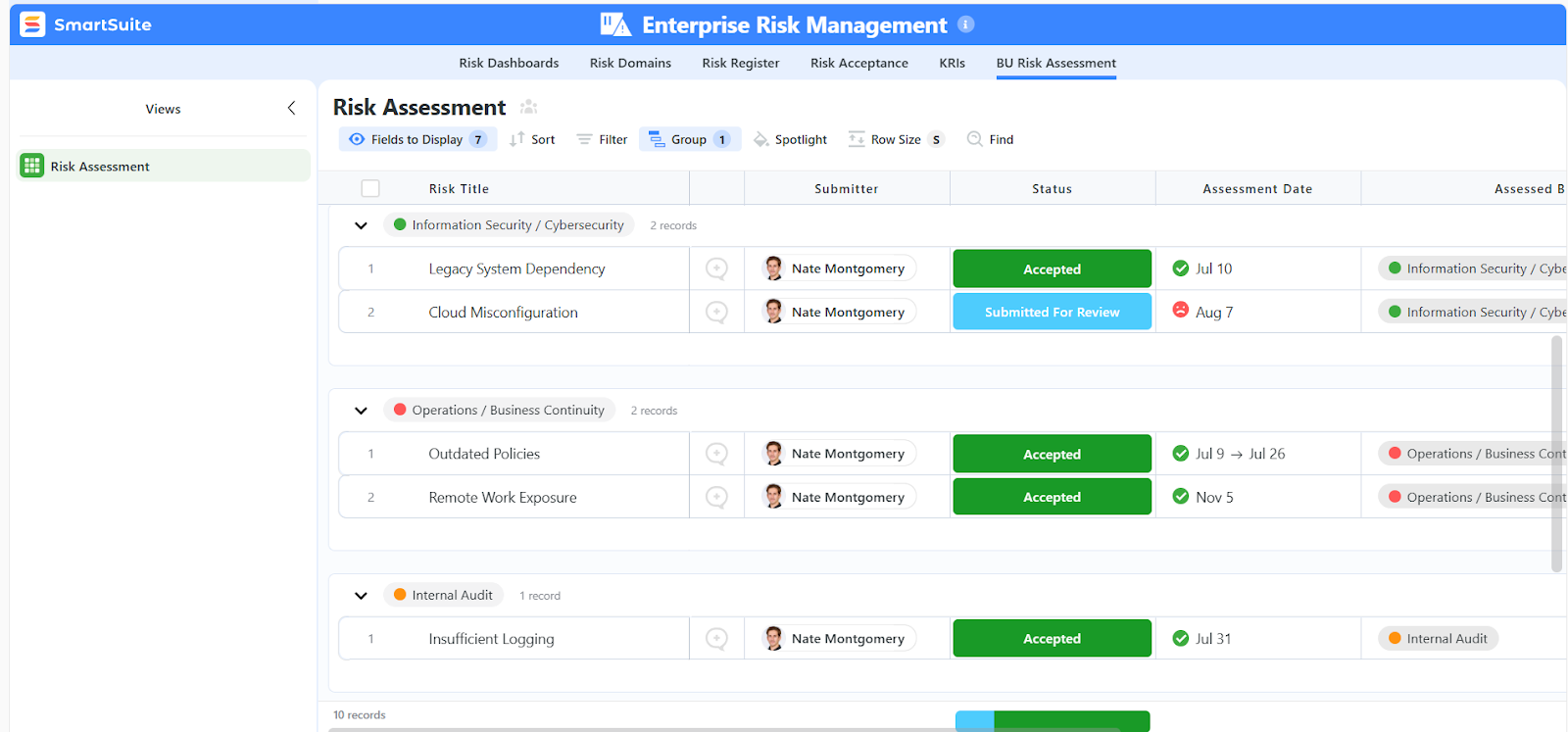
- Link documentation, evidence, and policies directly to the controls they support: Attach documentation, evidence, and policy files directly to relevant GRC records, making it easy for teams to see everything tied to a requirement or process.
- Manage vendor reviews, assessments, and risk findings all in one place: Third-party risk isn’t siloed, as vendor data, evaluations, and follow-ups sit next to internal risks, giving you a complete risk picture across the business.

- Coordinate audits from planning to evidence collection to remediation: Internal and external audits can be run end-to-end with assigned tasks, workflows, automated reminders, and linked evidence.
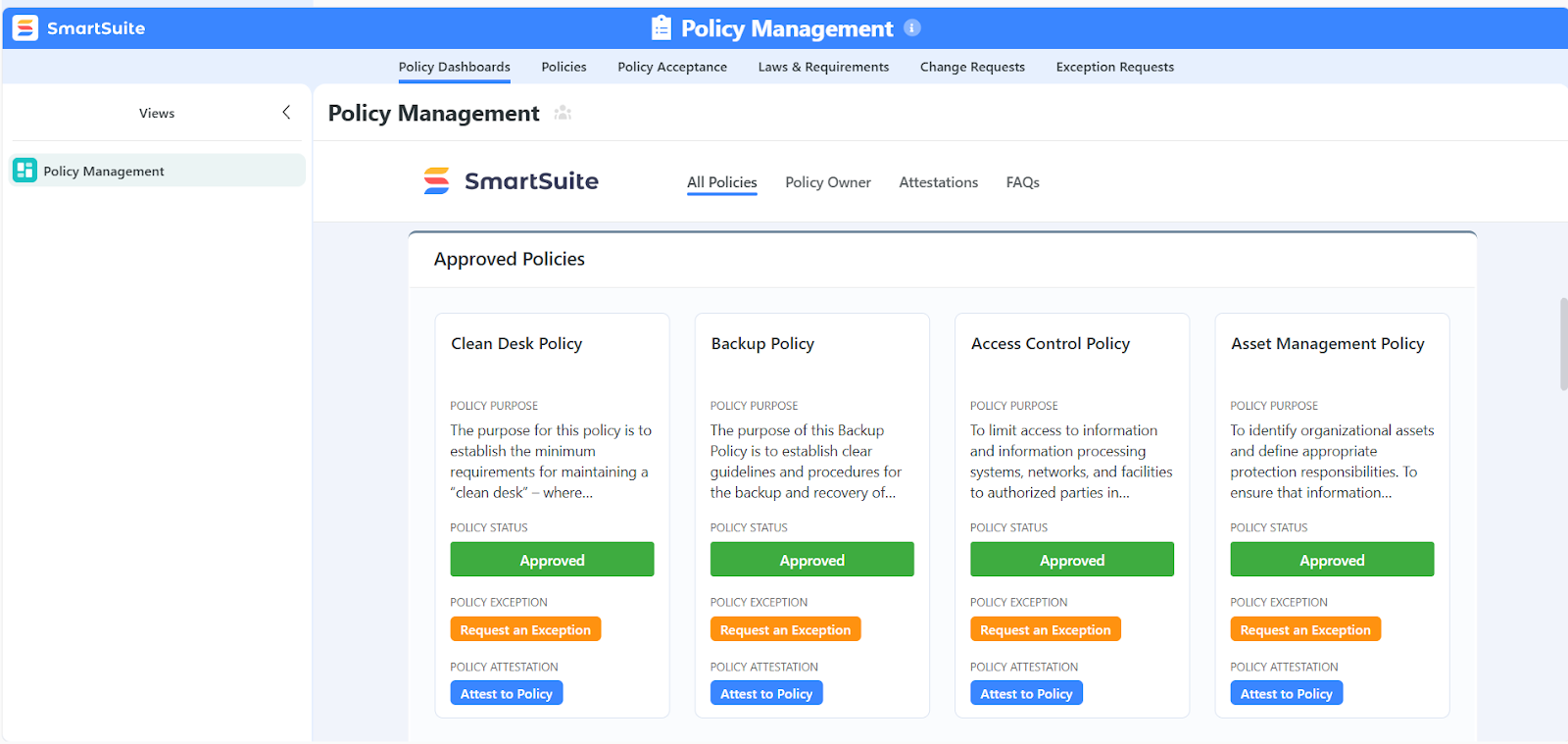
- Centralize policy management and track versions, ownership, and approvals: Teams can publish, update, and distribute policies directly, while maintaining a full audit trail and clear accountability for reviews and sign-offs.
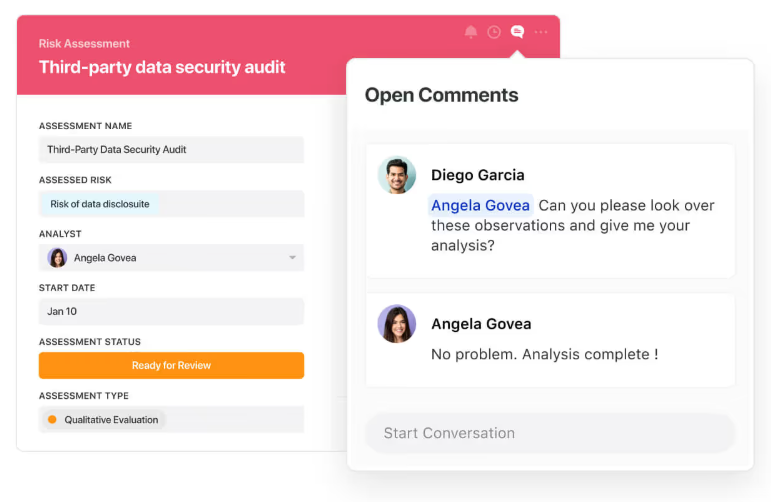
- Collaborate where the work happens: Comments, @mentions, real-time notifications, and activity history keep the entire team aligned and in the loop at all times.
The result is a system where GRC work feels organized and easy to follow, even as your program grows.
No fragmentation, no siloed modules, and no “where does this live?” moments - just one cohesive platform that keeps every part of your compliance operations aligned.
2. True no-code customization that adapts to any GRC program
A major advantage of SmartSuite is how easily teams can tailor the platform to match their exact compliance workflows without writing code or relying on technical admins.
Every part of the system is built to be shaped by the people who actually run GRC day to day.
SmartSuite gives you the ability to:
- Adjust fields, forms, and layouts with simple drag-and-drop control: Whether you’re tracking risks, controls, evidence, or vendor assessments, you can structure each record exactly the way your program requires with no backend configuration needed.
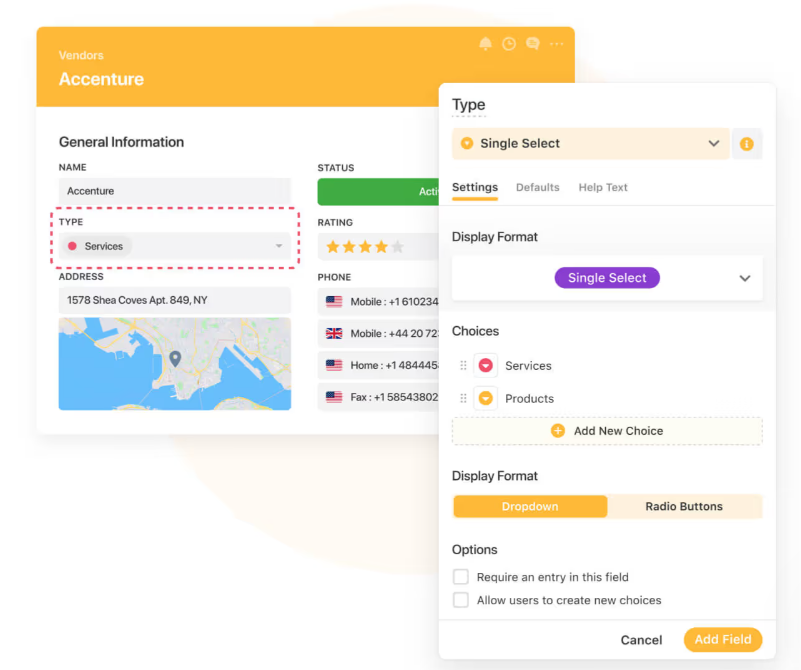
- Create views and dashboards that mirror how your team works: Grid, board, timeline, calendar, and custom dashboards let you visualize compliance tasks, audit progress, or risk scores in the format that makes the most sense for your stakeholders.
- Use prebuilt GRC templates as a starting point, then tailor everything: SmartSuite offers ready-made templates for risks, controls, audits, vendors, policies, and incidents. You can launch instantly and then modify fields, workflows, and structures to fit your exact processes.

- Expand or refine your setup as your GRC program matures: Because everything is no-code, you’re never locked into the structure you started with. Teams can evolve their program at any time without waiting for a developer or enduring long configuration cycles.
3. Powerful dashboards and reporting without the complexity
SmartSuite turns reporting into something teams can actually manage on their own.
Instead of relying on static exports or complex BI tools, every part of your GRC program can be visualized in real time through dashboards you build with just a few clicks.
SmartSuite lets you:
- Create all kinds of real-time dashboards for risks, audits, vendors, and policies: Risk heatmaps, audit progress summaries, open issues, upcoming reviews - everything updates automatically as records change, so leaders always see the latest picture.
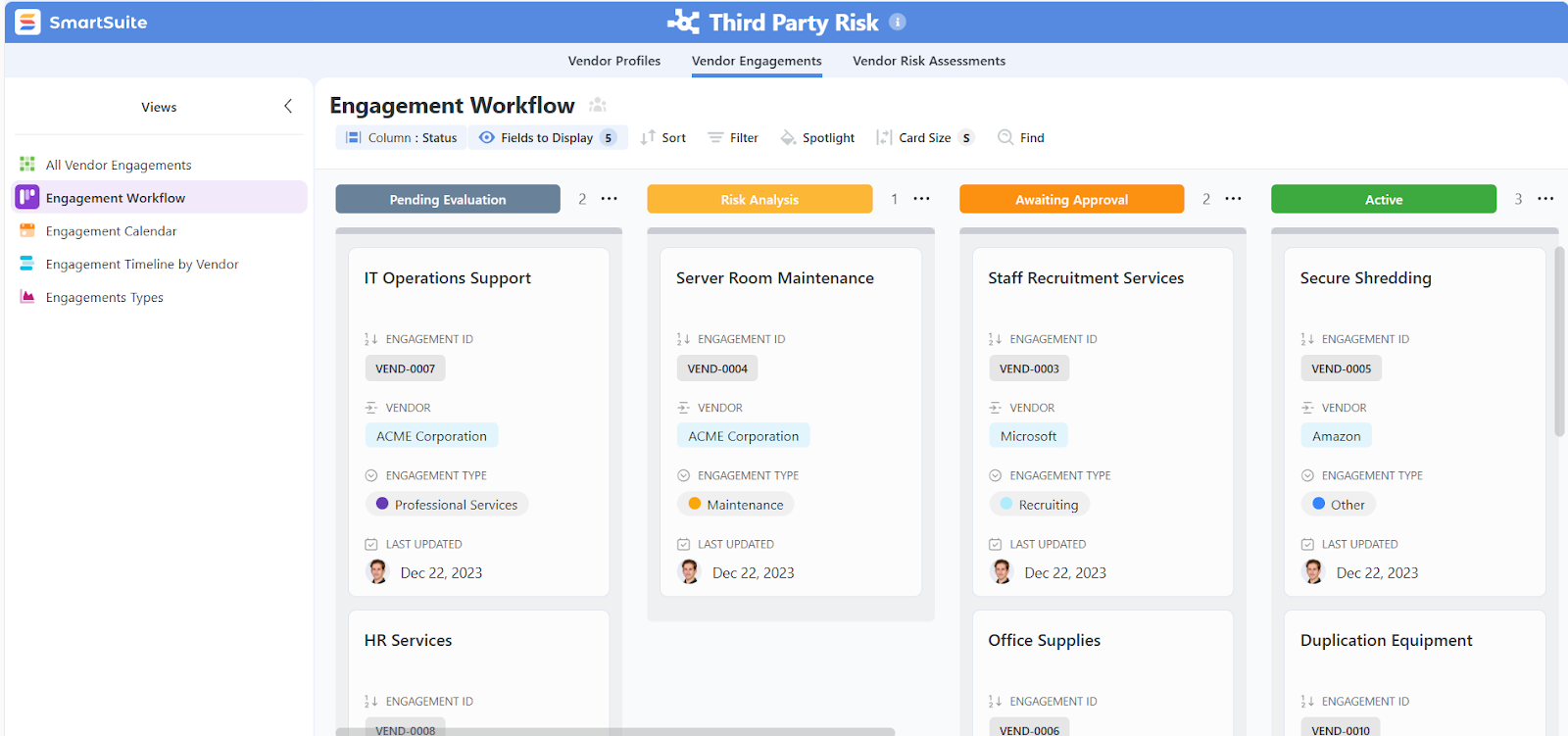
- Tailor views for different stakeholders: Create role-specific dashboards for auditors, risk owners, leadership, or cross-functional teams, ensuring everyone sees only what’s relevant to them.
- Visualize data the way you need it: Choose from charts, graphs, counters, lists, calendars, and custom widgets to highlight trends, bottlenecks, and areas that need attention.

- Automate the reporting you usually do manually: Scheduled views, dynamic filters, and linked records eliminate the recurring “end of quarter scramble” to gather data from multiple places.
4. Flexible workflow automation that keeps your GRC program moving
SmartSuite’s automation engine is built to take repetitive, manual work off your team’s plate without requiring scripts, technical configuration, or specialist support.
Every workflow in your GRC program can be streamlined so tasks move forward consistently and nothing stalls.
With SmartSuite, you can:
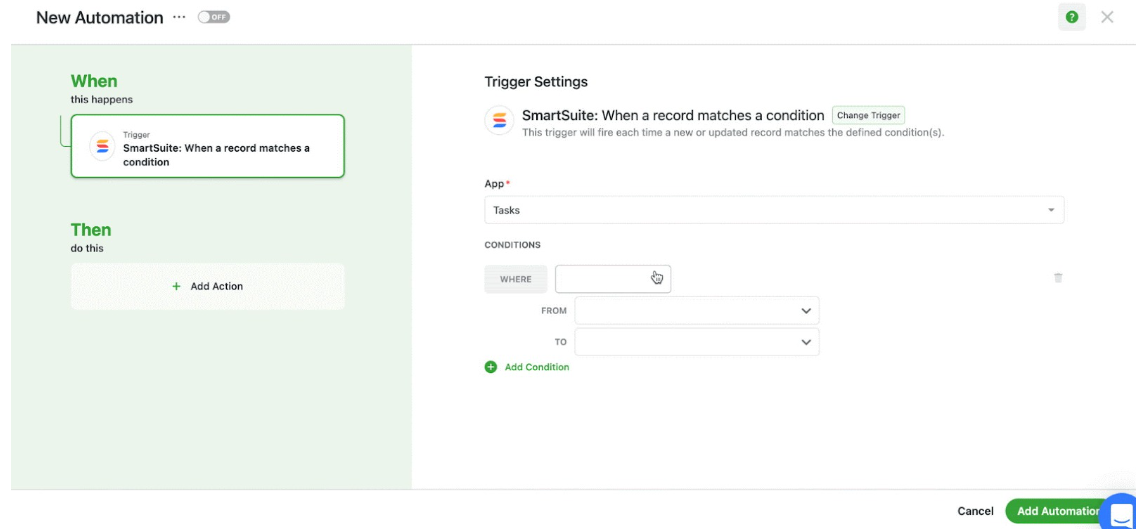
- Automate assignments, escalations, and due-date reminders: Risks, audit tasks, evidence requests, policy reviews, and vendor assessments automatically route to the right people at the right time, reducing follow-up emails and bottlenecks.
- Set up conditional logic to handle complex processes: Trigger different paths based on severity, status, risk score, or vendor tier so your workflows adapt automatically to the situation.
- Build multi-step approval chains without technical help: Whether approving a policy update, closing an audit finding, or validating a risk treatment plan, you can define clear approval stages that run on their own.
- Standardize recurring compliance tasks: Annual policy reviews, quarterly access audits, vendor reassessments, and other repeating activities can be automated so deadlines never slip.
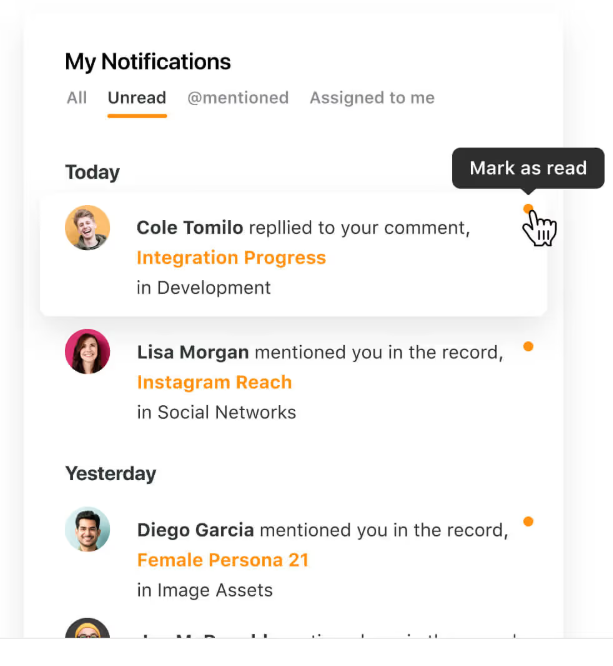
- Keep teams aligned with real-time notifications and updates: Everyone involved gets notified about changes, comments, and progress directly within the platform, boosting accountability and visibility.
And the best part?
All these workflows can be easily set up with SmartSuite’s drag-and-drop workflow builder, allowing both newbies and compliance veterans to streamline all kinds of processes.
How does SmartSuite’s pricing compare to StandardFusion’s?
If there’s one thing that makes StandardFusion difficult to evaluate early on, it’s the lack of published pricing.
That means teams often enter the sales process without a clear sense of what they’ll ultimately spend.
SmartSuite works very differently.
It offers simple, transparent, per-user pricing with no hidden modules or unpredictable add-ons.
Teams can calculate costs immediately, compare plans, and budget confidently before ever speaking to sales.
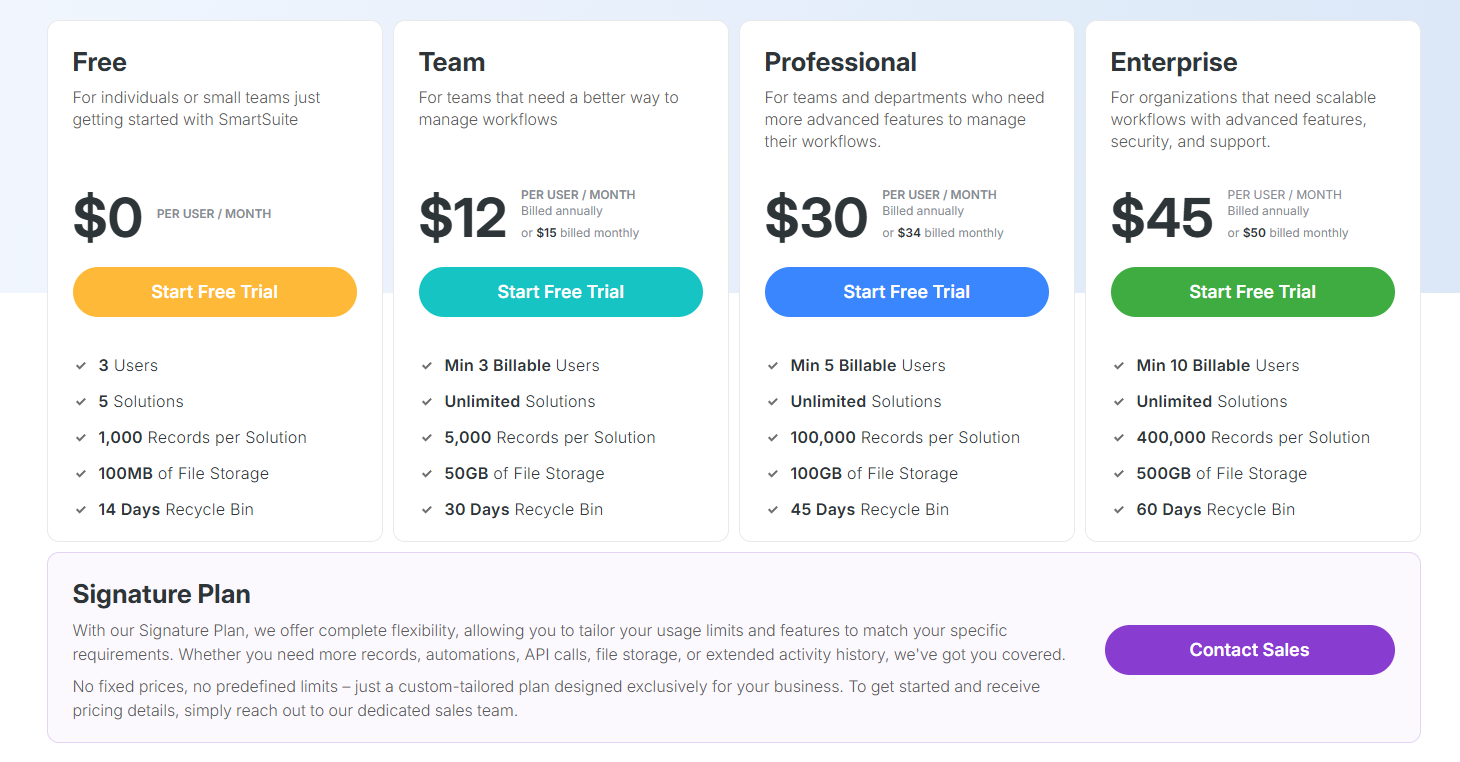
SmartSuite’s structure includes a Free Forever plan, ideal for small teams or organizations exploring the platform.
It comes with up to 3 users, 5 solutions, dashboards, automations, and core collaboration features - something StandardFusion doesn’t provide.
And when you need more functionality, SmartSuite has four predictable paid tiers:
- Team: $12/user/month, includes everything in Free, plus unlimited solutions, 5,000 records per solution, 50GB of file storage, advanced collaboration tools, and a 30-day recycle bin.
- Professional: $30/user/month, includes everything in Team and adds advanced permissions, two-factor authentication, Gmail & Outlook integrations, AI features, and 100GB of file storage.
- Enterprise: $45/user/month, includes everything in Professional, plus audit logs, data loss prevention, up to 50,000 monthly API calls, and 500GB of file storage.
- Signature: Custom pricing, a fully tailored plan with no predefined limits, offering extended storage, API capacity, records, automations, and advanced enterprise security options such as SCIM provisioning and regional data residency.
Every paid tier also comes with a 14-day free trial, no credit card required, adding another level of self-service evaluation StandardFusion doesn’t offer.
How is SmartSuite different from StandardFusion?
StandardFusion delivers strong GRC capabilities, but it comes with clear trade-offs: no public pricing, a heavier setup process, and a level of customization that often requires ongoing admin effort.
SmartSuite takes a very different approach built around speed, clarity, and ease of use.
Here’s how they differ at a glance:
- Platform structure: StandardFusion separates risk, audit, vendor, and policy workflows into distinct modules. SmartSuite brings everything into one consistent workspace so teams can work end-to-end without jumping between sections.
- Customization effort: StandardFusion is flexible but can feel complex to configure. SmartSuite offers true no-code customization, as fields, workflows, dashboards, and templates can all be adapted with drag-and-drop controls.
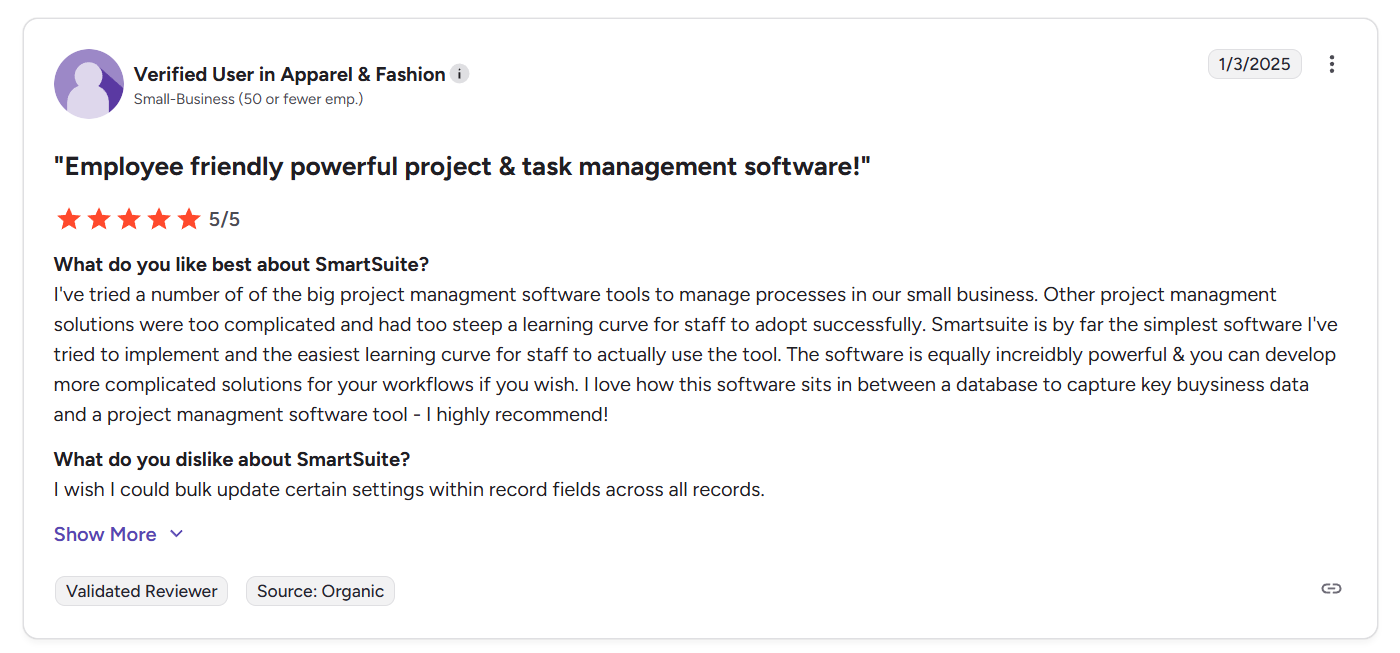
- Reporting experience: Users describe StandardFusion’s reporting as effective but basic. SmartSuite lets teams build real-time dashboards, charts, and heatmaps in minutes, giving leadership instant visibility.
- Workflow automation: StandardFusion’s automation can require more manual setup or integrations. SmartSuite automates assignments, approvals, escalations, and recurring tasks without technical support.
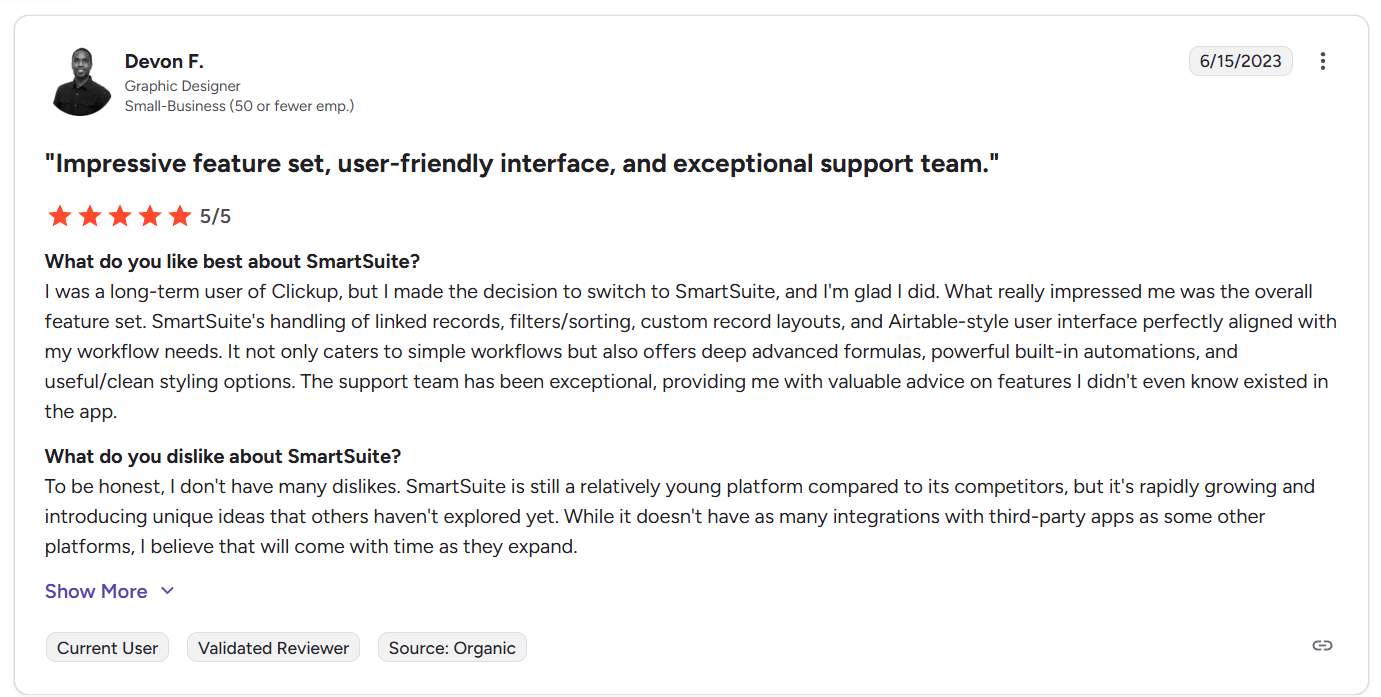
- Pricing transparency: StandardFusion offers only quote-based pricing with no trial. SmartSuite publishes clear per-user pricing, offers a Free Forever plan, and includes a 14-day free trial.
The bottom line?
If you want a modern, easy-to-adapt GRC platform with transparent pricing and faster deployment, SmartSuite offers a lighter, more flexible alternative to StandardFusion in 2026.
Final thoughts: Choosing the right GRC platform in 2026
StandardFusion is a capable, well-liked GRC tool, but it comes with trade-offs: no public pricing, no trial, a heavier setup process, and customization that often requires ongoing admin effort.
And with real contract values reaching a median of $72,000/year, it’s a serious investment that isn’t always easy to evaluate upfront.
With SmartSuite, on the other hand, you get:
- A unified GRC workspace.
- True no-code customization.
- Powerful reporting.
- Flexible automations.
- Transparent pricing you can understand instantly.
- No hidden costs, long onboarding cycles, or barriers to testing the platform yourself.
So, if you want a modern GRC solution that’s easier to adopt, easier to scale, and far more predictable in cost, SmartSuite is built for you.
Ready to streamline your GRC program without the enterprise-grade friction?
Start your free SmartSuite trial today and see the difference in minutes.
Or, if you prefer a tailored product tour, book a demo with our team of experts and find out exactly what SmartSuite can do for your organization.
Read more
- 10 Best Risk Management Software & Tools In 2026 - Discover the top risk management platforms that actually simplify assessments, strengthen oversight, and keep your organization ahead of emerging threats in 2026.
- Origami Risk Pricing: Is It Worth It For GRC In 2026? - A clear, no-nonsense breakdown of Origami Risk’s real costs, hidden factors, and whether it still delivers strong value for modern GRC teams.
- 10 Best Protecht Alternatives & Competitors [2026] - Explore the strongest Protecht competitors offering deeper automation, easier customization, and better pricing transparency for today’s GRC programs.
- SAI360 Pricing: Is It Worth It In 2026? - Get an honest look at SAI360’s pricing model, what drives costs up, and whether its GRC capabilities justify the investment in 2026.
- 10 Best Corporater Alternatives & Competitors In 2026 - See which Corporater replacements deliver cleaner UX, faster deployment, and stronger governance and risk management performance without enterprise complexity.
- Drata vs. Vanta vs. SmartSuite: Which One Is Better For GRC? - A side-by-side comparison of three leading compliance platforms to reveal which one actually offers the best balance of automation, flexibility, and long-term value.
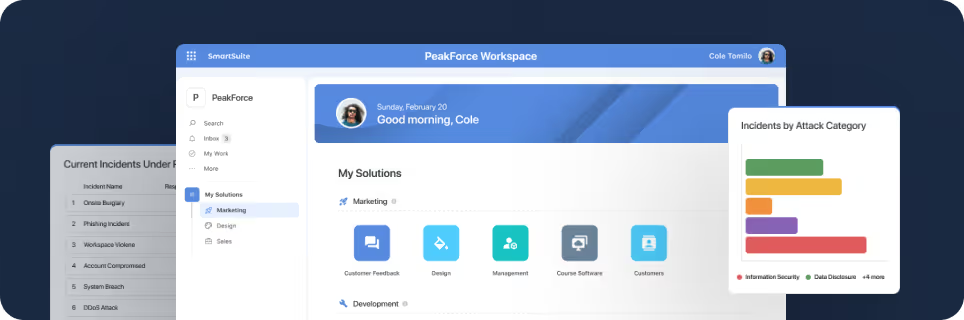
SmartSuite provides work platform for standardizing workflows in the following areas:
- Governance, Risk & Compliance
- IT & Service Ops
- Project / Portfolio Management
- Business Operations